

Most AI visibility conversations start with a screenshot. Someone asks ChatGPT, Gemini, Claude, Perplexity, or Google AI Mode for the best HVAC company in a city, then forwards the answer to marketing.
Schulte, Bleeker and Kaufmann put the problem with that in one line in an April 2026 arXiv paper on measuring visibility in AI search:
Answers can vary across runs, prompts, and time, making one-off observations unreliable.
Their recommendation is to treat visibility as a distribution rather than a single-point outcome. A screenshot is one draw from that distribution. It cannot show whether the right branch appears across services, whether the answer changes with prompt wording, whether competitors win on stronger sources, or whether one location is carrying the whole brand.
For a PE-backed home-services platform, franchise system, med spa group, or hospitality operator, the useful question is more operational: which locations are easy for AI systems to understand, cite, and recommend when a buyer asks who to hire?
Important
An AI visibility audit should measure location-level evidence, not brand ego. The goal is to find the market, source, review, profile, and page gaps that stop a specific branch from being recommended.
This workflow is built for operators who need a repeatable readout by market, not another generic GEO checklist.
One prompt is not an audit
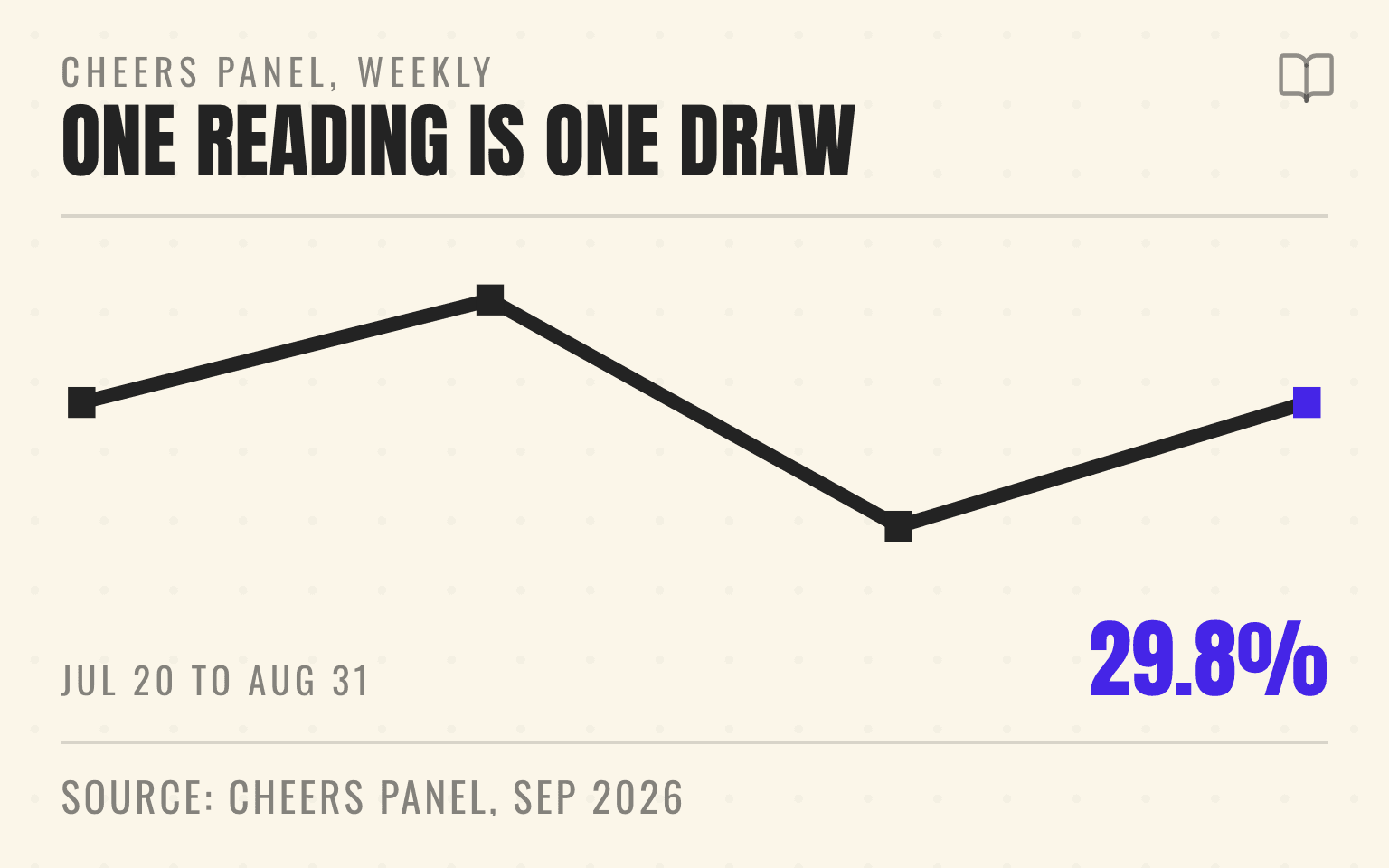
AI search is less stable than a classic ranking report, and the instability survives at panel scale rather than washing out. Across our own home-services panel, leaving out questions that name the company itself, pooled appearance rate ran at 29.8% in the week starting July 20, 2026, 32.2% in the week starting August 3, and 26.9% in the week starting August 10, on the same four engines, a 5.3-point drop in one week. The partial week starting August 31 came in at 29.8%, level with the week of July 20.
Cheers panel, weekly
One reading is one draw
7
Weeks
Pooled appearance rate by week, Cheers home-services panel, July to September 2026
Cheers panel, pooled appearance rate by week, 13 home-services companies, non-branded prompts, weeks starting July 20 to August 31, 2026 (earlier weeks are not used because an enrichment defect counted competitors in answer map widgets as the tracked business); the final week is partial through September 2. Aggregate only (corrected September 28, 2026). Methodology at cheers.tech/research/methodology.
| Week starting | Pooled appearance rate |
|---|---|
| Jul 20 | 29.8% (First published week) |
| Aug 3 | 32.2% (Highest published week) |
| Aug 10 | 26.9% (Lowest week; panel reached 13 companies) |
| Aug 31 | 29.8% (Partial week through September 2) |
Read that with the caveat attached: the panel grew from 12 to 13 companies over those seven weeks and the prompt sets changed, so part of any week-to-week move is composition rather than performance. That is exactly why a monthly cadence with a fixed prompt set beats an argument about last Tuesday's screenshot. The weekly series and the composition note are published in the home services AI visibility index.
Location and session context are two reasons those runs can differ. Why AI search results change by location documents the official platform controls and a repeatable test protocol before the broader audit begins.
That matters even more for multi-location brands. A plumbing brand might appear for "best plumber in Dallas" and disappear for "who fixes leaking water heaters near Lakewood." A franchise brand might be recognized nationally while a specific location has too little proof to be recommended. A med spa group might show up in one city because reviews mention the service, then lose in another because the location page is thin.
Do not start by asking whether the brand appears. Start by asking whether each priority location is explainable for the services and markets that create revenue.
Build the audit around buyer questions
The prompt set should come from how customers choose a provider, not from internal service labels. For a home-services rollup, that means emergency, replacement, maintenance, financing, warranty, after-hours, and near-me questions. For a med spa group, it may mean treatment, provider trust, pricing expectations, safety, and neighborhood fit.
Pick the markets before the tools. A national screenshot does not help a regional GM understand why Phoenix is weaker than Tucson, or why one franchisee wins in Google AI Mode but loses in Perplexity.
A useful audit row should record the buyer question, target city or service area, engine, date, recommended providers, cited source URLs, source type, whether the correct branch appeared, whether the answer used the right service language, and the owner of the next fix.
That level of detail matters because the rest of the work is judgment: compare patterns, not isolated outputs.
Record sources before you argue about answers
The answer wording matters, but the sources matter more. Google says AI Mode and AI Overviews may use query fan-out, issuing multiple related searches across subtopics and data sources before developing a response. OpenAI documents separate crawler behavior for search, model training, and user-triggered visits. Anthropic documents web search responses with citations. Perplexity documents search and answer APIs that return ranked results or cited prose.
If your team needs to explain that Google-specific mechanism to non-technical operators, start with What Is Query Fan-Out in Google AI Mode?, then turn the likely fan-out source jobs into audit rows.
The operator takeaway is that AI visibility is not one channel. Each engine can expose a different source path. If the answer cites Yelp, BBB, a local directory, a review page, a service-area page, or a competitor comparison, that source is a clue about what evidence the system found useful.
For each prompt, capture the cited domains and classify them in plain language: owned location page, Google Business Profile or Google surface, review site, trade directory, local media, forum or community source, social page, aggregator, or competitor page.
The source classification is what turns an AI answer into an operating plan. If competitors are winning through review sites, the fix is not another corporate blog post. If they are winning through clearer location pages, the fix is not a listings cleanup project. If the answer cites an old acquired brand name, the issue may be entity fragmentation.
Read AI search engines cite different sources before building the source taxonomy, then use the citation stack for AI search to decide which third-party sources deserve cleanup. For the step-by-step source log, use how to find which websites AI search uses as sources in your industry before assigning page, profile, citation, or review work. If the audit keeps surfacing competitors without the target branch, use why AI search recommends a competitor to diagnose whether the miss is query fit, location fit, source fit, proof fit, or routing fit.
Separate Google visibility from cross-engine visibility
Google AI visibility and ChatGPT visibility overlap, but they are not the same measurement problem.
Google says its AI features use the same foundational SEO best practices as Search. Pages need to meet technical requirements, be eligible for snippets, provide useful content, make important content available in text, and keep structured data aligned with visible page content. Google also says traffic from AI features is included in Search Console's Web search type.
That is useful, but it does not answer every operator question. Search Console cannot tell a CMO which branch was recommended in Claude, whether Perplexity cited a local directory, or whether an AI answer confused two acquired brands. Google Business Profile data still matters because local results are mainly based on relevance, distance, and prominence. Google's own guidance on that page is short enough to quote:
Businesses with complete and accurate info are more likely to show up in local search results.
Prominence, in Google's definition, means how well-known a business is, which is the part a branch earns through reviews, citations, and coverage rather than through a field in a dashboard.
An audit should therefore keep three views separate: Google Search and AI features, Google Business Profile and local profile health, and cross-engine AI recommendations from tools such as ChatGPT, Claude, Perplexity, Gemini, and Grok when they are relevant to the buyer journey.
Mixing those views makes the scorecard easier to read and less useful.
Next step
Is AI recommending your business?
Find out how visible you are across ChatGPT, Gemini, Perplexity, and AI Overviews.
Turn misses into location-level fixes
The audit is useful only when every miss becomes a fix with an owner. A branch can miss because the page is not crawlable, the service area is vague, the profile category is wrong, reviews are stale, third-party citations disagree, or the AI answer cannot connect an acquired local brand to the parent company.
Common fixes fall into five workstreams:
- Strengthen the location page with service-specific proof, service area language, booking paths, FAQs, reviews, and internal links
- Update Google Business Profile fields that affect customer understanding, including categories, hours, services, photos, and review response discipline
- Improve frontline review capture so recent customer language mentions the work, city, urgency, technician, and outcome
- Clean third-party citations where names, addresses, phone numbers, categories, or acquired-brand traces conflict
- Repair entity fragmentation by making parent brand, location, old brand names, profiles, and pages point to the same business reality
If the miss is review-driven, start with review collection at point of service. If the miss is entity-driven, read why AI treats your locations like strangers. If the miss is Google-specific, use the Google AI search guide for local businesses.
If the miss starts with crawlability or bot access, use which AI crawlers local businesses should allow before assigning content or reputation fixes.
Assign owners before the next run
AI visibility work fails when every issue is assigned to marketing. The audit might reveal marketing work, but the evidence often comes from operations.
Marketing can own prompt design, source tracking, location page updates, internal links, and reporting. Operations can own review velocity, technician coaching, service proof, and location-level playbooks. Local managers can own profile accuracy, photos, hours, and frontline adoption. Executives can choose priority markets and decide which fixes matter before the next acquisition, franchise launch, or seasonal campaign.
The best scorecard has fewer vanity metrics and more ownership. It should show each priority location, which buyer questions matter, where the branch appeared, which competitors appeared, which sources were cited, which source gaps blocked trust, and who owns the next action.
If the audit turns into a vendor decision, compare the category in Best AI Visibility Tools for Local Businesses. When the audit needs provider-level tracking instead of screenshots, use the provider-and-market tracking workflow.
When the audit turns into a budget question, use How Much Does AI Visibility Software Cost? to scope prompts, providers, locations, competitors, citations, and execution support.
When those misses turn into a buy-versus-build decision, compare the operating model in Local SEO Agency Alternative for Multi-Location Home Services. If the team already has owners and needs tooling, use Best Local SEO Software for Multi-Location Service Businesses.
If the team needs a plain-language benchmark before building that cadence, use What Is a Good AI Visibility Score for a Local Business? to separate a directional score from the source evidence underneath it.
For a one-business snapshot, the Cheers AI Visibility Grader can show how a business appears across key AI surfaces. For multi-location operators, the bigger value is turning the same logic into a branch-level operating cadence.
The cadence is the advantage
Run the audit monthly for the full priority set. Run it weekly for markets that are underperforming, recently acquired, newly launched, seasonal, or strategically important. Keep historical snapshots so the team can see whether fixes change source coverage and recommendation frequency over time.
The point is not to chase every answer variation. The point is to learn which locations have enough public evidence to be trusted, which ones are thin, and which source gaps repeat across prompts and engines.
AI search may feel unpredictable at the single-answer level. At the operating level, the work is concrete: make every important location easier to crawl, understand, verify, and recommend.
Sources
Checked September 2, 2026.
- Don't Measure Once: Measuring Visibility in AI Search (GEO). Julius Schulte, Malte Bleeker and Philipp Kaufmann, arXiv, April 8, 2026. arxiv.org/abs/2604.07585. Source of the quoted variability sentence and the distribution framing.
- AI features and your website. Google Search Central, last updated December 10, 2025. developers.google.com/search/docs/appearance/ai-features. Source of the query fan-out description and the Search Console reporting scope.
- Search Essentials: technical requirements. Google Search Central, accessed September 2026. developers.google.com/search/docs/essentials/technical. Source of the crawlability and eligibility requirements.
- Tips to improve your local ranking on Google. Google Business Profile Help, accessed September 2026. support.google.com/business/answer/7091. Source of the quoted completeness sentence and the relevance, distance, and prominence definitions.
- Overview of OpenAI crawlers. OpenAI developer documentation, accessed September 2026. developers.openai.com/api/docs/bots. Source of the OAI-SearchBot, GPTBot, and ChatGPT-User distinctions.
- Web search tool. Anthropic developer documentation, accessed September 2026. platform.claude.com. Source of the web search and citation behavior in the Claude API.
- Search API quickstart. Perplexity documentation, accessed September 2026. docs.perplexity.ai/docs/search/quickstart. Source of the ranked-result and cited-answer behavior.
- LocalBusiness. Schema.org vocabulary, accessed September 2026. schema.org/LocalBusiness. Source of the local business entity vocabulary.
- Cheers panel: 13 home-services companies, 28 days ending September 2, 2026, non-branded prompts, with a weekly pooled series published for the seven weeks starting July 20 through August 31, 2026, aggregate only (corrected September 28, 2026). Home services AI visibility index and methodology. Source of the weekly pooled appearance rates and the panel-composition caveat.
Dylan Allen-Arnegård is the CEO & Co-Founder of Cheers, the done-for-you platform that manages the website, reviews, listings, structured data, and local content that get service businesses recommended across Google, Maps, ChatGPT, and Perplexity.