

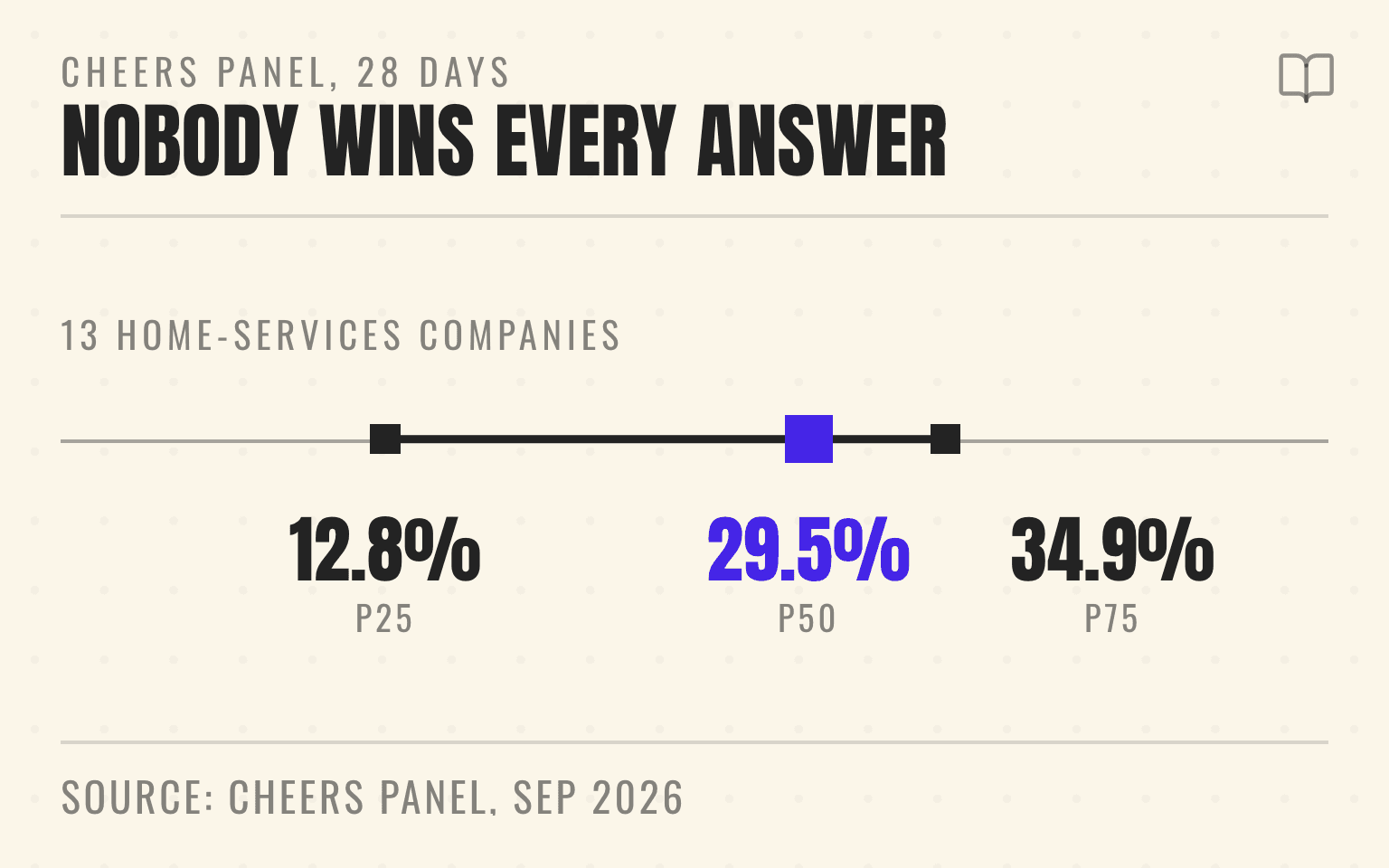
Across our own panel of 13 home-services companies, leaving out questions that name the company itself, the median company was named in 29.5% of the AI checks run on its behalf during the 28 days ending September 2, 2026. The top quartile cleared 34.9%. The bottom quartile sat at 12.8%. Nobody in that panel gets recommended every time, and every one of the 13 was named at least once.
That spread is what Generative Engine Optimization is actually about. Ask ChatGPT for an HVAC company in Las Vegas, or Gemini for a waxing salon in Dallas, and the answer may name businesses, cite web pages, show local results, or decline to recommend anyone. GEO is the work of measuring those answers and improving the public evidence a business can verify.
For local operators, GEO is not a hidden technical switch. It is a repeatable process: test the buyer questions that matter, record whether each location appears, inspect the visible sources, correct material errors, and retest after the source changes can be crawled.
Pro Tip
GEO adds answer-level measurement to SEO. It does not replace crawlability, useful pages, local profiles, or customer trust.
For a local service operator, this is not an abstract marketing trend. It is a practical evidence problem. A 40-location HVAC brand needs every market to show the same business facts, fresh reviews, clear service pages, and proof that technicians actually solve customer problems. A single strong homepage cannot carry weak location pages.
What GEO changes
Search reporting usually starts with rankings, impressions, clicks, and local-pack visibility. GEO adds questions that those reports do not answer: Did the business appear in the generated response? Was the right branch named? Which pages were cited? Did a competitor appear instead? Were the phone number, service area, and offer accurate?
An AI answer may name one business, several businesses, or none. The format varies by product and prompt, so the operator should save the exact answer rather than assuming every engine behaves like a shorter search-results page.
What the distribution looks like
A GEO baseline is only readable next to a population. Ours covers 13 home-services companies and 958,754 checks in the 28 days ending September 2, 2026.
Cheers panel, 28 days
Nobody wins every answer
13 of 13
Named at least once
Cheers panel, 28 days ending September 2, 2026: 13 home-services companies across 958,754 checks, non-branded prompts, aggregate only, corrected September 28, 2026. Percentiles taken across companies, each counted once. Methodology at cheers.tech/research/methodology.
| Population | Position | Appearance rate |
|---|---|---|
| AI appearance rate per company | p25 | 12.8% (A little over a third of the top-quartile rate) |
| AI appearance rate per company | p50 | 29.5% (Median company) |
| AI appearance rate per company | p75 | 34.9% (Top quartile starts here) |
The quartiles matter more than the mean. A company at 12.8% and a company at 34.9% are both normal in this panel, and the gap between them is nearly three to one, which is large enough to change a month. All 13 companies were named at least once, so the common fear that AI simply cannot see a local business is not what the data shows. What it shows is a wide, workable middle. The full distribution, plus the same cut by engine and prompt shape, is in the home services AI visibility index, with the appearance formula in the research methodology.
What operators can actually inspect
AI assistants do not expose one universal local-business ranking system. The reliable evidence is what the operator can observe:
The answer. Save the business names, wording, provider, prompt, market, and date.
The citations. Record the exact pages shown with the answer. A citation proves that a page supported that response, not that the page has a permanent ranking weight.
Public business facts. Check names, locations, services, hours, phone numbers, and booking paths across the business website and relevant profiles.
Owned pages. Confirm that location and service pages are crawlable, internally linked, useful to a buyer, and marked up consistently with their visible content.
Customer evidence. Maintain a policy-compliant review process because reviews help customers evaluate a business. Do not claim that review count, recency, sentiment, or particular wording has a published universal AI weight.
Important
Treat every suspected signal as an audit hypothesis until the answer, citation, or official product documentation supports it.
For a deeper breakdown of where ChatGPT-style systems may retrieve local business facts, see What Sources Does ChatGPT Use to Give Recommendations?. For Google's current advice, see How Local Businesses Can Show Up in Google AI Search.
Next step
Is AI recommending your business?
Find out how visible you are across ChatGPT, Gemini, Perplexity, and AI Overviews.
GEO and SEO are different measurements
SEO asks whether pages can be crawled, indexed, understood, and surfaced for relevant searches. GEO asks what happened in a defined set of generated answers and which sources were visible. A page can rank in Google without being cited in one AI answer, and an AI answer can change by provider, prompt, market, or date.
Google's guidance for AI features points site owners back to normal Search fundamentals, and its reasoning is worth quoting rather than paraphrasing:
The best practices for SEO continue to be relevant because our generative AI features on Google Search are rooted in our core Search ranking and quality systems.
The same guide, updated July 10, 2026, adds that you do not need new machine-readable files, AI text files, markup, or Markdown to appear in Google Search. GEO work should strengthen the ordinary foundations first, then add provider-level testing and source evidence.
Where reviews fit
Reviews are public customer evidence. They can help a buyer understand recent service experiences, and review pages may appear in search results or citations. No public source establishes a universal AI formula for review volume, velocity, sentiment, or wording.
Use one neutral eligibility rule, make every request optional, and follow each platform's policy. Measure review activity to improve the customer-feedback process, not to claim a guaranteed AI-ranking effect. For the evidence and policy boundaries, read How Reviews Support AI Visibility for Local Businesses.
What this means for your business
Start with a baseline for the services and markets that create revenue. Save the answers and citations, separate wrong facts from missing coverage, and assign each fix to the team that owns the source.
Correct customer-facing errors first. Then improve thin location or service pages, relevant profiles, internal links, and applicable structured data. Retest the same prompts after the changes have had time to be crawled. If you need the technical layer, start with What Is JSON-LD?. If you need the review layer, read How Reviews Support AI Visibility for Local Businesses. You can also run the free AI Visibility Grader for a one-profile snapshot.
For a more detailed operating sequence, use The GEO Playbook: Get Recommended by AI.
Sources
Checked September 2, 2026.
- Optimizing your website for generative AI features on Google Search. Google Search Central, last updated July 10, 2026. developers.google.com/search/docs/fundamentals/ai-optimization-guide. Source of the quoted core-systems sentence and the machine-readable-files guidance.
- How does ChatGPT conduct local searches? Damian Rollison, Search Engine Land, May 2, 2025. searchengineland.com. Source of the reported ChatGPT local retrieval mechanics.
- Local Consumer Review Survey 2026. BrightLocal, 2026. brightlocal.com/research/local-consumer-review-survey. Source of the consumer review behavior context.
- LocalBusiness. Schema.org vocabulary, accessed September 2026. schema.org/LocalBusiness. Source of the structured data vocabulary.
- Tips to get more reviews. Google Business Profile Help, accessed September 2026. support.google.com/business/answer/3474122. Source of the permitted review-request guidance and the incentive prohibition. Replaces the previous link to the Business Profile help home page.
- Cheers panel: 13 home-services companies, 958,754 checks, non-branded prompts, 28 days ending September 2, 2026, aggregate only (corrected September 28, 2026). Home services AI visibility index and methodology. Source of the appearance-rate quartiles and the count of companies named at least once.
Dylan Allen-Arnegård is the CEO of Cheers, the local search platform for service businesses.