

In the 28 days ending September 2, 2026, our market baseline watched four AI engines answer ordinary home-services questions in 100 metro service areas. Per metro, they cited between 373 and 852 distinct domains. Toronto alone drew 852.
That is the surface a branch record has to survive. AI encounters "Bob's Plumbing" on Google, "Robert's Plumbing LLC" on Yelp, and "Bob Plumbing Inc." on BBB. Same business, same owner, same phone number formatted three different ways, and neither a customer nor a retrieval system can reliably say which record is current, which location it belongs to, or where the next call should go.
Now multiply by 50 locations. Every duplicate or stale record is a routing problem, a reporting problem, or a customer who calls a disconnected number.
Important
Fix identity errors because customers, search products, directories, and internal teams need the correct branch facts. Do not promise that cleanup alone will produce an AI recommendation.
How AI builds entity knowledge
Before we fix the problem, it helps to understand how it works.
Search and AI products can use graphs, indexes, retrieved pages, profiles, and other systems to connect businesses, people, places, and concepts. The exact architecture varies by product and is not fully public. Even Google's own Knowledge Graph Search API is more limited than the name suggests, and its documentation says so:
This API is not suitable for use as a production-critical service.
The same page notes the API returns only individual matching entities rather than graphs of interconnected entities. Treat any vendor claim about reading or editing "the knowledge graph" for your brand against that.
When a product encounters "Bob's Plumbing" across a website, map profile, directory, and news article, it has to determine which records describe the same branch. A wrong phone number, former address, duplicate profile, or conflicting service area can create ambiguity. Minor formatting differences do not automatically create separate entities.
Accurate, well-linked records make it easier to present the correct branch facts. That is valuable even when a recommendation does not change: customers reach the right location, reporting is cleaner, and the website can point to the correct public profiles.
For the citation side of this work, read Citation Cleanup for Local and AI Search. For the structured data layer, read What Is JSON-LD?.
When the conflict appears inside a ChatGPT answer, use the location-level correction workflow to preserve the prompt, cited source, approved value, correction, and readback in one evidence trail.
The fragmentation audit
Here's what to look for across your locations. These are the inconsistencies that break entity resolution.
Name conflicts. "Bob's Plumbing" and "Bob's Plumbing & Heating" may describe different public brands or an old name. Document the approved public name and any legitimate former-name transition. Do not treat a legal suffix alone as proof of a separate entity.
Address errors. A former street address, missing suite that changes delivery, or wrong city is material. "St" versus "Street" is usually a formatting difference, not a different location. For a real branch move, use the Google Business Profile address-change workflow to preserve the existing profile while owned pages and citations catch up.
Phone number conflicts. Different formatting is harmless when the underlying number is the same. Old, disconnected, or misrouted numbers need correction.
Description conflicts. Your Google Business Profile says "residential plumbing," while another profile advertises commercial work the branch does not perform. That can mislead customers. It does not prove that an AI product created three separate entities.
Category differences. Platform taxonomies differ. Verify that each selected category describes real work and prioritize categories that advertise the wrong business line over harmless label differences.
Pro Tip
Pull up every platform listing for one location side by side. Ask whether a customer could identify the branch, confirm its services and hours, and reach it without guessing.
Why multi-location businesses get hit hardest
A single-location business has fragmentation risk across platforms. Five listings, five chances for inconsistency.
A 50-location business has many more records to maintain. They do not need identical punctuation or address abbreviations, but they do need the correct branch facts.
The records AI actually reads
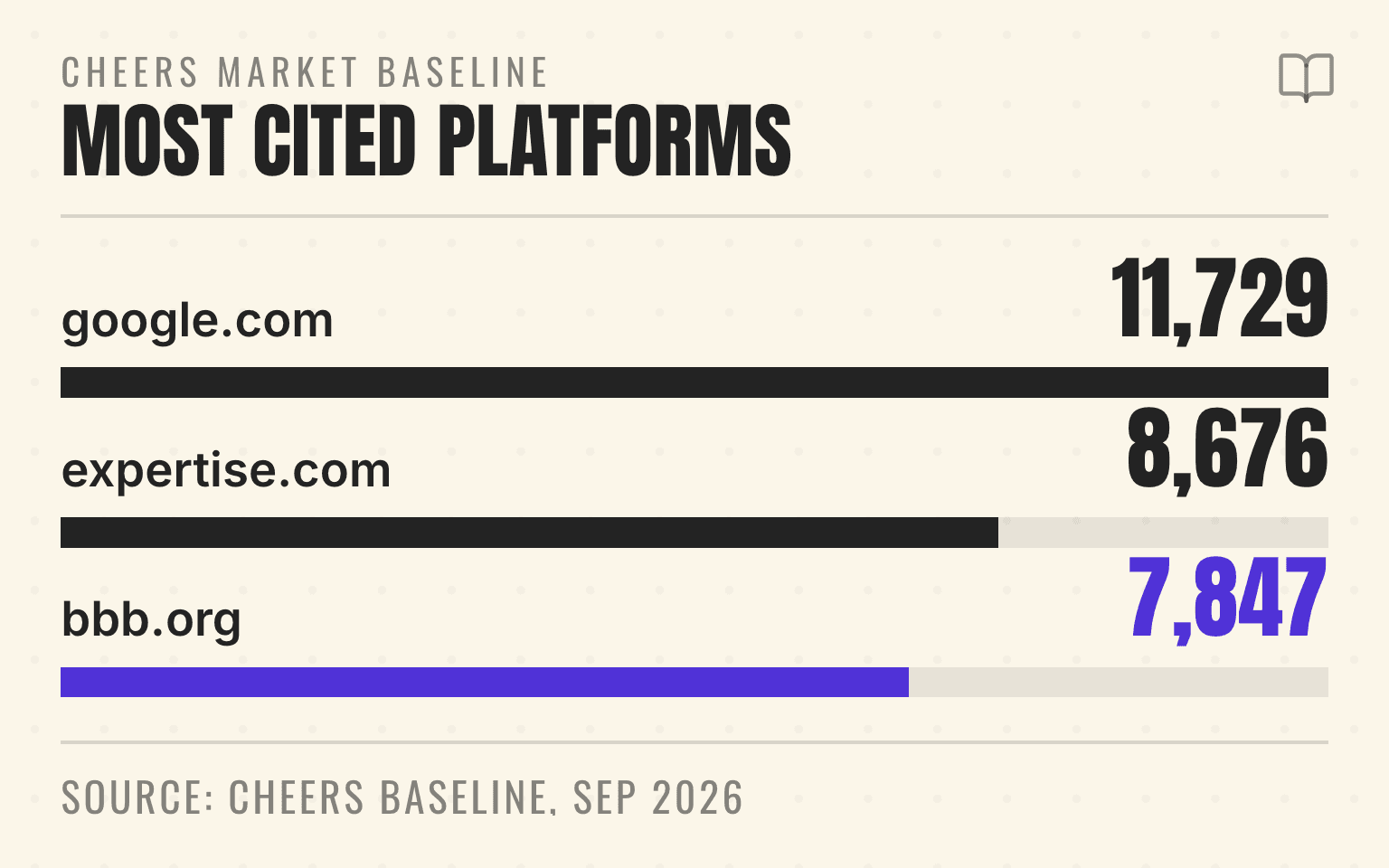
We can name the platforms rather than guess at them. Across the 100-metro baseline in the 28 days ending September 2, 2026, the most-cited platform and directory domains were google.com with 11,729 citations, expertise.com with 8,676, angi.com with 8,658, bbb.org with 7,847, serviceagent.ai with 6,695, and reddit.com with 6,536. Directories and review platforms as a class took 23.0% of all citations in that window.
Cheers Market Baseline
Six records, not two hundred
100
Metros
Most cited platform and directory domains, Cheers Market Baseline, 28 days ending September 2, 2026
Cited in all 100 metros
65 metros
76 metros
All 100 metros
69 metros
All 100 metros
Cheers Market Baseline, 28 days ending September 2, 2026: 32 home-services prompts across 100 metro service areas on four engines. Platform and directory domains only; business sites excluded on purpose. Methodology at cheers.tech/research/methodology.
| Domain | Citations in the window |
|---|---|
| google.com | 11,729 (Cited in all 100 metros) |
| expertise.com | 8,676 (65 metros) |
| angi.com | 8,658 (76 metros) |
| bbb.org | 7,847 (All 100 metros) |
| serviceagent.ai | 6,695 (69 metros) |
| reddit.com | 6,536 (All 100 metros) |
Contractor and franchise domains are deliberately left out of that list, so read it as the platform layer only. The operational point is that this is a short list, not an infinite one. Six domains carry most of the third-party weight in a typical metro, and each of them holds a version of your branch name, phone number, address, and hours that somebody at your company has probably never opened. Start the audit there rather than with a 200-directory submission service. The full per-metro table is in the home services AI visibility index, with the classification rules in the research methodology.
The parent company and each branch also need a clear relationship. If 20 locations use former URLs, old phone numbers, or unclear names, those branches become harder to manage and verify. Public evidence does not show that those errors automatically reduce visibility for the other 30.
Across multi-location accounts, the most consequential problems are concrete: outdated phone numbers, former addresses, duplicate profiles, incorrect hours, and branch pages that point to the wrong market. These errors can be fixed and verified without claiming a direct causal effect on AI recommendations.
The franchise problem. Franchisees and local managers often manage their own listings. Unapproved names such as "Bob's Plumbing - Managed by Mike" can conflict with brand policy and customer expectations. The fix is a documented naming and approval process, covered alongside the rest of the local proof layer in how franchise brands get recommended by ChatGPT.
The acquisition problem. When multi-location businesses acquire new locations, the acquired business's old listings stick around. "Former Name Plumbing (Now Bob's Plumbing)" on some random directory is a fragment that will persist for years unless you clean it up. How should home service rollups handle rebrands for AI search? is the full source-migration workflow for that cleanup.
Next step
Is AI recommending your business?
Find out how visible you are across ChatGPT, Gemini, Perplexity, and AI Overviews.
The entity consolidation playbook
Fixing entity fragmentation is methodical work. There's no shortcut, but there is a clear process.
Step 1: Define your canonical data
Create a master reference document for every location. This includes:
- Approved public-facing business name and legitimate former-name transitions
- Current physical address or service-area configuration
- Working phone number and routing owner
- Primary business description (one paragraph, used everywhere)
- Primary and secondary categories
- Hours format
- Website URL for each location
This document becomes your single source of truth.
Step 2: Audit and correct every listing
Go platform by platform for each location. Google Business Profile, Yelp, BBB, Facebook, Apple Maps, Bing Places, and your top industry directories. Compare every field against your canonical data. Fix discrepancies. For the current Bing workflow, use the multi-location Bing Places rollout guide and verify the imported result instead of treating Google as a permanent source of truth.
This is tedious for 50 locations, but it produces a verifiable result: each important source points to the correct branch, services, hours, and contact path.
Step 3: Implement structured schema for multi-location
Schema markup can describe relationships between entities on the website. For multi-location businesses, the pattern looks like this:
Your corporate site gets Organization schema with your brand name, logo, and corporate details.
Each location page gets LocalBusiness schema (or a specific subtype) with a parentOrganization property pointing to the parent Organization.
Add sameAs properties only for authoritative profiles that describe the same entity as the page. Keep the markup aligned with visible content and current Schema.org guidance; the sameAs JSON-LD examples show the brand and branch versions side by side.
For a technical deep dive on implementation, see What Is JSON-LD?.
Step 4: Lock down editing
Location data changes over time as hours, routing, services, ownership, and brand names change. An approval workflow helps the central record and public profiles stay aligned.
Centralize listing management. Use a platform or process that gives corporate control over the data while allowing local teams to request changes through an approval workflow. If a franchise owner wants to update their hours, they submit a request. They don't edit the Google Business Profile directly.
Step 5: Monitor for drift
Set up a quarterly audit process. Check a sample of locations against your canonical data. Run AI queries for each market to see if recommendations are consistent.
Watch for new, duplicate, or stale listings. Investigate where each record came from, who controls it, and whether it can misroute a customer before deciding how to correct or merge it. When Google changes a field, use the Business Profile update change-control workflow to compare, resolve, and read back the affected value.
Important
Record each material error, its source, the correct value, the owner, and the verification date. That turns a vague consistency project into a queue the team can close.
What clean entity data changes
Entity consolidation isn't a one-time project. It is maintenance work that affects every location.
Once the records are clean and connected, operators have a clearer reference for correcting future listings and handling platform-specific review or profile transfers. The transfer behavior depends on the platform.
The parent brand also gets a clearer public footprint. Customers and software systems can see which locations belong to the company and which page, phone number, and profile describe each branch.
This is ongoing data maintenance, not an early-mover moat. See how Hello Sugar standardized review and location operations across a large franchise network.
Important
Judge the cleanup by whether each branch can be found, understood, and contacted correctly. Treat any visibility movement as a separate measurement question.
Sources
Checked September 2, 2026.
- Google Knowledge Graph Search API. Google for Developers, accessed September 2026. developers.google.com/knowledge-graph. Source of the quoted production-critical caveat and the individual-entities limitation.
- LocalBusiness and parentOrganization. Schema.org vocabulary, accessed September 2026. schema.org/LocalBusiness and schema.org/parentOrganization. Source of the multi-location entity relationship pattern.
- Local business (LocalBusiness) structured data. Google Search Central, last updated December 10, 2025. developers.google.com/search/docs/appearance/structured-data/local-business. Source of the most-specific-subtype and page-alignment guidance. Replaces two previous entries that pointed at publisher home pages rather than an article.
- General structured data guidelines. Google Search Central, last updated July 10, 2026. developers.google.com/search/docs/appearance/structured-data/sd-policies. Source of the rule that structured data must be a true representation of the page content.
- Guidelines for representing your business on Google. Google Business Profile Help, accessed September 2026. support.google.com/business/answer/3038177. Source of the real-world representation standard behind the canonical record.
- From SEO to GEO: How Generative AI Is Redefining Search for Franchise Brands. Steve Buors, International Franchise Association, December 9, 2025. franchise.org. Source of the franchise GEO context.
- Cheers Market Baseline: 32 home-services prompts, 100 metro service areas, four engines, 28 days ending September 2, 2026, 356,019 citations, aggregate only. Home services AI visibility index and methodology. Source of the distinct-domain counts and the most-cited platform domains.
Amadeus Peterson is the CTO of Cheers, the local search platform for service businesses.