

Google answered the "should we" part of this question directly. From its generative AI optimization guide, last updated July 10, 2026:
You don't need to create new machine readable files, AI text files, markup, or Markdown to appear in Google Search.
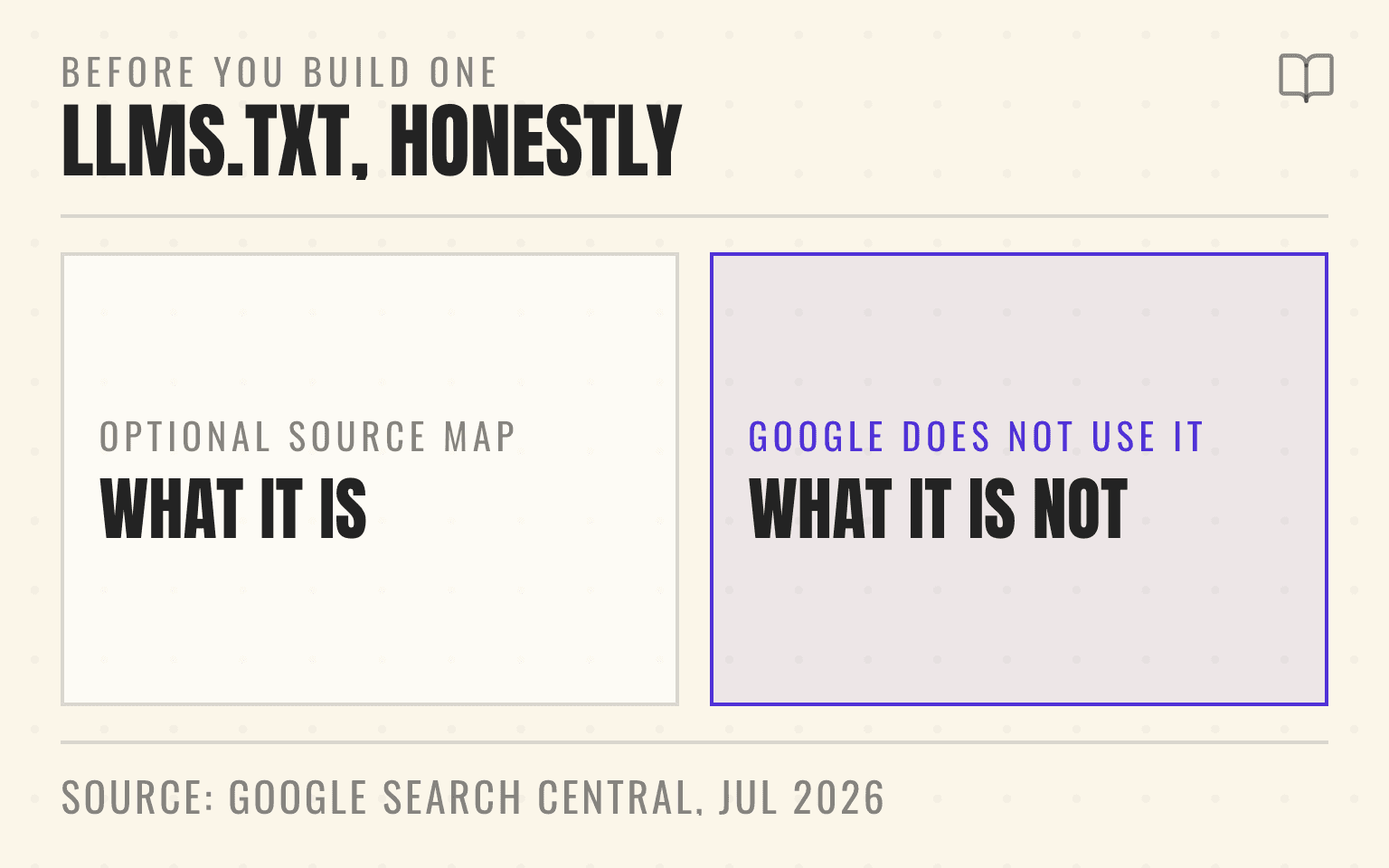
The guide adds that Google Search itself does not use them. So for the largest local surface a service business cares about, an llms.txt file buys nothing. That is worth knowing before a developer spends a sprint on it.
What llms.txt actually is, then. Jeremy Howard's proposal frames the problem it solves plainly:
Web pages are built for people. An HTML page wraps its information in navigation, ads, and JavaScript.
The file is an emerging Markdown convention that gives a tool a short, curated summary of your site and links to the pages that matter. It is not a replacement for crawlable pages, schema, sitemap.xml, or accurate third-party listings, and it is not a control layer.
For the practical AI Search baseline, read How Local Businesses Can Show Up in Google AI Search. For the machine-readable page layer, read What Is JSON-LD?.
What it does
An LLMs.txt file sits at the root of your website (yourbusiness.com/llms.txt) and follows a proposed plain-Markdown structure. It can carry what your business is and does, which canonical pages support that summary, which source pages cover each topic, and the contact details and service areas a reader would need.
Before you build one
A map, not a switch
Context layer
What llms.txt is
- An optional Markdown file at your site root
- A curated summary plus links to canonical pages
- Read only if a tool chooses to fetch it
- Cheap to generate from pages you already have
Not a control layer
What it is not
- Not needed for Google Search, which does not use it
- Not robots.txt, noindex, or authentication
- Not a ranking, citation, or recommendation lever
- Not a substitute for a crawlable branch page
Google Search Central, optimizing your website for generative AI features, last updated July 10, 2026; the /llms.txt file v2 by Jeremy Howard at llmstxt.org. Both checked September 2, 2026.
Pro Tip
Treat LLMs.txt as an optional source map. It can summarize and link to useful pages, but it does not replace those pages or control how a product describes the business.
Why this matters for GEO
The proposal was created to give tools a concise source map when they choose to fetch and process the file. It does not establish that major local-search or recommendation products retrieve the file, or that publishing one improves ranking, citation, or recommendation outcomes. Search Engine Land's March 2025 coverage put adoption no higher than that either, reporting that many LLMs have voiced support and many are using it or exploring its usefulness.
What does get cited is measurable. In the Cheers Market Baseline, 32 home-services prompts run across 100 metro service areas on four engines in the 28 days ending September 2, 2026, 68.1% of 356,019 citations pointed at a business or contractor website and 23.0% at a directory or review platform. The engines are citing pages a customer could also open. Publishing a better page beats publishing a file about the page. The full breakdown is in the home services AI visibility index, with the classification rules in the research methodology.
Important
Publish only facts that are also supported on visible canonical pages. The proposal does not guarantee that an AI product will fetch, trust, or cite the file.
What goes in an LLMs.txt file
The format is still evolving, but typical contents include:
Business identity. Your official name, what you do, your primary category.
Service information. What services you offer, what service areas you cover, what makes you different.
Reputation summary. Your aggregate ratings, review counts, notable achievements.
Contact information. Phone, email, address, hours.
Canonical descriptions. A concise summary supported by the linked website pages.
Maintenance note. A visible last-updated date for readers. It does not tell an AI crawler when to refresh.
Next step
Is AI recommending your business?
Find out how visible you are across ChatGPT, Gemini, Perplexity, and AI Overviews.
Example structure
# Smith Plumbing

> Family-owned plumbing company serving Austin, Texas with emergency repairs, water heater service, drain cleaning, and remodel plumbing.

Canonical facts:
- Official name: Smith Plumbing
- Category: Plumbing services
- Founded: 2005
- Service area: Austin, TX and surrounding areas within 30 miles
- Phone: 512-555-0123
- Website: https://smithplumbing.com

## Core Pages
- Homepage: Services, service area, reviews, and booking.
- Emergency Plumbing: 24/7 emergency service details.
- Water Heaters: Installation and repair details.

## Services
- Emergency plumbing repairs (24/7)
- Water heater installation and repair
- Drain cleaning
- Bathroom and kitchen remodeling

## Optional
- Privacy Policy: Privacy details.
Adoption status
LLMs.txt is a newer proposal, not a universally supported web standard. The project lists integrations and examples, but broad product adoption and local-search impact have not been established.
Important
Treat LLMs.txt as a low-effort context layer, not a guaranteed traffic lever. The fundamentals still matter more: crawlable pages, accurate schema, consistent citations, strong reviews, and third-party proof.
The file can still serve as a team-maintained source map when it is generated from canonical pages and kept current. That internal use is separate from any claim about AI adoption.
If the goal is actually to be found and recommended, spend the sprint on the layers that are documented to matter: crawlable branch pages, accurate structured data, and clean public records. What location pages should include for AI search covers the page standard, which AI crawlers local businesses should allow covers the access layer, and website optimization is how we run that work across a location set.
Sources
Checked September 2, 2026.
- Optimizing your website for generative AI features on Google Search. Google Search Central, last updated July 10, 2026. developers.google.com/search/docs/fundamentals/ai-optimization-guide. Source of the quoted machine-readable-files sentence and the statement that Google Search does not use them.
- The /llms.txt file, v2. Jeremy Howard, AnswerDotAI, accessed September 2026. llmstxt.org/index.md and the reference implementation at github.com/AnswerDotAI/llms-txt. Source of the quoted problem statement and the file format. Linked to the specification document rather than the site root.
- Meet llms.txt, a proposed standard for AI website content crawling. Rob Garner, Search Engine Land, March 28, 2025. searchengineland.com. Source of the adoption characterization.
- Cheers Market Baseline: 32 home-services prompts, 100 metro service areas, four engines, 28 days ending September 2, 2026, 356,019 citations, aggregate only. Home services AI visibility index and methodology. Source of the citation-class shares.
Two previously listed vendor blog posts, from Mintlify and Semrush, were removed. Both restated the proposal rather than adding primary evidence.
Amadeus Peterson is the CTO of Cheers, the local search platform for service businesses.