

Google's May 20, 2026 ads announcement was written for marketers, retailers, universities, and ecommerce teams. Home-services operators should still read it closely, starting with the sentence that describes the new format:
With Conversational Discovery ads, your ad answers a person's specific question.
Last verified: September 2, 2026.
The same announcement introduced Business Agent for Leads, which Google describes as putting "a smart brand agent right inside your ad." Search is becoming a place where a customer asks a complex question, compares options, reads an AI explanation, clicks a sponsored recommendation, and starts a lead conversation without passing through keyword, blue link, landing page, form.
Google published the demand side separately on May 19, 2026: AI Mode queries have more than doubled every quarter since launch, and the average AI Mode search is triple the length of a traditional Search query. A three-times-longer question is a question with a service, a place, a constraint, and usually a deadline in it.
For HVAC, plumbing, electrical, roofing, pest control, restoration, garage doors, and franchise service brands, this is not an ads-only update. It is a local proof problem.
Important
AI-powered ads can create a faster path to the lead. They cannot invent location-level evidence. If the website, Google Business Profile, reviews, and cited sources are thin or inconsistent, automation has weak material to work with.
The practical question is not whether Google will put more AI in ads. It already is. The practical question is whether each branch has enough proof for Google, customers, and AI systems to explain why that branch is the right provider for the job.
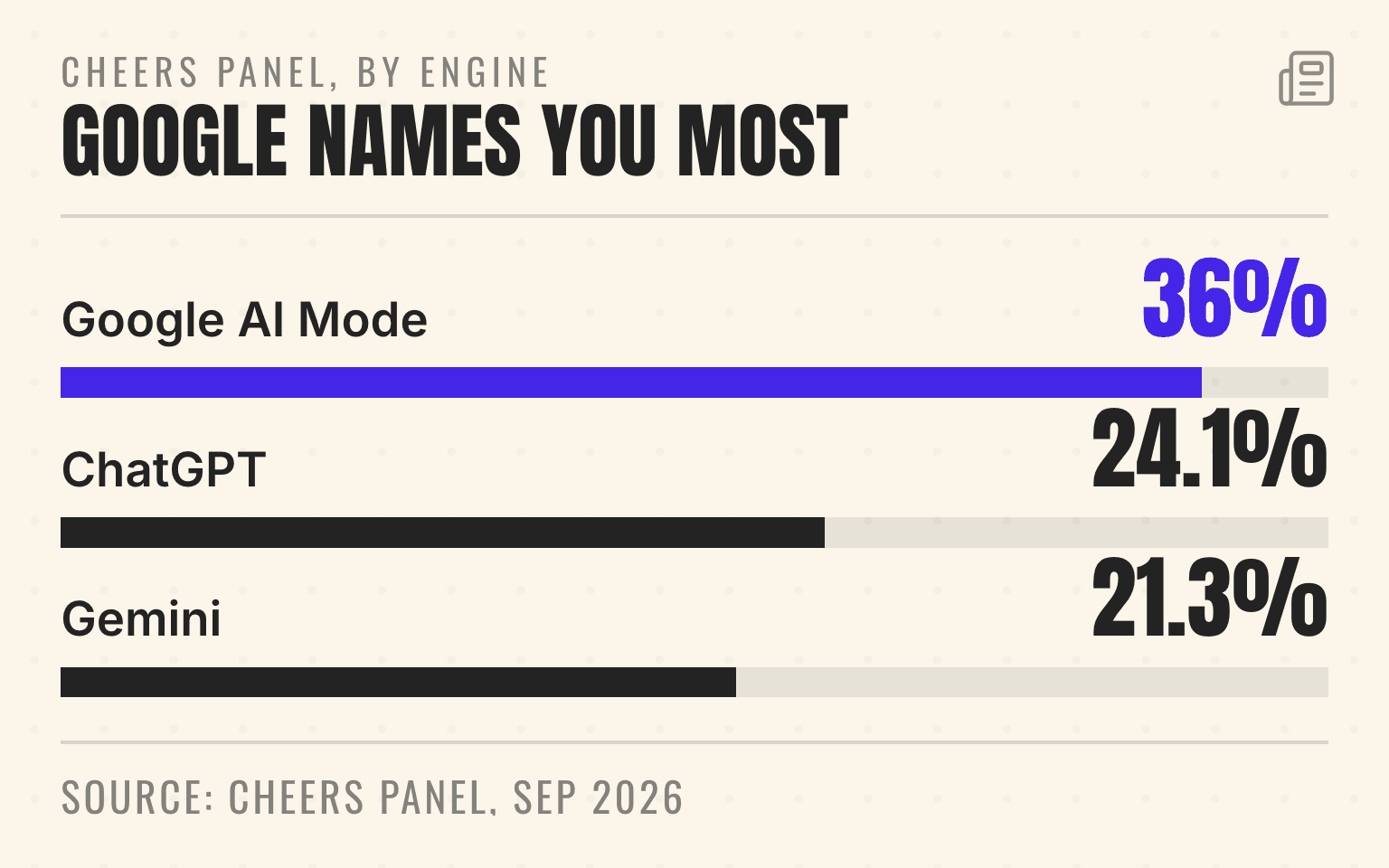
The organic half of that answer is measurable today. In the Cheers panel for the 28 days ending September 2, 2026, 13 home-services companies, leaving out questions that name the company itself, aggregate only, Google AI Mode produced the highest median appearance rate of any engine at 36.0% and the highest mean citation rate at 31.0%. The other three trailed on median appearance: ChatGPT at 24.1% (mean citation rate 11.5%), Gemini at 21.3% (10.8%), and Perplexity at 13.9% (23.4%). Google AI Mode is also the only engine where google.com itself is a meaningful share of citations, at 11.4% in the market baseline. It is the engine most likely to name a home-services company and the one most likely to keep the click. The cuts are in AI visibility statistics, with the sampling rules in the methodology.
Cheers panel, by engine
Google AI Mode names you most
11.4%
Cites google.com
Median appearance rate by engine, Cheers panel, 28 days ending September 2, 2026
Mean citation rate 31.0%
Mean citation rate 11.5%
Mean citation rate 10.8%
Mean citation rate 23.4%
Cheers panel, 28 days ending September 2, 2026: 13 home-services companies, non-branded prompts, company medians (corrected September 28, 2026). The 11.4% google.com citation share comes from the Cheers market baseline, 100 metro areas. Aggregate only.
| Engine | Median appearance rate |
|---|---|
| Google AI Mode | 36% (Mean citation rate 31.0%) |
| ChatGPT | 24.1% (Mean citation rate 11.5%) |
| Gemini | 21.3% (Mean citation rate 10.8%) |
| Perplexity | 13.9% (Mean citation rate 23.4%) |
What Google changed on May 20, 2026
Google said it is testing two AI Mode ad formats built with Gemini: Conversational Discovery ads and Highlighted Answers. Conversational Discovery ads are designed to answer a person's specific question. Highlighted Answers make sponsored recommendations eligible to appear inside AI Mode recommendation lists. Google also said these formats will include an independent AI explainer and remain labeled as Sponsored.
The same announcement introduced Business Agent for Leads, a Gemini-built chat experience inside an ad. Google's example is a student researching universities, but the mechanism matters for home services: a buyer can click "Chat," ask questions, and get answers based on the advertiser's website before becoming a lead.
Google's Marketing Live collection framed AI Max as a way for businesses to become part of AI Search conversations. Google Ads Help says AI Max for Search campaigns can use broad match, asset-based matching, landing page-based technology, text customization, final URL expansion, locations of interest, and reporting that shows why ads matched.
That creates a new dependency. The ad system is no longer matching only against a keyword and serving a static page. It may choose a query-relevant URL, customize ad copy from landing page copy and assets, and use geographic intent controls.
For local-service brands, that means the landing page set matters more, not less.
The same mechanics show up outside paid media. If a buyer asks one complex local question, Google AI Mode may fan that prompt out into service, market, profile, review, and booking checks. Use What Is Query Fan-Out in Google AI Mode? as the technical companion before you decide which pages or profiles need work.
Why home services has a different problem than ecommerce
Google's examples lean toward products, travel, shopping, and education. Home services behave differently because the customer is usually buying a local outcome under time pressure.
Someone searching for "best AC repair near me" is comparing risk as much as brand. They need to know who serves their neighborhood, who is open, who can send a technician, who has recent reviews, who handles the exact system, who has a working phone path, and who looks credible enough to let into the house.
Those facts rarely live in one place. Some live on the location page. Some live in the Google Business Profile. Some live in reviews. Some live in Yelp, BBB, Angi, HomeAdvisor, Facebook, YouTube, local news, or trade directories. Some live in technician performance that never becomes public evidence unless the business has a review operation.
That is why Google's AI Search guidance for local businesses matters alongside the ads news. Google says generative AI features in Search rely on core Search ranking and quality systems. For home services, the Search fundamentals are local fundamentals: accurate business data, crawlable service pages, complete profiles, reviews, photos, internal links, and third-party evidence that can be found and cited.
An AI ad can route demand. It still needs facts to route demand correctly.
The ad is only as good as the proof layer
AI Max and Business Agent for Leads make weak local data more expensive. If the campaign is allowed to expand into more queries, choose more URLs, customize more copy, and answer more questions, the system can expose every gap in the location structure.
A multi-location plumbing brand might have strong corporate copy but thin branch pages. A restoration rollup might have uneven Google Business Profiles after acquisitions. An HVAC platform might have thousands of five-star service moments, but the reviews are concentrated in three branches while newer markets look quiet. A garage door franchise might have accurate ads and messy citations.
The old campaign could hide some of that behind a landing page. The AI-assisted version is more likely to pull the gap into the conversation.
Before increasing AI Search spend, inspect these six assets for each priority market:
- The location page has the correct name, phone number, service area, hours, services, booking path, and local proof
- The Google Business Profile matches the page and uses complete categories, hours, services, photos, and review response practices
- The service pages answer real buying questions about urgency, process, cost drivers, equipment, guarantees, and eligibility
- The cited third-party sources show the same business identity and enough reputation evidence to support comparison queries
- The review operation asks customers neutrally and consistently at the point of service
- The tracking setup can survive dynamic landing pages, query-relevant URLs, and location-level attribution
This is where the paid and organic teams need the same operating model. The campaign needs good assets. The AI answer needs good sources. The branch needs good reviews. The operator needs to see which part is missing.
OpenAI applies the same separation even more explicitly: ChatGPT Ads cannot alter the answer above them. The ChatGPT Ads test plan for home services shows how to keep paid market results and organic recommendation results on separate scorecards.
Next step
Is AI recommending your business?
Find out how visible you are across ChatGPT, Gemini, Perplexity, and AI Overviews.
What Cheers is seeing in cited sources
Cheers' anonymized home-services checks from May 18 to May 20, 2026 point to one practical issue: AI answers are not building local recommendations from brand websites alone. The sample covered 13 home-services organizations, 113 tracked prompts, 13,797 provider results, and 120,928 valid source-domain mentions across ChatGPT, Perplexity, Gemini, and GAIO.
After excluding monitored business domains where matching was possible and applying a 10-organization threshold, the recurring domains were Yelp, Reddit, Google, Angi, Today's Homeowner, BBB, YouTube, HomeAdvisor, Facebook, and BestProsInTown.
That list should not be treated as one generic directory checklist. Yelp, Google, BBB, Facebook, and BestProsInTown usually carry reputation and location proof. Reddit adds informal customer language, comparisons, and objections. Angi and HomeAdvisor show category presence inside lead marketplaces. Today's Homeowner and YouTube can add educational or media context around the service category.
The operator takeaway is simple: each source has a job. Reviews prove customer experience. Citations prove the entity. Location and service pages explain fit. Third-party sources corroborate the claim. A branch can look strong in Google and still be underrepresented in the sources AI systems use for comparison prompts. A company can have strong reviews and still create confusion if acquisitions, old names, and duplicate profiles split the entity graph.
For the broader source strategy, compare this with our breakdown of how different AI search engines cite different sources. The point is to manage cited sources, review velocity, Google Business Profile hygiene, and location-page quality from one operating scorecard. If those workstreams sit in separate vendor lanes, the brand can fix individual listings while the source graph stays inconsistent.
How home-services brands should respond
Do not respond by making dozens of thin pages for every AI query variation. Google specifically warns against SEO work that exists only for machines. The better response is to make each priority location and service more complete, more specific, and easier to verify.
For a 40-location HVAC brand, that means the Phoenix AC repair page should not read like the Dallas AC repair page with the city swapped. It should explain the service area, common system issues, scheduling options, emergency coverage, technician credentials, review themes, and what happens when a customer books. It should link naturally to the Phoenix location page and relevant service pages. It should match the Google Business Profile. It should point to the same entity as the third-party profiles AI engines already cite.
For a plumbing franchise, the emergency plumbing page should answer the expensive questions: when to shut off water, what counts as an emergency, how pricing is handled, whether a branch offers after-hours service, what neighborhoods are covered, and how fast the customer can talk to a person. Those details are useful to customers first. They also give AI systems and ad agents something concrete to explain.
For a PE-backed rollup, the work starts with governance. Acquired brands, older domains, inconsistent names, duplicate listings, and uneven review volume create ambiguity. The citation stack and review collection process need owners, thresholds, and cadence. Sierra Air Conditioning & Plumbing is the home-services example we can point to publicly: the case study connects public Google review growth with AI visibility measurement, without pretending the same result is automatic for every company.
Watch · 1 minute 14 seconds
Don't rely on ads alone.
Why home service businesses need customers to find them beyond paid ads.
What to measure before increasing spend
The wrong way to use the Google announcement is to ask only, "Should we turn on AI Max?" The better question is, "Which locations have enough evidence for AI Max, AI Mode, and Business Agent for Leads to represent them accurately?"
Start with market-level visibility. Pick the services and markets that matter most, then test how Google, ChatGPT, Gemini, Perplexity, and AI Overviews describe the options. Record which competitors appear, which sources are cited, which branch is chosen, and which facts are missing. A one-location snapshot from the Cheers AI Visibility Grader can show the shape of this problem, but a multi-location brand should turn it into a recurring market review.
Then map paid media readiness against the same evidence. If AI Max sends a buyer to the most relevant URL, is that URL actually the best page for the job? If Business Agent for Leads answers from the website, does the website contain the answer? If an AI Mode ad appears beside an independent explainer, do third-party sources support the claim?
Brands with specific local evidence will be easier to represent than brands with generic AI content. The advantage goes to locations that are easiest to understand, easiest to verify, and easiest to contact when the buyer is ready.
Methodology
Cheers used anonymized aggregate first-party AI visibility checks. The public sample used in this article covers May 18 through May 20, 2026 and includes home-services businesses only. It includes 13 home-services organizations, 113 tracked prompts, 13,797 provider results, and 120,928 valid source-domain mentions across ChatGPT, Perplexity, Gemini, and GAIO. We excluded monitored business domains where matching was possible and named only domains that appeared across at least 10 organizations.
The data should be read as a current snapshot of source-domain appearances in Cheers checks, not as a universal ranking factor study.
Sources
Every link below was opened and checked on September 2, 2026.
- A new generation of ads for the AI era of Search. Google, May 20, 2026. Conversational Discovery ads, Highlighted Answers, Business Agent for Leads, and AI-powered Search ads.
- Google Marketing Live 2026 collection. Google, May 2026. AI Search ads, AI Max, Ask Advisor, measurement, commerce, and creative announcements.
- Optimizing your website for generative AI features on Google Search. Google Search Central, last updated July 2026. AI Overviews and AI Mode run on the core Search ranking and quality systems.
- How AI Max for Search campaigns works. Google Ads Help. Search term matching, text customization, final URL expansion, locations of interest, brand controls, and reporting.
- How AI Mode is changing the way people search in the U.S.. Google, May 19, 2026. Query growth more than doubling every quarter and searches averaging triple the length of a traditional query.
- A new era for AI in Search. Google, May 2026. AI Mode users, agentic booking, and calls on behalf of users.
- Improve your local ranking on Google. Google Business Profile Help. Relevance, distance, and prominence.
- Cheers panel and market baseline, 28 days ending September 2, 2026. 13 home-services companies and non-branded prompts for the per-engine medians and citation rates (corrected September 28, 2026); 32 prompts across 100 metro areas for the citation mix. Aggregate only. Methodology.
- Cheers: Google's AI Search guide for local businesses. Internal companion guide translating Google's AI Search guidance for local-service operators
- Cheers: AI search engines cite different sources. Internal source strategy guide for ChatGPT, Gemini, Perplexity, and AI visibility work
- Cheers: Sierra Air Conditioning & Plumbing case study. Public home-services proof point for Google review growth and AI visibility measurement
Dylan Allen-Arnegård is the CEO & Co-Founder of Cheers, the done-for-you platform that manages the website, reviews, listings, structured data, and local content that get service businesses recommended across Google, Maps, ChatGPT, and Perplexity.