

In the Cheers production review pull covering the 90 days ending September 2, 2026, the median home-services company collected 9.7 new reviews per location a month and the 75th percentile company collected 26.4, across 11 companies with at least one review. Same industry, same platform, roughly 2.7 times the volume. The difference is where the ask happens.
Last verified: September 2, 2026.
The video above gives home service operators a 90-day system with three moves: create the opportunity, make the ask a habit, and turn customer feedback into public proof. Those panel figures are aggregate only, no company named; the panel methodology and full cuts sit in the Home Services AI Visibility Index.
This written playbook is the field version of that system for multi-location teams. It starts when the job feels complete, gives the technician a direct NFC or QR path, makes adoption visible by employee and branch, and uses recurring customer language to improve the pages and profiles future buyers find.
If you want the product layer behind the video, see how Cheers handles review generation for multi-location service teams.
Important
The customer owns the review. Your team owns the opportunity: when to ask, how easy the path is, and whether the process happens consistently.
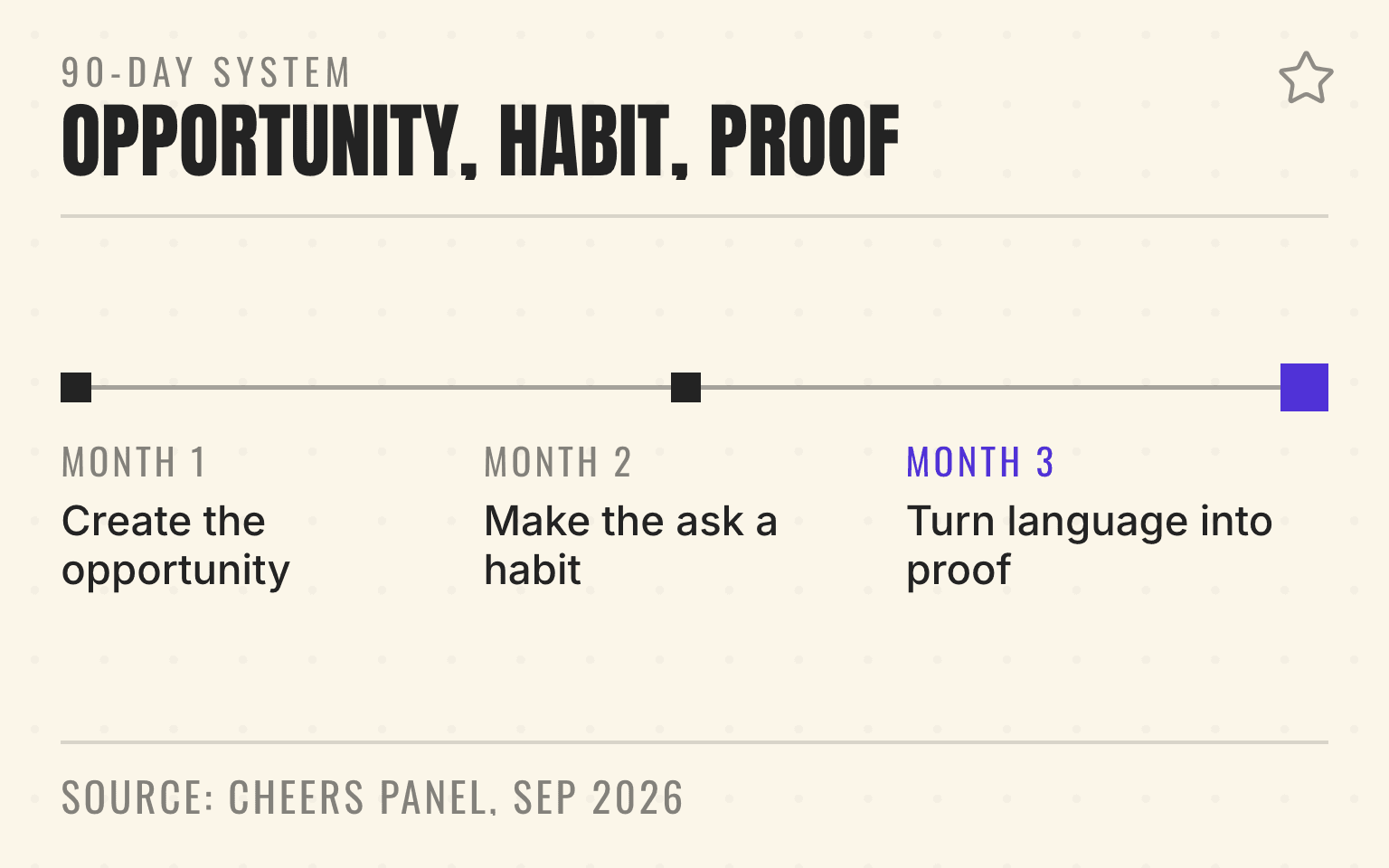
Month one: create the opportunity
Many review programs have an asking problem. The team finishes good work, the customer is standing with the technician who performed it, and the review request arrives hours later between unrelated texts and notifications.
The video breaks the opportunity into the moment, the person, and zero friction.
The moment is when the job feels done. The walkthrough is finished, the customer's questions are answered, and the service is still fresh. The person is the technician or frontline employee who completed the handoff. Zero friction means the correct review path opens without asking the customer to search for the company or choose between locations.
The customer does not need to finish the review in front of the technician. The job-close ask can make the option visible, and the customer can write privately or later. Use the same eligibility rule for every completed service event rather than trying to predict who will leave a positive review.
Pro Tip
Test timing against your own process. Compare requests sent at job close with a consistent follow-up, then review completion, complaint, and opt-out patterns before choosing a standard.
Start with one location, service line, or team. Keep the pilot small enough to watch the handoff, fix the script, and confirm that every link reaches the correct Google Business Profile.
Give technicians one simple ask
The personal ask works because the customer knows the technician who just performed the service. It should sound like a normal handoff, not a corporate campaign.
Give the team one short script:
Pro Tip
"If you'd like to share an honest review of today's service, you can tap here. It takes you straight to our Google page. No pressure, and you can always do it later."
That is enough. The technician creates the opportunity, then gives the customer room to choose whether to respond, which rating to leave, and what to write.
Role-play the handoff during onboarding and team meetings. Coach the timing and delivery until the ask feels as ordinary as explaining the invoice or confirming the next maintenance visit.
If your team needs software for technicians, dispatchers, and branch managers, compare that field workflow in Best Review Management Software for Home Services.
Remove friction without taking over
NFC badges, QR codes, and direct mobile links remove the search step. Google's own guidance names the same two tools:
"Remind customers to leave reviews: To leave reviews, you can ask customers to visit a Google link or scan a QR code."
An NFC badge lets the customer tap a phone and open the review flow for the correct location. A QR code adds a camera step but can still work well on an invoice, leave-behind card, counter sign, or technician badge.
The tool opens the path. It does not choose the rating or write the review. The customer still owns both.
The five-star tap shown in the video demonstrates the shortest path through Google's review composer. It is not a suggested rating. In the field, the customer chooses the rating and words.
Track the steps you can observe: eligible jobs, opportunities created, badge taps or link opens, and attributed reviews. That sequence shows whether the breakdown is the service handoff, the link, or the customer's decision after opening it.
If your current stack is messaging-first, use Podium Alternatives for Home Services Review Generation to compare general customer communication with field-service review capture and attribution.
Month two: make the ask a managed habit
Most review programs fade after the launch because nobody owns the play and managers cannot see whether the ask is happening.
Write the play on one page. Define which jobs are eligible, who asks, when the handoff happens, which words the team uses, where the link goes, and whether a follow-up is sent. Put one person's name on the program so branches know who reviews adoption and fixes broken paths.
Unique badges and links make the handoff observable. If one technician completes 25 eligible jobs and creates 25 review opportunities while another creates five, the gap is a coaching question. It does not prove that the second technician delivers worse service.
Important
Coach the ask, never the rating. Use attribution to find a missed handoff, help an employee through an awkward script, and verify that the approved process is being followed.
A friendly competition can help a team practice the new habit. Keep recognition tied to training, compliant participation, and service behaviors the employee controls. Google specifically prohibits merchants from asking staff to solicit a set number of reviews, so posted review count should remain a diagnostic rather than a quota or pay trigger.
The Action Furnace case study shows how employee cards and attribution support the operating model at field scale. Coaching and Compensation: Attribution for Teams covers the management boundary in more detail, and Review Generation Software With Employee Attribution covers the platform requirements.
Review the workflow every week during the pilot. Look for locations with eligible jobs but few opportunities, badges that open the wrong profile, employees who need another role-play, and follow-ups that arrive too late to be useful.
Next step
Is AI recommending your business?
Find out how visible you are across ChatGPT, Gemini, Perplexity, and AI Overviews.
Keep the system inside Google's rules
The video and the operating rule agree on the important line: ask consistently, keep it honest, and let the customer own the rating and words.
Google allows businesses to ask customers for genuine reviews and share a direct link or QR code. It prohibits customer incentives, fake engagement, review gating, pressure for a rating, requested wording, selective positive-review solicitation, and staff targets for a certain number of reviews.
If Google has already restricted a profile, use the multi-location review restriction recovery plan before changing evidence, submitting an appeal, or restarting requests.
What works:
- Give every eligible customer the same honest review opportunity
- Make the correct location easy to reach
- Let the customer choose the rating, words, place, and time
- Train and coach the service handoff
What crosses the line:
- Offer customers discounts, gifts, or rewards for reviews
- Gate the public review path behind a satisfaction survey
- Ask only customers expected to leave positive feedback
- Require staff to solicit a fixed number of reviews
- Suggest a rating, request specific wording, or watch the customer write
For the full compliance framework, see Compliance Playbook: Collect More Reviews Without Getting Flagged.
Month three: turn customer language into public proof
After two months, the system should produce more than a review count. It should produce location-specific language about what customers noticed, which services they hired, and why the experience stood out.
Pull a bounded sample of recent public reviews for one location and look for repeated service details. A Phoenix plumbing team may see customers repeatedly mention same-day water heater replacement while its location page says only "fast, professional service." The customer language is more specific.
Verify the repeated theme with the operations team. If the location reliably offers that service, replace generic page copy with the accurate service detail. Make the location page, Google Business Profile, service pages, and relevant directories describe the same business reality.
ChatGPT or Claude can help group a bounded set of public review text into themes. Remove customer names and unnecessary personal details, keep private CRM notes and job records out of general AI tools, and have the local operations owner verify every proposed theme before publishing it.
AI can also help draft a starting point for the business's public reply. Use the Gemini review reply workflow when the team needs a one-profile pilot and human approval gates. A manager still needs to verify the facts, protect customer privacy, and make the response sound like a person who understands the service. The tool should never write the customer's review.
The review-to-content operating guide covers that workflow in detail. The goal is not to copy customer reviews into SEO pages. It is to use verified customer language to make real service capabilities easier for people and AI systems to understand.
Measure the 90-day system against your baseline
The benchmark examples in the video show how much the service moment, a personal ask, and a direct path can change review conversion for some Cheers customers. Treat them as evidence that the operating model is worth testing, not as a guaranteed target for every location.
Use one consistent denominator. Track eligible jobs, opportunities created, taps or link opens, attributed reviews, opt-outs, complaints, and policy exceptions. Compare the pilot with its own starting point, then expand only after the team can explain what changed. To pick the count a branch is working toward, compare it with the businesses AI already names in its trade; how many Google reviews you need for AI recommendations has those medians from the Cheers Market Baseline.
More legitimate reviews give buyers and managers a fresher public record of the service. Google's local ranking page says it in five words: "More reviews and positive ratings can help your business's local ranking." Recency is the other half. BrightLocal's 2026 survey of 1,002 US adults found that 74% seek reviews written in the last three months, so a profile that stopped collecting in March is already stale to a buyer in September. Reviews also give AI systems more public customer language to encounter, although model providers do not publish a universal review weight. Measure review operations, local ranking, and AI visibility separately so the team can see which outcomes actually change.
Start with one location or team today. You cannot collect last month's missed reviews, but you can make the next completed job the first clean opportunity in the new system.
Sources
- Tips to get more reviews. Google Business Profile Help, undated help page. Review links, QR codes, balanced feedback, and the incentive prohibition. Checked September 2, 2026.
- Prohibited and restricted content, including fake engagement. Google Maps contribution policy, undated policy page. Checked September 2, 2026.
- Tips to improve your local ranking on Google. Google Business Profile Help, undated help page. Relevance, distance, prominence, review count, and ratings. Checked September 2, 2026.
- Local Consumer Review Survey 2026. BrightLocal, 2026, 1,002 US adult consumers. Checked September 2, 2026.
- Rule on the Use of Consumer Reviews and Testimonials: Questions and Answers. Federal Trade Commission, November 2024. Rule effective October 21, 2024. Checked September 2, 2026.
- Home Services AI Visibility Index 2026. Cheers Research, September 2, 2026, corrected September 23, 2026.
Dylan Allen-Arnegård is the CEO of Cheers, the local search platform for service businesses.