

BrightLocal's 2026 Local Consumer Review Survey, fielded with 1,002 US adults, found that 89% of consumers expect business owners to respond to reviews and that 80% say they are likely to use a business that responds to all of them. Replying is table stakes; replying accurately is where most teams lose.
Last verified: September 2, 2026.
A clear response process helps the team verify what happened, resolve legitimate problems, and give future readers useful context. The response should be specific enough to show attention and careful enough to protect customer and employee privacy. It is customer-service work, not a proven AI ranking tactic.
Google's own reply guidance draws the privacy line first:
"Protect privacy and avoid personal attacks: Never share a reviewer's private information or engage in personal attacks."
Important
The goal isn't to make negative reviews disappear. It's to use them as an opportunity to demonstrate that you handle problems professionally.
If your team is still building the review workflow itself, start with Review Collection at Point of Service: A Playbook. If you need the policy guardrails first, pair this with the compliant review collection playbook.
The real audience for your response
When you respond to a negative review, you are addressing the customer and writing for future readers at the same time.
Think about it from a potential customer's perspective. They're researching your business, they see a 1-star review, and then they see your response. What do they learn?
If your response is defensive or dismissive, they learn you don't handle criticism well. If your response is genuine and solution-oriented, they learn that even when things go wrong, you make it right.
Important
A response cannot erase the underlying service failure. It can show that the business understood the concern and provided a credible next step.
What a good response looks like
Avoid publishing the same generic paragraph under every complaint. Use a consistent review-and-escalation framework, then write to the verified facts of the incident.
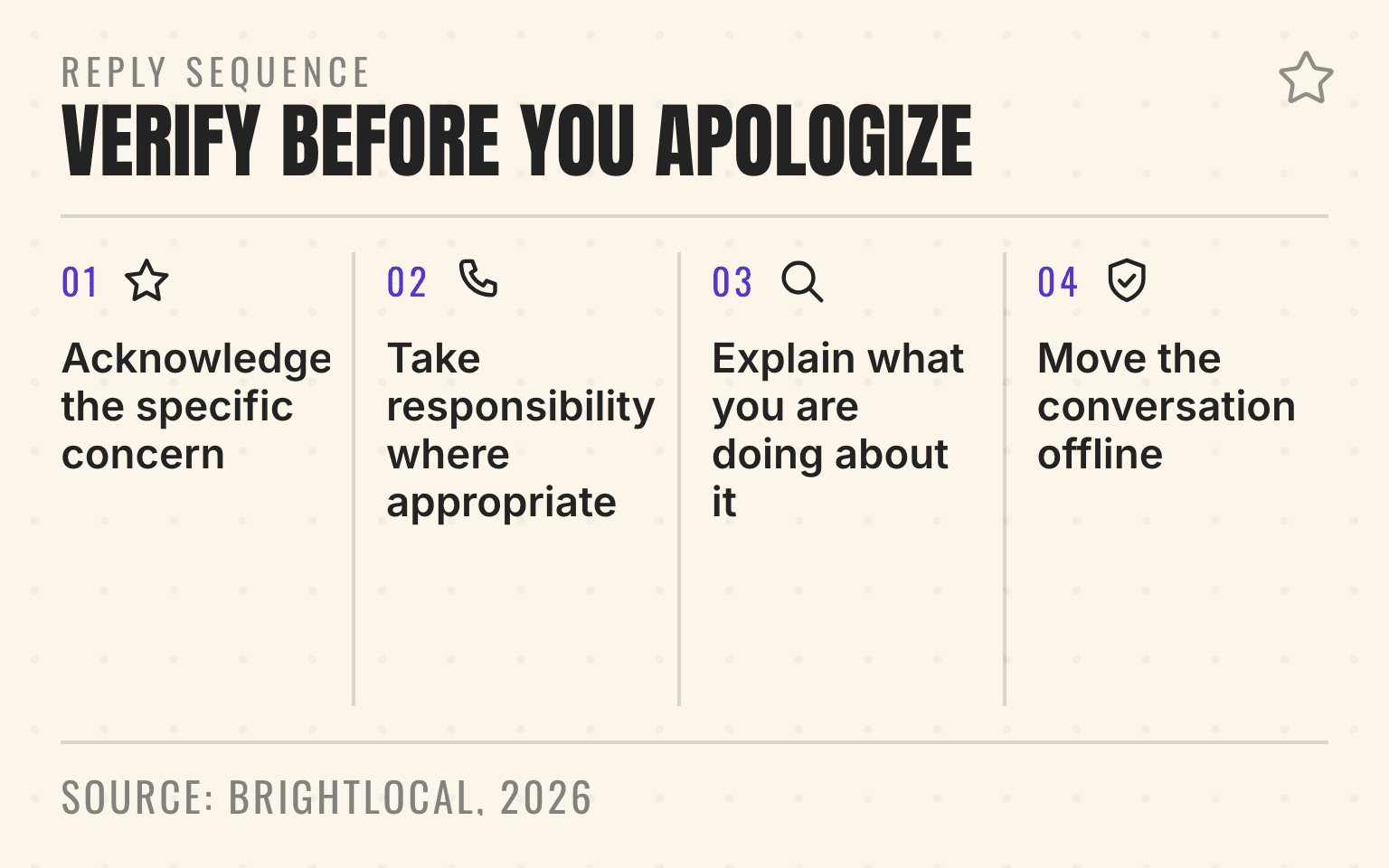
A good response does four things:
Acknowledge the specific concern. Show that you read the review without admitting an unverified fact. If dispatch records confirm the technician was late, say so. If the facts are still being checked, name the concern and provide a direct follow-up path.
Take responsibility where appropriate. If you messed up, say so. "We didn't meet our standards on this job" is more credible than "We're sorry you feel that way."
Explain what you're doing about it. This could be internal ("We've reviewed this with our team") or external ("We'd like to make this right"). Either way, show that this matters to you.
Move the conversation offline. Provide a direct way to reach you. "Please call me directly at [number]" is better than "Please contact customer service." Make it personal.
Pro Tip
After verification, a response can be specific: "John, thank you for letting us know. We confirmed that our technician arrived 45 minutes late. We are reviewing the scheduling handoff and would like to follow up directly. Please call [contact]."
That response acknowledges the problem, takes responsibility, shows action, and opens a door to resolution. Anyone reading it learns something positive about how this business operates.
What a bad response looks like
Avoid arguing in public. Responses such as "That's not what happened" or "You never told us about this" rarely help the customer or a future reader understand the next step.
Generic responses are almost as bad. "We're sorry you had a negative experience. Please contact us." This tells readers nothing. It looks like you're checking a box.
Not every review needs a reply. Google recommends focusing on reviews where the business can share a helpful update, answer a question, or address a concern, and it says so directly:
"Make your replies count: Instead of sending the same 'thank you' to everyone, focus on reviews where you can share a helpful update or answer a question."
Response coverage is the part home services already does well. In the Cheers production review pull covering the 90 days ending September 2, 2026, owners responded to 82.6% of reviews across 11 home-services companies, and the median company responded to 84.4%. Aggregate only, no company named. The panel methodology and the rest of the cuts are in the Home Services AI Visibility Index.
Next step
Is AI recommending your business?
Find out how visible you are across ChatGPT, Gemini, Perplexity, and AI Overviews.
Timing matters, but not as much as quality
Respond promptly after the team has enough information to be accurate. There is no universal published response-time benchmark.
Pro Tip
A careful response after fact-checking is better than a fast response written while the team is defensive.
Take time to step away if the draft is defensive, and have another owner review sensitive responses before posting. Reviews can be edited, removed, or appealed, so preserve the incident record separately from the public thread.
If the profile also shows a generated overview of recent review themes, the Google AI review summary guide explains what the owner can edit, which feedback path applies, and why an unflattering theme should be tested against the underlying customer experience.
When the customer is wrong
Sometimes a review conflicts with the job record, describes a policy the customer understood differently, or attributes the wrong event to the business.
When the mismatch points to a possible policy violation rather than a real customer dispute, use the fake Google review reporting and appeal workflow to preserve evidence, classify the contribution, and choose the correct Google path.
Your response still needs to be professional. You can gently correct misinformation without being defensive: "I want to clarify that our technician did call ahead as our policy requires, though I understand the timing was still frustrating."
Pro Tip
Don't die on that hill. Even if you're right, a prolonged argument in a public review thread makes you look bad. Acknowledge their frustration, offer to discuss offline, and move on.
The reviews you can't fix
Some negative reviews are legitimate. You did mess up, and the customer has every right to be angry.
The best response to these is genuine accountability: "You're right. We made a mistake, and I'm sorry. Here's what we're doing to make sure it doesn't happen again." Then actually do something to address the root cause.
Future customers know that service failures happen. A factual apology and a real recovery step give them useful context about how the business handles one.
Playing the long game
Review responses remain public context for future customers. Over time, they show whether the business repeatedly verifies complaints, protects privacy, and offers a practical resolution path.
A pattern of thoughtful, accountable responses to negative reviews tells a story: this is a business that cares, that takes feedback seriously, that fixes problems instead of making excuses.
Important
Do not use responses to argue with the customer, manufacture praise, or disclose private service details.
Sources
- Manage customer reviews. Google Business Profile Help, undated help page. Checked September 2, 2026.
- Tips to get more reviews, including reply tips. Google Business Profile Help, undated help page. Checked September 2, 2026.
- Local Consumer Review Survey 2026. BrightLocal, 2026, 1,002 US adult consumers. Checked September 2, 2026.
- Historical Trends in Consumer Review Behavior. BrightLocal, covering 2010 to 2025. Checked September 2, 2026.
- Report inappropriate reviews on your Business Profile. Google Business Profile Help, undated help page. Checked September 2, 2026.
- Home Services AI Visibility Index 2026. Cheers Research, September 2, 2026, corrected September 23, 2026.
If replies are piling up faster than the branches can verify them, review generation is the operating scope that covers the queue and the asks that fill it.
Dylan Allen-Arnegård is the CEO of Cheers, the local search platform for service businesses.