

ChatGPT Ads is ready for a measured local-services test in eligible markets: OpenAI reported availability in over 40 countries on August 31, 2026. Its announcement describes CPC and outcome bidding, geographic targeting, and Pixel and Conversions API measurement. I would start with one service area where the branch can handle the leads and the website can track the result.
OpenAI also announced wider self-service access across India, Europe, the Middle East, and North Africa. That expands the opportunity for local-service advertisers, subject to account and ad review. Paid placement still cannot change the answer above it, under OpenAI's answer-independence policy.
Last verified: September 4, 2026.
OpenAI began the US test on February 9, 2026. For a test this week, confirm that your account and chosen locations are eligible, then verify a lead event reaches the reporting system before committing spend.
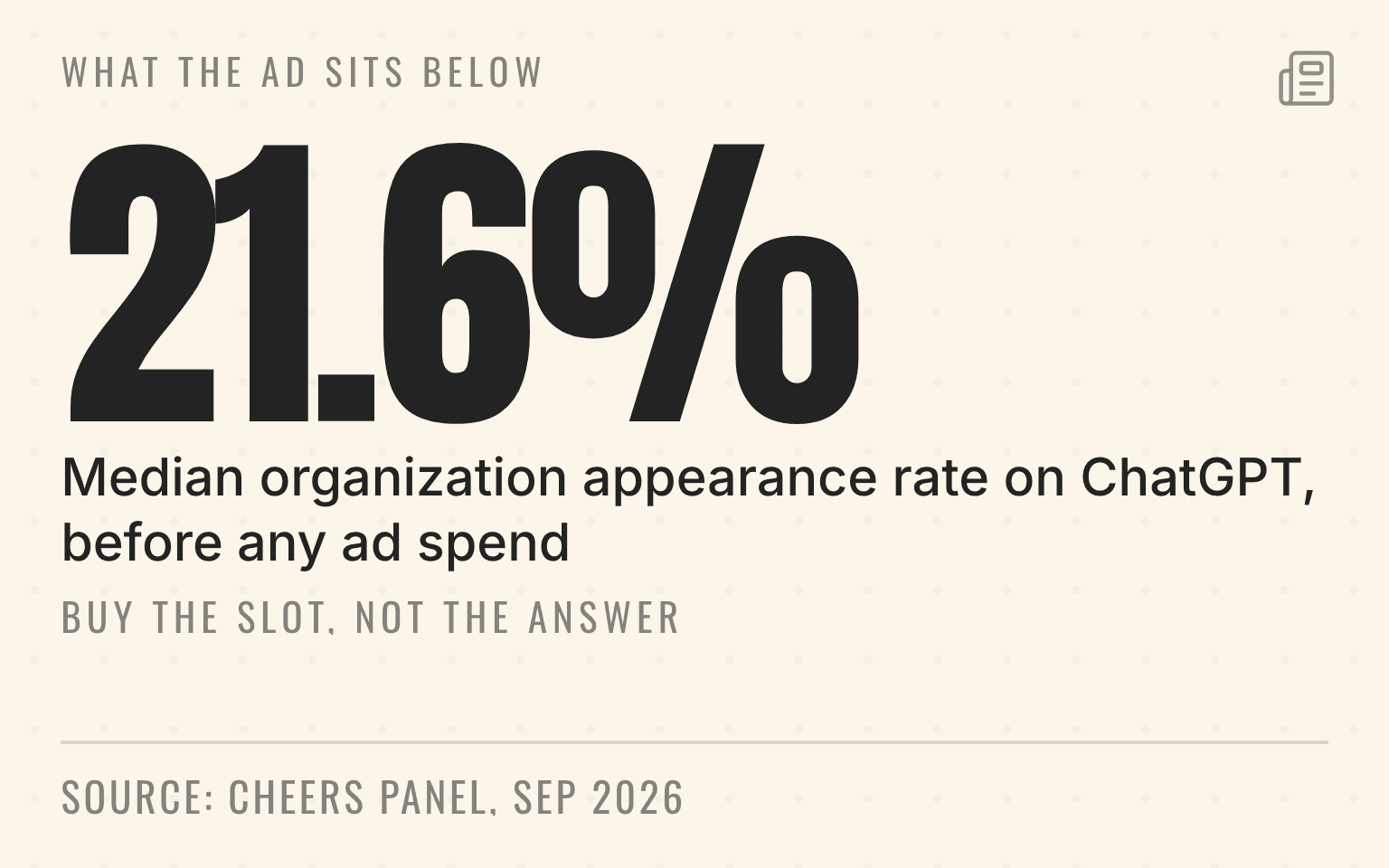
The organic number underneath is the one worth knowing before you write a budget. In the Cheers panel for the 28 days ending September 2, 2026, 119 home-services organizations, aggregate only, ChatGPT had the lowest median appearance rate of the four engines at 21.6%, and when it did name an organization the mean mention position was 2.87. In the separate market baseline, 48.8% of ChatGPT's home-services citations went to a contractor website and 44.7% went to directories and review platforms. The ad sits below that answer, not inside it. The cuts are in the home-services AI visibility index and AI visibility statistics, with sampling rules in the methodology. These are organic-answer observations; the panel does not establish any business's paid exposure or expected ad return.
Important
Run two scorecards. The paid scorecard covers ad delivery, clicks, qualified leads, booked jobs, and cost. The organic scorecard covers whether ChatGPT names the right brand or branch, which sources it cites, and whether the answer is accurate.
Before spending, save an organic baseline for the same service and markets with a location-level AI visibility check. The paid test should show what the ad bought. The baseline should show whether the business earned a recommendation without the ad.
What ChatGPT Ads actually buy
OpenAI's advertiser basics says ads appear below ChatGPT responses. The unit includes the advertiser name, favicon, title, copy, landing page, and image. The system considers the current conversation, the landing page, ad copy, advertiser-provided context hints, and other permitted signals when deciding which ad may be relevant.
Ads are not shown to every ChatGPT user. OpenAI's consumer ad FAQ draws the line by plan:
Free and Go users may see ads; the paid Plus, Pro, Business, Enterprise, and Edu plans remain ad-free.
OpenAI also says it does not show ads to accounts identified as belonging to people under 18. That limits reachable inventory and makes a small pilot more useful than a reach forecast copied from another platform.
OpenAI's campaign guide lists CPM, CPC, and conversion-optimized CPC objectives. Conversion-optimized CPC still charges per valid click, rather than per conversion. Choose the objective your measurement can support. The matching system is different from a conventional keyword auction because conversation context and context hints help determine relevance. A search campaign structure can be a starting reference, but copying an existing Google Ads account line for line misses the product's operating model.
Start with one market, one service, and one outcome
OpenAI recommends separate campaigns for meaningfully different regions or business goals. That is especially important for multi-location service brands because market eligibility and operations rarely match a national brand promise perfectly.
A restoration roll-up might begin with water-damage response in one designated market area where dispatch is staffed around the clock. An HVAC platform might test replacement consultations in two warm-weather markets where the location pages, financing disclosures, phone routes, and sales capacity are already verified. A plumbing franchise should not combine emergency sewer work, routine drain clearing, and water-heater replacement in one ad group if the branches, urgency, and customer handoffs differ.
Use a separate campaign or ad group when the real customer path changes:
- The branch, franchisee, or service area that owns the lead is different.
- The buyer's need has a different urgency, service scope, or qualification rule.
- The destination page, phone route, booking form, or conversion event changes.
- The public claim needs different availability, licensing, price, or financing language.
OpenAI's campaign guide says Ads Manager Beta supports location targeting where available. Confirm every market in the live location picker. A ZIP code in a media plan is not proof that the assigned branch can serve it profitably or within the advertised response window.
Context hints describe conversations, not exact keywords
At the ad-group level, OpenAI lets advertisers provide context hints: phrases about the conversations, needs, and topics where the service may be relevant. Its ad-group guidance then removes the temptation to treat them as keywords:
Context hints are not exact-match controls
The same page recommends describing the buyer's need in natural language and makes clear that hints cannot guarantee delivery for a particular conversation. For a plumbing brand, describe the job and the buyer instead of stacking service keywords.
For a Phoenix HVAC branch, a focused hint could describe a homeowner comparing repair and replacement after an air conditioner stops cooling. A separate ad group could cover planned heat-pump replacement, because the buyer questions, offer, landing page, and conversion event differ. For a restoration company, water removal after a burst pipe belongs apart from fire cleanup even when one branch handles both.
This is a portfolio-governance task. The media team should write context hints from the services a branch can fulfill, then have operations verify the claim set before launch. Do not use broad hints such as "all home repairs" if the campaign routes to a plumbing-only location.
The landing page must prove the local promise
OpenAI uses the landing page for ad review and may use its content to understand relevance. Its crawler guidance for advertisers says OAI-AdsBot is required for landing-page validation and review. OpenAI recommends allowing OAI-SearchBot as well.
The page needs to return a successful response without a login, CAPTCHA, unsupported redirect, or bot challenge. Engineering should check robots.txt, firewall and CDN rules, bot mitigation, authentication, geo restrictions, and rate limiting if OAI-AdsBot cannot reach it. A page that works in a marketer's browser can still fail ad review at the infrastructure layer. Use the current crawler documentation when reviewing access rules; verify each crawler independently.
The organic Google equivalent of this test is in How Google AI Mode Changes Local Leads.
Crawlability is only the first gate. The destination should name the location or service area, explain the actual service, show the current phone or form path, state relevant hours and limits, and send the lead to the branch that owns the job. The location-page checklist for multi-location service brands covers the source details that should already be present. The AI appointment-booking guide covers the form, accessibility, and handoff issues that can break after the click.
Next step
Is AI recommending your business?
Find out how visible you are across ChatGPT, Gemini, Perplexity, and AI Overviews.
Paid placement and organic recommendation are separate
OpenAI is unusually direct on this point: advertisers cannot pay to change the answer. Ads appear separately below the response, and a paid placement does not mean OpenAI endorses or recommends the advertiser.
That distinction should survive the reporting meeting. A branch can earn ad clicks while never appearing in the organic response. It can also appear organically because its location page, reviews, Google Business Profile, and third-party sources support the query, even if the brand buys no ad.
Do not report both outcomes as "ChatGPT visibility." Record sponsored impressions and clicks under paid media. Record organic appearances, competitors, cited sources, branch accuracy, and source gaps under AI visibility. The AI search traffic measurement guide explains how to keep mentions, citations, referral sessions, crawler access, and booked demand from collapsing into one number. The broader home-services recommendation guide covers the reviews, pages, profiles, and outside sources behind the organic scorecard.
OpenAI's separate beta Get Quote flow for home services belongs on a third line. It describes an eligible local-business conversion launcher backed by an approved provider plugin, not an ad placement or an organic ranking signal.
Pro Tip
If the ad wins a click but the answer recommends a competitor, record both facts. Paid acquisition may be working while the public source system still needs repair.
Measure the job after the click
OpenAI's conversion measurement documentation supports the OpenAI Pixel, the Conversions API, or both. It appends an oppref click reference to landing-page URLs and recommends preserving that value through redirects and site navigation when it is available. If browser and server events report the same action, use the same event ID so OpenAI can deduplicate them.
OpenAI also supports static UTM parameters on destination URLs. Its reporting guide warns that ad clicks and analytics sessions can differ because of page loads, redirects, consent, browser blocking, attribution windows, and time zones. Attributed conversions can take 24 to 48 hours to appear.
For a local service pilot, instrument the whole handoff before launch:
- Ad impression, click, spend, campaign, ad group, market, and landing page.
- Form start, form submission, phone click, connected call, and qualified lead.
- Assigned branch, service requested, service-area eligibility, and booking outcome.
- Completed job and revenue when the CRM and privacy rules support that join.
- Organic ChatGPT appearance and citations for the same market-service prompt set.
Clicks are a delivery signal. A qualified lead shows that the ad and page reached a plausible customer. A booked and completed job shows that the location could fulfill the promise. Keep those stages separate, especially when one call center routes demand across several branches.
What the ad sits below
Buy the slot, not the answer
48.8%
Of ChatGPT citations point at a contractor website
Base: Market baseline, 70,723 ChatGPT citations
44.7%
Point at directories and review platforms
Angi, BBB, Yelp, Expertise and similar
21.6%
Median organization appearance rate
119 organizations, lowest of the four engines
2.87
Mean mention position when present
119 organizations, ChatGPT
Cheers panel and market baseline, 28 days ending September 2, 2026: 119 home-services organizations for the median appearance rate and mention position, 70,723 ChatGPT citations across 100 metro areas for the source split. Aggregate only.
| Finding | Value | Base |
|---|---|---|
| Of ChatGPT citations point at a contractor website | 48.8% | Market baseline, 70,723 ChatGPT citations |
| Point at directories and review platforms | 44.7% | Angi, BBB, Yelp, Expertise and similar |
| Median organization appearance rate | 21.6% | 119 organizations, lowest of the four engines |
| Mean mention position when present | 2.87 | 119 organizations, ChatGPT |
Run a 30-day pilot with a stop rule
Before launch
Pick one or two markets where the branch facts, capacity, landing page, phone route, conversion event, and organic AI baseline are already verified. Save the live OpenAI eligibility and targeting settings because the beta can change. Name one paid-media owner, one web analytics owner, and one operations owner for the test.
During the first two weeks
Watch delivery, search-context fit, rejected ads, crawl failures, landing-page quality, qualified calls, and misrouted leads. Review the aggregate campaign, ad-group, and ad metrics alongside the inquiries your business receives directly. OpenAI keeps users' private conversations from advertisers; context hints are not a search-term report. Fix service or routing mismatches before adding more markets.
During the final two weeks
Compare cost per qualified lead, booked rate, branch acceptance, and completed work with the brand's normal channel benchmarks. Read the organic ChatGPT baseline again, but do not attribute a recommendation change to ad spend. Organic movement needs its own source and prompt evidence.
The stop rule should be written before launch. Pause a market when the ad repeatedly attracts an unsupported service, the page routes to the wrong branch, OAI-AdsBot cannot validate the destination, conversion measurement is incomplete, or the local team cannot fulfill the demand. A small clean test teaches more than a national campaign whose leads cannot be reconciled.
Decide whether the channel deserves another market
The first decision is not whether ChatGPT Ads "work" in general. It is whether one market-service pair produced qualified, fulfillable demand at an acceptable cost without confusing paid placement with organic recommendation.
Scale only when the campaign can answer five questions: which ad groups produced delivery, which location owned the lead, which page and call path converted it, what happened after booking, and what the organic answer showed at the same time. If any answer is missing, keep the pilot narrow and fix the measurement or customer route first.
Sources
Sources checked September 4, 2026. The research numbers retain their original 28-day window ending September 2, 2026.
- A milestone in expanding access to AI. OpenAI, August 31, 2026. Availability in over 40 countries, self-service expansion, bidding, and measurement. Read September 4, 2026.
- Ads in ChatGPT: the basics. OpenAI Help Center. Ad format, delivery signals, buying models, and measurement.
- Ads in ChatGPT. OpenAI Help Center. The February 9, 2026 US test start, plan eligibility, placement below responses, and the statement that advertisers cannot shape, rank, or alter responses.
- Create campaigns for ChatGPT Ads. OpenAI Help Center. Objectives and supported state, DMA, and ZIP-code targeting.
- Create ad groups for ChatGPT Ads. OpenAI Help Center. Context hints as thematic signals rather than exact-match controls.
- Advertiser guidance for allowing OpenAI web crawlers. OpenAI Help Center. The OAI-AdsBot requirement and landing-page crawl troubleshooting.
- Conversion measurement. OpenAI Help Center. Pixel, Conversions API, oppref, attribution, and event deduplication.
- Measure results. OpenAI Help Center. Reporting metrics, conversion lag, static UTM support, and why ad clicks differ from analytics sessions.
- Ad policies. OpenAI. Local-services eligibility and the limits applied to ad content, landing pages, and sensitive contexts.
- Cheers panel and market baseline, 28 days ending September 2, 2026. 119 home-services organizations for the ChatGPT median appearance rate and mention position; 32 prompts across 100 metro areas for the citation split. Aggregate only. Methodology.
Dylan Allen-Arnegård is the CEO & Co-Founder of Cheers, the local search platform for multi-location service businesses.