


Eligible existing Search, Shopping and Performance Max campaigns can participate in Google AI Mode without a separate campaign or budget, according to Google Ads Help, checked October 31, 2026. Before paying for another setup, inspect the campaign you already run and the branch receiving its enquiries.
Last verified: October 31, 2026.
Google includes these placements in aggregate campaign and search-term reports. Advertisers cannot target AI Mode alone or opt out of it separately from Search. Your current campaign totals therefore cannot answer "How many jobs did AI Mode produce?"
I would begin with one existing campaign, one destination and one branch manager. Check where a request arrives and agree on what the conversion action actually counts.
Start with the campaign you already have
Ask the campaign owner for the exact account and campaign, service, destination URLs, location settings and conversion action. Save a dated copy before any change. An acquired brand can have its own account and call route even when the regional spreadsheet lists one parent company.
Treat participation as eligibility, not proof that an ad served. Review the branch's actual market and language availability with its campaign owner. Keep Local Services Ads migration work separate; a similar campaign name is not enough to establish which serving rules apply.
This check should reveal whether the proposed work is a real campaign change, a broken destination or simply another name for settings you already use.
Follow the question to the right branch
Google distinguishes direct commercial intent from a contextual match using both the question and AI response. Exact and phrase match Search can participate in the first; eligible AI-powered targeting, including AI Max or broad match Search, can participate in contextual matching too.
The following electrical-service examples are fictional. They show the distinction without implying that Google displayed a particular ad or answer.
Illustrative journeys · not captured Google results
Two questions, two paths to a service
Direct request
Question asks for a provider
Direct query match. Exact / phrase or eligible AI targeting.
Check destination: Electrical-service booking page.
Exploratory question
Professional inspection may be a next step
Contextual match. Eligible AI targeting (e.g. AI Max or broad match).
Check destination: Inspection service and contact route.
Can the receiving branch serve this request?
Google Ads Help · About ads in AI-powered Search · checked October 31, 2026. Electrical questions and destinations are fictional Cheers examples.
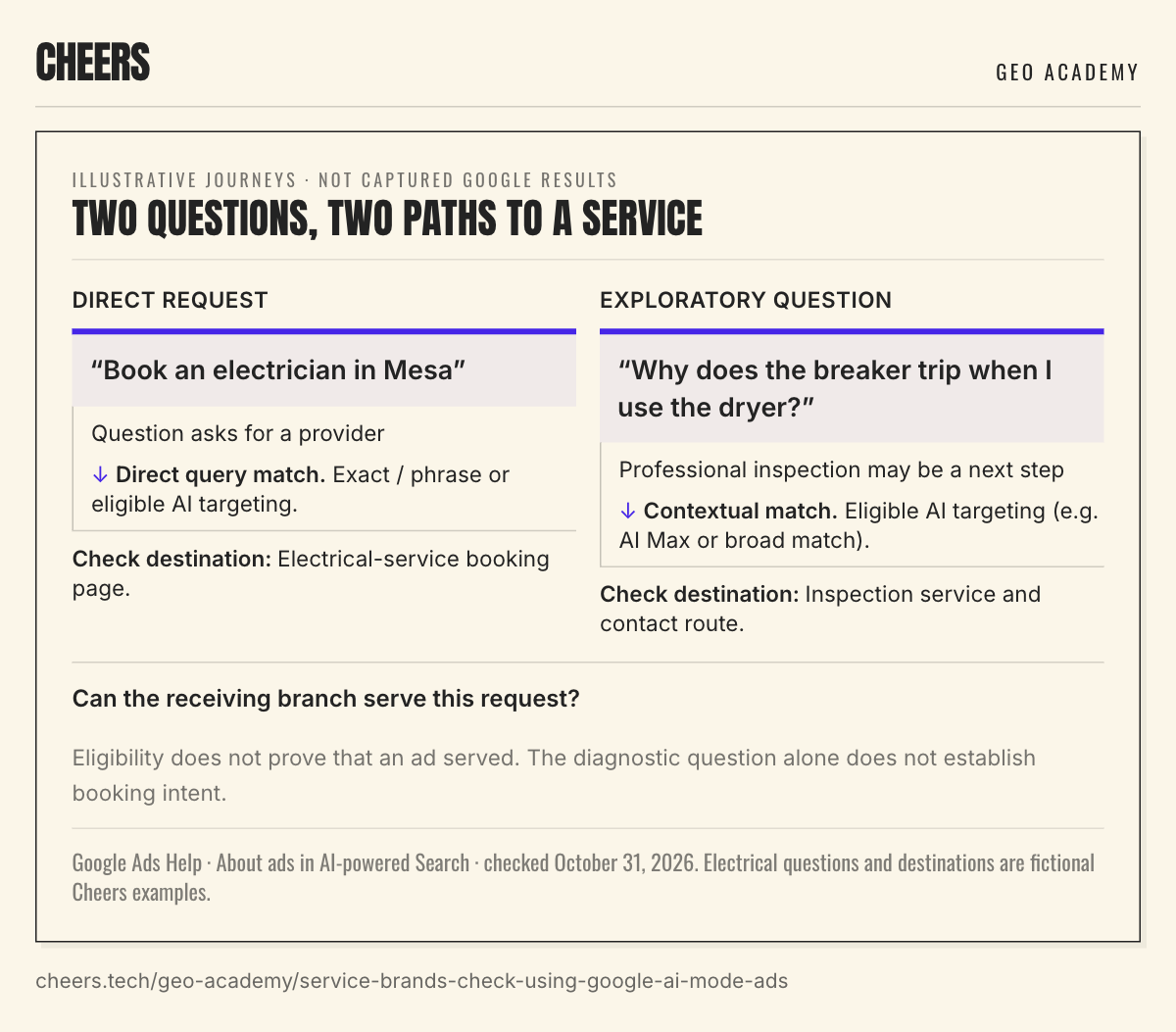
"Book an electrician in Mesa" asks for a provider directly. "Why does the breaker trip when I use the dryer?" starts with a problem; a relevant professional inspection could become a next step. In either case, the destination should describe the service the receiving branch can provide and explain how to request it. The diagnostic question alone does not prove that someone wants to book.
Open the actual landing page on a phone. Check the service and coverage beside the contact action, then send a test enquiry using the branch's normal test procedure. Confirm which team receives it and whether the selected location survives the journey into dispatch. A convincing page can still route every form to the wrong market.
Use the location-page guide for missing facts. A clear existing service page is a better starting point than duplicating it around the words AI Mode.
Count the event your branch cares about
Google's qualified and converted lead guidance separates a lead qualified in a CRM or internal system from one that completes the chosen conversion step. Your team needs to define that step. A form submission and an appointment are different events even when both appear under the heading conversions.
In this fictional campaign, the conversion action is a submitted enquiry. The CRM confirms the requested work and address are serviceable, but the customer has not chosen a time. That record should show a submitted enquiry, a qualified lead and a pending booking. Its AI Mode placement remains unknown.
Fictional example · campaign action = submitted enquiry
A conversion can still be an unbooked job
Campaign conversion
Recorded
Submitted enquiry
Google Ads action
Qualified lead
Confirmed
Service + address fit
CRM qualification
Booked appointment
Pending
No time selected
Scheduler
AI Mode placement
Unknown
No isolated placement record
Aggregate reporting
Cheers fictional reporting example · October 31, 2026. Definitions: Google Ads Help, qualified and converted leads; aggregate AI Mode reporting.
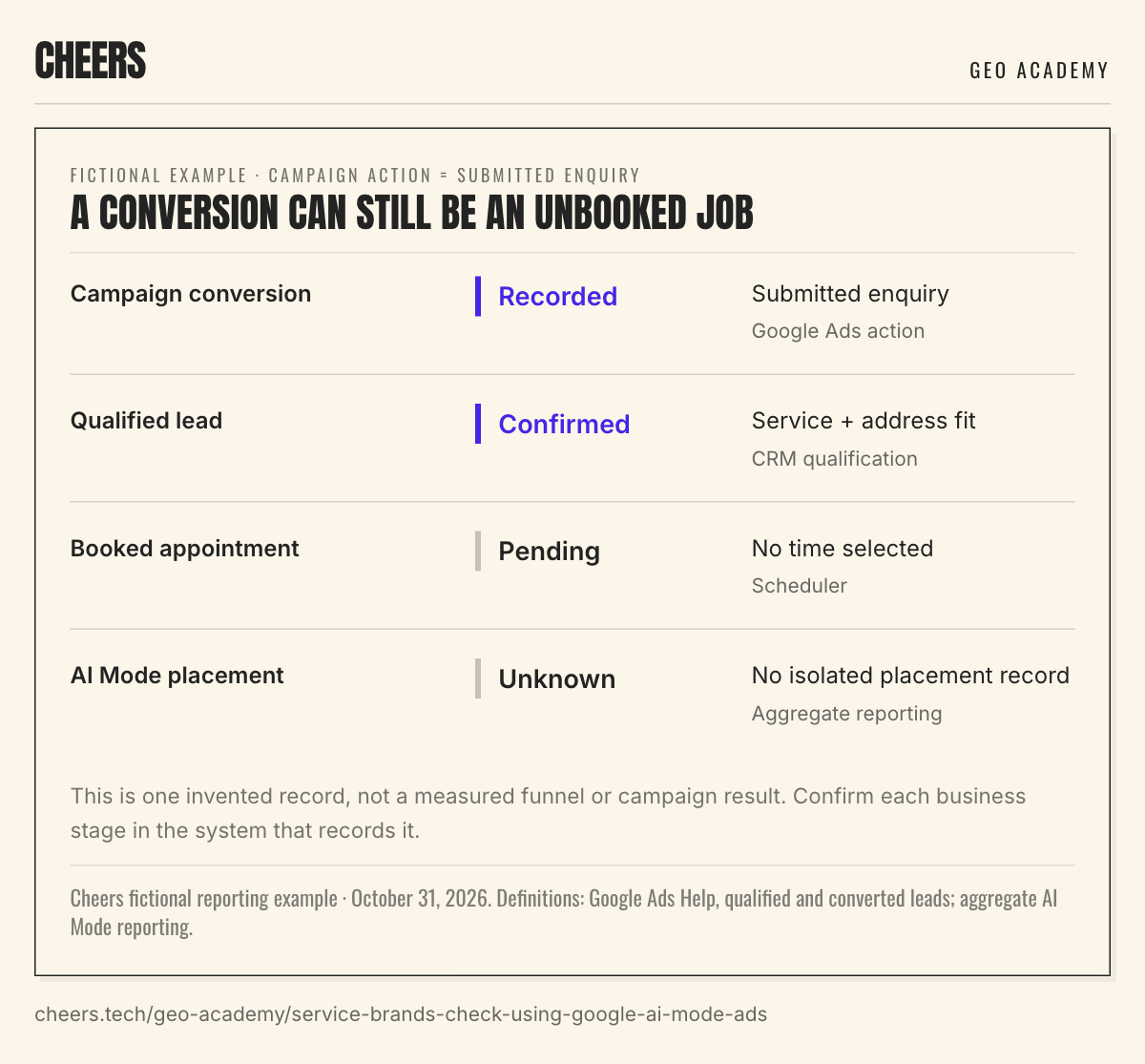
Keep those fields separate when reviewing campaign reports with branch managers. A valid phone number does not make an out-of-area request serviceable. A qualified enquiry can remain unbooked. A booked visit can later be cancelled. State which event you are reporting and which system confirms it.
Save a comparable reporting window before an approved change, with the account, campaign and conversion definition attached. Record a routing repair separately from a targeting change. A later increase could reflect either repair, demand or several causes; aggregate results cannot identify the contribution of AI Mode alone.
The AI traffic measurement guide covers the companion website record.
What the October expansion changes
In its October 28 announcement, Google named Australia, Canada, India, Kenya, Malaysia, New Zealand, Nigeria, Pakistan, the Philippines and Singapore. Its announcement also describes ads across follow-up questions in the U.S. The list is an announced expansion, not evidence that a particular branch's ad has served. Check the current market and language availability with the campaign owner.
The announcement supplies no home-services cost-per-lead or booked-job benchmark. The number of countries is not a reason to increase a portfolio budget.
Keep paid and organic results separate
Google labels these placements Sponsored and says paid advertising does not influence organic AI responses. Assess paid outcomes in the campaign record and unpaid branch recommendations in a separate visibility check.
The Google AI Search guide covers the page and profile work behind organic discovery. A sponsored placement should not be counted as an unpaid recommendation.
Finish one branch check this week
Give the campaign owner and receiving branch one shared task: trace an enquiry through the real destination and agree on the outcome definition. Save the starting settings, confirm the receiving team and reconcile the test with the branch's records.
If the route fails, assign the specific repair. If it passes, retain the result and move to the next branch. Take any proposed targeting or budget change to the campaign owner with that evidence attached. A checked route and an agreed booking definition give both teams something useful to manage.
Sources
Read October 31, 2026. This guide interprets public platform documentation. Customer journeys and branch checks are editorial examples, not measured campaign results.
- Ads in AI Mode expand to new markets. Google, October 28, 2026. Ten named additional markets and U.S. multiturn ads.
- About ads in AI-powered experiences in Google Search. Google Ads Help, no visible publication date. Eligibility, matching, controls, reporting and the separation of paid and organic answers.
- About qualified leads and converted leads. Google Ads Help, no visible publication date. Distinct lead stages and business-defined conversion steps.
Dylan Allen-Arnegård is the CEO & Co-Founder of Cheers, the local search platform for multi-location service businesses.