

A plumbing platform with 70 locations may receive 70 different Local Services Ads migration notices, but they won't arrive as one clean portfolio event. One storefront account could move in August while a service-area branch waits until later in the year; an acquired brand may still use manual bidding, and two categories can share a budget despite having different lead values. Treating all of that as one switch creates gaps before the first migrated ad serves.
Google's transition guide states the change in one sentence:
Existing Local Services Ads campaigns will be automatically migrated to a specialized Performance Max campaign type optimized specifically for pay-per-lead goals.
Last verified: September 2, 2026.
The first phase began in August 2026 for select U.S. home and storefront service advertisers. Google says service-area businesses and accounts using features such as custom bidding or booking are scheduled for later in 2026, with remaining and non-U.S. advertisers planned for 2027.
This is not a standard Performance Max launch. Google says the campaigns keep pay-per-lead billing and remain limited to Search and Maps in the same Local Services Ads positions. What changes is the control surface: budgets, settings, reporting, and lead management move into Google Ads.
Important
Run the change as an account-by-account migration. Export the old reporting baseline, assign an owner to every transferred setting, read back every customer route, and hold performance conclusions until the new record is stable.
Cheers does not manage Google Ads. If the migration exposes conflicting branch facts, review ownership gaps, or location-level source drift, use the demo action below. The campaign work stays in Google Ads; Cheers helps operators keep the local reputation and visibility record behind each market measurable.
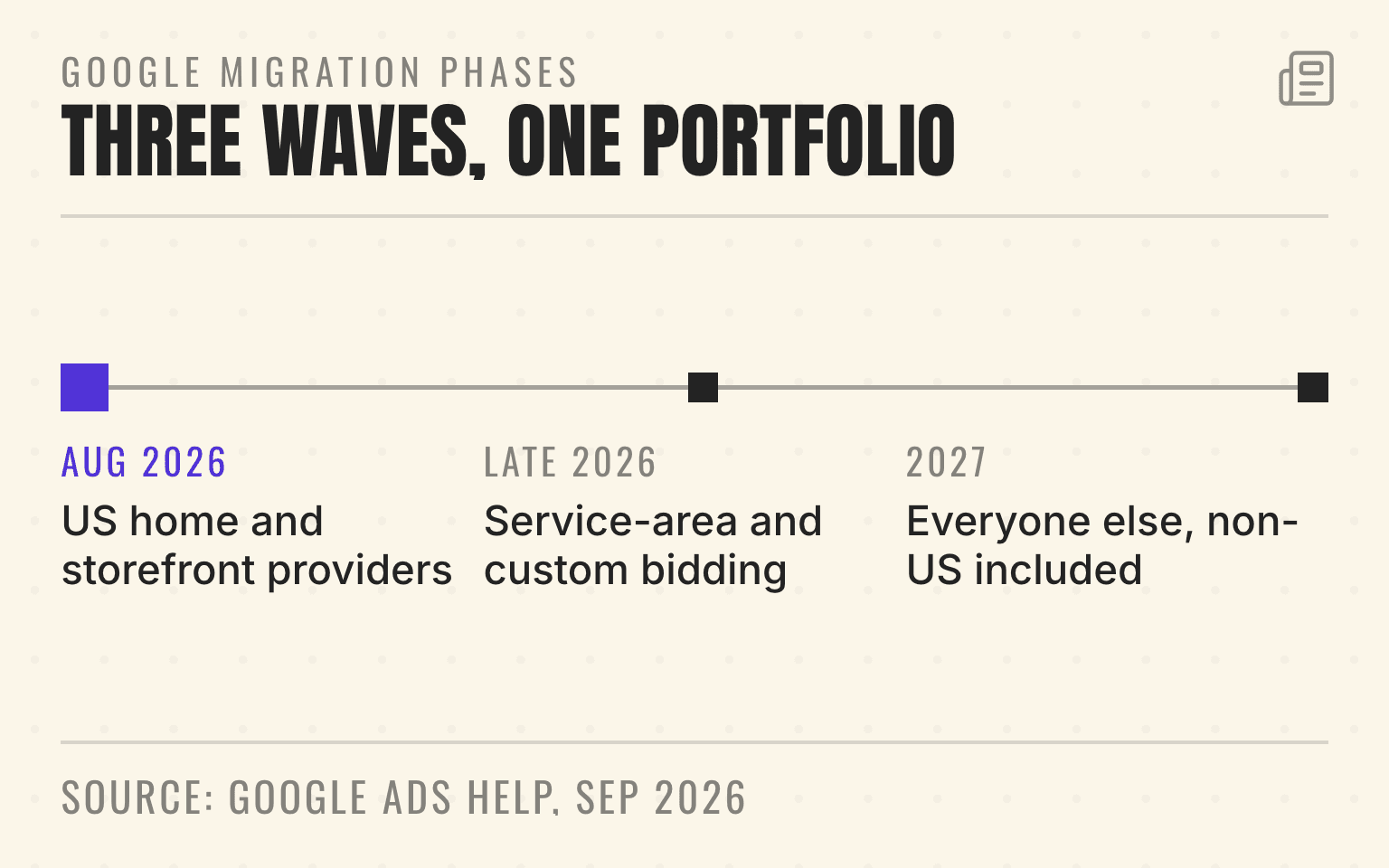
What Google is changing, and what stays the same
Google's Local Services Ads transition guide keeps the two things that made Local Services Ads different:
Your campaign remains keywordless. Your targeting is based on the service categories and areas you offer with the other settings you select.
And the billing model holds: you still only pay for valid leads such as phone calls and messages rather than ad clicks. The ad can still appear on Search and Maps.
The operating console changes. After migration, advertisers manage campaign settings, billing, leads, and performance in Google Ads instead of the Local Services Ads dashboard. Google says location targeting, service categories, budget, ad schedule, photos, and other settings transfer automatically. Verified status also carries into the migrated campaign.
Automatic transfer is useful, but it is not a control record. A 40-market roofing brand still needs to know which account moved, which settings appeared, who checked them, and whether the first lead reached the right local team.
The timing also varies by account. Google says it will send a notice 14 days before a campaign is scheduled to move, followed by another reminder seven days later. The portfolio owner should collect those notices in one queue. Do not assume every branch under the same manager account will share a date.
Why multi-location brands carry more migration risk
A single-location advertiser can compare one old account with one new campaign. A multi-location operator has to preserve relationships across account, market, brand, category, call route, profile, budget, and owner.
Mixed location types are one source of drift. Google places storefront and home-service advertisers in the first phase, while service-area businesses move later. A plumbing rollup may operate public showrooms, dispatch-only branches, and acquired companies inside the same region. The team needs a migration state for each account rather than one brand-level status.
Shared service categories create another problem. Google says manual bidding and category-level target cost per lead controls will not continue in the new campaign. Target cost per lead moves to the campaign level. Google recommends separate campaigns when an advertiser needs distinct targets for different categories. That advice matters for a company that values water-heater replacement leads differently from drain-cleaning leads.
There is a current setup constraint. Google also says advertisers cannot yet create new pay-per-lead Performance Max campaigns directly in Google Ads and should continue onboarding through Local Services Ads. Confirm the supported creation path before restructuring categories. A recommendation to separate campaigns is not permission to invent a setup path the platform does not offer.
Geographic overlap adds a third risk, and Google spells it out:
If your business has multiple locations that serve the same geographic area, Local Services will show only the highest ranking ad in response to a user's query. Migrating neighboring accounts on different dates can change what the portfolio sees without proving that one branch gained or lost demand. Preserve the account and market map before comparing outcomes.
Export the baseline before each account moves
Historical Local Services Ads performance reports do not carry into Google Ads. Google says lead history does transfer, but the old reporting baseline needs its own export.
The Local Services Ads reporting guide documents charged leads, lead type, search category, spend, lead credits, and other report fields. Save the account-level export before the migration date, along with the report period, time zone, and person who ran it. A screenshot is too weak for a portfolio comparison because it cannot be joined to the branch and campaign record later.
For manager accounts, Google offers a Local Services Ads API for scalable lead and performance reporting. Its bulk account guide also supports creating up to 100 provider accounts in one CSV. Those tools can help an operator reconcile a portfolio, but the exported identifiers still need to map to the real branch, category, and owner.
Record the old weekly budget and calculate the expected daily amount. Google says the migration divides the weekly budget by seven, then applies the Google Ads monthly spending limit using the average daily budget multiplied by 30.4. That conversion can raise the portfolio's apparent monthly ceiling above four weekly budgets. Review the total before serving starts rather than explaining it after finance sees the new cap.
Keep paid metrics separate from Business Profile actions. The Google Business Profile performance guide explains why a profile call click, website click, or direction request is not a booked job. The migration baseline should preserve charged leads and spend from Local Services Ads, then join them to connected calls, appointments, completed work, and revenue in the systems that own those outcomes.
Build one migration control record
The control record can live in a spreadsheet, database, or project tool. Its job is to make each account auditable. For every migrating provider, record the old Local Services Ads account, Google Ads customer, manager account, branch code, public brand, location type, service categories, service area, ad schedule, weekly budget, expected daily budget, target cost per lead, phone and message routes, linked Business Profile, migration date, primary owner, and verification state.
Access deserves a separate read. Google's Local Services Ads access guidance distinguishes account access levels and manager-account access. A person who could manage the old account may not have the right Google Ads role after the transfer. Confirm the manager, admin, billing, and operating owners before the notice window closes. The Google Business Profile access standard covers the companion profile-side controls.
Don't collapse all providers into a national marketing account without preserving local accountability. Central marketing can own the standard and migration queue; paid media and finance can verify campaign settings and the new budget view. Operations must check category coverage, schedules, and lead routing, while a local or regional owner reads back the customer experience for the branch.
Next step
Is AI recommending your business?
Find out how visible you are across ChatGPT, Gemini, Perplexity, and AI Overviews.
Read back every transferred setting on day one
Google says the campaign transfers location targeting, service categories, budget, ad schedule, photos, business information, and verification status. Day-one verification should test each of those claims against the pre-migration record.
Start with category and service-area accuracy. An appliance-repair provider should not inherit a category it stopped staffing. A pest-control branch should not promise a county it no longer serves. A moving company should not share a target cost per lead with a category that has a different close rate unless leadership chose that tradeoff.
Then test every lead route. Place a controlled call or message through the customer-facing path, record the displayed number, confirm the receiving queue, and verify the branch that can book the job. If the campaign uses a tracking number, compare it with the location's stable public route using the multi-location call tracking guide.
Inspect the linked Business Profile too. Google says migrated campaigns sync key business details with the profile. Significant changes to the name, address, or primary category can trigger review and may pause serving for 24 to 48 hours. Photos and service areas can still require separate management. Do not use migration day to bundle unrelated profile edits into the same change window.
Finally, inspect the customer view. A saved setting is not proof that the right ad, profile, phone path, and service promise appear together. Capture the date, market, query context, visible business, and route result. Escalate mismatches while the old export and notice are still close at hand.
Treat pay-per-lead Performance Max as its own campaign type
The name can invite the wrong comparison. Standard Performance Max campaigns may span several Google properties and optimize toward conversion values or actions. Google's Local Services Ads migration guide says this version keeps pay-per-lead billing and serves only on Search and Maps in the Local Services Ads positions.
That boundary should shape reporting. Do not blend migrated lead volume with click-priced paid search and call the total Performance Max. Keep the pay-per-lead campaign identified by provider, location, category, and migration cohort. Preserve charged lead, credit, connected-call, booking, completed-job, and revenue definitions.
The profile still matters. Google lists proximity, review score and count, responsiveness, business hours, verification, and profile quality among Local Services Ads ranking considerations, and says all provider listings are displayed and ranked based on an auction where the highest ranked ads show first. The migration does not turn reputation or branch accuracy into paid-media settings. It makes those inputs easier to overlook when the operator is staring at a Google Ads screen.
The organic side of the same market keeps moving while this happens. Across the Cheers panel of 13 home-services companies, leaving out questions that name the company itself, the weekly pooled appearance rate in AI answers moved between 32.2% in the week of August 3, 2026 and 26.9% in the week of August 10, a 5.3-point swing in one week, aggregate only. The panel grew from 12 to 13 companies over those weeks and the prompt sets changed, so read it as a shape, not a direction. A paid migration is a poor moment to also lose track of that number. The cuts are in AI visibility statistics, with the sampling rules in the methodology.
For current photo rules, use the Local Services Ads real-photo workflow. An image that transfers successfully may still need a policy, provenance, and branch-accuracy review. For the AI-format side of the same Google announcements, see How Google AI Mode Changes Local Leads.
Use the first two weeks as a comparability bridge
Google tells advertisers to allow "up to two weeks for the migration process to fully complete and for your campaign performance to ramp back to stable levels". Use that window as a comparability bridge, not as a verdict on whether the new campaign won.
Google migration phases
Three waves, one portfolio
2 wks
To stabilize
August 2026
Wave 1
Select US home and storefront service providers move first
Later in 2026
Wave 2
Service-area businesses and accounts using custom bidding or booking
2027
Wave 3
Remaining advertisers and non-US accounts
Google Ads Help: Local Services Ads transition to Performance Max campaigns with pay-per-lead goals, checked September 2, 2026. Phase timing is Google's published plan and can change.
| Date | Event |
|---|---|
| August 2026 | Wave 1 (Select US home and storefront service providers move first) |
| Later in 2026 | Wave 2 (Service-area businesses and accounts using custom bidding or booking) |
| 2027 | Wave 3 (Remaining advertisers and non-US accounts) |
Watch delivery, charged leads, lead type, cost per charged lead, answer rate, qualified calls, booked jobs, completed revenue, and credits by account. From October 1, 2026, answer rate moves spend as well, because Google charges some missed Local Services Ads calls as leads once the caller has waited more than 20 seconds. Compare those outcomes with the old Local Services Ads baseline and the correct day-of-week pattern. Mark any days affected by profile review, paused service, route failure, budget correction, or staffing constraints.
Do not treat a lead dip as a platform result until the account is comparable. A budget that transferred incorrectly, a category that disappeared, an unanswered call, or a paused Business Profile can all change the result. The operating record should explain those exceptions before leadership changes the bid target or reallocates spend.
Once the first two weeks are clean, compare cohorts. Storefront accounts that moved in August should be evaluated against similar storefront accounts, not service-area businesses that have not migrated. A portfolio can then expand its control standard from the first cohort to later 2026 and 2027 accounts.
A 30-day migration operating plan
- Fourteen days before migration: Capture the Google notice, export Local Services Ads reports, confirm access, save every active setting, map the account to its branch, and calculate the expected daily budget.
- Seven days before migration: Resolve missing owners, unsupported category plans, profile conflicts, phone routes, billing access, and regional overlap. Freeze unrelated account and profile changes.
- Migration day: Read back categories, coverage, schedule, daily budget, target cost per lead, photos, Business Profile, and every customer lead route. Record exceptions and owners.
- The first two weeks: Monitor delivery and lead outcomes without declaring a winner. Annotate route failures, profile review, staffing constraints, credits, and budget changes.
- The rest of the first month: Compare stable cohorts with the exported baseline, approve category or budget changes, document what later accounts should inherit, and schedule the next migration review.
The useful output is not a green migration status. It is a portfolio record that shows what moved, what the customer saw, who verified it, and which outcome can be compared with the old channel.
Sources
Every link below was opened and checked on September 2, 2026.
- Local Services Ads transition to Performance Max campaigns with pay-per-lead goals. Google Ads Help. Migration phases starting August 2026, the keywordless and pay-per-lead guarantees, transferred settings, profile sync, and the two-week stabilization guidance.
- View reports. Google Local Services Ads Help. Lead and performance report fields plus manager-account API reporting.
- Create multiple accounts. Google Local Services Ads Help. Bulk provider creation, up to 100 accounts per CSV.
- Access levels and manager accounts. Google Local Services Ads Help. Account roles, manager access, and billing separation.
- About ad rankings. Google Local Services Ads Help. The auction, profile quality, responsiveness, proximity, and the highest-ranking-ad rule for overlapping locations.
- Business Profile details. Google Local Services Ads Help. Profile synchronization rules and field boundaries.
- Cheers panel, 28 days ending September 2, 2026. 13 home-services companies, non-branded prompts, weekly pooled appearance rates from the week of July 20 (earlier weeks are not used because of an enrichment defect), aggregate only (corrected September 28, 2026). Methodology.
Dylan Allen-Arnegård is the CEO & Co-Founder of Cheers, the local search platform for multi-location service businesses.