

Google's Business Profile guidelines settle the first question for you: "The phone number must be under the direct control of the business." A rented number from a call-tracking pool that the vendor can reclaim is not that. Everything else about call tracking for AI search follows from whether your public number passes that test.
Call tracking is useful because home service demand still turns into phone calls. A buyer may find a plumbing branch in Google, read a location page, ask ChatGPT or Perplexity who to hire, then call instead of filling out a form. Marketing needs attribution. Operations needs the call to reach the right branch. Search systems need public sources that agree.
The risk starts when those goals are handled by different teams. Google Business Profile shows one number. The location page swaps in another. LocalBusiness schema emits a third. Citations still show the old acquired brand. The call center routes the customer to a national queue that cannot actually serve the market.
Important
Use call tracking to measure demand, not to fragment the public identity of a location. The number customers, Google, citations, schema, and AI-search sources see should resolve to the same real branch or service area.
The short answer
Home service brands can use call tracking numbers for AI search as long as one location's public source stack stays coherent.
For a multi-location HVAC, plumbing, electrical, pest control, roofing, restoration, garage door, or med spa brand, the safe pattern is one stable customer-facing number for each location or service area. That number should appear consistently on the Google Business Profile, location page, citations, and LocalBusiness structured data unless there is a deliberate, documented reason to vary it.
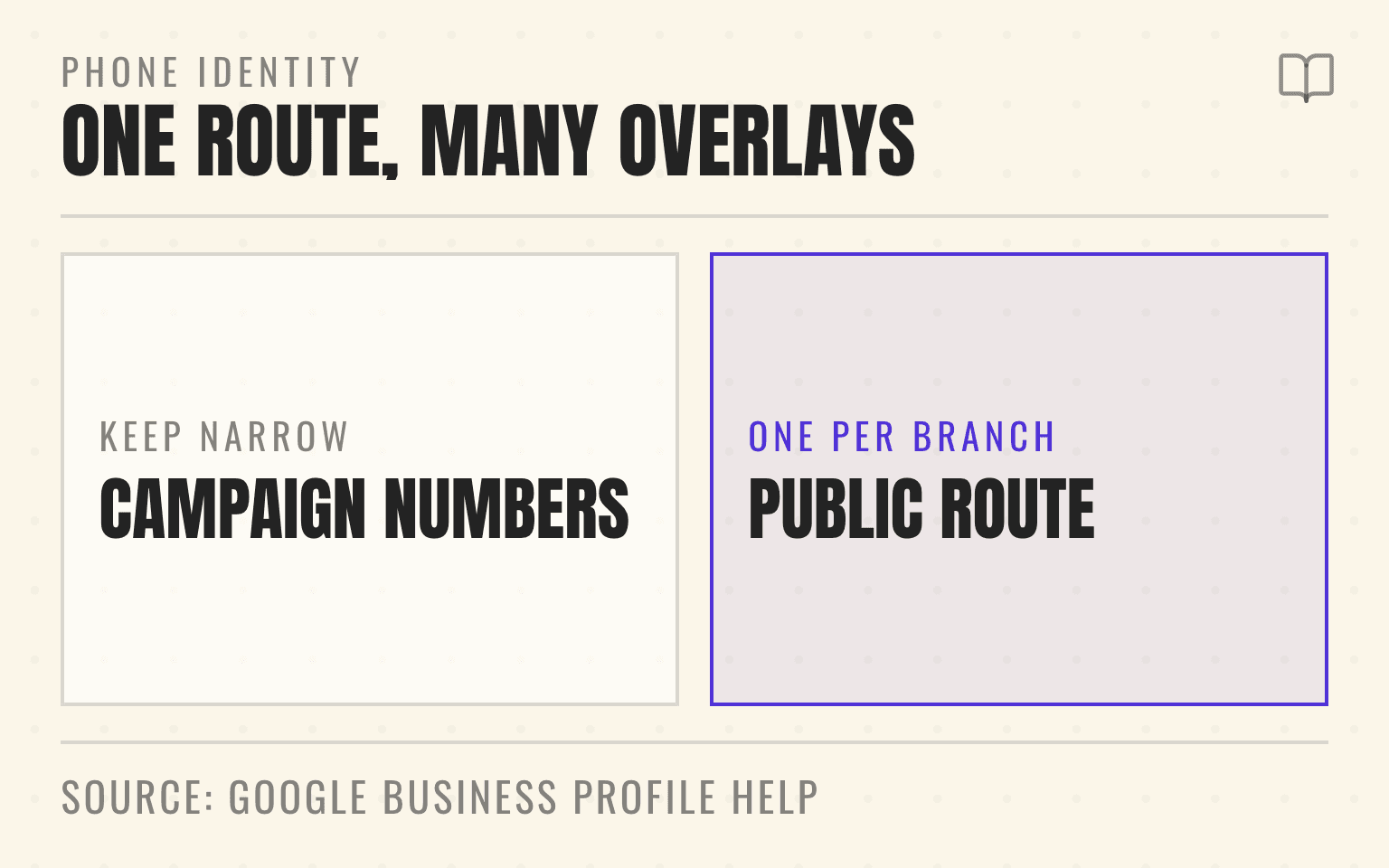
Tracking can still happen. It can happen through a ported main number, a stable profile number that the business owns and controls, campaign-specific numbers that are kept out of permanent local citations, or dynamic number insertion on the website. The operating rule is that every tracking number must route to the same customer promise the public source makes.
If your team is not sure which number AI systems see for each market, start with a recurring AI visibility check and compare the cited sources against your real call routes.
Why AI search makes phone drift more visible
AI search does not make phone-number consistency a new problem. It makes the old problem easier to expose.
Google says its generative AI features rely on normal Search foundations and that site owners should focus on useful, crawlable, public content. For local businesses, that means the sources a customer can inspect still matter: Google Business Profile, location pages, service pages, citations, reviews, photos, schema, and the actual booking or call path.
OpenAI also documents separate crawlers for different jobs, including OAI-SearchBot for surfacing and linking websites in ChatGPT search features. That does not mean a tracking number directly controls whether a brand appears in ChatGPT. It means public pages and sources can be retrieved, summarized, or cited. If those sources disagree about how to reach the business, the answer may inherit that confusion.
For a 70-location garage door brand, that matters in practical ways. A branch page might rank for "garage door spring repair in Plano," but an AI answer may cite a directory with an old acquisition number. A Google Business Profile might show a tracking number that routes correctly during business hours but fails after 6 p.m. A location page might show a dynamic website number to one visitor while schema still publishes a different number.
The buyer does not care which system created the mismatch. They only know whether the call reaches the right team.
There is a measurable reason the profile cannot carry this alone. In the Cheers Market Baseline over the 28 days ending September 2, 2026, we classified 356,019 citations from 32 home-services prompts run in 100 metro service areas on four engines. Google properties were 11.4% of citations inside Google AI Mode, but 0.2% on ChatGPT, 0.1% on Perplexity, and 0.0% on Gemini. Outside Google AI Mode, the linkable record an assistant hands a buyer is your own page or a directory profile, not your Business Profile. Whatever number those carry is the number that gets dialed. Per-engine detail is in the home-services AI visibility index, with domain classification in the methodology.
Cheers Market Baseline
Off Google, no Google links
Share of citations pointing at google.com, by engine
99,904 citations
70,723 citations
144,036 citations
41,356 citations
Cheers Market Baseline, 28 days ending September 2, 2026: 32 home-services prompts in 100 metro service areas on four engines, 356,019 classified citations. Method at cheers.tech/research/methodology.
| Engine | Google-domain share of citations |
|---|---|
| Google AI Mode | 11.4% (99,904 citations) |
| ChatGPT | 0.2% (70,723 citations) |
| Perplexity | 0.1% (144,036 citations) |
| Gemini | 0% (41,356 citations) |
What Google asks the public number to do
Google Business Profile guidelines are plain about the customer job of a phone number:
Use a local phone number instead of a central call center helpline number whenever possible.
The same page adds two rules that matter more for call tracking than most attribution debates: provide a number that connects to your individual business location, and "Do not provide phone numbers or URLs that redirect or 'refer' users to landing pages or phone numbers other than those of the actual business." Additional numbers are allowed on Business Profile websites and other local surfaces, and premium-rate numbers are not acceptable at all.
For chains and multi-location brands, that creates a practical hierarchy. The primary profile number should be the most reliable customer route for that location. Additional numbers can help when the business needs alternate routes, but they should not turn one branch into a maze of campaign numbers.
Google's LocalBusiness structured data guidance also supports phone numbers as visible business facts. The telephone value should describe the business customers can read about on the page. It should not quietly point to a tracking destination that the visible page, profile, and citations do not support.
This is why call tracking belongs inside the location source architecture. If the phone path is part of the local entity, it belongs in the same audit as name, address, service area, hours, URL, profile links, reviews, and citations. Is Google Business Profile enough for AI visibility? explains why the profile needs that supporting source graph.
Where call tracking creates source conflict
Call tracking usually creates trouble in four places.
The first is permanent citations. If Yelp, BBB, Angi, Apple Maps, Bing Places, the website, and the Google Business Profile all show different phone numbers for one branch, the business has made entity resolution harder. Search systems and customers have to decide which number is current. A citation cleanup process should treat phone numbers as a core field, not as a campaign setting.
The second is location-page templates. Many brands use dynamic number insertion on the site, then forget that crawlers, cached pages, page source, schema, and returning visitors may not all see the same state. If the default HTML shows a number, that default should still be a valid customer-facing route.
The third is acquisitions and rebrands. A rollup may inherit old numbers, port some numbers, launch new tracking pools, and update profiles at different times. If the old brand number stays live in citations while the new location page shows a national tracking number, the business may still receive calls, but the public identity is split. How home service rollups should handle rebrands for AI search covers that transition in more detail.
The fourth is dispatch reality. A tracking number can look correct on the page and still fail the customer if it routes to the wrong market, the wrong after-hours queue, or a sales team that cannot schedule the service. For emergency, seasonal, or service-area work, the phone path is part of the promise. Where home service brands should publish emergency hours for AI search is the companion article for that problem, and the response-time publishing standard covers same-day, arrival-window, and dispatch-speed claims.
Next step
Is AI recommending your business?
Find out how visible you are across ChatGPT, Gemini, Perplexity, and AI Overviews.
The safer architecture
The safest call tracking architecture starts with the real location, then adds attribution.
One branch or service-area team should have one canonical public route. That route can be a native local number, a ported tracking number that the business owns, or a stable call tracking number that functions as the business line. The important test is whether the number can live across the profile, page, citations, schema, and customer service workflow without misleading anyone.
Campaign numbers should have narrower jobs. Paid search landing pages, offline mailers, radio, LSAs, franchise development campaigns, and local promotions can use dedicated numbers when the team knows where they are published, how they route, and when they should be retired. Those numbers should not leak into permanent local citations unless they are meant to become the stable public number for that location.
During the Local Services Ads Performance Max migration, test each transferred phone and message route against the branch record before comparing lead performance.
Dynamic number insertion can be useful on the website because it attributes a session without asking every public source to change. The technique assigns a number to a traffic source and swaps it in for visitors from that source, which lets marketing separate calls from paid search, organic search, directories, and campaigns.
The local-search guardrail is that the default source still matters. The un-swapped page, structured data, profile, and citations should expose a stable route. Dynamic number insertion should not create a different business identity for each visitor.
What to audit by location
Use this audit when call tracking providers change, an acquisition closes, a branch moves, or a high-value market starts showing inconsistent AI answers.
- Export the current public number for each location from Google Business Profile, the location page, LocalBusiness schema, top citations, paid landing pages, and the call tracking platform.
- Label each number as canonical public, additional profile, dynamic website pool, paid campaign, offline campaign, destination, retired, or unknown.
- Confirm ownership and portability for any number that appears in permanent public sources.
- Test routing during normal hours and after hours for priority services.
- Compare the number shown to customers with the number emitted in structured data and default page HTML.
- Remove retired campaign numbers from citations, profile fields, old landing pages, and partner pages.
- Add an owner and review date for each mismatch instead of leaving the cleanup inside a spreadsheet.
This is a technical and operational audit. Operations has to verify where the call goes. Marketing has to verify where the number appears. Development has to verify the default page and schema. Local managers have to confirm that the phone path matches how the branch actually handles demand.
How to decide which number goes where
Use the customer job as the deciding rule.
Google Business Profile should usually use the number that reaches the location or service-area team most directly. If the business uses a tracking number there, make it stable, owned, and operationally equivalent to the branch's public line. Do not rotate profile numbers as if the profile were an ad campaign.
The location page should show a number that matches the page's promise. If the page represents a branch, the number should reach that branch or its proper dispatch route. If the page represents a service area, the number should reach a team that can serve that area. For a deeper page standard, use what location pages should include for AI search.
Structured data should mirror the visible page. If LocalBusiness schema says one telephone number while the visible page shows another, the team should be able to explain why. In most cases, that is a bug.
Citations should use the stable public number. Campaign numbers should not spread through citation networks unless the team is prepared to maintain them as long-term business identifiers. The citation stack for AI search covers the broader cleanup order.
Analytics should preserve attribution without breaking the source graph. How local service brands should track AI search traffic explains how to separate visibility, cited sources, referral sessions, calls, forms, and booked demand.
The standard to use
Call tracking can support AI visibility. Messy call tracking weakens it.
A home service brand should be able to answer five questions for every priority location: which number is the public route, which numbers are tracking overlays, which numbers are campaign-only, which number appears in structured data, and which route actually reaches the team that can serve the job.
If those answers are clear, call tracking helps the business measure demand without weakening local identity. If those answers are unclear, the next fix is not another campaign number. It is a location-level phone source audit, and across a portfolio that sits inside multi-location local SEO rather than inside the ad platform.
Sources
Every link below was opened and checked on September 2, 2026.
- Guidelines for representing your business on Google. Google Business Profile Help. Undated help page, checked September 2, 2026. support.google.com/business/answer/3038177. Source of the quoted direct-control rule, the local-number preference, and the prohibition on numbers that redirect or refer users elsewhere.
- Google's guide to optimizing for generative AI features on Google Search. Google Search Central. Last updated July 10, 2026, checked September 2, 2026. developers.google.com/search/docs/fundamentals/ai-optimization-guide. Supports the point that AI Search visibility depends on normal Search foundations, useful public content, crawlability, and current business details.
- Local business structured data. Google Search Central. Checked September 2, 2026. developers.google.com/search/docs/appearance/structured-data/local-business. Supports the recommendation that telephone, URL, address, hours, and related local facts match visible page content.
- Overview of OpenAI crawlers. OpenAI Platform documentation. Checked September 2, 2026. platform.openai.com/docs/bots. Supports the distinction between OAI-SearchBot for ChatGPT search features and other OpenAI crawling or user-triggered agents.
- Home Services AI Visibility Index 2026. Cheers Research. Market Baseline citation pull, 28 days ending September 2, 2026. cheers.tech/research/home-services-ai-visibility-index-2026. Source of the per-engine Google citation shares.
Last verified: September 2, 2026.
Amadeus Peterson is the CTO & Co-Founder of Cheers, the local search platform for multi-location service businesses.