

Google Search Central says local businesses should keep Business Profile information current for AI search, but it also says AI features rely on normal Search foundations. That guidance was updated July 10, 2026.
Last verified: September 2, 2026.
Google's documentation says:
Don't just recycle what others on the internet have already said, or could easily be produced by a generative AI model.
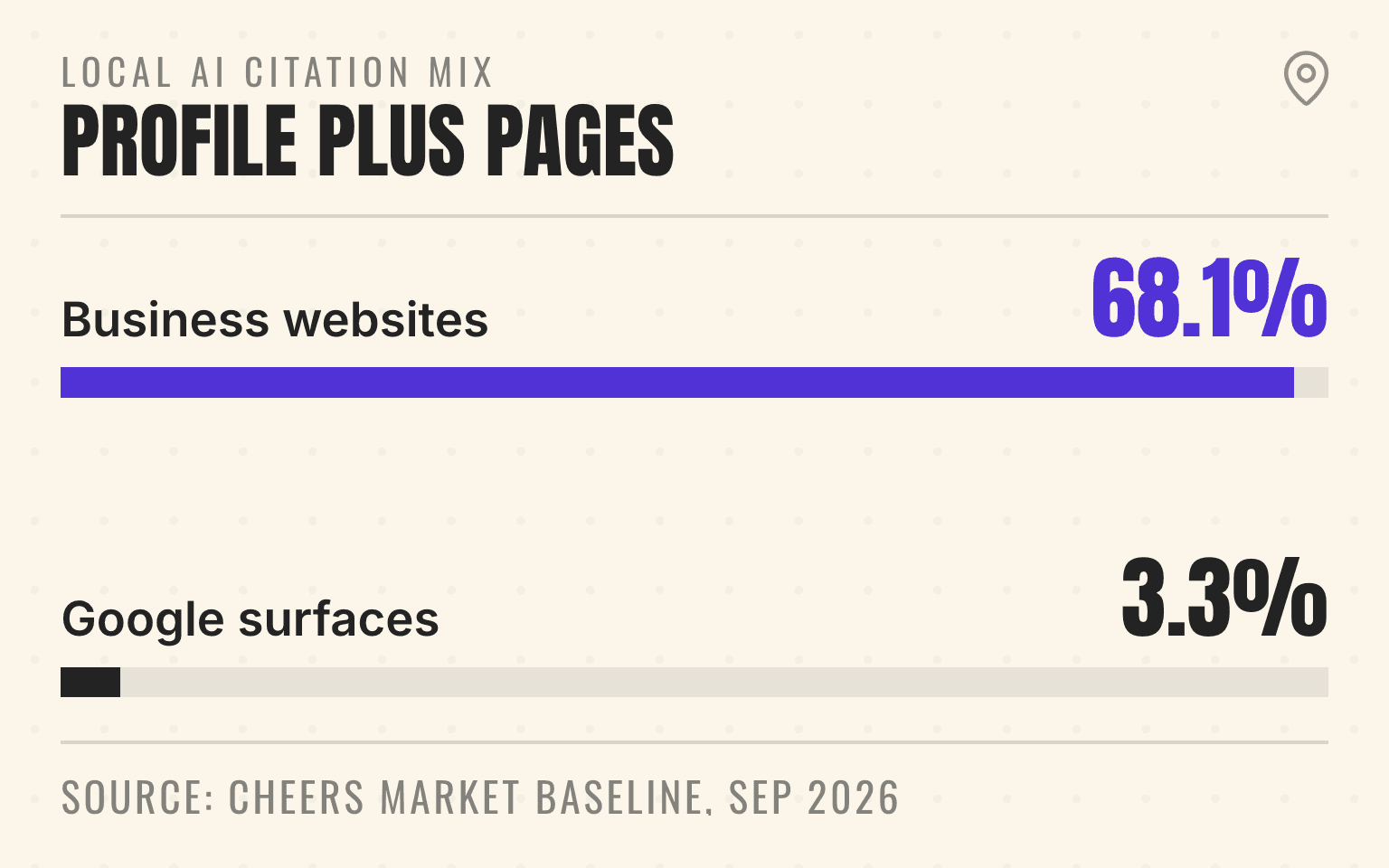
Local AI citation mix
The profile needs an owned source stack
Pooled citation share in the Cheers Market Baseline
Pooled share of citations
Pooled share of citations
Cheers Market Baseline, 28 days ending September 2, 2026; 100 metros, four engines, 49,677 runs, 356,019 citations, aggregate only (corrected September 23, 2026).
| Source class | Pooled citation share |
|---|---|
| Business websites | 68.1% (Pooled share of citations) |
| Google surfaces | 3.3% (Pooled share of citations) |
But a complete profile is not the same thing as AI visibility.
For multi-location service brands, the better question is whether each Google Business Profile is backed by specific proof. A profile can say "AC repair," but the branch page should mention AC repair in that market, reviews should mention the service or city, and citations should point to the same branch and phone path.
Important
Use GBP to anchor identity. Use the location page, reviews, citations, and structured data to prove service, market, and contact facts.
Start with the profile, then verify the graph
Google Business Profile is not enough by itself. It is the owner-controlled place to maintain category, hours, address or service area, phone, services, photos, and reviews on Google surfaces. Google explicitly tells businesses to keep Business Profile information up to date for AI features in Search. Google also says AI Overviews and AI Mode rely on the same Search fundamentals: indexed pages, crawlable content, internal links, visible text, page experience, and structured data that matches the page.
Start with the fields that drift: primary category, additional categories, service area or address, hours, phone, services, website URL, photos, and review recency. Then check whether the linked page says the same thing. When service availability varies by branch, use what services multi-location brands should list in Google Business Profile to keep the profile tied to real operations. For profile fields that change more often, add governance for Google Business Profile Posts, Google Business Profile Q&A, and coupon or offer terms.
Some customer-facing facts do not fit cleanly inside profile fields. When they vary by branch, govern response-time promises, accepted payment methods, and equipment-brand support on the service or location page that can state the conditions, then keep the profile from contradicting that source.
Cheers' Market Baseline makes the gap measurable. Business websites supplied 68.1% of pooled citations, while Google surfaces supplied 3.3%, across 49,677 local-intent runs and 356,019 citations. That does not diminish the profile. It shows why the profile needs a strong owned source stack around it. Cheers Market Baseline, 28 days ending September 2, 2026, 100 metros, four engines, aggregate only. Read the methodology.
Once the profile is accurate, the multi-location Business Profile performance guide shows how to read discovery and action metrics without treating call clicks, website clicks, or directions as completed leads.
If your team needs the broader Google-specific guide, start with How local businesses can show up in Google AI Search. For the product-level distinction between Gemini Apps, Ask Maps, Google AI Search, and Maps-grounded applications, use How do I get my business recommended by Gemini?. This article focuses on the profile question: what Google Business Profile can do, where it stops, and how multi-location operators should govern it.
Why the profile still matters
Google says local results are mainly based on relevance, distance, and prominence. A complete Business Profile helps Google understand what the business does, where it operates, and when customers can reach it. Google also says review count and rating can factor into local ranking, while profile completeness, verification, hours, photos, and review responses all help customers evaluate the business.
For a service brand, those are not small details. They describe whether the location is a real match for the job.
An HVAC branch in Phoenix should not look identical to a plumbing branch in Dallas. A med spa franchise should not hide service differences behind one corporate profile template. A restoration company should not let one branch say "water damage restoration" on the profile while the matching location page only talks about the parent brand.
Google also explains that Business Profile information can come from business owners, publicly available web content, licensed third-party data, user contributions, reviews, photos, and Google's own interactions with the place. That is the point operators often miss. Google can reconcile owner fields with crawled pages, third-party data, user edits, reviews, and photos, so mismatches become profile risk. If the mismatch is two public records for one branch, start with how multi-location brands should fix duplicate Google Business Profiles.
Where Business Profile stops
A Google Business Profile can explain a branch, but it cannot carry every local proof point.
It usually cannot show the full service-area logic behind a 70-location rollup. It cannot explain why one branch handles emergency plumbing while another branch handles only scheduled installation. It cannot turn weak location pages into strong pages. It cannot fix citations that disagree with the profile. It cannot make reviews describe the services customers actually ask about.
If the profile issue is really a coverage issue, use How service-area businesses should show coverage for AI search to decide whether the profile, page, citations, reviews, and schema agree by market.
It also should not be treated as a universal source for every AI system. OpenAI's ChatGPT search documentation says ChatGPT can search the web and provide answers with links to relevant web sources. That does not mean a Google profile is ignored. It means operators should avoid relying on one platform-owned listing when AI tools can retrieve and compare multiple public sources.
This is why What Sources Do ChatGPT, Gemini, and Perplexity Use for Local Businesses? matters. A branch can look clean in Google and still have risk elsewhere: an old directory page visible in Bing, a stale Yelp profile, or a thin branch page that gives another answer less to verify. The same local facts need to hold up across those sources.
It also matters because Google AI Mode can use query fan-out to inspect several pieces of evidence behind one local question. What query fan-out means in Google AI Mode explains the retrieval mechanism behind that source pressure.
Next step
Is AI recommending your business?
Find out how visible you are across ChatGPT, Gemini, Perplexity, and AI Overviews.
The idea in one picture
Your profile is one part of the picture.
Customers can find your business through several sources. Check the pages and listings beyond Google, too.
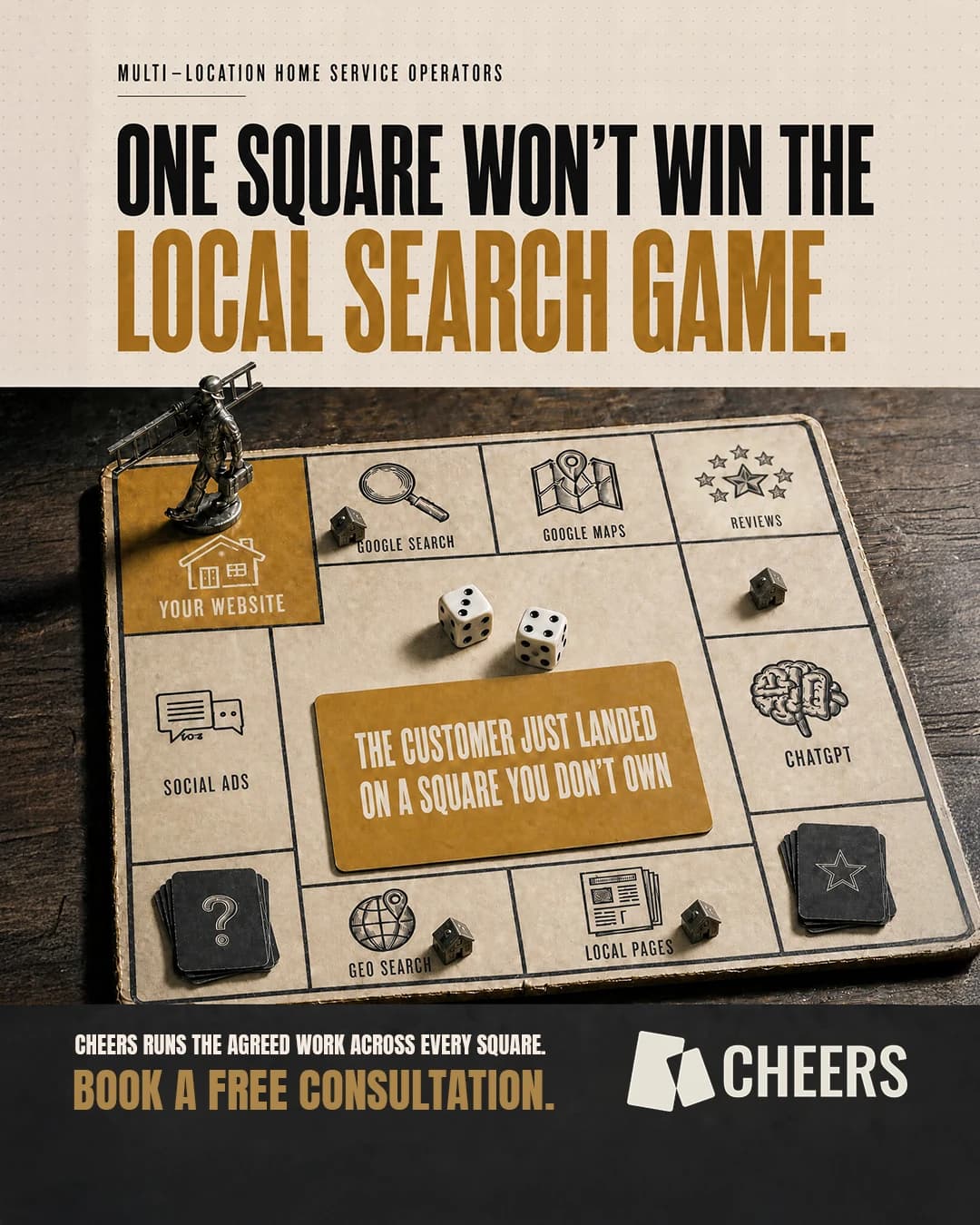
Multi-location home service operators. One square won't win the local search game. Your website. Google Search. Google Maps. Reviews. ChatGPT. Local pages. GEO search. Social ads. The customer just landed on a square you don't own. Cheers runs the agreed work across every square. Book a free consultation.
Audit the profile against the artifacts around it
Open the Google Business Profile and the matching URL side by side. The name, phone number, hours, service area, categories, service list, and booking path should match.
Then read a review sample from the last 60 to 90 days. Look for recency, service keyword, city or neighborhood, technician or team mention, response time, and outcome. A profile for "emergency AC repair" is weaker when recent reviews only mention maintenance or generic praise.
Then check top citations: Yelp, BBB, Apple Maps, Bing Places, Facebook, and the vertical directories that appear for the market. Finally, inspect the schema block on the location page and verify that it reinforces visible facts instead of adding hidden claims.
That is how a brand avoids source conflict. If Google Business Profile says one thing, the website says another, and Yelp or BBB says a third, an AI answer has less reason to treat that branch as a clean recommendation.
The page side of this work is covered in What should location pages include for AI search?. The citation side is covered in Which citations matter for AI search?.
Make GBP changes visible on the page
The high-performing Google AI Search guide works because it translates official guidance into local operating work. Apply the same rule here: every meaningful profile edit should have a page-side check.
If the Business Profile adds "emergency AC repair," the linked branch page should explain emergency AC repair in that market. If the profile changes service areas, the market page should show the same coverage rule. If photos are updated on the profile, the page should not still rely on old stock photos or a generic corporate image.
The profile is the anchor. The page is where the customer can inspect the claim.
What to govern across many locations
For one storefront, profile cleanup can be a short project. For a 120-location service brand, it has to become governance.
Start with the fields that create local identity: business name, primary category, additional categories, address or service area, hours, phone number, website URL, services, attributes, photos, and review response ownership. Then compare those fields against the matching location page and against the sources that appear for priority service queries.
Google's guidelines for chains say locations that provide the same service should generally maintain consistent names and categories. That matters for rollups and franchise systems because acquisition history often leaves behind mismatched names, outdated categories, inherited phone numbers, and service-area claims that no longer match operations.
Every profile should match the real branch. If one branch offers drain cleaning and sewer repair, the profile and page should say that. If another branch handles HVAC maintenance only, remove inherited plumbing services from the parent template.
For review operations, use How to collect reviews at point of service to connect profile quality with frontline execution. Watch recency, service terms, city or neighborhood, technician or team mentions, response time, and outcome language.
What to avoid
Do not stuff profile descriptions with keywords. Google's profile guidelines tell businesses to be upfront, honest, relevant, and useful, and they prohibit low-quality or irrelevant content. A profile description should describe the real business, not repeat every city and service variation. If Google offers to draft the field, use the multi-location AI description review process before publishing it.
Do not add services the branch does not provide. Google's service editor lets service businesses organize services, add descriptions, and create custom services when needed, but the service list should still match what the location can sell and deliver.
Do not use a profile as a substitute for a location page. Google AI features can show supporting links from indexed pages, and those pages need enough visible text and internal links to be eligible and useful. A strong profile should point to a page that helps the customer decide, not a thin corporate page with a phone number.
Do not hide service-area complexity. Google tells service-area businesses to be specific and accurate, with service areas set by city, postal code, or another area type, not by a radius. For a hidden-address service-area business, a bad pattern looks like this: GBP lists ZIPs the branch will not dispatch to, a city page claims the whole metro, and an old citation still shows a former office address.
What to inspect first
Pick one branch and one service. Compare GBP against the matching page, the last review sample, the top third-party results, and the schema block. Fix the first contradiction before adding new content.
If the answer depends only on Google Business Profile, the branch is under-supported. If GBP, page, reviews, citations, schema, and third-party mentions agree, mark the branch as supported. If one artifact disagrees, assign that artifact to an owner before publishing more content.
Sources
- AI features and your website, Google Search Central, July 2026. Checked September 2, 2026.
- Tips to improve your local ranking, Google Business Profile Help, no publication date. Checked September 2, 2026.
- How Google sources and uses business information, Google Business Profile Help, no publication date. Checked September 2, 2026.
- Guidelines for representing your business on Google, Google Business Profile Help, no publication date. Checked September 2, 2026.
- Manage your services, Google Business Profile Help, no publication date. Checked September 2, 2026.
- Manage your service areas, Google Business Profile Help, no publication date. Checked September 2, 2026.
- Web crawlers and user agents, OpenAI, no publication date. Checked September 2, 2026.
- LocalBusiness, Schema.org, no publication date. Checked September 2, 2026.
- AI Visibility Statistics, Cheers Research, September 2026. Checked September 2, 2026.
- Research methodology, Cheers Research, September 2026. Checked September 2, 2026.
Dylan Allen-Arnegård is the CEO & Co-Founder of Cheers, the done-for-you platform that manages the website, reviews, listings, structured data, and local content that get service businesses recommended across Google, Maps, ChatGPT, and Perplexity.