

Google Business Profile Help says certain business categories can publish services and that Google may highlight a listed service when customers search for it. The page had no publication date when checked on September 2, 2026.
Last verified: September 2, 2026.
Google's documentation says:
Your service may be highlighted on your profile when local customers search for a service you offer.
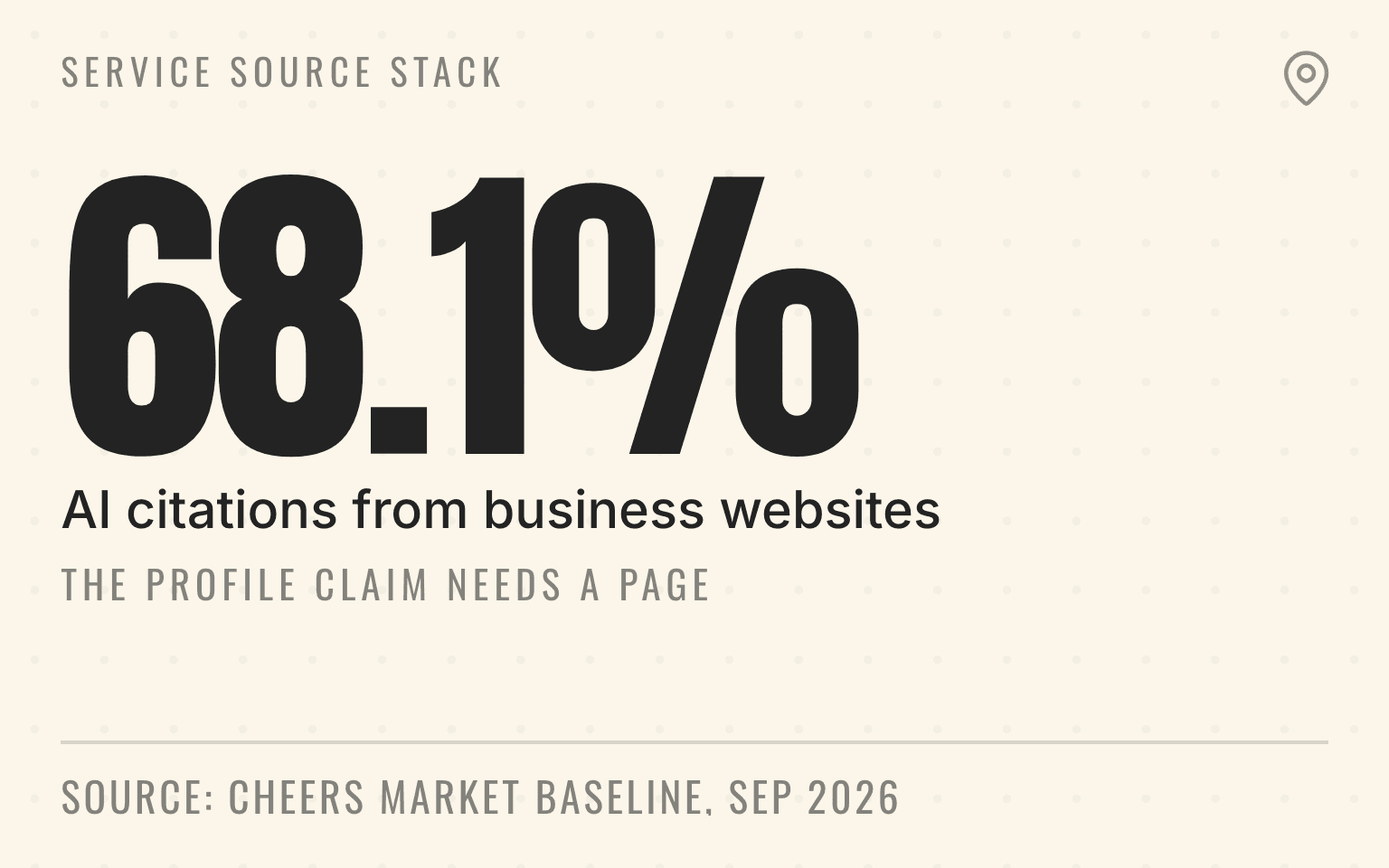
Service source stack
The profile claim needs a page
68.1%
Pooled AI citations from business websites
100
U.S. and Canadian metros
4
Answer engines
49,677
Local-intent runs
Cheers Market Baseline, 28 days ending September 2, 2026; 100 metros, four engines, aggregate only.
| Finding | Value | Base |
|---|---|---|
| Pooled AI citations from business websites | 68.1% | Stated in the source |
| U.S. and Canadian metros | 100 | Stated in the source |
| Answer engines | 4 | Stated in the source |
| Local-intent runs | 49,677 | Stated in the source |
An HVAC branch may offer AC repair, furnace installation, duct cleaning, indoor air quality, and emergency service. A plumbing location may handle drain cleaning in one market but send sewer line jobs to a different crew. A smart-home installer may sell security cameras in every market, but only a few branches may install EV chargers.
If the Google Business Profile service list says every location does everything, the brand creates a source problem. Customers see services that may not be available. Google sees one public profile claim, while the location page, service area, reviews, and call path may say something else. AI search systems have the same problem: they need to understand which branch can actually do the job.
Important
Use Google Business Profile services as a location-level truth list. Add the jobs the branch can perform, remove the jobs it cannot, and make the same service reality visible on the website and in reviews.
The short answer
A multi-location brand should list the services that a specific location actually offers, using Google's suggested services when they fit and custom services only when the job is real, customer-facing, and supported by the website.
The service list is not a keyword bucket. Copying one national service menu into every profile, adding a service because a competitor lists it, chasing search volume from an SEO tool, or listing jobs the brand only hopes to sell later all create the same failure: the profile describes a business that does not exist at that address.
The useful test is operational: if a customer calls this location for that service today, can the right team quote, schedule, dispatch, or explain the job without transferring the lead to a different branch?
Cheers' Market Baseline found that business websites supplied 68.1% of pooled citations across 49,677 local-intent runs and 356,019 citations. A profile service should therefore match the owned page that explains the job and the location that can fulfill it. Cheers Market Baseline, 28 days ending September 2, 2026, 100 metros, four engines, aggregate only. Read the methodology.
That standard is stricter than most profile audits, but it is easier to defend. It also fits how Google frames local relevance. Google says local results are mainly based on relevance, distance, and prominence, and that complete, detailed business information helps Google understand the business and match it to relevant searches.
For the broader source-stack question, read Is Google Business Profile enough for AI visibility?. The service-list version is narrower: which jobs belong on each profile, and which public sources prove them. If the profile team also manages time-bound updates or public answers, pair the service list with Google Business Profile Posts and Google Business Profile Q&A governance.
Categories say what the location is
Categories and services should not do the same job.
Google's category guidance says to choose categories that describe what the business is, not what it has. In bulk profile guidance, Google uses the same rule for multi-location management: choose a category that best represents the business, keep it consistent within similar business groups, and use additional categories only when they also describe what the business is.
For a home service brand, the primary category might be HVAC contractor, plumber, electrician, pest control service, roofing contractor, garage door supplier, restoration service, or security system installer. Additional categories can help when the business truly operates across more than one business type, but they should not become a list of every service line.
This matters because categories can expose category-specific profile features. It also matters because an overloaded category set can blur the location's identity. A branch that is primarily a pest control service should not look like a generic home improvement store because someone tried to stuff every treatment, inspection, and prevention service into the category layer.
Services are where the specific jobs belong.
Services say what this location can do
Google's services editor lets service businesses add services, group different types of services under the appropriate category, and add details such as descriptions or prices when supported. Google also says services may be highlighted on the profile when local customers search for a service the business offers.
When price is part of the service detail, use the same standard as the service itself: publish only what the branch can honor, explain what changes the estimate, and keep the profile aligned with the page. The deeper pricing workflow is covered in Should home service brands publish prices for AI search?.
That editor is where the location-level specifics belong.
For an HVAC branch in Phoenix, that might mean AC repair, AC installation, heat pump repair, furnace maintenance, ductless mini-split installation, and indoor air quality service. A med spa group has a stricter version of the same rule: laser hair removal, Botox, microneedling, facial treatments, and body contouring belong only on the profiles of locations that actually offer them. Security installers should hold video doorbell, alarm, smart lock, and camera installation to the markets that staff trained installers.
The profile should not pretend every branch has the same crews, licenses, equipment, hours, or service-area coverage. If a restoration rollup acquired a branch that handles water damage but not mold remediation yet, that branch's profile should not list mold remediation until the operation can support it. If the difference is a manufacturer, equipment model, or product line, use the equipment-brand publishing standard before adding brand-specific claims to the profile or location page.
The same standard applies to emergency work. If only some markets provide 24/7 drain cleaning or after-hours garage door repair, keep the service list and hours aligned. Where home service brands should publish emergency hours for AI search covers that availability layer.
Why this matters for AI search
Google's AI Search guidance says AI Overviews and AI Mode are rooted in core Search ranking and quality systems. It also explains that AI features can use retrieval-augmented generation and query fan-out to gather related information from the Search index.
For a local service brand, a service query is rarely just one fact. "Who installs smart locks near me?" can involve the branch category, the service list, location-page copy, service-area coverage, reviews that mention smart locks, photos of completed work, structured data, and the booking path. "Best emergency drain cleaning in Mesa" can involve the service, market, after-hours coverage, customer proof, and which location answers the phone.
Google Business Profile is one source in that system. It is not the whole system.
Google also explains that Business Profile information can come from business owners, publicly available web content, licensed third-party data, users, and Google's interactions with local places. That means the service list is strongest when other public sources corroborate it.
If the profile says "EV charger installation" but the location page never mentions EV chargers, reviews never mention charger work, and the booking path has no charger option, the claim is weak. If the profile, page, reviews, photos, and call path all support the same service, the branch is easier for customers and search systems to understand.
Next step
Is AI recommending your business?
Find out how visible you are across ChatGPT, Gemini, Perplexity, and AI Overviews.
Build the list from operations, not keywords
Before editing profiles, build a service taxonomy that the business can actually run.
- Start with the real job types sold, scheduled, dispatched, and completed by each location.
- Map each job to the right branch, service area, license requirement, seasonality, and call path.
- Use Google's suggested services when they match the job language customers use.
- Add custom services only when the service is real, public, and not already covered by a better suggested option.
- Remove services that are aspirational, handled only by another branch, discontinued, or too vague to help a customer decide.
- Keep service names clean. Use descriptions or the location page for nuance instead of stuffing prices, phone numbers, cities, or promotional copy into the service name.
For a franchise system, this often becomes a governance problem. Corporate may own the master taxonomy, regional operators may confirm what each market can perform, and local managers may report changes when crews or licenses change.
That process is slower than a keyword export, but it prevents the common failure: every profile says the same thing while the operation varies by market.
Make the website prove the profile
The location page should be the owned source that explains the service list.
If a profile lists sump pump repair, the matching location page should explain whether that branch offers sump pump inspection, repair, replacement, emergency response, and which service areas it covers. If a profile lists video doorbell installation, the page should show that the local team installs doorbell cameras, smart locks, cameras, or alarms, and route the visitor to the correct booking or call path.
This does not mean creating a thin page for every service-city variation. Google's AI Search guidance warns against overdoing pages for every possible query variation when the purpose is to manipulate rankings or AI responses. A better approach is one strong branch page with clear services, plus dedicated service pages when the topic deserves real depth.
Use What location pages should include for AI search for the page standard, and how service-area businesses should show coverage for AI search when the branch serves customers at homes or job sites instead of a storefront. If the real split is residential, commercial, property-manager, or mixed-use work, apply the residential and commercial service-rules standard before copying the same service list across every branch.
Structured data comes after the visible page is clear. Schema.org's Service type and Google's local business structured data can help label business facts, but they should mirror what a customer can already read. If the page does not explain the service, adding machine-readable markup is not a substitute.
Reviews and summaries can corroborate the service list
Service lists become more credible when customer language backs them up.
Google's Business Profile summaries documentation explains that review snippets and Place Topics can use repeated terms from customer reviews when there is enough review data. Business owners cannot force those topics on demand, but they can run a better operation for earning specific, truthful reviews.
For a pest control branch, repeated reviews that mention termite inspection, wasp nest removal, or rodent exclusion give public support to the services on the profile and page. For an HVAC branch, reviews that mention same-day AC repair, mini-split installation, or maintenance plans help clarify which jobs customers actually experienced.
Do not script customers to mention keywords. That creates trust and policy risk. Instead, ask for honest reviews after real service moments, route the review to the correct location, and use recurring customer language to improve the page. How to turn reviews into AI search content explains that workflow in more detail.
How to audit service lists across locations
Use this when a brand inherits messy profiles, adds a service line, or wants a defensible standard across locations.
- Build a master service taxonomy by vertical, then mark which services are active by location.
- Compare the taxonomy against the current Google Business Profile service list for every priority branch.
- Flag four mismatches: listed but not offered, offered but missing, offered only in some service areas, and listed on the profile but unsupported on the website.
- Rewrite location pages before adding services that need explanation, proof, licensing, price caveats, or booking nuance.
- Update profile services in batches by market or region so local managers can verify the final list.
- Check whether reviews, photos, service-area pages, and booking paths support the top services.
- Re-audit before peak season, after acquisitions, after rebrands, and when crews or licenses change.
The output is a branch-level service truth list that marketing, operations, and local managers can maintain, not a longer keyword list.
What to inspect next
Start with the services that create the highest-value local demand.
In HVAC, that usually means AC repair, installation, maintenance, emergency service, indoor air quality, and heat pumps. Plumbing brands should look hardest at drain cleaning, water heater repair, sewer line repair, leak detection, and emergency plumbing. Electrical has its own short list: panel replacement, EV charger installation, generator installation, lighting, and emergency repair. Med spas should start wherever services vary by license, equipment, provider, or location.
For each service, ask one question: would a customer, Google, and an AI search tool see the same truth across the profile, page, service area, reviews, and call path?
If not, fix the public sources before adding more services. A profile that matches the business customers can actually hire will outperform a longer one in every check that matters: the customer call, the Google result, and the AI answer.
Sources
- Manage your services, Google Business Profile Help, no publication date. Checked September 2, 2026.
- Create a bulk upload spreadsheet, Google Business Profile Help, no publication date. Checked September 2, 2026.
- Tips to improve local ranking, Google Business Profile Help, no publication date. Checked September 2, 2026.
- AI features and your website, Google Search Central, July 2026. Checked September 2, 2026.
- How Google sources business information, Google Business Profile Help, no publication date. Checked September 2, 2026.
- Business summaries on Google Maps, Google Business Profile Help, no publication date. Checked September 2, 2026.
- Service, Schema.org, no publication date. Checked September 2, 2026.
- LocalBusiness structured data, Google Search Central, June 2026. Checked September 2, 2026.
- AI Visibility Statistics, Cheers Research, September 2026. Checked September 2, 2026.
- Research methodology, Cheers Research, September 2026. Checked September 2, 2026.
Dylan Allen-Arnegård is the CEO & Co-Founder of Cheers, the done-for-you platform that manages the website, reviews, listings, structured data, and local content that get service businesses recommended across Google, Maps, ChatGPT, and Perplexity.