

Google updated its spam policies on August 28, 2026, and the doorway definition is the sentence that should govern this decision: "Doorway abuse is when sites or pages are created to rank for specific, similar search queries." A residential page and a commercial page for every city, differing by one word, is that. A residential page and a commercial page that carry different crews, response windows, licences, and proof is not.
So split the work when residential and commercial change what the customer can buy, which branch owns the job, what proof matters, or how the lead should route. Do not split it to have two URLs where you had one.
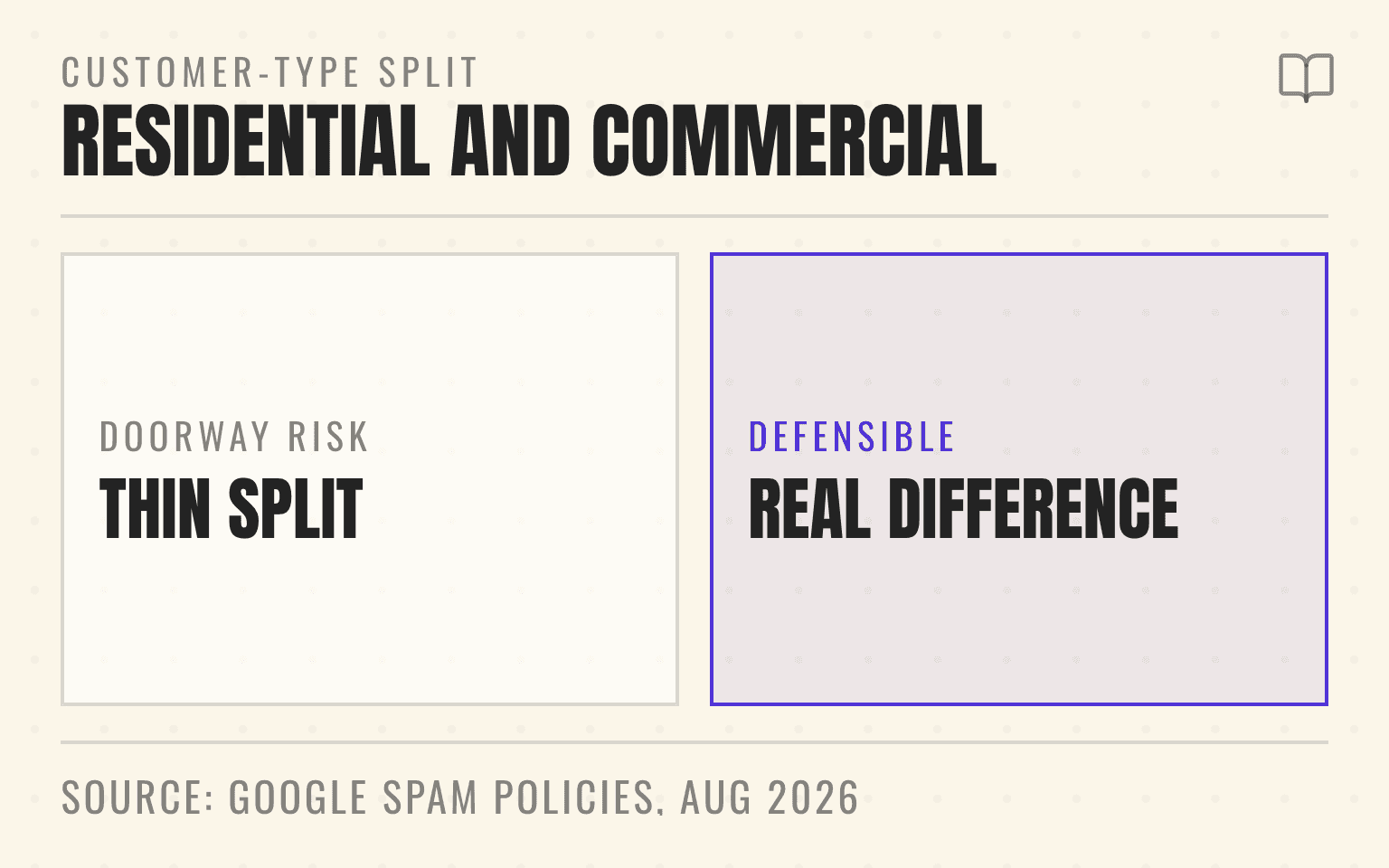
Customer-type split
Two pages or one section
Doorway risk
Split with nothing behind it
- Same crew, same phone, same proof
- One word changed per city page
- Profile service list widens the promise
- Google calls this substantially similar
Earns the URL
Split with real difference
- Different crew, response window, licence
- Contract scope, access rules, insurance
- Reviews and photos from that customer type
- Booking path dispatch can actually honor
Google Search Central: Spam policies for Google web search (developers.google.com/search/docs/essentials/spam-policies), last updated August 2026.
This is a practical problem for HVAC, plumbing, electrical, garage door, pest control, roofing, restoration, smart-home, med spa, hospitality, and franchise service brands. One location may handle residential service calls but not commercial maintenance. Another may serve property managers but not national accounts. A med spa may offer a treatment to consumers at one studio but not through corporate wellness or employer programs. A garage door branch may repair residential doors across a market while commercial roll-up door work belongs to a different crew.
AI search does not need a clever label for that. It needs public operating facts it can verify. Google's guidance for generative AI features in Search points back to normal Search foundations: useful content, crawlable pages, clear structure, and content that brings non-commodity information. The same logic applies to ChatGPT, Gemini, Perplexity, Claude, Grok, and other answer systems that may use search, citations, crawlers, or retrieved sources.
If you want to see whether AI answers already understand which customer types your locations serve, start with an AI visibility check. Then decide whether the fix belongs on a location page, service page, Google Business Profile service list, service-area page, review program, or booking path.
Important
Publish customer-type service rules only where they reflect real operations. The page should help a buyer understand whether this branch serves homes, businesses, property managers, associations, or mixed-use jobs.
The short answer
A multi-location service brand should publish residential and commercial service rules when the split affects customer fit.
That does not mean every branch needs separate residential and commercial pages. It means every branch needs a public way to answer the question: "Do you handle my type of property and job?"
For some brands, one section on the location page is enough. For others, residential and commercial deserve separate service pages because the jobs have different crews, response times, equipment, proof, licenses, warranties, estimate paths, or review examples.
The strongest version is not a keyword page. It is a source of truth that sales, marketing, dispatch, field operations, Google Business Profile, and reviews can all use.
Why this matters for AI search
Local service questions are rarely just "near me." They are often customer-type questions.
A facility manager may ask for commercial electrical panel service. A homeowner may ask for residential water heater replacement. A property manager may ask for emergency garage door repair across apartment buildings. A franchise operator may ask which pest control branch serves restaurants after hours. A med spa customer may ask whether a provider treats first-time patients, members, or group appointments.
If the public source stack does not answer the customer-type question, answer engines have to infer it from scattered signals. A page may say "full-service plumbing." The Google Business Profile service list may say "commercial plumbing." Reviews may mostly mention homes. The booking form may route apartment work to a different team. The result is ambiguity.
Google says AI features in Search use core Search ranking systems and retrieved pages from the Search index. Google also warns that structured data is not a special shortcut for generative AI search. That makes visible operating content more important, not less.
For the location-page foundation, use what location pages should include for AI search. For service-area coverage, use how service-area businesses should show coverage for AI search. For Google Business Profile service-list governance, use what services multi-location brands should list in Google Business Profile.
What Cheers saw in aggregate prompt data
We checked whether first-party Cheers data could responsibly strengthen this topic.
The useful cut was aggregate-only. Across the last 90 days of Cheers prompt fan-out observations, a broad customer-type query family covering residential, commercial, business, homeowner, property manager, and property-management language cleared the public-count threshold with 41 organizations and 16,134 observations.
This is not a ranking factor study. It is not a universal market benchmark. It says one useful thing: customer-type language appears often enough in local-service prompt families that multi-location operators should audit whether their public sources answer it.
No raw prompts, rows, customer names, locations, emails, phone numbers, row IDs, private URLs, or unapproved customer names were exported or published.
Pro Tip
Treat first-party prompt data as a prioritization clue, not as proof that a page will rank or get cited. The publishable standard still has to come from customer need, operational truth, and source-backed guidance.
What to publish
Publish the rule in plain customer language. The page should not say "commercial solutions" if the dispatch rule is actually "we serve retail shops and offices, but not industrial plants or multi-story apartment buildings."
A useful rule usually answers:
- Customer type: homeowner, tenant, property manager, facility manager, restaurant operator, franchisee, HOA, landlord, or business owner.
- Property type: single-family home, condo, apartment community, retail site, office, warehouse, restaurant, hotel, clinic, studio, or mixed-use building.
- Service scope: repair, replacement, maintenance, inspection, emergency dispatch, consultation, recurring service, warranty work, or installation.
- Branch ownership: which location, franchisee, region, license holder, or specialized crew owns the job.
- Proof: reviews, photos, licenses, certifications, equipment, team context, and case snippets that match that customer type.
- Contact path: the phone, form, booking route, estimate process, and handoff that the customer should actually use.
That list should not become a giant table on every page. Use it as an editorial checklist before writing the public version.
Avoid residential and commercial page sprawl
The worst version of this work is a duplicate page farm.
Google's spam policies name two patterns that a careless residential and commercial split walks straight into: "Generating pages to funnel visitors into the actual usable or relevant portion of a site" and "Creating substantially similar pages that are closer to search results than a clearly defined, browseable hierarchy." If the only difference between two pages is the word on them, that is the second pattern.
Create separate pages only when the customer gets meaningfully different information. A commercial AC maintenance page may deserve its own URL if it explains contract scope, roof-unit access, service windows, filter programs, facility-manager handoff, insurance requirements, and commercial proof. A residential AC repair page may deserve its own URL if it explains homeowner symptoms, replacement decision points, financing, emergency availability, and review proof.
If the branch simply handles both homes and light commercial jobs with the same crew and phone path, a strong location or service page can carry the distinction. Do not split the content just to target another query variation.
This rule also protects acquisitions and franchise launches. A new branch may inherit a commercial customer base that the parent brand is not ready to publish everywhere. A franchisee may serve residential jobs only until a commercial license, crew, or insurance requirement is in place. The page should reflect the current operating state, not the aspiration.
Next step
Is AI recommending your business?
Find out how visible you are across ChatGPT, Gemini, Perplexity, and AI Overviews.
Connect the rule to Google Business Profile
Google Business Profile is one of the places where customer-type drift becomes public.
Google's service-area help says service areas show customers where the business can provide products and services, and that service areas should be specific and accurate. Google's services help says businesses may add services they offer and group different service types under the right category.
For this topic, the profile question is simple: does the profile make the same promise the page makes?
If a branch does not handle commercial electrical work, its service list should not imply that it does. If a plumbing location handles multifamily work only for existing property-management accounts, the page should explain the handoff instead of letting the profile service list imply open commercial availability. If a med spa location does not offer group or corporate treatments, do not bury that difference in a generic service menu.
Service lists, descriptions, categories, service areas, and booking links should all point toward the same customer-type rule. The deeper profile workflow is covered in the Google Business Profile service-list standard.
Write rules ops can honor
Residential and commercial service rules fail when marketing publishes faster than operations can maintain.
Before publishing, confirm:
- Dispatch can identify the customer type before routing the lead.
- The branch can honor the service promise in the listed market.
- The call center, form, and booking flow use the same customer-type language.
- The profile service list and service-area fields do not widen the promise.
- Reviews, photos, credentials, warranties, financing, payment, and equipment claims belong to the same branch or service line.
- A named owner can update the rule after acquisitions, staffing changes, licenses, service-area changes, or new commercial accounts.
This is an operating control. It prevents wasted leads. A commercial facility manager who lands on a residential-only branch page should find the right route quickly. A homeowner should not call a commercial-only crew that cannot handle their job.
If payment terms, financing, warranties, equipment brands, or response expectations change by customer type, connect the page to those standards too. Use payment-method publishing, financing options, workmanship warranties, equipment-brand support, and response-time publishing where the distinction matters.
Use structured data after the visible rule is clear
Schema can clarify service facts, but it should not introduce facts the page does not visibly support.
Schema.org's Service type can describe a service, provider, service type, and area served. Schema.org's LocalBusiness type describes a particular physical business or branch and includes properties such as address, opening hours, telephone, price range, and areaServed. Those fields are useful when they mirror the page.
For a branch that serves both residential and commercial customers, the visible page should explain the split before markup labels it. For a service-area business, areaServed should match the public coverage and dispatch rule. For a commercial-only page, structured data should not imply residential service if the customer path does not support it.
Google's AI Search guidance is clear enough on the principle, in its own words: "Structured data isn't required for generative AI search, and there's no special schema.org markup you need to add." Use markup to reinforce visible truth. It cannot compensate for thin content.
The other constraint is advertising law, not search. The FTC's standard is short: "Under the law, claims in advertisements must be truthful, cannot be deceptive or unfair, and must be evidence-based." A commercial capability published for a branch that cannot staff it is an evidence problem before it is an SEO problem.
How to test the rule
Run the test as a customer would.
Pick one location, one service, one market, and one customer type. Search and prompt the way a buyer would: "commercial garage door repair near Tempe," "residential panel upgrade in Plano," "property manager pest control in Orlando," or "med spa provider for first-time Botox consult near Scottsdale."
Then inspect the sources that an answer could use. Does the location page answer the question? Does the service page match it? Does the Google Business Profile service list agree? Do reviews and photos support the customer type? Does the booking path route correctly? Do citations or old acquisition pages contradict the claim?
If the answer is inconsistent, do not start by writing more pages. Start by making the real rule public in the strongest existing source, then align the profile, service-area page, booking path, review prompts, photos, and schema around it.
If dispatch would have to correct the page on a customer call, the page is not done. Publish the real customer-type rule first, then test whether the profile, proof, and booking path repeat it without explanation.
Sources
Every link below was opened and checked September 2, 2026.
- Spam policies for Google web search. Google Search Central, last updated August 2026. Source of the quoted doorway-abuse definition and the two quoted example patterns.
- Optimizing your website for generative AI features on Google Search. Google Search Central, last updated July 2026. Source of the quoted statement that structured data is not required for generative AI search, and of the non-commodity content guidance.
- Manage your service areas. Google Business Profile Help, checked September 2026. Source of the service-area accuracy rules and the 20-area limit.
- Manage your services on your Business Profile. Google Business Profile Help, checked September 2026. Source of the rule to keep profile services tied to real offerings.
- Service and LocalBusiness. Schema.org vocabulary, checked September 2026. Source of service type, provider, branch facts, and areaServed.
- Overview of OpenAI crawlers, Claude web search tool, Perplexity Search API quickstart, and xAI web search. Provider documentation, checked September 2026. Current crawler, search, and cited-source behavior. The Anthropic and xAI links replace two URLs that now redirect.
- Advertising and marketing basics. United States Federal Trade Commission, checked September 2026. Source of the quoted truthful, non-deceptive, evidence-based advertising standard.
Dylan Allen-Arnegård is the CEO & Co-Founder of Cheers, the done-for-you platform that manages the website, reviews, listings, structured data, and local content that get service businesses recommended across Google, Maps, ChatGPT, and Perplexity.