

Google's spam policies define keyword stuffing as "the practice of filling a web page with keywords or numbers in an attempt to manipulate rankings in Google Search results", and give "Lists of phone numbers without substantial added value" as an example. A wall of manufacturer names on a branch page is the same shape with different nouns.
A manufacturer or model name belongs on the page when it reflects a real service capability at that location. A list added for search volume tells the customer nothing about whether the branch has the training, parts access, warranty workflow, or booking path to support the equipment.
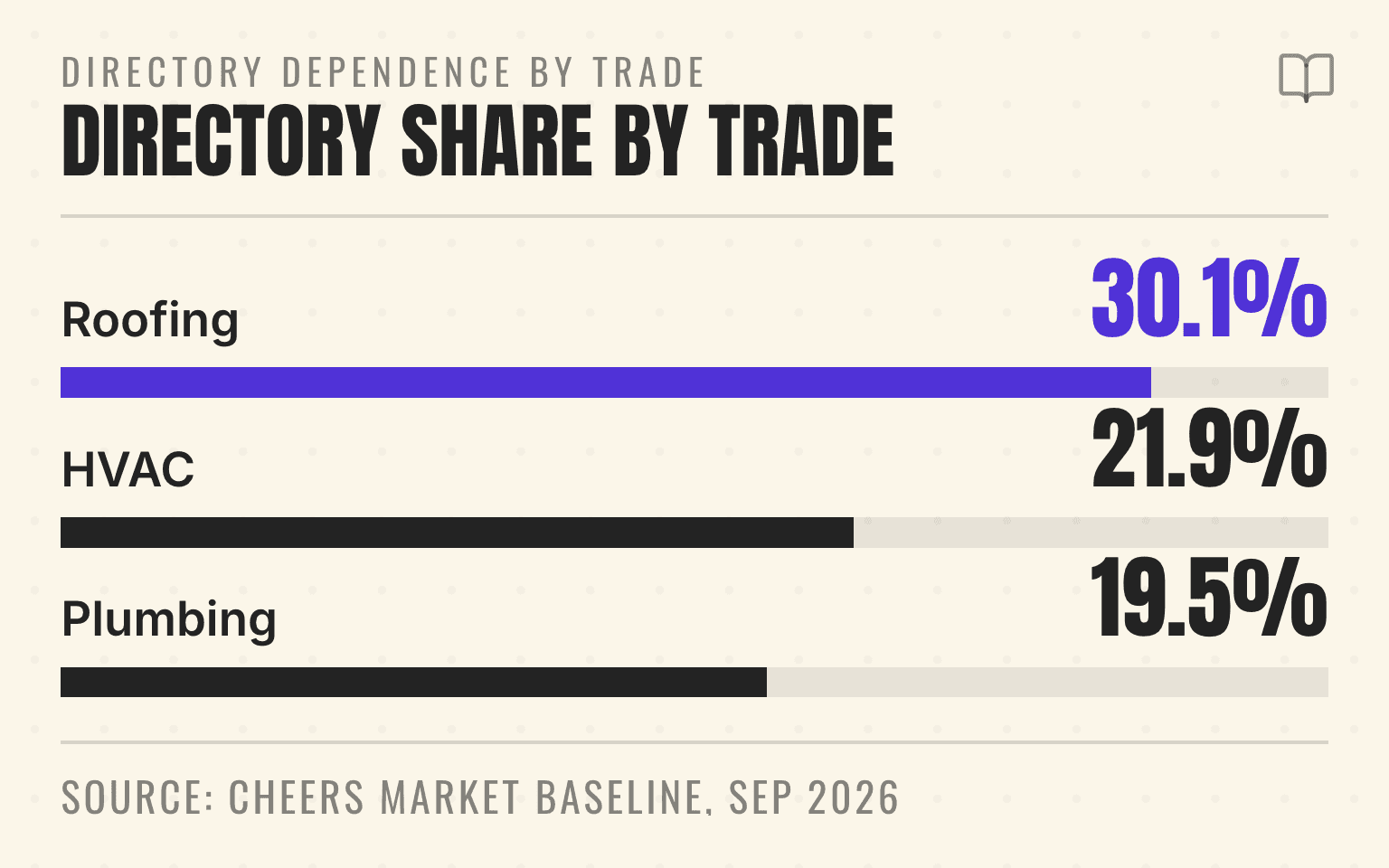
Directory dependence by trade
How much you control
Directory and review-platform share of citations by trade prompt, Cheers Market Baseline, 28 days ending September 2, 2026
22,071 citations
10,200 citations
10,997 citations
108,878 citations, the largest trade
100,465 citations
Cheers Market Baseline, 28 days ending September 2, 2026: 32 home-services prompts in 100 metro service areas across four engines, aggregate only.
| Trade | Directory share of citations |
|---|---|
| Roofing | 30.1% (22,071 citations) |
| Garage door | 30% (10,200 citations) |
| Pest control | 26.9% (10,997 citations) |
| HVAC | 21.9% (108,878 citations, the largest trade) |
| Plumbing | 19.5% (100,465 citations) |
For HVAC, garage doors, smart-home security, plumbing, electrical, med spa, restoration, and franchise service brands, equipment-brand content can be useful. A customer may not ask only for "AC repair." They may ask who services a Trane heat pump, repairs a LiftMaster opener, installs a Nest doorbell, supports a Generac generator, handles a Navien tankless water heater, or uses a specific med-spa device.
Those are capability questions. The branch either has the technician training, parts access, warranty workflow, booking path, and local service coverage, or it does not.
Important
Publish equipment-brand and model support only when the page, profile, photos, reviews, booking path, and local team can repeat the same truth. AI search is not a reason to imply authorization, parts access, or warranty coverage the branch cannot prove.
Why equipment-brand facts belong in the source stack
Google's current guidance for generative AI features in Search says AI Overviews and AI Mode rely on core Search ranking and quality systems. Google also says local business and product information can appear in generative AI responses when the underlying sources are useful, crawlable, and eligible for Search.
For a multi-location service brand, that puts equipment-brand facts in the normal source stack. The source might be a service page, a branch page, a Google Business Profile service, a photo caption, a review theme, a structured data field, or a booking flow. If those sources disagree, a customer can be misled before an AI answer ever summarizes the page.
OpenAI's crawler documentation creates the same practical boundary for ChatGPT search features: public pages need to be accessible if the business wants them surfaced as search sources. That does not mean a page will be cited. It means hidden sales sheets and private dispatch notes are weak public evidence.
If a leadership team wants to know which sources AI systems already use for category and brand-specific local prompts, start with a live AI visibility check. Then turn the misses into page, profile, and source work instead of adding brand names everywhere.
What equipment-brand content should actually say
The useful version is plain and specific.
An HVAC page can say which system types the local team services, which manufacturer lines the technicians commonly diagnose, whether the branch installs new equipment, whether warranty work is included, and when the customer should contact the manufacturer instead. A garage door page can separate opener repair, spring replacement, door panel work, commercial doors, and access-control hardware. A smart-home installer can separate cameras, doorbells, locks, monitoring, and service after installation.
That detail helps customers because brand and model questions often carry operational constraints. A technician may service one equipment family but not another. A branch may install a product but not handle manufacturer warranty claims. A market may stock common parts but order specialty parts. A franchisee may carry different brands than the national page suggests.
The weak version is a brand-name wall. A page listing every manufacturer in the category, with nothing about service fit, market coverage, warranty role, or booking rules, is hard for a customer to trust and sits close to what Google calls keyword stuffing: "filling a web page with keywords or numbers in an attempt to manipulate rankings in Google Search results".
Separate service capability from authorization
This is where multi-location brands get into trouble.
"We service Brand X equipment" is not the same as "authorized Brand X dealer." "We repair Brand Y openers" is not the same as "we perform Brand Y warranty work." "We install Brand Z systems" is not the same as "every branch stocks Brand Z parts."
The FTC's advertising guidance is the guardrail: "Advertising must be truthful and non-deceptive; Advertisers must have evidence to back up their claims; and Advertisements cannot be unfair." For a local service page, evidence means training records, a documented manufacturer relationship, service history, a parts policy, invoice templates, or branch operating rules. Something a regional manager could produce if asked.
If a manufacturer relationship matters to the buyer, name the relationship accurately. Use "factory authorized," "certified installer," "preferred dealer," "warranty service provider," or "trained on" only when those words match the real agreement. If the business simply has experience repairing equipment from that manufacturer, say that instead.
For warranty-sensitive claims, pair this article with the workmanship and manufacturer warranty standard. Equipment-brand content should not blur who owns labor coverage, part coverage, registration, claim approval, or callback rules.
Put the detail where customers compare providers
Start with the page, not the profile field.
Google Business Profile services are useful because customers find service details on Search and Maps, and Google generates the suggestions by category. Its own example is a plumbing business getting options such as Install faucet or Repair toilet. Those are jobs, not manufacturers. The service list is a good place to describe real customer-facing work and a bad place for a brand-name dump.
The service page or location page should carry the durable explanation. That page can answer the buyer's real questions: which equipment brands are supported, which model families are excluded, which locations handle the work, whether emergency service applies, whether parts are stocked, whether the branch installs or only repairs, and who owns warranty claims.
The Google Business Profile service list should then match the page at a higher level. Use the Google Business Profile service-list workflow when deciding which services belong on each profile.
Make brand support local, not national by default
A national service page can define the standard. The local page has to prove the market.
For an HVAC rollup, the corporate page may explain the system types and manufacturer families the brand supports. The Phoenix branch page should still say whether that market handles heat pumps, ductless mini-splits, emergency AC repair, warranty registration support, and stocked parts. The Denver branch may have a different winter-service mix.
For a garage door franchise, the national page may explain opener repair and door replacement. The branch page should say whether the local team handles commercial doors, gate operators, specific opener classes, high-lift systems, or same-day spring replacement.
For a smart-home or security installer, the page should separate installation from monitoring, warranty support, device replacement, and post-install troubleshooting. If only certain markets install EV chargers, cameras, smart locks, or access-control systems, do not imply national coverage.
Next step
Is AI recommending your business?
Find out how visible you are across ChatGPT, Gemini, Perplexity, and AI Overviews.
Publish the facts without building thin doorway pages
Google's AI Search guidance warns site owners not to create pages for every possible query variation when the purpose is manipulating rankings or AI responses. Brand and model support can fall into that trap quickly.
Use a page only when it gives the customer enough real information to act. For most service brands, that means one strong service page with a clear equipment-support section, plus branch-level notes where support varies by market. Create a dedicated manufacturer or model page only when the brand has enough substance: trained technicians, recurring demand, real photos, service examples, warranty rules, common failure modes, parts constraints, and a clear booking path.
Use this publishing standard before adding new URLs:
- Put manufacturer names near the service they clarify, not in a detached keyword list.
- Explain whether the branch repairs, installs, sells, maintains, or performs warranty work.
- Name location differences when parts, technicians, licenses, or manufacturer relationships vary.
- Add real job photos only when they avoid customer privacy issues and support the claim.
- Keep schema markup aligned with visible copy. Schema.org Service, Product, Brand, areaServed, and warranty vocabulary can reinforce facts, not replace them.
- Remove unsupported brand names during seasonal or acquisition cleanup instead of letting stale claims sit on branch pages.
That standard creates fewer pages, but better sources.
How much of the evidence is even yours
Equipment-brand content is a contractor-website asset, so it is worth knowing how much of the cited evidence in your category sits on your own site. In the Cheers Market Baseline for the 28 days ending September 2, 2026, 32 home-services prompts ran in 100 metro service areas across four engines. On garage door prompts, 30.0% of the 10,200 citations came from directories and review platforms. On roofing, 30.1% of 22,071. On HVAC it was 21.9% of 108,878, and on plumbing 19.5% of 100,465.
In garage door and roofing markets, close to a third of what the engines cited was not a page anyone at the company could edit. That is a reason to make the pages you do control unusually specific about equipment, and a reason to keep third-party listings accurate rather than ignoring them. Definitions are in the Cheers Research methodology.
The operating plan for the first 30 days
Start with the brand and model claims already in the wild.
- Days 1 to 7: Inventory service pages, location pages, Google Business Profile services, booking menus, review responses, ad copy, technician scripts, and estimate templates for manufacturer names and model claims.
- Days 8 to 14: Classify each claim as repair, install, sell, maintain, troubleshoot, warranty, certified, authorized, parts stocked, or unsupported. Remove claims that cannot be substantiated.
- Days 15 to 21: Update the owned pages first. Add local variation where branch capability, parts access, warranty role, service area, or emergency coverage differs.
- Days 22 to 30: Align Google Business Profile services, photos, review-response guidance, booking paths, schema, and AI visibility prompts with the updated source.
Then test the prompts customers actually ask. Use service plus manufacturer, model family, market, urgency, and comparison variants. Inspect which sources are cited, whether the right location appears, and whether the answer overstates the branch's relationship with the manufacturer.
If the public answer is wrong, fix the source that caused it. If the branch cannot support the claim, remove the claim.
Sources
Every external link below was opened and checked September 2, 2026.
- Spam policies for Google web search. Google Search Central, last updated August 2026. Source of the quoted keyword-stuffing definition and example.
- Manage your services on your Business Profile. Google Business Profile Help, checked September 2026. Source of the quoted suggested-service example and of how services are added and described.
- Advertising FAQs: a guide for small business. United States Federal Trade Commission, checked September 2026. Source of the quoted three-part advertising standard behind authorization and warranty claims.
- Optimizing your website for generative AI features on Google Search. Google Search Central, last updated July 2026. Source of the normal Search foundations behind AI Overviews and AI Mode.
- How Google sources business information. Google Business Profile Help, checked September 2026. Source of the mix of owner, web, licensed, and user contributions behind a profile.
- Overview of OpenAI crawlers. OpenAI developer documentation, checked September 2026. Source of OAI-SearchBot surfacing accessible public pages in ChatGPT search.
- Service, Product, Brand, areaServed, and WarrantyPromise. Schema.org vocabulary, checked September 2026. Source of the service, product, brand, geography, and warranty properties.
- Cheers Research methodology. Cheers Market Baseline, 28 days ending September 2, 2026: 32 home-services prompts in 100 metro service areas across four engines, aggregate only. Source of the directory citation shares by trade quoted above.
- What services should multi-location brands list in Google Business Profile for AI search?. Internal companion for service-list governance.
- Should home service brands publish workmanship warranties for AI search?. Internal companion for manufacturer warranty and labor warranty separation.
- What response-time promises should each service location publish?. Internal companion for parts readiness, service fit, and local dispatch promises.
Amadeus Peterson is the CTO & Co-Founder of Cheers, the local search platform for multi-location service businesses.