

Google now checks availability by calling. Its help page on checking local prices and availability with AI says: "Google can contact businesses on your behalf to check for availability and prices", and tells the user that "Google will call multiple service providers near you." Whoever picks up your phone is being compared against the page, in real time, by a machine acting for a customer.
A response-time promise therefore belongs on the page only when the local team can honor it for the named service, market, daypart, and contact channel. A website is not ready to say "fast response" while the call center uses a different definition and the technician schedule changes the promise again.
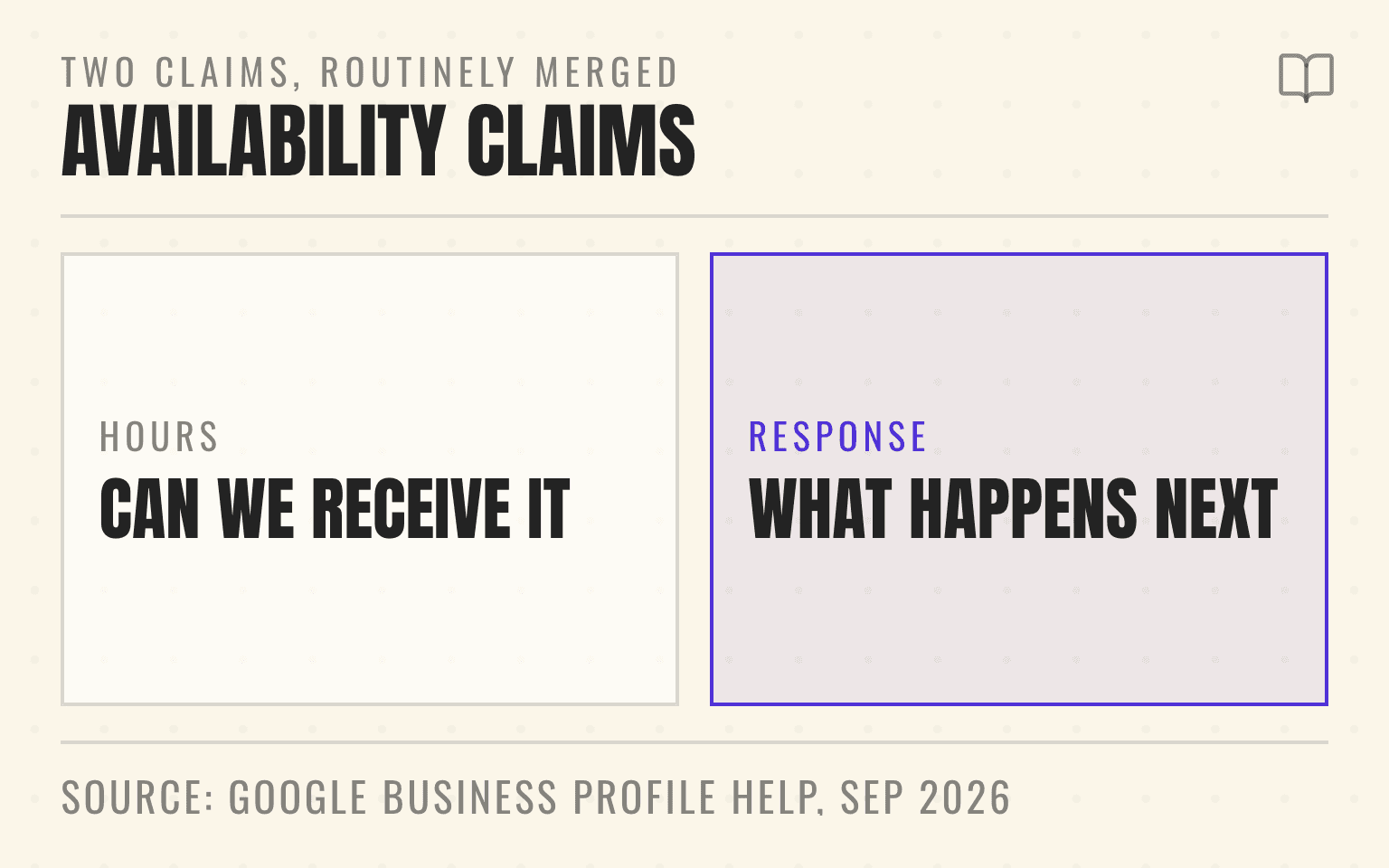
Two claims, routinely merged
Open now or on the way
Emergency hours
Can we receive it
- When the phone is answered
- Main, special and more hours on the profile
- Holiday and weather exceptions
- Owned by the profile and call center
Response time
What happens next
- Answer, qualify, schedule, dispatch, arrive
- By service, market, daypart and channel
- Parts, crew coverage and route density
- Owned by dispatch and field operations
Google Business Profile Help: Edit your business hours (support.google.com/business/answer/15300403), checked September 2026, for the main, special and more hours fields.
For HVAC, plumbing, electrical, restoration, garage door, roofing, pest control, med spa, and franchise service brands, response time is a booking fact. A customer asking who can repair an AC unit today, stop a leak tonight, or arrive after water damage needs more than a provider name. They need to know whether that provider can respond in the real market, for the real service, through the real channel.
Important
Publish response times only when the location page, profile, phone path, booking route, and dispatch team can repeat the same rule. AI search is not a reason to turn operational uncertainty into a public promise.
Why response times are becoming a source issue
Google's guidance for generative AI features in Search is not a secret markup checklist. Google says site owners should focus on helpful, crawlable, customer-first content and the same Search foundations that already apply to normal results.
For a local service brand, response time sits inside that normal source layer. It can appear on a location page, a service page, a Google Business Profile, a booking flow, a review, a call script, or structured data. If those sources disagree, a customer sees the conflict before any AI system needs to interpret it.
None of that means every response-time claim feeds one Google feature. It does mean availability language has stopped being a static brochure detail. Search products are increasingly built around whether the customer can act on the information, and around whether the business confirms it when asked.
When that request reaches the business by phone, use the Google automated-call operating guide to define what the branch may confirm and how to verify the customer handoff.
That matters for multi-location operators because speed claims drift faster than brand positioning. A 24/7 restoration promise may be true for water mitigation but not reconstruction. A same-day garage door claim may be true in Dallas but not a new acquisition two counties away. A med spa group may have same-week consultation availability in one market and a three-week backlog in another.
If you need to see which prompts and markets expose those gaps, run a recurring AI visibility check and compare cited sources against real dispatch capacity.
Response time is not the same as emergency hours
Emergency hours answer whether someone can receive urgent demand.
Response time answers what happens next.
Those two facts are related, but they are not interchangeable. A plumbing branch can answer calls 24/7 while scheduling non-emergency water heater replacements during normal hours. A restoration branch can accept emergency calls all night while crew arrival depends on equipment, service area, and severity. A garage door location can promise same-day spring repair only when the right parts and technician coverage exist.
That is why response-time content should sit beside the existing availability standard, not replace it. Use the emergency-hours publishing workflow for open-now and after-hours rules. For holidays and other date-specific exceptions, use the multi-location holiday-hours operating guide. Use this response-time standard for arrival windows, same-day claims, queue handling, diagnostic scheduling, and branch-level capacity.
The phone path also matters. If a tracking number routes to a queue that cannot schedule the promised service, the source is broken even if the page looks right. The companion standard is how home service brands should use call tracking numbers for AI search.
Publish the promise in five places
The response-time promise should be written once, then distributed carefully.
- Service page: explain the response expectation for that job type, including normal hours, emergency exceptions, inventory limits, diagnostic windows, and what happens after a form or call.
- Location page: show whether the branch, market, franchisee, service area, or daypart changes the promise.
- Google Business Profile: keep hours, special hours, more hours, services, phone, website URL, and booking links aligned with the same operating rule. Google separates the three deliberately. Main hours are for "your business's most up to date and accurate hours of operation for a normal week", special hours are "For days when you have unusual hours, such as holidays or special events", and more hours exist for when "you offer specific services with different times such as senior hours, or delivery and takeout hours".
- Phone and booking path: make sure the dispatcher, form, scheduler, confirmation message, and tracking number do not create a faster promise than the page can support.
- Reviews and field proof: use customer language to support reliability, but do not let one review become a universal speed guarantee.
For pricing-sensitive work, connect response-time language to the offer the customer is comparing. A customer asking for "same-day AC repair cost" needs the price range, the availability rule, and the branch that can actually handle the request. Use the service-price publishing standard for Google AI Search when the speed claim depends on diagnostic fees, emergency charges, coupons, or trip fees.
Write claims by job type, not brand slogan
The strongest response-time content is boring in the right way. It says exactly what the customer can expect and when the promise changes.
For HVAC, separate emergency cooling, maintenance visits, replacement estimates, heat pump service, and after-hours dispatch. "Same-day AC repair" may be true during a heat wave only for certain ZIP codes, equipment types, or call windows. If the speed claim depends on a specific equipment brand, model family, or stocked part, use the equipment-brand publishing standard before promising the response time.
For plumbing, separate burst pipes, drain clearing, water heater repair, water heater replacement, leak detection, and non-urgent fixture work. "Available today" should not hide whether a technician can arrive, diagnose, complete the repair, or only schedule an estimate.
For restoration, separate 24/7 call answering, emergency mitigation, crew arrival, equipment placement, reconstruction, insurance coordination, and contents work. A national 60-minute claim is risky if the branch does not have the equipment and coverage to prove it.
For garage doors, separate spring repair, opener repair, door replacement, panel replacement, commercial work, and after-hours service. Same-day repair depends on parts, door type, tech coverage, and local route density.
For med spas and elective local services, response time may mean appointment availability rather than arrival. The page should explain consultation windows, deposit requirements, provider availability, and whether online booking reflects real capacity.
Do not write one generic "fast response" paragraph and copy it across every branch. The whole point is to make the operational difference visible before a customer books.
Next step
Is AI recommending your business?
Find out how visible you are across ChatGPT, Gemini, Perplexity, and AI Overviews.
Avoid speed claims the team cannot substantiate
The FTC's small-business advertising guidance is the right guardrail: "Advertising must be truthful and non-deceptive; Advertisers must have evidence to back up their claims; and Advertisements cannot be unfair." Where a qualifier is what keeps the claim honest, the FTC adds that "the information should be presented clearly and conspicuously so that consumers can actually notice and understand it."
That matters because speed language often sounds harmless until it becomes a guarantee. "Fast service" is vague. "Same-day service available in most markets when booked before noon" is more useful. "Guaranteed arrival within 60 minutes" is a much stronger claim and needs evidence, staffing, routing, exclusions, and a remedy if the promise fails.
The riskiest terms are usually fastest, guaranteed, instant, 24/7, same-day, emergency, always available, and no-wait. Some brands can support those claims in some markets. Few can support them across every branch, service line, holiday, weather event, and acquisition state.
If the condition matters, publish it near the claim. Do not save the real rule for the phone call.
Use schema only after visible content is clear
Structured data can help label local business facts, but it is not a place to hide operational nuance.
Google's LocalBusiness structured data guidance focuses on visible business details such as address, phone, opening hours, and related local facts. Schema.org has vocabulary for LocalBusiness, ContactPoint, OpeningHoursSpecification, and hoursAvailable. Those properties can reinforce what a customer can read on the page.
They should not invent a response promise the page does not state. If the visible page says emergency plumbing calls are answered 24/7 but non-emergency estimates are scheduled during business hours, the markup should not flatten that into a generic always-open signal for every service.
The safer order is simple: write the customer-facing rule, align the profile and call path, then use structured data to reinforce stable facts.
A 14-day response-time audit
Use this before peak season, after an acquisition, when call routing changes, or when AI answers cite competitors for urgent service queries.
- Pick the highest-intent service and market combinations: AC repair in summer, drain cleaning, water damage, electrical emergencies, garage door spring repair, pest emergencies, med spa consultations, or the jobs that create real revenue pressure.
- Write the allowed response-time claims by service, branch, daypart, season, and channel. Label each as guaranteed, available, typical, conditional, or not allowed.
- Compare the location page, service page, Google Business Profile, structured data, paid landing page, booking flow, phone route, and dispatcher script.
- Remove unsupported fastest, guaranteed, same-day, 24/7, and instant-booking language before it spreads into profiles, ads, reviews, or partner pages.
- Test buyer prompts that include service, market, urgency, competitor, price, and availability language. Record which sources are cited and whether the answer matches operations.
- Assign an owner and review date for every mismatch. Marketing cannot keep this true without operations, and operations cannot keep it visible without marketing.
A generic speed claim does not break the tie
When a customer asks for the best provider near them, several branches in the answer can claim to be fast.
Saying fast does nothing to separate one from the rest. A specific, conditional, market-true availability rule is at least something a retrieval step can tell apart from the others.
Do not end the audit with a list of copy edits. End it with a branch-level operating rule that customers, dispatchers, and public sources can all repeat.
The standard to use
Publish response times when they help the customer make a better booking decision.
Do not publish response times just because AI search might summarize them.
The useful standard is not "say you are fast." It is "say what the customer can expect, where that expectation applies, which service it covers, and what channel honors it."
If the branch can respond today, publish the proof clearly. If the promise is conditional, name the condition. If it varies by location, show the variation. The strongest response-time source is the one a customer can act on without being corrected later by a dispatcher.
Sources
Every external link below was opened and checked September 2, 2026.
- How to check pricing for local businesses with AI in Google Search. Google Search Help, checked September 2026. Source of the two quoted lines in the opening about Google contacting and calling providers to check availability and prices.
- Edit your business hours. Google Business Profile Help, checked September 2026. Source of the three quoted definitions of main hours, special hours, and more hours.
- Advertising FAQs: a guide for small business. United States Federal Trade Commission, checked September 2026. Source of the quoted advertising standard and the clear-and-conspicuous disclosure requirement behind speed claims.
- Optimizing your website for generative AI features on Google Search. Google Search Central, last updated July 2026. Source of the useful, crawlable, people-first content standard.
- AI features and your website. Google Search Central, last updated December 2025. Source of the statement that AI Overviews and AI Mode need no additional technical requirements or special schema.
- Guidelines for representing your business on Google. Google Business Profile Help, checked September 2026. Source of the requirement to keep public profile information accurate and current.
- Local business (LocalBusiness) structured data. Google Search Central, last updated December 2025. Source of using structured data to reinforce visible local facts.
- LocalBusiness, ContactPoint, OpeningHoursSpecification, and hoursAvailable. Schema.org vocabulary, checked September 2026. Source of the availability and contact properties.
- Overview of OpenAI crawlers. OpenAI developer documentation, checked September 2026. Source of search-enabled products fetching and surfacing public website sources.
- Where home service brands should publish emergency hours for AI search. Internal companion for after-hours and open-now availability.
- Should home service brands use call tracking numbers for AI search?. Internal companion for phone-routing and dispatch-source consistency.
Dylan Allen-Arnegård is the CEO & Co-Founder of Cheers, the local search platform for multi-location service businesses.