

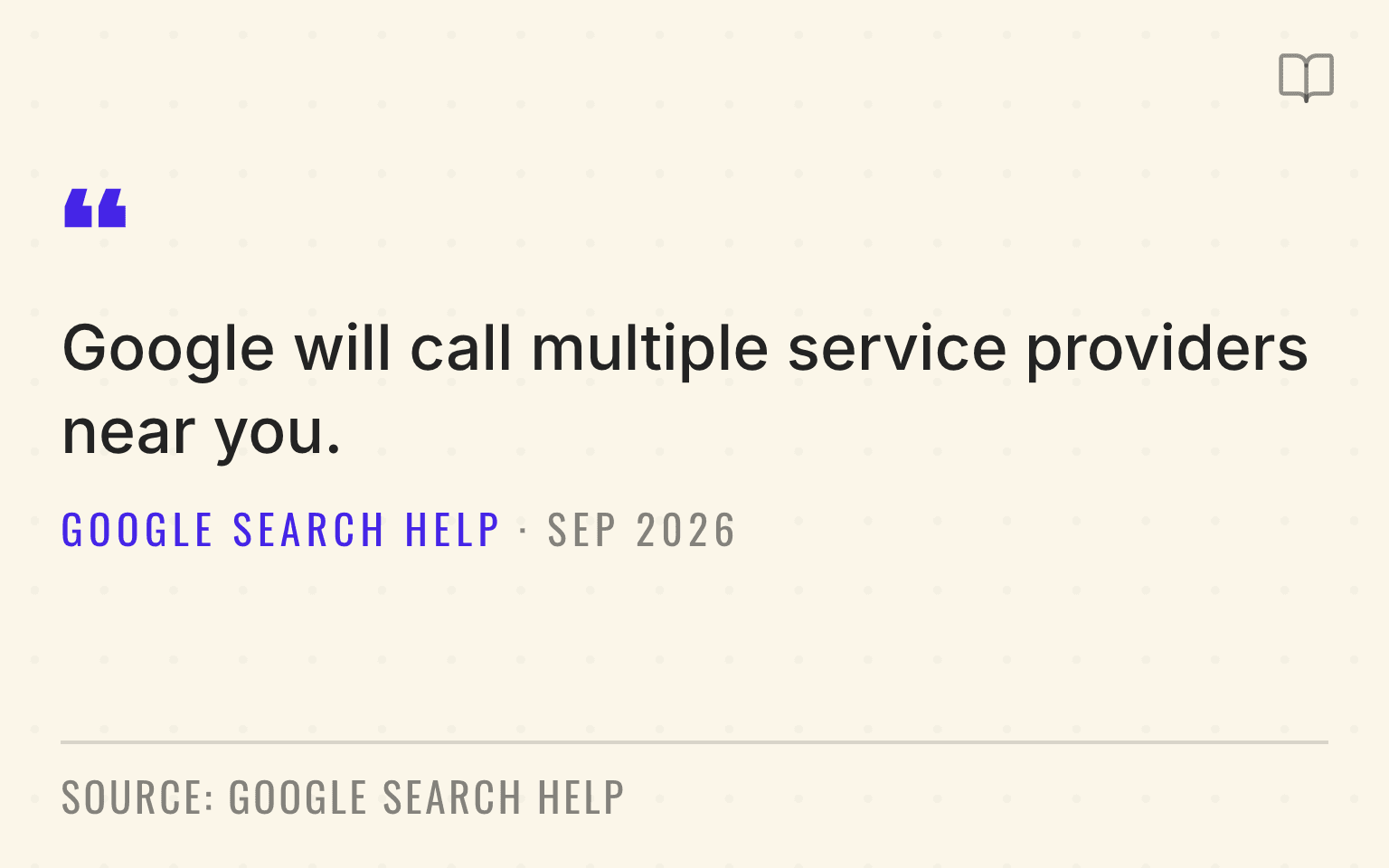
Google Search now has a button that dials your competitors for you. Google's own help page for the feature says: "Google will call multiple service providers near you." The buyer fills in a form, and Google's documentation says it takes about 30 minutes to email back quotes and availability. Whatever your published pricing does or does not say, that comparison is happening.
The goal is pricing clarity, not fake precision. Home service brands often avoid publishing prices because real jobs vary. A water heater replacement can depend on code upgrades, access, disposal, permits, equipment, and emergency timing. A roof repair can depend on pitch, material, storm damage, and whether the customer needs a temporary fix or a full replacement. A med spa service can depend on provider, dosage, package, membership, and consultation requirements.
That complexity is real. It is also exactly why the page needs cost context.
When a customer asks Google AI Mode, "how much does AC repair cost near me," the answer may inspect several sources before the buyer ever calls. If the brand gives no pricing explanation, the answer has to lean on competitors, directories, forums, or generic national averages. The safer move is to publish what the business can honestly stand behind: fees, ranges, estimate rules, price drivers, exclusions, financing, and the location-specific path to a quote.
Google's documented AI pricing flow currently covers service categories such as auto repair, hair salons, pet groomers, wellness centers, phone repair, and driving schools, and Google says it is expanding coverage. The feature runs in English for signed-in US users over 18. For service operators, the important part is not the category list. It is that price, availability, website clarity, and the local call path now meet before the buyer ever dials. Google is also clear that the flow stops short of booking:
Using this service will not create a booking; once you receive the information from Google you can contact the service provider and make the booking that matches your needs.
So the quote your branch gives on that call is a lead, and it competes against every other quote in the same email.
If Google contacts the branch for that information, the Google automated-call operating guide explains how to bound the quote, identify the call, and record the outcome by location.
Important
Publish the pricing facts your operators can defend. If exact prices vary, explain why they vary and what the customer should expect before the technician arrives.
The short answer
Home service brands should publish prices for AI search when the information is useful to customers, accurate by location, and tied to the real estimate path.
That does not mean every plumbing, HVAC, electrical, roofing, pest control, restoration, garage door, or med spa location needs a fixed menu of prices. It means the website should answer the cost question honestly enough that a customer can decide whether to call, book, or request an estimate. Useful pricing content can cover service call fees, minimum visit charges, defensible ranges, price drivers, emergency rules, financing rules, accepted payment methods, inspection requirements, and what is included or excluded.
If your team is unsure whether AI answers already mention your prices, fees, or competitors for priority services, run a location-level AI visibility check and inspect the sources behind those answers.
Why pricing is now a source problem
Google says its generative AI features in Search are rooted in normal Search ranking and quality systems. Google also says AI Mode and AI Overviews may use query fan-out, issuing related searches across subtopics and data sources to build a response.
For a local service query, price is one of those subtopics.
Google's pricing-help documentation supports a bounded claim: a customer can ask Google to check price and availability across local businesses. The answer may depend on which businesses can be reached, which details the customer submits, and whether the website, profile, phone path, and branch handoff all tell the same story.
Someone asking "best emergency plumber near me" may also care about service fees, after-hours charges, warranty, response time, and whether the company can quote before dispatch. Someone asking for "roof leak repair cost" may need to know whether inspection is free, whether insurance coordination changes the process, and whether the branch handles temporary tarping.
When license, insurance, or credential proof changes whether the customer should trust the estimate, use the companion standard on publishing license and insurance proof for AI search.
If the brand page has no cost context, AI search has fewer owned sources to work with. If the brand page says "affordable" but never explains the estimate path, it gives the customer little to trust. If the page publishes a low starting price without conditions, it can create a worse problem: a promise the branch cannot honor.
The operator standard is simple. Price content should reduce ambiguity without inventing certainty.
What Google and schema can support
Google Business Profile services can include descriptions and prices when the field is available. That makes service pricing a profile-level source as well as a website issue. For multi-location brands, the field should be used carefully because the profile describes a real branch or service area.
If one HVAC branch can honor a diagnostic fee and another cannot, do not push one national price across every profile. If a franchise location has different membership discounts, financing rules, or emergency fees, the pricing source needs local governance. The same logic applies to service descriptions: use them to clarify the real service, not to stuff promotions into a field that should identify what the location does.
Structured data can support pricing clarity too, but it should follow the page. Google LocalBusiness structured data can describe local business facts, and Schema.org includes priceRange, Offer, and PriceSpecification vocabulary. Those are useful only when the page itself is clear. Google structured data policies warn against markup that is misleading, hidden from users, or not representative of the main content.
For the profile layer, pair this article with what services multi-location brands should list in Google Business Profile. For the page layer, use what location pages should include for AI search.
What to publish when the exact price depends on inspection
Most home service categories cannot publish one price for every job. That is fine. The page can still answer the cost question.
Use visible copy for the facts customers need before they call:
- State whether estimates, inspections, consultations, or diagnostic visits are free, credited, or billed separately.
- Explain the main price drivers, such as equipment type, access, parts, permit requirements, emergency timing, job size, membership status, or warranty coverage.
- Give ranges only when operations can defend the low and high end for that market.
- Clarify what the range excludes, such as code upgrades, disposal, complex access, specialty parts, financing costs, or after-hours work.
- Say when the final quote is confirmed, for example after inspection, before work begins, or after a diagnostic step.
- Keep discounts, memberships, and financing terms current.
- Update pages when branch coverage, crews, vendors, or franchise policies change.
This is not a conversion concession. It is a trust filter. The wrong customer can self-select out before calling. The right customer can call with a clearer expectation. The dispatcher and technician spend less time explaining why a generic price did not fit the job.
Multi-location pricing needs local governance
Pricing content gets harder as the brand scales.
A 90-location plumbing franchise may have one national service taxonomy, but service fees can vary by market, franchisee, labor cost, trip distance, emergency coverage, parts availability, and state disclosure rules. A restoration rollup may have acquired branches with different inspection policies and insurance workflows. A med spa group may have services that vary by provider license, product dosage, package, or consultation requirement.
That means the content owner cannot publish pricing alone. Operations, regional leaders, franchise owners, legal or compliance, and call center teams all need a role.
For an HVAC brand in Phoenix, the AC repair page might publish a diagnostic fee, the conditions that affect repair cost, and a clear rule that the technician confirms the estimate before work begins; the service-line version of that evidence problem is covered in how HVAC companies get recommended by ChatGPT. For a roofing company in Dallas, the roof repair page might explain inspection policy, minimum repair scope, storm damage documentation, and when insurance coordination changes the timeline. For a med spa location in Columbus, the service page might publish consultation requirements, starting ranges, membership discounts, and what changes final treatment cost.
The page should match the actual branch. If a location cannot honor the claim, the claim should not appear on that location page, in that profile, or in that structured data.
Next step
Is AI recommending your business?
Find out how visible you are across ChatGPT, Gemini, Perplexity, and AI Overviews.
Where pricing creates search and compliance risk
Pricing pages become risky when the marketing claim is cleaner than the customer reality.
The FTC's Guides Against Deceptive Pricing cover price comparisons, former prices, bargain claims, and related representations. The FTC's rule on unfair or deceptive fees is narrower, aimed at live-event ticketing and short-term lodging, but it is still a useful reminder that hidden fees and bait-and-switch pricing are a consumer protection issue.
For local service brands, the practical cautions are straightforward. Do not advertise a low starting price if only a tiny edge case qualifies. Do not compare against a former price unless the former price was genuine and supportable. Do not hide unavoidable fees until the last step of booking. Do not let schema publish a price the visible page does not explain. Do not create "cheap AC repair in every city" pages if the real price model is inspection-based.
This article is not legal advice. The operating point is that AI visibility should not push pricing claims ahead of the business truth. If the page helps a customer understand the cost path before calling, it is usually stronger than a vague promise. If the page creates a price promise the location cannot defend, it is a risk no matter how well it ranks.
How pricing connects to AI visibility
AI search does not need a pricing page in isolation. It needs the price explanation to fit the rest of the source stack.
The service page should explain the work, the pricing model, the price drivers, and the path to an estimate. The location page should confirm whether that service and pricing policy apply in the market. Google Business Profile services should use descriptions and prices only when they match the branch. Reviews can support the promise when customers mention fair pricing, clear estimates, communication, or surprise fees, but do not script those words into the review ask. The booking path should tell the customer what happens next.
That matters for agentic experiences too. If a customer or AI agent tries to book an estimate, the site should make the local rules clear before the form submission. Can AI agents book appointments from your website? covers that path in more detail.
Avoid treating pricing as a standalone SEO asset. The article, service page, profile, schema, reviews, and booking path should all describe the same operating reality.
A 30-day pricing content standard
Start with the services where pricing confusion costs the most: emergency calls, high-ticket replacements, financing-heavy jobs, after-hours work, and services with frequent customer questions.
- Pick five priority services by market or region.
- Define which pricing facts can be public: diagnostic fees, estimate policy, ranges, exclusions, financing, memberships, emergency rules, and discount conditions.
- Decide what belongs on the national service page versus the location page.
- Update Google Business Profile service descriptions and prices only where the branch can support them.
- Make LocalBusiness, Offer, or PriceSpecification markup match visible copy when markup is used.
- Check the booking path, phone script, and confirmation message against the page.
- Confirm the call or email path can answer the same price rule the page publishes.
- Recheck AI answers and cited sources after the pages are indexed.
Across a portfolio, keeping that price context true by market is multi-location local SEO work with an operations owner attached, not a one-time content sprint. Publish the price context each priority location can defend. The page should make the branch easier to compare, easier to trust, and easier to contact without misleading the customer.
Sources
Every link below was opened and checked on September 2, 2026.
- How to check pricing for local businesses with AI in Google Search. Google Search Help. Undated help page, checked September 2, 2026. support.google.com/websearch/answer/16421135. Source of the quoted lines that Google will call multiple service providers, that the flow does not create a booking, and of the roughly 30-minute quote email.
- Google's guide to optimizing for generative AI features on Google Search. Google Search Central. Last updated July 10, 2026, checked September 2, 2026. developers.google.com/search/docs/fundamentals/ai-optimization-guide. Supports the point that AI Search visibility depends on normal Search foundations, useful public content, crawlability, and current business details.
- AI features and your website. Google Search Central. Checked September 2, 2026. developers.google.com/search/docs/appearance/ai-features. Supports the query fan-out explanation for AI Overviews and AI Mode.
- Creating helpful, reliable, people-first content. Google Search Central. Checked September 2, 2026. developers.google.com/search/docs/fundamentals/creating-helpful-content. Supports writing pricing content for customers before search systems.
- Manage your services on your Business Profile. Google Business Profile Help. Undated help page, checked September 2, 2026. support.google.com/business/answer/9455399. Supports the guidance that service businesses can add service descriptions and prices when the feature is available.
- Local business structured data. Google Search Central. Checked September 2, 2026. developers.google.com/search/docs/appearance/structured-data/local-business. Supports structured data for local business facts.
- General structured data guidelines. Google Search Central. Last updated July 10, 2026, checked September 2, 2026. developers.google.com/search/docs/appearance/structured-data/sd-policies. Supports the warning that structured data must be a true representation of visible page content.
- PriceSpecification and LocalBusiness. Schema.org vocabulary. Undated type pages, checked September 2, 2026. schema.org/PriceSpecification and schema.org/LocalBusiness. Support the pricing and local-business vocabulary references.
- 16 CFR Part 233, Guides Against Deceptive Pricing. Electronic Code of Federal Regulations, US Federal Trade Commission. Current as of the September 2, 2026 check. ecfr.gov/current/title-16/chapter-I/subchapter-B/part-233. Supports the caution around price comparisons and bargain claims.
- 16 CFR Part 464, Rule on Unfair or Deceptive Fees. Electronic Code of Federal Regulations, US Federal Trade Commission. Current as of the September 2, 2026 check. ecfr.gov/current/title-16/chapter-I/subchapter-D/part-464. Supports the caveat that hidden fees and bait-and-switch pricing are consumer protection concerns, while noting the rule's narrower industry scope.
Last verified: September 2, 2026.
Dylan Allen-Arnegård is the CEO & Co-Founder of Cheers, the local search platform for multi-location service businesses.