

The Federal Trade Commission tells homeowners exactly what to do before hiring: "Check with your state or county government to confirm a contractor's license, and ask the contractor for proof of insurance." Your customers are being told to verify you. Publishing the proof is answering a question the government already told them to ask.
That does not mean every location page needs a wall of legal copy. It means a buyer should not have to call the office, download a PDF, or trust a vague "licensed and insured" badge without context. A homeowner comparing roofers, electricians, plumbers, restoration teams, garage door companies, pest control branches, or med spa clinics wants to know whether the provider is allowed to do the work and whether the promise matches the actual location.
AI search makes the same gap more visible. Google says AI features in Search rely on normal Search foundations, including publicly accessible, crawlable content. OpenAI and Anthropic both document separate web crawlers or user agents that can affect search-style retrieval. If license and insurance proof is missing from crawlable pages, AI systems may lean on competitors, directories, state databases, complaint pages, or generic advice instead of the brand's own source.
Important
Treat license and insurance proof as customer trust evidence first. The AI-search benefit comes from making that evidence clear, current, and easy to verify.
If you do not know whether AI answers already mention your licenses, warranties, insurance process, or competitor credentials, start with a location-level AI visibility check, then inspect the sources behind each answer.
The short answer
Publish license and insurance proof when it is public, current, and tied to the exact service and location it supports.
- Put core proof on the relevant service page or location page, near the claim it verifies.
- Show the jurisdiction, trade, business entity, expiration or renewal cadence when appropriate, and a verification path when one exists.
- Explain when proof varies by branch, franchisee, technician, provider, state, county, or subcontractor.
- Keep structured data aligned with visible copy. Do not hide machine-only credential claims in JSON-LD.
- Review the proof after renewals, acquisitions, rebrands, new service lines, and market expansions.
The best page does not ask the customer to decode corporate compliance. It answers the practical question: can this local team do this job safely, legally, and under the promise being advertised?
Why credentials are now part of the source stack
The FTC's home-improvement advice leads with one line:
Consider only contractors who are licensed and insured.
It goes on to tell consumers to confirm the license with state or county government, ask for proof of insurance, read reviews, and get the contractor's name, address, phone number, and license number in the contract. That is not SEO advice. It is buyer-protection advice, and it defines the shape of the answer a buyer is looking for.
For home service brands, it is also search-source advice. A buyer asking an AI assistant "who should I hire for electrical panel replacement in Phoenix" may need more than a rating and a phone number. In our Market Baseline, ChatGPT and Google AI Mode answers about electricians mentioned licensing about five times as often as their HVAC answers did. The useful answer should resolve the service, market, branch, proof, contact path, and risk. License and insurance proof can help when it is part of the same public source stack as the location page, Google Business Profile, reviews, photos, citations, and service content.
Google's helpful content guidance also asks whether content is presented in a way that makes someone want to trust it, including clear sourcing and evidence of expertise. For a local-service page, that trust evidence is often concrete: license numbers, insurance status, certifications, permit process, manufacturer authorization, staff qualifications, safety process, and warranty terms.
This is why the page standard matters. What location pages should include for AI search already treats proof as a branch-level requirement. License and insurance proof is the trust layer inside that proof system.
What counts as proof
A proof claim should be specific enough that a customer can understand what it covers.
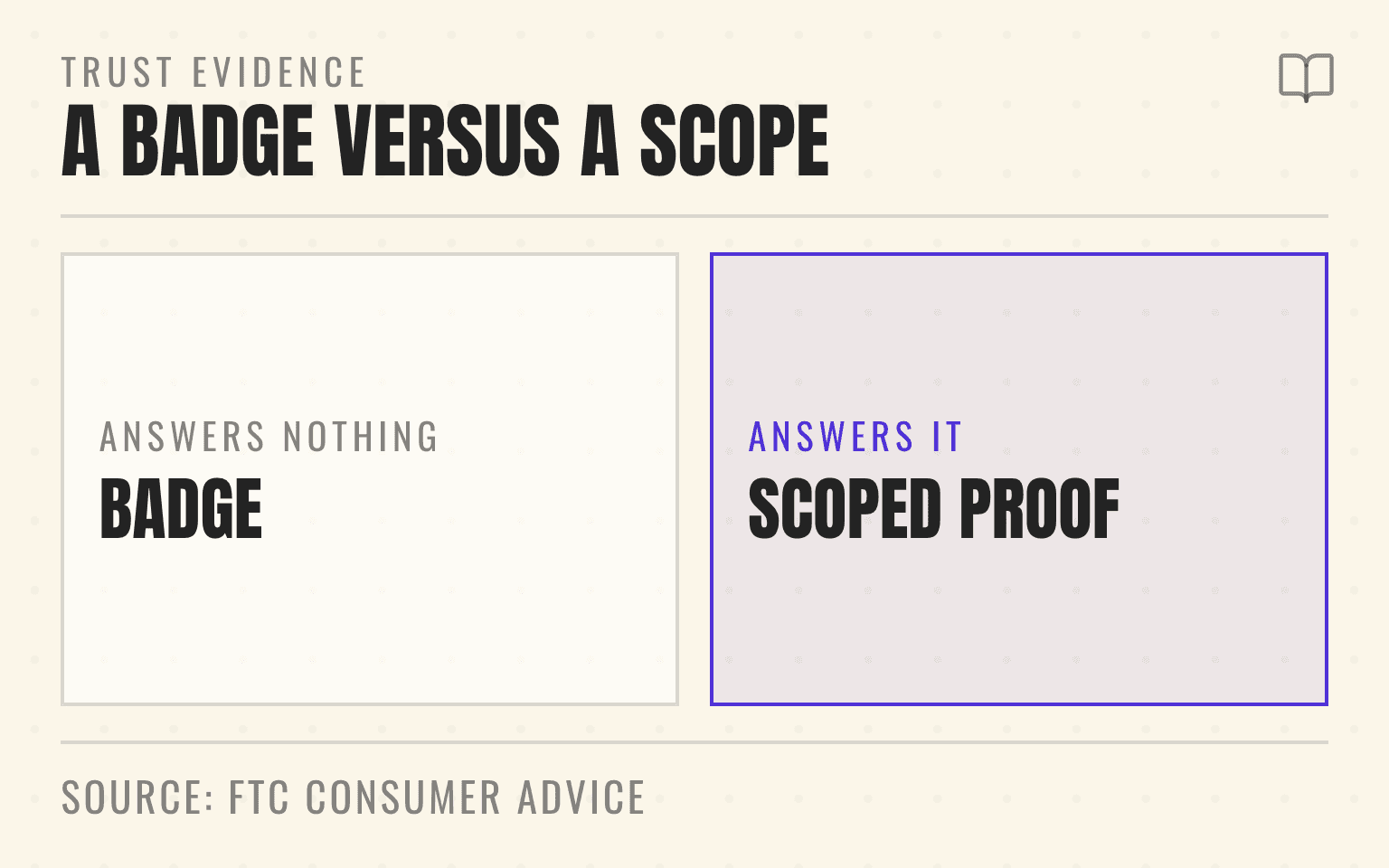
"Licensed and insured" is weak by itself. It does not say who holds the license, where it applies, which trade it covers, whether it is active, whether the branch or subcontractor performs the work, or how a customer can verify it.
For an HVAC branch, useful proof might include the contractor license category, jurisdiction, insurance statement, manufacturer certifications, and whether warranty coverage differs for repair, replacement, maintenance, or emergency work. For an electrical brand, the proof may need to separate company license, master electrician oversight, panel-work rules, permits, and EV charger qualifications. For a restoration rollup, the proof may include IICRC-style certifications, insurance coordination process, emergency response limits, and the branch that owns the job.
Med spa and wellness groups have their own version of the same problem. A location page should not imply that every treatment, provider type, or credential exists at every studio if only some licensed professionals can offer the service. When the proof belongs to a public-facing provider or field lead, use the technician bio standard so the person, branch, service scope, and credential do not drift apart. A franchise system has another layer: corporate may own brand standards, but the local franchisee may hold the operating license or insurance documents.
The operator rule is simple: publish the proof that belongs to the customer's decision, then label the scope.
Where the proof belongs
License and insurance proof belongs close to the promise.
If a plumbing page says the branch handles sewer excavation, put the license, insurance, permit, or excavation caveat near that service explanation. If a roofing page says the team handles storm-damage repair, explain inspection, insurance coordination, warranty limits, and local license proof near the repair section; storm damage comes up in most ChatGPT and Gemini answers about roof repair. If a restoration page says emergency water mitigation is available, show the branch, response area, certification type, equipment proof, and call path together.
For service-area businesses, do not let the proof float above the market. A brand may be licensed in one state, insured nationally, and certified by technician or branch. The page should tell the customer which team serves the market and which proof applies there. The service-area standard is covered in how service-area businesses should show coverage for AI search.
Google Business Profile can support this, but it should not carry the entire proof burden. Google's profile guidelines say the business should be represented accurately, and Google says profile information can come from owners, crawled web content, licensed data, users, reviews, photos, and other interactions with local places. The website should be the clean owned source that other public surfaces can corroborate.
Next step
Is AI recommending your business?
Find out how visible you are across ChatGPT, Gemini, Perplexity, and AI Overviews.
What to avoid
The common mistake is turning proof into a slogan.
A national badge that says "licensed, bonded, and insured" may be true for the brand but unclear for a specific branch. A warranty banner may be accurate for replacement jobs but misleading on diagnostic visits. A contractor license number may be public in one state but irrelevant in another. A franchise brand may have corporate standards but local operators with different legal entities.
The second mistake is using structured data to say more than the page says. Google's general structured data guidelines, last updated July 10, 2026, set the bar in one sentence:
Your structured data must be a true representation of the page content.
The same page names the failure modes: markup that is not representative of the main content, is potentially misleading, or refers to content hidden from the user. Schema.org includes vocabulary for credentials and certifications, including hasCredential, but that does not make every credential claim eligible for a Google rich result. Use schema to reinforce visible proof, not to create a hidden credential layer.
The third mistake is overexposing private or sensitive documents. Do not publish internal insurance certificates, personal IDs, employee license scans, private customer claim documents, or anything that creates avoidable privacy or fraud risk. Publish the customer-relevant claim, the verification path, and the scope. Keep internal documents in the system your compliance team controls.
How to keep proof current across locations
Credential proof decays quietly.
A license renews. A branch opens. A franchisee changes hands. A provider leaves. A restoration company acquires a market with different certifications. A warranty program changes. A state updates license language. Marketing keeps the old page alive because it still converts.
For a multi-location brand, the fix is ownership. Compliance or operations should own the source of truth. Marketing should own how that proof appears on pages and profiles. Local managers should confirm exceptions. The person responsible for AI visibility should verify whether AI answers, cited sources, and location pages still tell the same story.
Tie credential review to events the business already understands: renewals, acquisitions, rebrands, new services, branch launches, seasonal campaigns, and customer complaint patterns. The same governance logic applies to pricing, categories, services, and emergency hours. If pricing context is the adjacent issue, use the pricing transparency standard for AI search as the companion workflow.
A 30-day operating plan
Start with the services where proof changes the buying decision: electrical panels, HVAC replacement, roof repair, water mitigation, mold remediation, sewer excavation, pest treatment, smart-home installation, garage door spring repair, and med spa treatments.
- Days 1 to 7: Inventory the proof. For each priority service and market, capture the license, insurance, certification, warranty, permit, manufacturer, and provider requirements that are safe to publish.
- Days 8 to 14: Map proof to pages. Match each proof claim to the service page, location page, Business Profile field, citation profile, warranty page, or FAQ where a customer would expect it.
- Days 15 to 21: Rewrite visible copy. Replace vague badges with scoped language: who holds the credential, where it applies, what service it supports, and how the customer can verify or ask for details.
- Days 22 to 30: Align the source stack. Update internal links, structured data that mirrors visible copy, service pages, location pages, and review or photo sections that support the same local claim.
- After launch: Test the same buyer questions across priority markets. Record whether AI answers mention the right proof, cite the right pages, or still rely on weaker third-party sources.
Across a portfolio, that inventory and the page mapping behind it is multi-location local SEO work with a compliance owner attached. The useful outcome is a source stack where the local service promise, proof, and contact path agree. A longer compliance page only helps if it makes that agreement easier to verify.
Sources
Every link below was opened and checked on September 2, 2026.
- How to avoid a home improvement scam. FTC Consumer Advice, US Federal Trade Commission. Undated consumer article, checked September 2, 2026. consumer.ftc.gov/articles/how-avoid-home-improvement-scam. Source of the quoted licensed-and-insured guidance and the license-confirmation instruction.
- General structured data guidelines. Google Search Central. Last updated July 10, 2026, checked September 2, 2026. developers.google.com/search/docs/appearance/structured-data/sd-policies. Source of the quoted true-representation rule and the hidden or misleading markup failure modes.
- Google's guide to optimizing for generative AI features on Google Search. Google Search Central. Last updated July 10, 2026, checked September 2, 2026. developers.google.com/search/docs/fundamentals/ai-optimization-guide. Supports the point that Google AI features use normal Search foundations, query fan-out, and publicly accessible crawlable content.
- Creating helpful, reliable, people-first content. Google Search Central. Checked September 2, 2026. developers.google.com/search/docs/fundamentals/creating-helpful-content. Supports the trust and expertise framing for clear sourcing, evidence, and useful content.
- Local business structured data. Google Search Central. Checked September 2, 2026. developers.google.com/search/docs/appearance/structured-data/local-business. Supports using structured data for local business facts such as address, phone, URL, hours, and business details.
- hasCredential. Schema.org vocabulary. Undated property page, checked September 2, 2026. schema.org/hasCredential. Supports the credential vocabulary for people and organizations, with the caveat that implementation follows visible-page and platform rules.
- How Google sources business information. Google Business Profile Help. Undated help page, checked September 2, 2026. support.google.com/business/answer/2721884. Supports the point that profile information can come from owners, crawled web content, licensed data, users, reviews, photos, and other sources.
- Overview of OpenAI crawlers. OpenAI Platform documentation. Checked September 2, 2026. developers.openai.com/api/docs/bots. Supports the distinction between OAI-SearchBot, GPTBot, and user-triggered ChatGPT access.
- Does Anthropic crawl data from the web, and how can site owners block the crawler? Anthropic Support. Checked September 2, 2026. support.claude.com/en/articles/8896518-does-anthropic-crawl-data-from-the-web-and-how-can-site-owners-block-the-crawler. Supports the distinction between ClaudeBot, Claude-User, and Claude-SearchBot access.
Last verified: September 2, 2026.
Dylan Allen-Arnegård is the CEO & Co-Founder of Cheers, the local search platform for multi-location service businesses.