

Google draws a line most staff directories walk straight over. Its Business Profile guidelines define an individual practitioner as "a public-facing professional, typically with their own customer base. Doctors, dentists, lawyers, financial planners, and insurance or real estate agents are all individual practitioners." Then, one line later: "Support staff should not create their own Business Profiles."
That boundary is a good test for the website too. A technician or provider bio earns a public page when it helps a customer understand who may do the work, what that person is qualified to do, and which branch or service line owns the proof. A copied staff directory does the opposite, producing hundreds of pages of job titles, thin credentials, repeated headshots, and no connection to location operations.
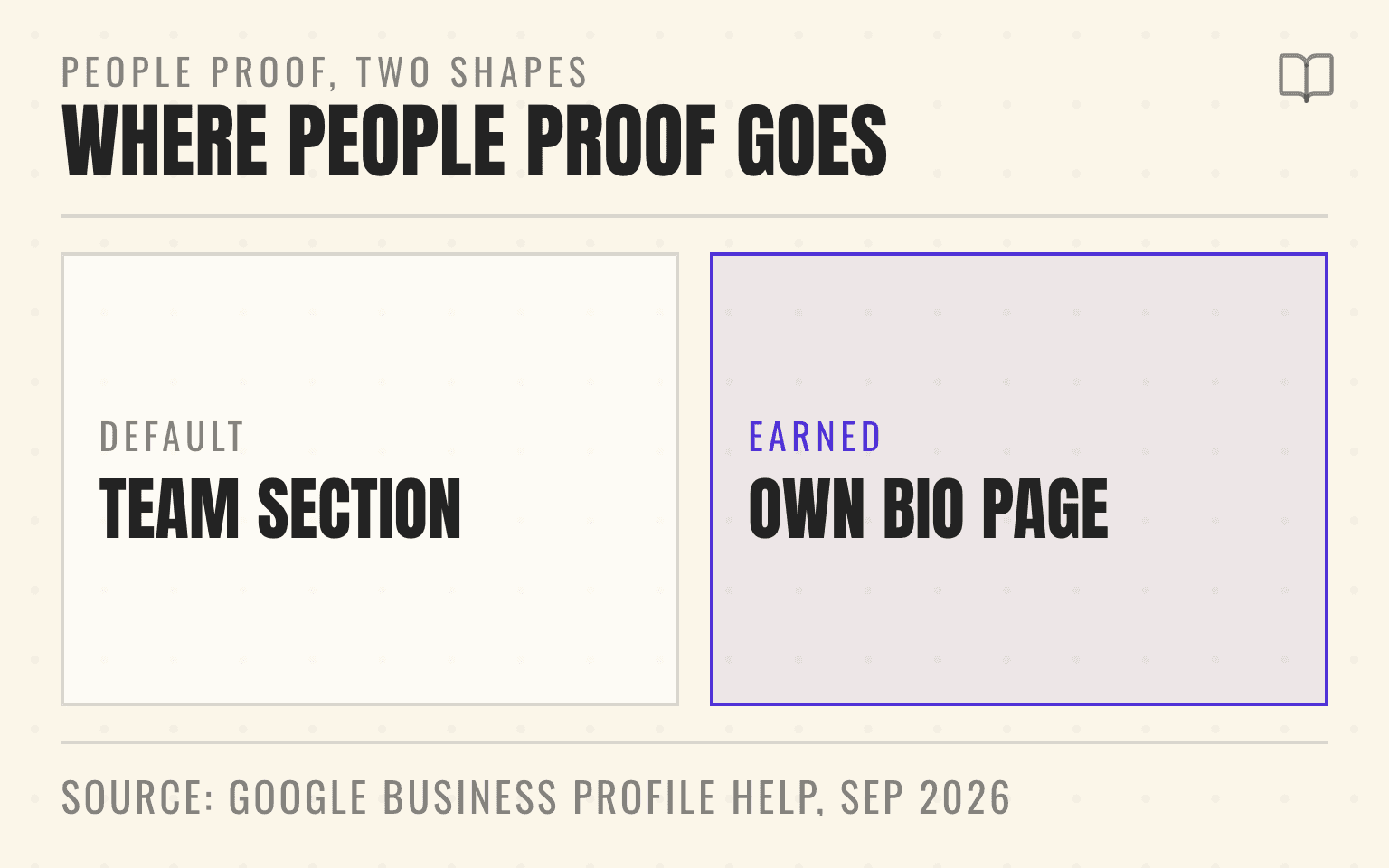
People proof, two shapes
Team block or own page
Start here
Team section on the branch page
- Roles, credentials and review themes in one block
- One page to keep current after turnover
- No practitioner-profile ambiguity
- Right for installers, techs, dispatch, sales
Earn this
Individual bio page
- Public-facing, part of the booking decision
- Licence or treatment scope the customer checks
- Links to branch, service page and review path
- Right for providers, master trades, crew leads
Google Business Profile Help: Guidelines for representing your business on Google (support.google.com/business/answer/3038177), checked September 2026.
Technician bios are not an AI search shortcut. For HVAC, plumbing, electrical, restoration, roofing, garage doors, pest control, med spas, hospitality groups, and franchise service brands, they are trust sources. They can help when the page gives Google, ChatGPT, Gemini, Perplexity, Claude, Grok, and customers a clearer public record of real people, credentials, service roles, and local proof.
Google's guidance for generative AI features in Search points back to normal Search foundations: useful content, clear structure, non-commodity information, and pages that can be selected from the Search index. Google's helpful content guidance also asks whether content shows clear sourcing and evidence of expertise. For a local service brand, a good technician or provider bio can be one place where that evidence becomes specific.
If you want to see whether AI answers already mention your people, credentials, service roles, or competitors by market, start with an AI visibility check. Then decide whether the fix is a technician bio, a stronger location page, a credential section, review attribution, or source cleanup.
Important
A technician bio should publish customer-relevant proof, not a staff directory for crawlers. The bio needs to connect a real person, role, branch, credential, service, and customer handoff.
When a technician bio earns a page
An individual bio earns its own page when the person is part of the buying decision.
For a med spa group, the provider's license type, treatment scope, location, and appointment path can matter before a customer books. For an electrical contractor, a master electrician's role may matter on panel upgrades, EV charger installs, or commercial work. For an HVAC branch, a service manager or lead installer may matter when the page explains factory training, complex replacement work, or warranty handoffs.
The page does not earn its place because the employee exists. It earns its place because the customer needs context that cannot be handled cleanly in a short team block.
Most home service brands should start smaller. Add a technician or provider section to the location page, service page, or proof page. Show the real service roles, credentials, review themes, and branch ownership there first. Create a standalone bio only when the person is public-facing, stable enough to maintain, and important enough to the customer journey.
What belongs in a useful bio
The bio should answer practical customer questions. Who is this person? What work do they do? Where do they work? What proof supports the claim? What should the customer do next?
Useful bios usually include:
- Role and location: service technician, installer, provider, crew lead, comfort advisor, branch manager, or other customer-facing role.
- Service scope: the service lines, equipment types, treatment categories, or job types the person actually handles.
- Credentials: licenses, certifications, manufacturer training, safety training, or provider qualifications that are public and safe to show.
- Proof: review themes, job photos, project examples, customer education, or branch outcomes that support the role.
- Source connection: links back to the branch page, service page, credential standard, review system, and booking path.
Do not overbuild the page with personal trivia. A homeowner does not need a life story before choosing a plumber. A med spa customer may need provider qualifications and treatment scope. A restoration customer may need crew training, emergency process, and insurance handoff context. The amount of biography should match the risk and decision.
Keep bios tied to location pages and proof
A technician bio should not float outside the local source stack.
For a multi-location service brand, the same person may work across branches, markets, brands, or service lines. A page that says "Austin HVAC expert" should connect to the Austin branch page, the service page, the public review path, and the credential proof that supports that claim. If the person works in multiple markets, say that plainly. If the credential belongs to the company rather than the person, do not imply otherwise.
This is where the article fits into the existing source system. Location pages for AI search should already explain branch services, proof, contact paths, and local facts. License and insurance proof should explain credentials at the right scope. Review generation with employee attribution should show which employees, branches, and service moments create legitimate public trust.
The bio should sit inside that system. It should not become a separate version of the truth.
Watch the practitioner profile boundary
Technician bios are website content. Google Business Profiles are a separate system with separate rules.
Google Business Profile guidelines separate individual practitioners from ordinary staff: "An individual practitioner is a public-facing professional, typically with their own customer base. Doctors, dentists, lawyers, financial planners, and insurance or real estate agents are all individual practitioners." Google adds that "Support staff should not create their own Business Profiles", and that an eligible practitioner is one where "They can be contacted directly at the verified location during stated hours."
That matters for multi-location service brands. A med spa provider, dentist, lawyer, or real estate agent may fit Google's practitioner model. The med spa practitioner profile workflow explains how to apply that eligibility test across clinic locations, ownership, pages, and departures. A dispatcher, installer, apprentice, sales rep, service technician, or branch support role usually does not need a separate Business Profile. Creating extra profiles for staff can create duplicate, misleading, or hard-to-maintain local records.
The safer pattern is simple: publish useful bios on the website when customers need them, then keep Google Business Profile tied to the actual branch or eligible practitioner. If a person has a legitimate practitioner profile, the website bio, location page, profile name, phone path, hours, and service scope should agree.
Next step
Is AI recommending your business?
Find out how visible you are across ChatGPT, Gemini, Perplexity, and AI Overviews.
Do not turn reviews into staff endorsements
Employee attribution can make bios stronger, but it also creates a compliance line.
Google's Maps user-generated content policy defines the conflict broadly: "A conflict of interest may include current or former employment, a contractual or consultory relationship, or other professional or personal affiliations that demonstrate a conflict of interest." Staff should not review the business, review themselves, or manufacture customer-looking praise. A bio can use real customer review themes, carefully, without inventing quotes, shifting their meaning, or implying that every customer gets the same person.
For example, a plumbing branch can say customers often mention clear explanations after water heater repairs if that theme appears in real reviews. It should not say "John is the highest-rated plumber in Phoenix" unless the company can substantiate the claim and keep it current. A med spa can explain a provider's treatment scope and customer education style. It should not copy protected customer details into a staff page.
The useful connection is attribution, not pressure. Reviews tell managers which service moments create trust, and bios can turn that trust into public proof when the facts are accurate, current, and customer-safe.
Check whether there is enough review volume to find a theme before you build a page around one. Across the 11 home-services companies and 76 locations with reviews in the Cheers panel over the 90 days ending September 2, 2026, aggregate only (corrected September 23, 2026), the median company collected 9.7 new reviews per location a month while the 75th percentile company collected 26.4. Owners responded to 82.6% of those reviews, and 92.4% of the reviews came from Google. At about ten reviews a month shared across a branch's crew, one technician may need most of a year to show a defensible review theme. At twenty-six, they might have one this quarter. Definitions are in the Cheers Research methodology.
Where schema helps and where it does not
Structured data can clarify a page. It cannot make a thin bio useful.
Schema.org Person includes properties such as name, jobTitle, image, url, and contact details. Schema.org employee can connect a Person to an Organization. Those vocabulary pieces may help a developer model a legitimate employee or provider page. Google also says structured data helps it understand page content.
Use that only after the visible page is right. Do not hide credentials in JSON-LD that customers cannot verify on the page. Do not mark every employee as a separate local business. Do not use Person schema to imply medical, legal, contractor, or manufacturer qualifications that the page and operation cannot support.
For most service brands, the schema order is conservative: keep Organization and LocalBusiness facts clean first, use Person markup only where the person is genuinely part of the page's visible subject, and test the markup before shipping. If the bio is only a short section inside a branch page, heavy Person markup may not be worth the complexity.
How to decide what to publish first
Start where a bio reduces customer uncertainty.
An HVAC brand might begin with branch managers, lead installers, and service advisors tied to replacement, warranty, and complex diagnostic pages. A garage door company might publish crew-lead proof for commercial doors or high-risk spring work. A restoration rollup might show certified crew leads for water mitigation and mold work. A med spa group might publish provider pages because treatment scope and credentials directly shape booking confidence.
Do not start with every employee. Start with the service lines where proof affects conversion, compliance, or trust. Then inspect whether the page helps the customer make a better decision.
The best first pass is an operating audit:
- Pick the locations and service lines where people proof matters most.
- Decide whether the proof belongs on a location page, service page, team section, or individual bio.
- Confirm credentials, service scope, photos, review themes, and booking paths with operations.
- Add internal links from the bio back to the branch, service page, proof standard, and review or attribution workflow.
- Retest AI answers and cited sources by market before scaling the template.
If the customer does not benefit, hold the page. A smaller set of real bios is stronger than a complete staff directory nobody can maintain.
Sources
Every link below was opened and checked September 2, 2026.
- Guidelines for representing your business on Google. Google Business Profile Help, checked September 2026. Source of the three quoted practitioner rules: the definition, the support-staff restriction, and the direct-contact requirement.
- Maps user generated content policy. Google, checked September 2026. Source of the quoted conflict-of-interest definition covering current or former employment.
- Optimizing your website for generative AI features on Google Search. Google Search Central, last updated July 2026. Source of the useful non-commodity content standard and the normal Search foundations behind AI features.
- Creating helpful, reliable, people-first content. Google Search Central, checked September 2026. Source of the trust, expertise, and who-created-it questions.
- Establish your business details with Google. Google Search Central, checked September 2026. Source of the official-website and business-detail alignment guidance.
- Person and employee. Schema.org vocabulary, checked September 2026. Source of jobTitle, image, url, and the person-to-organization relationship.
- Overview of OpenAI crawlers. OpenAI developer documentation, checked September 2026. Source of the separation between search crawling and training crawling.
- Cheers Research methodology. Cheers home-services panel, 90 days ending September 2, 2026, 11 companies and 76 locations with reviews, aggregate only (corrected September 23, 2026). Source of the review velocity, response rate, and Google share quoted above.
Dylan Allen-Arnegård is the CEO & Co-Founder of Cheers, the local search platform for multi-location service businesses.