

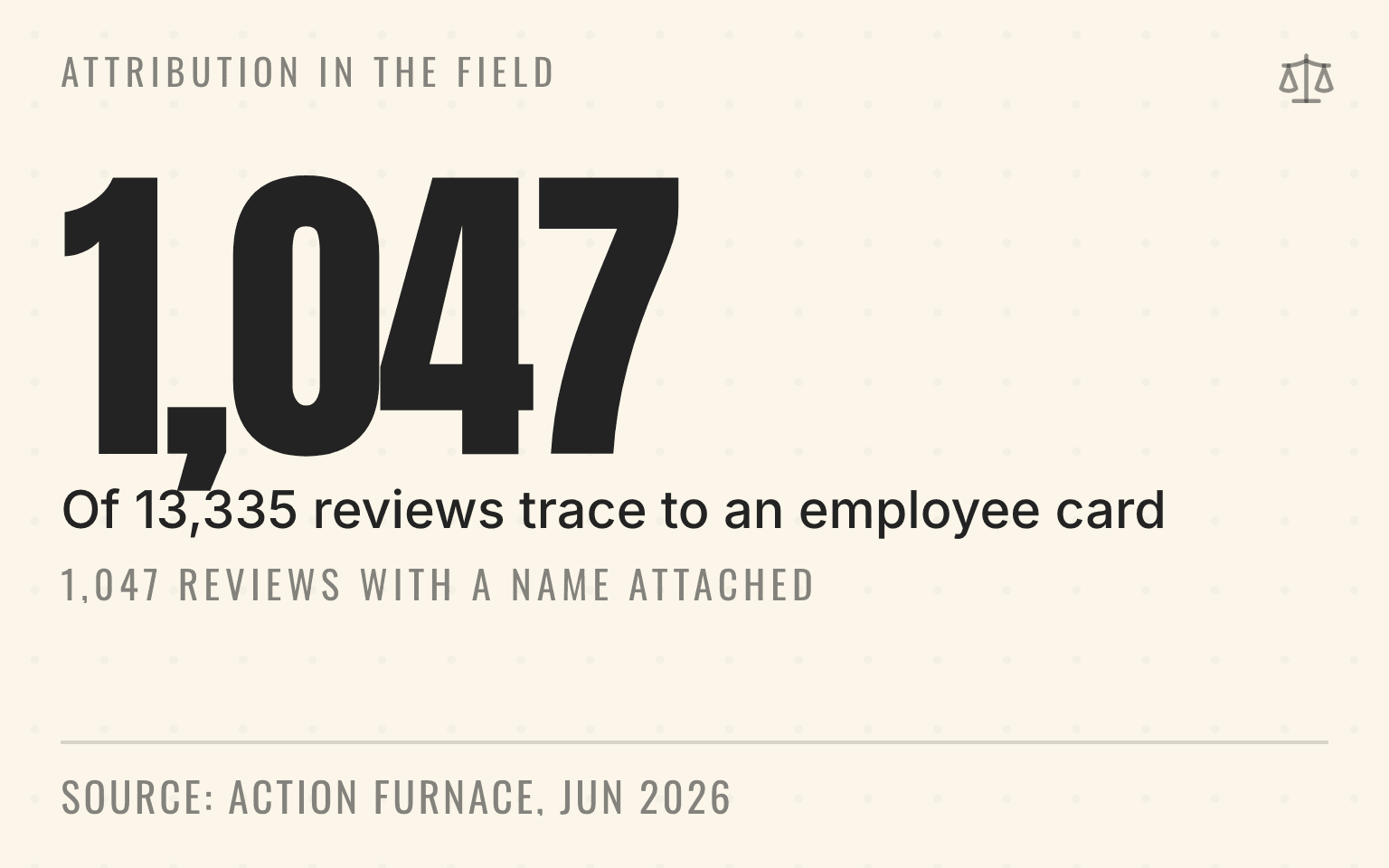
On June 4, 2026, Action Furnace's active Google-connected locations carried 13,335 reviews. Of those, 1,047 carry the ID of the employee card the customer tapped, and 406 carry a tap ID, produced by 240 active cards and 2,474 taps. That attributed minority is the entire point: it is the part a manager can coach from.
Last verified: September 2, 2026.
Review generation software with employee attribution answers a different question than ordinary review request software. The ordinary question is, "Can we send more review links?" The better question is, "Which employees, branches, and service moments are creating legitimate public trust?"
For a multi-location service business, that difference matters. Reviews are earned at the job site, front desk, counter, estimate, dispatch call, install, or follow-up. If the software cannot connect that moment to a person and a location, managers see only the company average.
The Cheers review generation platform is built for that operating layer: compliant asks, employee-level attribution, branch reporting, and local visibility work around the reviews.
Important
Employee attribution should make review generation coachable. It should not turn reviews into pressure, quotas, incentives, or selective asks.
Why attribution changes review generation
Without attribution, most review programs become marketing reports. The team sees review count, average rating, response rate, and maybe sentiment. Those numbers are useful, but they do not explain who is creating the moments that produce reviews.
With attribution, a manager can see which technicians ask consistently, which branch has weak adoption, which service line creates detailed customer language, and which employees deserve recognition for real customer trust.
Action Furnace is the clean public example. The Action Furnace case study reports the full June 2026 proof window, including the growth from 12,097 Google reviews before the November 19, 2025 start date to 13,335 on June 4, 2026, counted the same way throughout. The important part is not the card itself. The important part is that the review program has an operating signal managers can use.
For context on what normal looks like, the Cheers production review pull covering the 90 days ending September 2, 2026 puts the median home-services company at 9.7 new reviews per location a month and the 75th percentile company at 26.4, across 11 companies and 76 locations with at least one review. Aggregate only (corrected September 23, 2026), no company named; see the panel methodology and the Home Services AI Visibility Index.

What attribution should record
A buyer should ask what the system records before, during, and after the review request. At minimum, the platform should separate the review opportunity from the review itself.
- Employee, crew, or role tied to the request path.
- Branch, market, service line, and customer-facing profile.
- Tap, QR path, link click, or request event that started the review path.
- Whether the eventual review can be tied back to the originating path.
- Manager views that compare adoption without turning ratings into quotas.
Not every review will attribute perfectly. Customers can search the business later, click a profile directly, or write from another device. A good system should be honest about that. The attributed subset is still valuable when it is large enough to show patterns by employee, branch, and workflow.
The compliance boundary
Employee attribution is useful only if the review program stays policy-safe.
Google says businesses can ask customers for reviews and provide a review link. Its contribution policy sets the other boundary in two sentences:
"Contributions to Google Maps should reflect a genuine experience at a place or business. Fake engagement is not allowed and will be removed."
The FTC rule that took effect on October 21, 2024 adds the employee question. Asked whether staff may review their own employer, the Commission's guidance answers: "Yes, but ask them to clearly and conspicuously disclose their relationship to your business." An attribution system that quietly counts staff-written reviews as customer proof is a compliance problem, not a reporting quirk.
For operators, that means the software should make neutral asking easier. It should not encourage employees to ask only happy customers, request a specific rating, offer incentives, or pressure customers while they write. Managers should coach behavior: explain the job clearly, finish the work, ask neutrally, and make the review path easy.
Review Collection at Point of Service covers the customer-facing workflow. This article is about the software layer that makes the workflow visible.
If your vendor comparison includes a messaging-first platform, read Podium Alternatives for Home Services Review Generation before treating review texts and technician attribution as the same thing. If it includes a broad reputation suite, the Birdeye alternatives comparison shows which vendors publish technician attribution at all.
Next step
Is AI recommending your business?
Find out how visible you are across ChatGPT, Gemini, Perplexity, and AI Overviews.
How managers use attribution
The best use of attribution is weekly coaching. A branch manager should see whether the team is asking, whether taps or requests are happening after eligible jobs, whether review language mentions the right services, and whether certain employees need help with the handoff.
That view also changes recognition. Instead of praising only the highest-rated branch, leadership can recognize employees whose customers consistently mention professionalism, cleanup, clarity, punctuality, or problem solving.
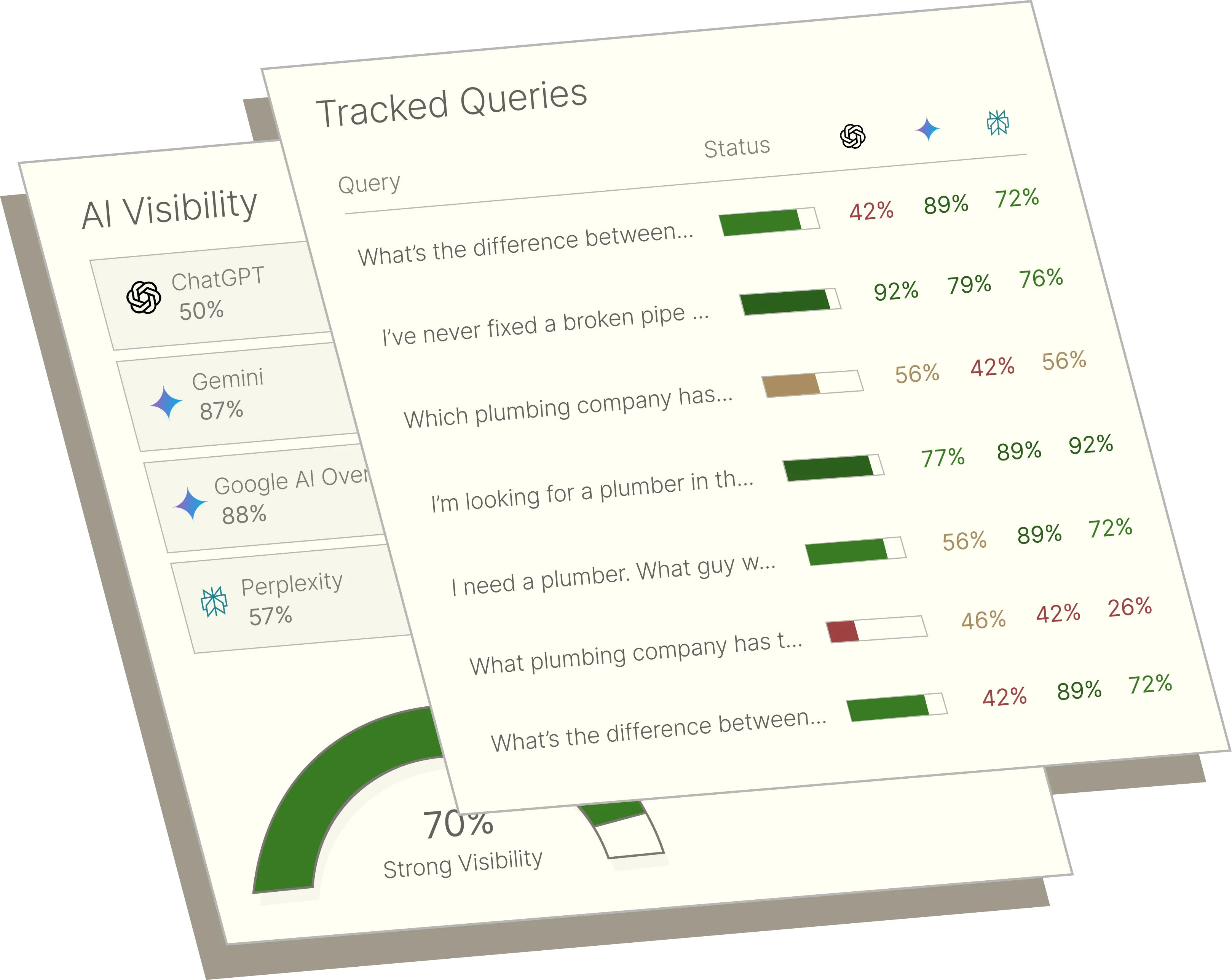
The connection to AI visibility is not automatic, but it is practical. Reviews create public, recent, local language. When that language lines up with Google Business Profile, location pages, citations, and service pages, the business gives search and AI systems more evidence to evaluate. How to turn reviews into AI search content explains the content side of that loop. When an employee or provider is genuinely part of the trust proof, the technician bio standard explains how to publish that proof without creating thin staff pages or policy risk.
What to ask vendors
Use a real operating sample before choosing software. Pick one strong employee, one new employee, one strong branch, one weak branch, and one service line where reviews are thin.
Ask the vendor to show the workflow end to end:
- How does the employee create the review opportunity?
- What does the customer see, and is the request neutral?
- What happens if the customer writes later from another path?
- What can the manager see by employee, branch, market, and service line?
- How does the system prevent quotas, incentives, and selective asking?
- How does review language feed local pages, profiles, and AI visibility work?
Use one final test: review generation software with employee attribution should help managers improve the behavior that creates legitimate reviews. If it only sends more links, it is not enough for a multi-location service brand.
If employee attribution is the buying question, use the demo action below with the branch, employee, and service-line reporting you want to inspect.
Sources
- Tips to get more reviews. Google Business Profile Help, undated help page. Review links, QR codes, and the incentive prohibition. Checked September 2, 2026.
- Manage customer reviews. Google Business Profile Help, undated help page. Checked September 2, 2026.
- Prohibited and restricted content. Google Maps contribution policy, undated policy page. Genuine experience, fake engagement, conflict of interest, and staff review targets. Checked September 2, 2026.
- Rule on the Use of Consumer Reviews and Testimonials: Questions and Answers. Federal Trade Commission, November 2024. Rule effective October 21, 2024. Insider review disclosure and sentiment-conditioned incentives. Checked September 2, 2026.
- Action Furnace case study. Cheers, June 2026 proof window. 13,335 Google reviews, 240 active employee cards, 2,474 taps, 1,047 reviews carrying a card ID, 406 carrying a tap ID.
- Home Services AI Visibility Index 2026. Cheers Research, September 2, 2026.
Dylan Allen-Arnegård is the CEO & Co-Founder of Cheers, the done-for-you platform that manages the website, reviews, listings, structured data, and local content that get service businesses recommended across Google, Maps, ChatGPT, and Perplexity.