

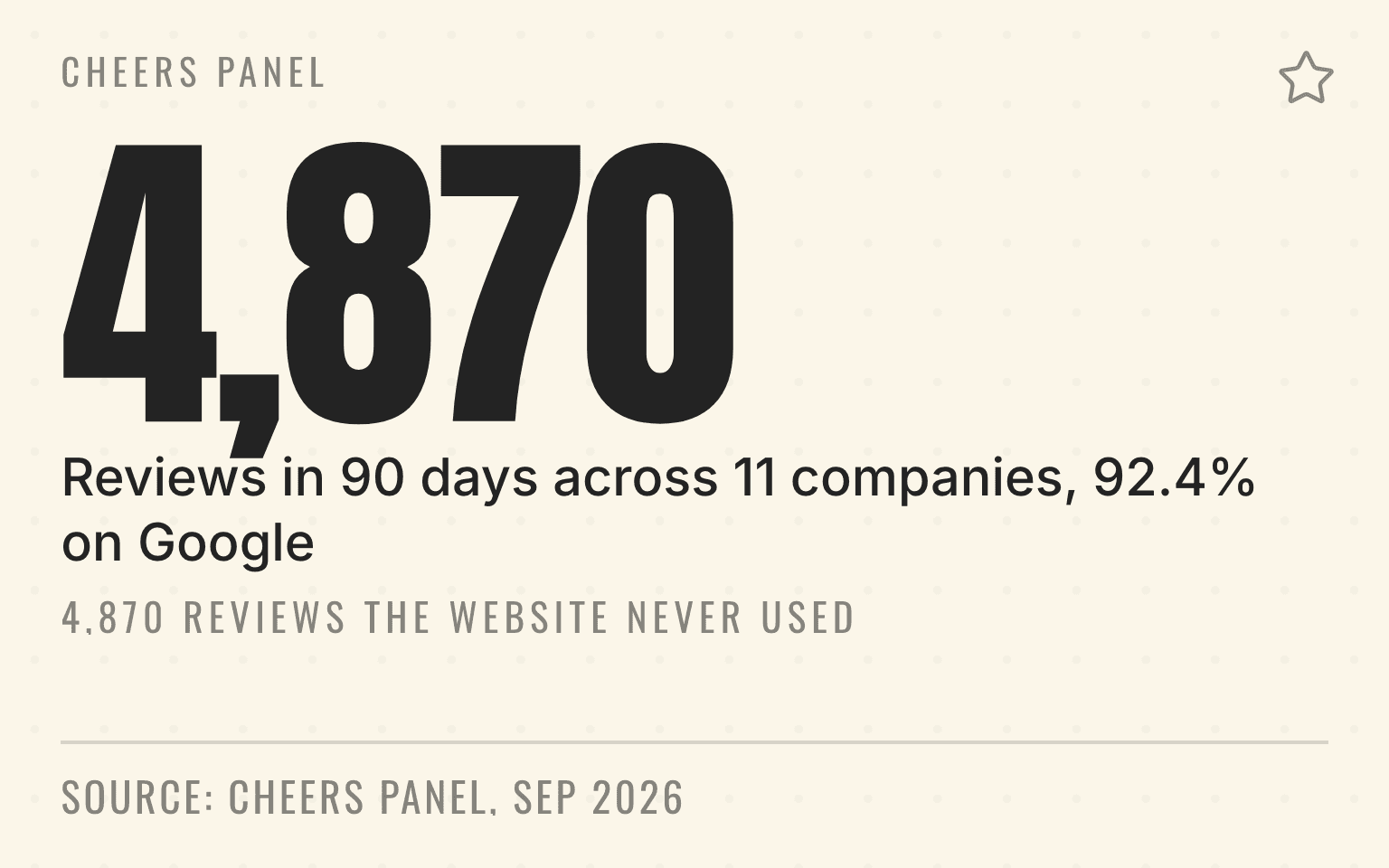
In the Cheers production review pull covering the 90 days ending September 2, 2026, 11 home-services companies collected 4,870 reviews across 76 locations, 92.4% of them on Google, and owners responded to 82.6% of them. That is a large pile of customer language, written by the people who hired the branch, sitting outside the website. Aggregate only (corrected September 23, 2026), no company named; see the panel methodology and the Home Services AI Visibility Index.
Last verified: September 2, 2026.
Multi-location service brands often have better customer evidence in their reviews than on their own pages. Google reviews, Yelp reviews, BBB profiles, call notes, technician feedback, customer surveys, and manager escalations all hold details the website may miss. The Dallas reviews mention slab leaks. The Phoenix reviews mention tankless water heaters. The location pages still say every branch is "fast, friendly, and professional."
When a customer asks "who handles emergency AC repair near me tonight?", AI search has to decide whether a specific branch looks like a fit. Category and distance are not enough. The answer may look for service fit, local coverage, recent review language, response speed, and signs that the right branch can actually handle the job.
Leave the review request neutral, whether the team runs it or review generation runs it for them. After the reviews come in, read them for repeated customer language, verify the patterns with operations, and turn the confirmed themes into page content that customers and AI systems can inspect.
Important
Reviews should inform the page, not script it. Publish the verified theme on the matching location or service page, then explain what the customer should expect.
Use reviews to find page gaps
Review text should answer three page-edit questions.
What words do customers use for the job? They may write "same-day AC repair," "cleaned up after the job," "explained financing," "fixed the issue on the first visit," or "front desk walked me through prep." Those phrases belong on service and location pages when they describe work the business actually performs.
Which branch does the proof belong to? A corporate page can claim the brand is responsive. Recent reviews from the Phoenix branch, Plano franchisee, or Scottsdale studio show whether customers in that market say the same thing.
What customer concern is missing from the page? If customers keep praising water-heater cleanup but the location page never mentions water heaters, the page is under-explaining the work. If reviews mention confusing arrival windows, the page may need a clearer scheduling section.
Google's AI features guidance says AI Overviews and AI Mode use normal Search foundations, including crawlable text, internal links, page experience, structured data that matches visible copy, and up-to-date Business Profile information. On the question operators keep asking, its answer is five words:
"There are no additional technical requirements."
The AI optimization guide repeats it from the schema side: "Structured data isn't required for generative AI search, and there's no special schema.org markup you need to add." Google's generative AI guidance also pushes site owners toward original, people-first content and gives first-hand reviews as an example of a first-hand perspective. For a local service brand, review themes are a direct way to find that perspective without inventing it.
Use patterns, not testimonial walls
Recurring review patterns should shape the service explanation, local proof, FAQ, and operating notes on the matching page. Testimonial walls are a separate marketing asset.
An HVAC location page might add a section explaining same-day diagnostics because recent reviews repeatedly mention fast response for failed condensers. A med spa page might clarify consultation, prep, and aftercare because reviews mention anxiety before the first appointment. A restoration page might explain insurance coordination because customers keep praising the office team for paperwork help.
Do not copy a five-star review into every page and call the job done. Ask: "What do customers keep telling us about this service and location, and does the page answer that same concern?"
When the page already answers the concern, the review theme gives the content owner proof to keep it. When the page does not answer the concern, the content owner has a specific gap to fix. What should location pages include for AI search? covers the broader page standard. This article focuses on the review-to-page workflow behind that standard.
Give one person the review pass
The owner can sit in marketing, reputation, customer experience, or regional ops. The important part is that someone reads the reviews before the next batch of page edits goes live.
Monthly, pull 20 to 50 recent reviews for each priority location and service line. Tag repeated themes: service, urgency, staff behavior, outcome, complaint, and customer question. Ask the local manager which themes are true enough to publish. Then update the matching public page, review response guidance, FAQ, or coaching note and retest the AI answers.
For a 60-location plumbing brand, that workflow might show that Dallas customers mention "slab leak," Phoenix customers mention "tankless water heater," and Atlanta customers mention "after-hours sewer backup." Those terms belong on the relevant pages only if the branch actually handles the work.
For a franchise wellness brand, the themes may be less technical: first-visit anxiety, cleanliness, front desk clarity, provider names, treatment prep, pricing confusion, or membership questions. A page edit can answer the customer concern. A coaching note can fix the front-desk behavior that created the concern in the first place.
Keep the review ask neutral
This workflow starts after the review exists. It should not change the review request itself.
Google Business Profile guidance says businesses can remind customers to leave reviews and can share a Google review link or QR code. The same guidance says reviews should reflect genuine experience and prohibits incentives in exchange for posting, changing, or removing reviews.
Google Maps user-generated content policies also prohibit misleading accounts, conflict-of-interest content, advertising or solicitation in reviews, repetitive content, and content that is not based on an experience at a specific location. For operators: never tell customers what to write.
That means no "please mention emergency repair," no "please say five stars," no contests for review wording, no review gating, and no pressure while a technician watches the customer type.
Use the same compliant request covered in Review collection at point of service: ask eligible customers neutrally, make the review link easy, attribute the request to the frontline employee when possible, and analyze the customer's own wording only after the review is posted.
If the review system still only monitors reviews after the fact, use Best Review Management Software for Home Services Companies to compare field capture, attribution, branch reporting, and response workflows.
Next step
Is AI recommending your business?
Find out how visible you are across ChatGPT, Gemini, Perplexity, and AI Overviews.
Publish themes where AI systems can find them
Put each review theme on the source an answer engine would retrieve for that local buying question.
A brand-level blog post about "great customer service" will not help much if the buyer is choosing a branch in Mesa, a garage door team in Tampa, or a med spa studio in Columbus. The theme should land on the page that answers the local buying question.
For a storefront location, that usually means the location page. For a service-area business, it may mean the market page, dispatch-area page, or service page for the branch that handles the job. How service-area businesses should show coverage for AI search explains how those sources need to agree.
OpenAI's crawler docs make this operational. OAI-SearchBot is the crawler OpenAI uses for surfacing websites in ChatGPT search features. OpenAI also says sites opted out of that crawler will not be shown in ChatGPT search answers, except as navigational links. If OAI-SearchBot cannot crawl the page where the theme lives, ChatGPT search has less public source evidence to use.
Turn each review theme into customer-facing operational detail. A theme about "cleanup" should become a plain section that explains what cleanup means after the service, what the crew removes, and what the customer should expect. A theme about "confusing pricing" should become clearer pricing context, not a defensive review response copied into the page.
Do not misuse testimonials or review schema
Using review themes affects two claims: testimonial advertising and structured-data proof.
The FTC's Consumer Reviews and Testimonials Rule went into effect on October 21, 2024. FTC staff guidance says testimonials are advertising messages, and that a business putting testimonials on its own website is disseminating them. The FTC guidance also warns that non-representative use of consumer reviews in marketing can be deceptive under Section 5 of the FTC Act.
For a multi-location operator, that means a page should not cherry-pick one glowing review and imply it represents every location or service. If you quote a customer, use a quote you have the right to use, keep the wording accurate, protect private details, and do not hide the broader reality of the review profile.
Structured data has its own boundary. Google's review snippet documentation says LocalBusiness review snippets apply only to sites that capture reviews about other local businesses and points readers to the self-serving review guidelines. It also notes that Google does not guarantee rich result display from structured data.
Use LocalBusiness, Organization, Service, FAQPage, and other markup to reinforce visible facts. Do not add fake aggregate ratings, scrape third-party reviews into schema, or use markup to claim proof the page does not show.
Make the page prove the review theme
A review theme should not land as a sentence stuffed into an old paragraph. Put it where a buyer or answer engine would naturally look.
If Phoenix reviews keep mentioning same-day AC repair, the Phoenix location page should name same-day AC repair, explain the dispatch rule, show the branch phone path, and link to the AC repair service page. If Plano reviews keep mentioning financing explanations, the page should explain where financing comes up in the service process and what the customer should ask before booking.
The strongest pages use review language as proof of real operations. The weakest pages use review language as decoration.
Measure the answer, then trace the source
The operator question is not "did we publish content?" The question is "did the answer get better?"
Pick one service, one market, and one location. Test the same buying-intent prompt across Google AI Mode when available, AI Overviews, ChatGPT, Gemini, and Perplexity. Record which brands appear, which sources support the answer, which location is named, and which customer proof is missing.
Then compare the answer against the public evidence. If AI answers mention competitors with stronger review language for "same-day repair," inspect the reviews and pages. If the branch page has the theme but the third-party sources do not, the issue may be source coverage. If reviews have the theme but the page does not, the content owner has work to do.
How to audit AI search visibility across locations covers the full market-by-market audit. How local service brands should track AI search traffic covers the measurement stack behind that audit. The review-to-content layer is one source check inside that work.
Start with one location and one service
Do not turn this into a 200-page rewrite. Start with a high-value service in one market where the brand has enough recent reviews to see a pattern.
Read the last 20 to 50 reviews across Google, Yelp, BBB, or the relevant vertical source. Mark the themes customers repeat. Verify the themes with the location owner. Update one page so it explains the service, local proof, process, and customer concern more clearly. Then retest whether the answer names the updated source, the right location, and the verified customer proof.
For the first pass, give marketing a one-page change list: the review theme, the source, the location manager's confirmation, the page that needs the edit, and the prompt or AI answer you will retest. After one page improves, repeat the same review pull, manager verification, page update, and AI-answer test for the next high-value service.
Sources
- AI features and your website. Google Search Central, last updated December 2025. Search foundations for AI Overviews and AI Mode, and the statement that there are no additional technical requirements. Checked September 2, 2026.
- Optimizing your website for generative AI features. Google Search Central, last updated July 2026. People-first content and the structured-data statement. Checked September 2, 2026.
- Tips to get more reviews. Google Business Profile Help, undated help page. Review links, QR codes, incentives, and balanced feedback. Checked September 2, 2026.
- Prohibited and restricted content. Google Maps contribution policy, undated policy page. Checked September 2, 2026.
- Review snippet structured data. Google Search Central, last updated July 24, 2026. Limits on Review and AggregateRating markup for self-controlled reviews. Checked September 2, 2026.
- Overview of OpenAI crawlers. OpenAI, 2026. OAI-SearchBot surfaces websites in ChatGPT search; GPTBot crawls content for foundation model training. Checked September 2, 2026.
- Rule on the Use of Consumer Reviews and Testimonials: Questions and Answers. Federal Trade Commission, November 2024. Rule effective October 21, 2024. Checked September 2, 2026.
- Home Services AI Visibility Index 2026. Cheers Research, September 2, 2026.
Dylan Allen-Arnegård is the CEO & Co-Founder of Cheers, the done-for-you platform that manages the website, reviews, listings, structured data, and local content that get service businesses recommended across Google, Maps, ChatGPT, and Perplexity.