

Google caps what one profile may claim. Business Profile Help allows up to 20 service areas, and sets a boundary most brands never check:
The boundaries of your overall area shouldn't be more than about 2 hours of driving time from where your business is based.
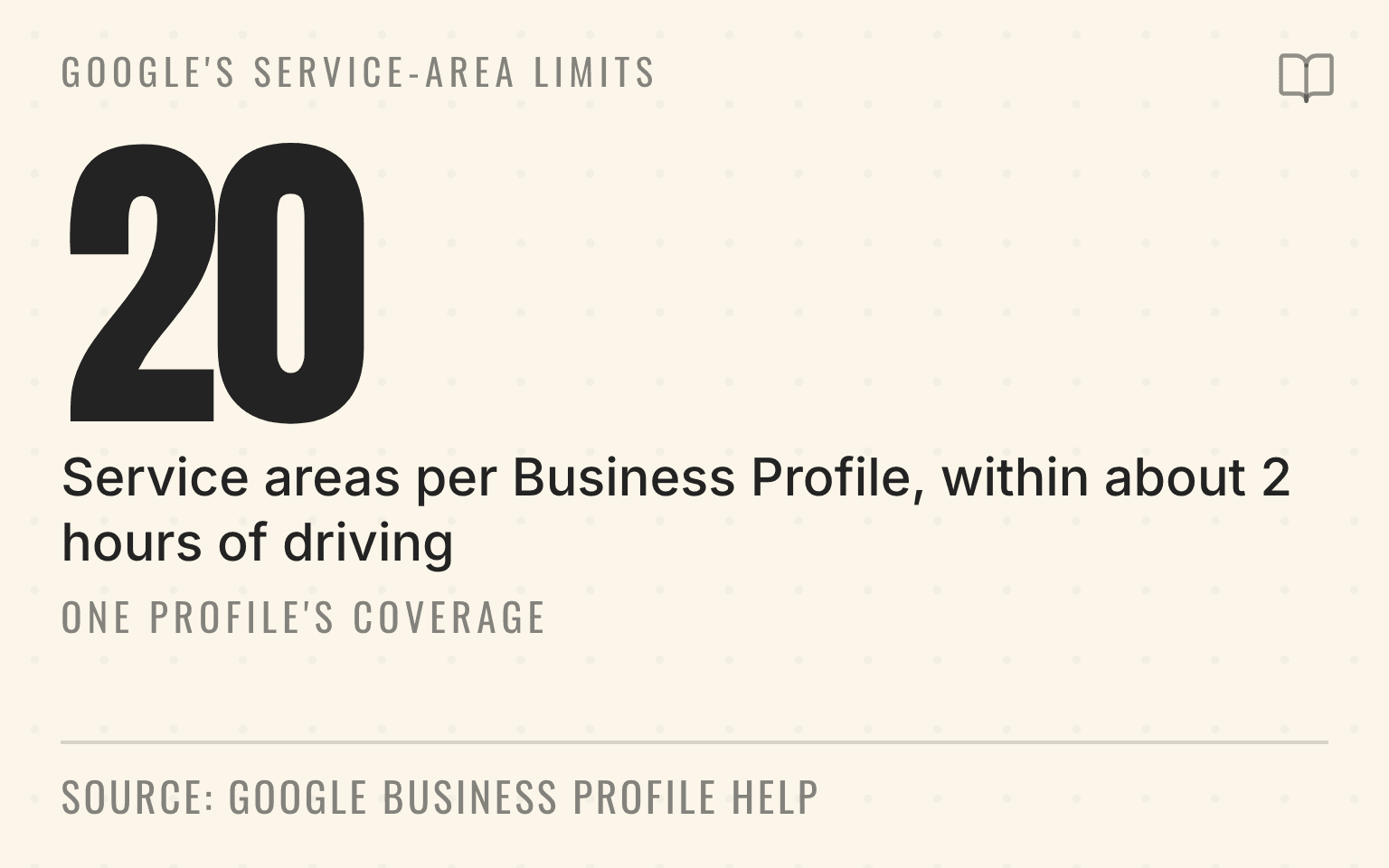
Two hours of driving, 20 areas. That is the territory one profile is allowed to describe, however many cities the sales team has promised. Most service-area coverage problems start there, with a profile claiming a metro the branch cannot actually reach, and end four sources later when the website, the reviews, the old citations, and the schema each tell a different version.
Google's service-area limits
What one profile can claim
20
Service areas one Business Profile may list
2 hours
Rough outer limit of driving time from the base
Google Business Profile Help: Manage your service areas (support.google.com/business/answer/9157481), checked September 2, 2026.
| Finding | Value | Base |
|---|---|---|
| Service areas one Business Profile may list | 20 | Stated in the source |
| Rough outer limit of driving time from the base | 2 hours | Stated in the source |
For AI search, that spread is the whole problem. The answer has to decide whether this branch serves this customer, and it decides by comparing public sources. Vague or conflicting coverage does not read as a bad business. It reads as a business the engine has to guess about, so it picks one it does not have to guess about.
Important
Pick one branch, one service, and one market. The GBP service area, market page, review text, top citations, and schema should all describe the same coverage.
Start with coverage customers can verify
Service-area businesses should show coverage in five places: the Google Business Profile service area, the matching location or market page, the service details, review and citation sources, and structured data that matches visible page content.
Google Business Profile lets service-area and hybrid businesses define where they provide products or services. Google says service areas should be specific and accurate, can be set by city, postal code, or another area type, and cannot be set as a radius. Google also says businesses that do not serve customers at their address should remove that address from the public profile.
That profile work needs support from the website. The market page should be indexable, linked from the relevant branch or service page, and clear about the service area in visible copy. The JSON-LD should match that copy. The Business Profile should stay current after dispatch rules, service areas, or hidden-address settings change.
For the broader profile question, read Is Google Business Profile Enough for AI Visibility?. This guide focuses on the coverage layer for service-area businesses.
When a second staffed base opens inside the same metro, use the multiple Google Business Profiles eligibility guide to decide whether it is another real service operation or only another territory.
If the proposed base is a mailbox, rented suite, or coworking office, apply the Google Business Profile virtual-office rules before changing the coverage model or adding a map record.
Why service-area coverage is harder for AI search
A storefront can usually anchor itself with a visible address. A service-area business often has to prove a different kind of local fit: crews travel to the customer, coverage may change by job type, and a nearby city may or may not be inside the real dispatch area.
That matters for HVAC, plumbing, roofing, pest control, garage doors, smart home installation, restoration, mobile med spa services, and other dispatched categories. A buyer may ask, "who handles same-day AC repair in Gilbert?" or "which security installer serves homes in Plano?" The answer needs to know more than the parent brand name. It needs to know whether the local team covers that area, performs that service, and offers a real contact path.
AI search can expose weak coverage because it can compare several public sources before summarizing an answer. A page may say "serving the metro," while the profile lists only a few ZIP codes and citations show an old office. That conflict does not prove the business is bad. It means the page, profile, and citations are asking the answer engine to guess.
For the retrieval mechanics behind those multi-source checks, read What query fan-out means in Google AI Mode.
Place-named prompts are where coverage gets tested
The prompt shape service-area brands care about most is the one that names a place or says near me. Cheers does not publish an appearance rate for it yet. In the 28 days ending September 2, 2026, fewer than 10 of the 13 home-services companies in our panel tracked that shape, which is below the floor we set before publishing any cut.
The mechanics do not need a panel number. A brand can be visible on "best AC repair companies" and still lose "who does same-day AC repair in Gilbert," because the second question forces the engine to resolve a place against a business, and nothing in the brand's public record resolves it cleanly. The cuts we do publish sit in the home services AI visibility index, with definitions in the research methodology.
Build coverage proof across sources
Treat coverage as an operating workflow. The GBP owner sets the correct service-area or hybrid business type, hides the address when customers are not served there, and keeps service areas specific.
Marketing owns the matching location or market page. It should explain the real coverage area, dispatch branch, services, hours, phone path, and booking rules in visible text. Ops owns the dispatch rule, including exclusions or emergency rules that affect routing.
The review owner checks whether recent customers naturally mention the job, market, technician, response time, and outcome. The listings owner checks Yelp, BBB, Apple Maps, Bing Places, Facebook, and category directories for the same name, phone, URL, category, service area, and old-address conflicts. The web owner adds LocalBusiness, Service, URL, telephone, opening hours, and areaServed only where those facts already appear on the page.
The next action is simple: compare the GBP service area against the matching market page and top citation rows. What should location pages include for AI search? covers the page standard. Which citations matter for AI search? covers the off-site source layer.
For bilingual markets, the same rule applies in Spanish. Use the Spanish-language service page standard so a translated page does not claim cities, services, response paths, or language support the branch cannot actually provide.
Use Google Business Profile accurately
Google's service-area guidance creates a useful baseline. A service-area business visits or delivers to customers directly and does not serve customers at its business address. A hybrid business serves customers at a business address and also visits or delivers to them. Google's representation guidelines are blunt about the address:
If you're a service-area business, you should hide your business address from customers.
The same guidelines say a service-area business should have one profile for the central office or location with a designated service area, which rules out the common instinct to spin up a profile per city.
For multi-location operators, the hard part is governance. A rollup may acquire a contractor with an old home address on the profile. A franchisee may add cities that the team cannot realistically serve. A regional manager may change call routing without updating the profile. Each drift creates a public source conflict.
The clean standard is operational truth. If a plumbing branch serves three counties, show those areas. If a roofing team does not cross a state line, do not imply that it does. If a security installer handles residential jobs in one market and commercial jobs in another, separate that in the page copy and service details instead of hiding it inside a broad "service area" claim. Use the residential and commercial service-rules standard when customer type changes dispatch, equipment, proof, or routing.
Google also lets service businesses manage services on the Business Profile, including suggested services, custom services, descriptions, and prices when appropriate. Use that field set carefully. It should match what the branch can sell and deliver, and it should connect to the services described on the matching page.
Treat service areas like dispatch rules
Strong coverage pages read like the public version of the dispatch rule. A weak page says "serving the greater metro." A strong page explains which team handles which market, which services are available there, whether emergency work changes the boundary, and how the customer reaches the right office.
For home services, this can be the difference between a useful market page and a doorway page. "We serve Mesa" is weak. "Our Phoenix East branch handles AC repair, water heater service, and smart thermostat installs in Mesa, with after-hours emergency calls routed through the same dispatch team" gives a customer and an answer engine something to verify.
Next step
Is AI recommending your business?
Find out how visible you are across ChatGPT, Gemini, Perplexity, and AI Overviews.
Make website pages answer the coverage question
A service-area page should not read like a list of cities bolted onto a corporate service page. The page should answer the question a customer is actually asking: "Can this team handle my problem where I am?"
For an HVAC brand, that may require coverage details by city, system type, emergency availability, financing, warranties, and the branch that handles the request. For a restoration brand, it may require the dispatch area, response expectations, insurance coordination, certifications, and after-hours routing. For a smart home or security installer, it may require installation territory, product categories, monitoring options, and whether the same team services the system after installation.
That does not mean every suburb deserves a separate page. Google warns against creating separate content for every possible search variation when the purpose is manipulating rankings or AI responses. A useful page has real local substance: service rules, proof, photos, FAQs, reviews, contact paths, and a reason for the URL to exist.
If your team is deciding whether to create or consolidate pages, use this test: would a customer in that market learn something specific that changes their decision? If the answer is no, improve a stronger market page instead of creating another thin city variant.
Add structured data only after the visible facts are clean
Structured data helps when it labels facts already present on the page. Google's LocalBusiness structured data documentation says LocalBusiness markup can be added to pages that contain business information, and it recommends using the most specific subtype possible. Schema.org defines areaServed as the geographic area where a service or offered item is provided.
For a service-area business, areaServed belongs only when the visible page already explains the coverage. A Scottsdale AC repair page can use areaServed for Scottsdale if the page names that market, the branch handles the service there, and the contact path routes correctly. Do not add areaServed for cities the dispatch team will not serve or for a generic corporate page with no local coverage detail.
Do not let schema become a shortcut around weak content. If the visible page does not explain the coverage area, adding areaServed to JSON-LD will not fix the customer experience. It also creates a trust problem if the structured data claims cities, services, or hours that the page does not support.
For HVAC-specific ChatGPT visibility across service-area markets, see How Do HVAC Companies Get Recommended by ChatGPT?.
For implementation details, pair this guide with What is schema markup for local businesses? and What is JSON-LD for local businesses?.
Measure coverage by market and brand
Service-area visibility should be audited at the market level. A brand-level view can hide the exact branch where the coverage story breaks.
Pick the highest-value service lines and the markets where one booked job matters. Test prompts across Google AI Mode or AI Overviews when available, ChatGPT, Gemini, and Perplexity. Write the row like an operator would: "emergency AC repair in Mesa," expected Phoenix East branch, answer cited Yelp, Yelp shows the old office phone, GBP and page use the new call-routing number, listings owner fixes Yelp, rerun next Friday.
Then compare the answer against the profile, page, reviews, citations, and schema. If the profile is accurate but the page is thin, marketing owns the page. If the page is strong but citations show an old phone number, the listings owner handles citations. If the profile claims cities the team cannot serve, operations needs to tighten the territory rule.
How to Audit AI Search Visibility Across Locations gives the operating cadence. How local service brands should track AI search traffic explains how to separate visibility, citation, referral, and lead signals while that audit runs. The service-area layer is one row in that audit, but for home services it is often the row that decides whether the branch belongs in the answer.
What to inspect first
Choose one high-value service, one priority market, and one location or territory. Ask whether a customer and an AI answer can verify coverage without calling first.
Spend 30 minutes on the first inspection. Open the GBP service areas, the matching page copy, the last 20 reviews, the top citation rows, and the JSON-LD. Mark the first conflict and assign it to the owner: profile, marketing, ops, listings, or web. Fix that before adding more pages or expanding the service-area claim.
Cheers manages those coverage signals across location pages, Google Business Profiles, reviews, listings, and structured data. The multi-location local SEO page shows the operating model. Use the demo action below to see where one of your priority markets is telling conflicting stories.
Sources
Checked September 2, 2026.
- Manage your service areas for service-area and hybrid businesses. Google Business Profile Help, accessed September 2026. support.google.com/business/answer/9157481. Source of the quoted 2-hour driving boundary, the 20-area limit, and the service-area and hybrid definitions.
- Guidelines for representing your business on Google. Google Business Profile Help, accessed September 2026. support.google.com/business/answer/3038177. Source of the quoted address-hiding rule and the one-profile-per-central-office rule.
- Manage your services on your Business Profile. Google Business Profile Help, accessed September 2026. support.google.com/business/answer/9455399. Source of the suggested and custom service fields, including price and description.
- AI features and your website. Google Search Central, last updated December 10, 2025. developers.google.com/search/docs/appearance/ai-features. Source of the point that AI Overviews and AI Mode run on normal Search foundations.
- Optimizing your website for generative AI features on Google Search. Google Search Central, last updated July 10, 2026. developers.google.com/search/docs/fundamentals/ai-optimization-guide. Source of the warning against separate pages for every search variation.
- Local business (LocalBusiness) structured data. Google Search Central, last updated December 10, 2025. developers.google.com/search/docs/appearance/structured-data/local-business. Source of the most-specific-subtype guidance.
- areaServed. Schema.org vocabulary, accessed September 2026. schema.org/areaServed. Source of the definition of areaServed as the geographic area where a service or offered item is provided.
- Cheers panel: 13 home-services companies, 28 days ending September 2, 2026, non-branded prompts, aggregate only (corrected September 28, 2026). Home services AI visibility index and methodology. Source of the 10-company floor for publishing a prompt-shape cut.
Dylan Allen-Arnegård is the CEO & Co-Founder of Cheers, the done-for-you platform that manages the website, reviews, listings, structured data, and local content that get service businesses recommended across Google, Maps, ChatGPT, and Perplexity.