

Google's spam policies name the failure mode directly. Scaled content abuse is "when many pages are generated for the primary purpose of manipulating search rankings and not helping users", and one listed example is generating many pages "including through automated transformations like synonymizing, translating, or other obfuscation techniques, where little value is provided to users". Bulk translation of an English site is that example, almost word for word.
So publish a Spanish-language page when customers already ask for the service in Spanish and the local team can support the same promise from page visit through booking and field handoff. Auto-translating every English page and swapping city names produces bilingual URLs without proving the branch can deliver a bilingual customer experience.
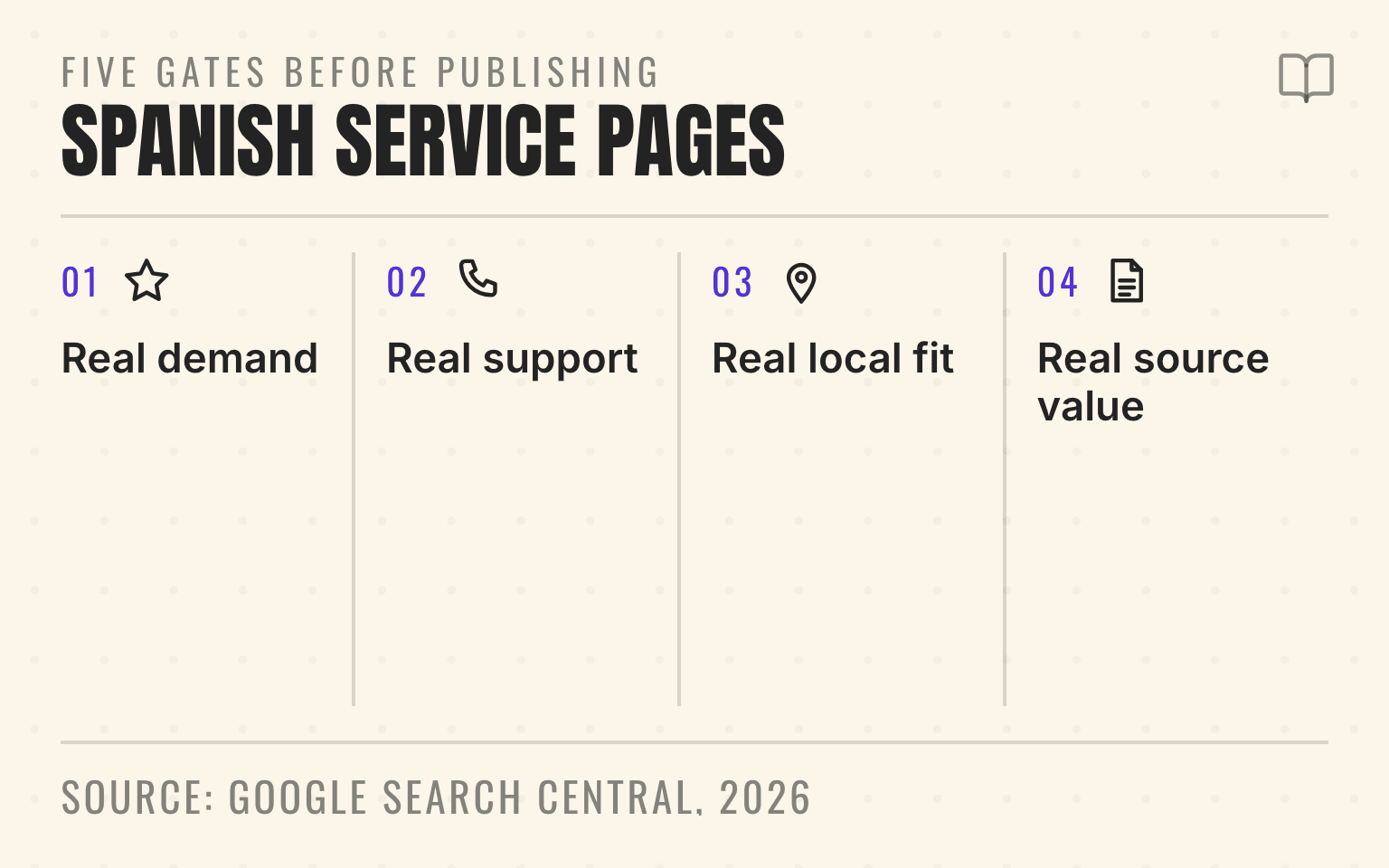
Five gates before publishing
Earn the Spanish URL
- 01Market
Real demand
Calls, reviews, forms or prompts show Spanish service questions in that market
- 02Ops
Real support
Branch, call center, form and field team can honor the promise in Spanish
- 03Branch
Real local fit
Maps to one branch, service area, service line and booking path
- 04Content
Real source value
Explains what the customer needs before booking, not translated brand copy
- 05Technical
Real alternates
Each version lists itself and every other version, per Google's hreflang rule
Article body; hreflang requirement from Google Search Central, Tell Google about localized versions (developers.google.com/search/docs/specialty/international/localized-versions), last updated December 2025; scaled content abuse from Google Search Central spam policies, August 2026.
- Flow diagram of the five gates a Spanish-language service page has to clear before publishing.
- 1. Real demand: Calls, reviews, forms or prompts show Spanish service questions in that market
- 2. Real support: Branch, call center, form and field team can honor the promise in Spanish
- 3. Real local fit: Maps to one branch, service area, service line and booking path
- 4. Real source value: Explains what the customer needs before booking, not translated brand copy
- 5. Real alternates: Each version lists itself and every other version, per Google's hreflang rule
Spanish-language pages are not an AI search shortcut. For HVAC, plumbing, electrical, restoration, roofing, pest control, garage doors, med spas, hospitality groups, and franchise service brands, they are customer-service sources. They should help a real customer understand the service, coverage, next step, and proof in the language they are using to make the decision.
Google's current guidance for AI features in Search points businesses back to normal Search foundations: useful content, crawlable pages, clear page structure, and sources that can be selected from the Search index. Google's international guidance says localized versions should use different URLs and can use hreflang to show alternates. Google's spam policies also warn against scaled content that exists mainly to manipulate rankings, including translated pages with little added value.
That creates a narrow operating standard for local service brands: publish Spanish pages when they translate real operating truth. Do not publish them when they only translate keywords.
If you need to see whether AI answers already mention Spanish-speaking service, bilingual dispatch, or competitors by market, start with an AI visibility check. Then fix the public sources that a customer or answer engine can verify.
Important
A Spanish service page should translate an operating source instead of an English keyword page. The service, branch, coverage, booking path, and frontline handoff need to stay true in both languages.
When a Spanish page earns its own URL
A Spanish service page deserves a separate URL when it answers a customer question better than the English page can.
For a plumbing brand in Phoenix, that might be a Spanish drain-cleaning page tied to the branch that actually has Spanish-speaking dispatch coverage. For a pest control company in Dallas, it might be a Spanish termite inspection page that explains prep steps, service-area limits, and what happens before the technician arrives. For a restoration brand, it might be a Spanish water-damage page that explains the emergency call path, documentation, insurance handoff, and safety steps.
The page should not be a second copy of the English page with translated headings. It needs a reason to exist:
- Real demand: customers, calls, reviews, forms, or prompts show Spanish-language service questions in that market
- Real support: the branch, call center, form, or field team can honor the Spanish-language promise
- Real local fit: the page maps to a branch, service area, service line, and booking path
- Real source value: the page explains details customers need before booking rather than generic brand copy
- Real alternates: the English and Spanish versions point to each other cleanly through internal links and hreflang
For multi-location operators, the most common mistake is treating language as a brand-wide setting. Spanish support may be strong in one region, partial in another, and unavailable in a third. A national template should not imply every branch can support the same customer journey.
What to localize before writing
Translate the facts that affect the booking decision first.
Start with the English source page and mark the pieces that must stay aligned: service name, branch or market, service area, emergency rules, price or fee caveats, financing or payment rules, warranty limits, eligibility, booking steps, phone routing, and proof. Then decide what needs a customer-friendly Spanish explanation instead of a literal translation.
That work connects to several existing source standards. If the Spanish page names a branch, it should match the location-page standard. If it describes dispatch coverage, it should match the service-area coverage standard. If it creates a new city page, it should pass the doorway-risk standard.
For field-service categories, the page should also explain what the technician or dispatcher can actually do in Spanish. A Spanish page that sends the customer to an English-only booking flow, an English voicemail, or a technician who cannot honor the page creates a service failure. The same problem happens when the page says same-day service in Spanish but the local dispatch rule only supports next-day visits for that market.
Hreflang is a routing label, not the strategy
Hreflang helps search systems understand localized versions of a page. It does not make a weak page useful.
Google's localized-version guidance sets one requirement teams routinely half-implement: "Each language version must list itself as well as all other language versions." Google also suggests a fallback: "Consider adding a fallback page for unmatched languages, especially on language/country selectors or auto-redirecting home pages", using the x-default value. For a United States Spanish page, that usually means an English page, a Spanish page, and sometimes an x-default for visitors who match neither target.
The technical pattern matters because multi-location brands often create language pages in inconsistent ways. One market may use /es/ac-repair-phoenix/. Another may use query parameters. Another may place the Spanish copy inside the same page behind a tab. Another may block the translated page from indexing while still linking it from the site.
Use a simple rule: if the Spanish page is meant to be found and cited, give it a stable crawlable URL, make the language obvious in visible content, add a clear route back to the English version, and keep the alternates complete. Then make sure robots rules do not block the page from the search and AI systems you want to reach. OpenAI's crawler documentation, for example, distinguishes search crawling from model-training crawling, so robots decisions should be intentional instead of copied from a generic blocklist.
Avoid thin translated city pages
Spanish-language pages can create the same quality problem as city pages.
A rollup may decide to translate every English service page across every market. The result looks comprehensive in a spreadsheet, but many pages have no local proof, no Spanish booking support, no review language, no service-area nuance, and no branch-specific answer. That is not a bilingual source system. It is a translated doorway pattern.
Google's AI content guidance accepts automation when the output is useful and meets Search quality expectations. Its spam policies draw the line at "many pages" generated "for the primary purpose of manipulating search rankings and not helping users", and name automated translation as one of the transformations that produces them "where little value is provided to users". The test is value to the reader, not whether a human pressed the button.
For local service brands, the practical test is simple: would a Spanish-speaking customer in that market learn something specific enough to decide what to do next? If not, improve the stronger branch page, service-area page, or location finder before creating another URL.
This is also why indexable location finder pages matter. The locator should help customers find the right branch and language path. It should not hide a pile of translated pages that the branch cannot support.
Next step
Is AI recommending your business?
Find out how visible you are across ChatGPT, Gemini, Perplexity, and AI Overviews.
Match the page to profiles, booking, and field handoffs
A Spanish page should not stand alone. It has to agree with the public source stack around the branch.
Google Business Profile guidance says profile information should be accurate and up to date. Google's business-details documentation also tells site owners to establish the official website and business details that Google can use. For local brands, that means the Spanish page should not claim services, hours, booking paths, or language support that the profile, website, phone path, and field team do not support.
Structured data can reinforce the same visible facts. LocalBusiness structured data should represent the actual local business or branch on the page. Schema.org availableLanguage can describe a language someone may use with a service or place. Those labels are useful only when the visible customer experience supports them. Do not add availableLanguage for Spanish if the page, form, phone route, or branch cannot serve the customer in Spanish.
The same standard applies to reviews and citations. If Spanish-speaking customers mention the service, market, technician, or result in reviews, that language can strengthen the page. If directories still point to old phone numbers or old branch names, fix the source conflict before testing Spanish prompts.
How to test Spanish-language AI visibility
Test the page the way a customer would ask.
Use prompts in Spanish and include the service, market, urgency, and category. Compare answers across Google AI Mode or AI Overviews when available, ChatGPT, Gemini, Perplexity, Claude, and Grok. Record which sources are cited, whether the right branch appears, whether the answer respects the service area, and whether the booking route matches the page.
The useful scorecard has six checks:
- Query: Spanish prompt, service, market, and intent
- Page: Spanish URL, English alternate, local facts, and next step
- Profile: category, services, hours, phone path, and service area
- Proof: reviews, photos, licenses, credentials, and recent job language
- Access: crawlability, robots rules, internal links, hreflang, and schema
- Owner: marketing, operations, listings, call center, or field team
Do not treat the first test as a ranking report. Treat it as a source audit. If the answer cites an old directory, fix the directory. If the answer finds the English page but not the Spanish page, check linking, crawlability, and hreflang. If the answer recommends a competitor because that competitor explains Spanish service more clearly, decide whether the gap is real operations or missing content.
What Cheers can and cannot tell you here
Cheers does not publish a Spanish-language cut. The tracked prompts in the Cheers Market Baseline are English, so nothing in the panel measures Spanish demand, Spanish citation behavior, or bilingual conversion. Anyone selling you a Spanish AI visibility benchmark should be asked where the Spanish prompts came from.
What the panel does support is the market-by-market argument underneath this whole article. Running the same 32 English home-services prompts in 100 metro service areas over the 28 days ending September 2, 2026 produced between 373 and 852 distinct cited domains per metro, and a directory citation share ranging from 12.3% to 34.6%. Identical prompts, identical engines, and the source environment still changed that much between markets. Language support deserves at least the same market-level treatment rather than a brand-wide switch. Definitions are in the Cheers Research methodology.
The publish decision
Publish the Spanish page when the branch can support the customer journey and the page adds local value. Hold it when the page would overpromise language support, expand service areas beyond dispatch reality, or duplicate an English template with no new customer help.
For PE-backed and multi-location service brands, this should become a small governance loop: pick the markets where Spanish-speaking customers already ask, confirm local support with operations and dispatch, publish one strong service or location page before scaling templates, add hreflang and visible alternate links, then test Spanish AI prompts by market and fix source conflicts.
That loop is slower than bulk translation. It is also the version that can survive a customer call, a branch audit, and an AI answer that cites the page.
Sources
Every link below was opened and checked September 2, 2026.
- Spam policies for Google web search. Google Search Central, last updated August 2026. Source of the quoted scaled content abuse definition and of the automated-translation example.
- Tell Google about localized versions of your page. Google Search Central, last updated December 2025. Source of the quoted bidirectional hreflang requirement and the x-default fallback guidance.
- Managing multi-regional and multilingual sites. Google Search Central, checked September 2026. Source of the separate-URL recommendation, visible language choices, and the caution about automatic redirects.
- Optimizing your website for generative AI features on Google Search. Google Search Central, last updated July 2026. Source of the crawlability and usefulness framing and the absence of an AI-specific shortcut.
- Google Search's guidance about AI-generated content. Google Search Central, checked September 2026. Source of the standard that automation is judged on whether the output is useful.
- Edit your Business Profile. Google Business Profile Help, checked September 2026. Source of the accurate and current profile requirement, and of the review step before an edit goes live.
- Establish your business details with Google. Google Search Central, checked September 2026. Source of the official-website and business-detail guidance.
- Local business (LocalBusiness) structured data. Google Search Central, last updated December 2025. Source of the branch-level markup guidance.
- availableLanguage. Schema.org vocabulary, checked September 2026. Source of the language-availability property.
- Overview of OpenAI crawlers. OpenAI developer documentation, checked September 2026. Source of the separation between search crawling and training crawling.
- Cheers Research methodology. Cheers Market Baseline, 28 days ending September 2, 2026: 32 English home-services prompts in 100 metro service areas across four engines, aggregate only. Source of the per-metro cited-domain and directory-share ranges, and of the stated absence of any Spanish-language cut.
Amadeus Peterson is the CTO & Co-Founder of Cheers, the local search platform for multi-location service businesses.