

Google's spam policies, last updated August 28, 2026, name the exact failure mode a location finder can produce: "Creating substantially similar pages that are closer to search results than a clearly defined, browseable hierarchy." That is a description of an unfiltered locator with a URL per zip code. It is also, read the other way, a description of what a good one looks like: a clearly defined, browseable hierarchy.
Most multi-location service brands have a location finder. Far fewer have a location system that search engines and AI answer tools can use.
The common version looks fine to a customer who already reached the website. A visitor types a zip code, moves a map, taps a branch, and gets a phone number. The problem is that many finders expose the location only after a script, iframe, search form, map interaction, or fragment route. The customer can see the branch. Crawlers may see one generic finder page with very little branch-level text.
For a 60-location HVAC group, franchise med spa, pest control brand, restoration rollup, or garage door company, that is a missed source. Google, ChatGPT search, Perplexity, and other answer systems need public pages and sources that connect a service, location, business profile, reviews, contact path, and local proof. If the locator is the only place that relationship exists, and the locator is not crawlable, the brand has made its own locations harder to recommend.
Important
Index the locations customers can actually hire from. Do not index every search result, map state, or city-name variant. The goal is a crawlable branch directory with useful local pages instead of a flood of thin locator URLs.
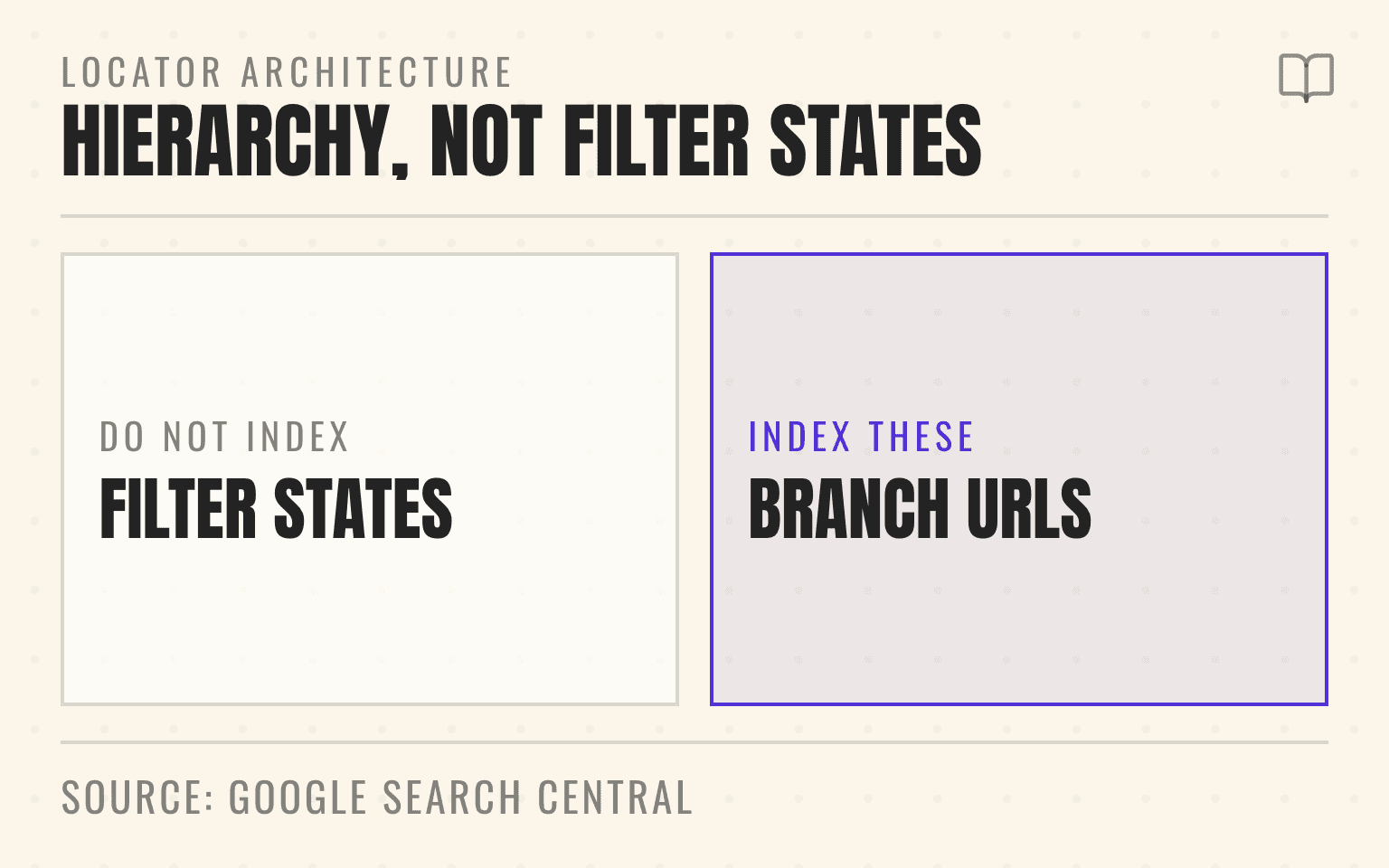
The short answer: index branch URLs, not every locator state
A location finder should usually be crawlable as a directory or browse path. Each important branch, office, store, or service-area team should have a stable URL that can be discovered through normal links. That does not mean every zip-code result, map pin, radius filter, or query parameter should be indexed.
Google says AI Overviews and AI Mode are Google Search features, and there are no separate technical requirements for appearing in them. A page must be indexed and eligible for Search with a snippet before it can be shown as a supporting link. Google also lists ordinary SEO work as the foundation for AI features: crawling allowed, internal links, important content in text, structured data that matches visible text, and current Business Profile information.
For a local service brand, that translates into a simple architecture rule. The locator can help people browse. The branch page should help search and AI systems understand one real local business unit.
That difference matters because AI Mode may use query fan-out across subtopics and sources. A query like "best emergency HVAC repair near Buckhead" can create evidence checks around the service, market, branch, reviews, opening hours, profile data, and booking path. A single map widget rarely gives enough stable evidence for that whole job. What query fan-out means in Google AI Mode explains why one local prompt can depend on several source checks.
What a crawlable location finder needs to expose
The first test is whether a crawler can discover the branch URLs from links. Google's crawlable-links guidance is narrow about what counts:
Most links in other formats won't be parsed and extracted by Google's crawlers.
The same page says Google cannot reliably extract URLs from anchor elements without an href attribute, or from other tags that behave like links because of script events. A locator built on clickable map pins, script-only handlers, or search results with no real anchors is weaker than a directory that links to branch pages the ordinary way.
The second test is whether the page exposes important content in text. A map can be useful for customers, but the branch name, service area, address when shown, phone number, services, hours, and nearby branch relationships should not live only inside map tiles or a third-party iframe.
The third test is URL stability. A branch page should have a clean permanent URL rather than only a fragment route such as a hash-based map state. Google's JavaScript guidance says Google can discover links when they use normal anchor elements and href attributes, and it warns that fragment-based content can be hard to resolve reliably. JavaScript can be part of the experience, but the location URLs should still work as pages.
In practice, a stronger finder has three layers: a main directory page, browsable region or state pages when the brand is large enough, and one page per real branch or service-area team. The directory links to the branches. The branch pages link back to the directory, nearby branches, relevant service pages, and the correct booking path.
The directory also needs a stable website boundary. Should franchise location pages use subfolders or subdomains? explains when those branch URLs belong on the parent site and when a separate operating boundary is justified.
What each location page should prove
A branch URL earns indexation by helping a customer choose the right local team. Existence alone rarely clears that bar.
For a storefront location, the page should make the real-world branch clear: name, address, hours, local phone path, services, reviews or review themes, photos, credentials, nearby areas, and the Google Business Profile link target. For a service-area business, the page should explain the staffed office or team, the cities or regions served, dispatch constraints, available services, local proof, and the contact route without exposing a hidden residential address.
Google Business Profile guidelines say the website should represent the individual business location, and the phone number should connect to that location when possible. For chains and brands, Google also emphasizes consistent names and categories across locations, with exceptions only when real-world representation varies. That makes the location page part of profile governance as well as website content.
This is where a locator often fails. The Business Profile points to a generic homepage. The locator shows a map pin. The branch page has a thin address block. Reviews mention emergency service, financing, or a specific neighborhood, but the page does not. When an answer system tries to connect those facts, the brand has weak owned evidence.
What should location pages include for AI search? covers the page-level standard in more detail. The locator version is the system around those pages: discovery, linking, canonical URLs, profile targets, and the source of truth for location data.
Where location finders become doorway risk
The risk sits in volume: large numbers of pages that do nothing for the local customer.
Google's spam policies describe doorway abuse as pages created to rank for specific, similar queries that funnel users to an intermediate page less useful than the final destination. The examples include city or regional pages that funnel users to one page and substantially similar pages that look closer to search results than a clear browseable hierarchy.
For multi-location service brands, this usually shows up in three ways.
- A city page that lists no real branch, service team, availability, proof, or contact route.
- A locator search-results URL that changes only the city, radius, or filter while sending everyone to the same generic form.
- Hundreds of near-duplicate branch pages where the address changes but the services, proof, reviews, photos, and local operating details do not.
Those pages may look like coverage. They create ambiguity, and they enter a field that is already crowded. In the Cheers Market Baseline over the 28 days ending September 2, 2026, we ran 32 home-services prompts in 100 metro service areas on four engines. The median metro returned citations from 566 distinct domains in that window. Toronto reached 852; Medicine Hat, one of the smallest markets we track, still reached 373. Your branch URL is one candidate among several hundred that already got cited in that metro, so it has to be the page that answers the local job rather than a page that exists. Metro-level detail is in the home-services AI visibility index, with the domain classification in the methodology.
{{visual:location-finder-metro-domain-field}} Google has also warned in its generative AI guidance not to create separate content for every possible query variation mainly to manipulate rankings or AI responses. If the page exists because the customer needs it, make it useful. If it exists because the keyword list has a city column, consolidate it.
How to build city pages without doorway risk in AI search is the companion article for city, market, and service-area pages. The locator rule is narrower: make real locations discoverable, then noindex, canonicalize, block, or consolidate the search states that do not deserve to stand alone.
Next step
Is AI recommending your business?
Find out how visible you are across ChatGPT, Gemini, Perplexity, and AI Overviews.
How service-area and franchise brands should handle complexity
Home services and franchise systems rarely fit a clean retail-store pattern.
An HVAC rollup may have one staffed office that dispatches across 22 cities. A pest control franchise may have protected territories with no public storefront. A med spa group may have appointment-only locations with different treatment menus. A restoration brand may have emergency teams that cross market boundaries after storms.
The location system should reflect those facts instead of pretending every market is the same. A service-area branch page can describe the team and coverage without showing a customer-facing address. A franchise page can explain ownership, local services, booking path, and nearby territories. A med spa page can show appointment hours, treatments available at that studio, practitioner proof when approved, and the correct profile link.
Google's service-area guidance says businesses should use specific, accurate service areas, and Business Profile guidelines caution that service-area businesses without storefronts have different address rules. The website should match that reality. If the locator claims a branch serves the whole metro but the profile, reviews, and dispatch team point to a smaller area, AI search has a source conflict.
Is Google Business Profile enough for AI visibility? explains why the profile works best when owned pages, reviews, citations, and structured facts support it. A locator is one of the main places that support either becomes clear or falls apart.
The technical checks your team should run
Run these checks before asking whether the locator is "AI optimized."
- Crawl from the main directory to every priority branch URL using normal links instead of relying on the map interface.
- Inspect a branch URL with JavaScript limited and with rendered HTML. The branch name, service area, phone path, hours, and services should be readable.
- Confirm the canonical URL, indexability, sitemap inclusion, status code, internal links, and duplicate URL parameters for every branch page.
- Check the Google Business Profile website URL for each location. It should point to the best matching branch page or market page, not a generic homepage unless that is genuinely the best user path.
- Compare visible page facts with LocalBusiness structured data. The schema should reinforce the current name, address or service area, phone, hours, URL, image, and profile links that customers can see.
- Review robots.txt and AI crawler rules if ChatGPT search or other answer systems are part of the visibility goal. OpenAI documents OAI-SearchBot as the crawler used to surface websites in ChatGPT search features, separate from GPTBot for training.
Keep that last check from turning into crawler theater, though. An allow rule simply avoids blocking a source that could have been useful. A weak branch page stays weak either way. Which AI crawlers should local businesses allow? covers that access decision.
How to measure whether the locator is working
Do not measure the locator only by clicks on the map.
Start with index coverage. Are the priority branch pages indexed? Are low-value filter URLs staying out of the index? Are the branch pages appearing for branded location queries, service-plus-city queries, and "near me" variants where the brand has real coverage?
Then check source agreement. Search and ask AI tools about the same service in the same market. Does the answer name the right branch or brand? Does it cite the branch URL, profile, reviews, or third-party sources that match the page? Does the phone path reach the correct location? Does the answer invent coverage the team cannot serve?
Finally, connect visibility to demand. Track organic landing pages, Business Profile website clicks, calls, forms, bookings, and source citations by branch or market. A finder that gets traffic but routes every lead to the wrong call path is not working. A branch page that gets fewer visits but supports the right AI citation or profile click may still be doing useful source work. That branch-level view of citations, profile clicks, and demand is what the multi-location local SEO solution reports on.
For the broader reporting stack, use how local service brands should track AI search traffic. For the operating audit, use how to audit AI search visibility across locations.
The operating rule
Treat the location finder as source infrastructure.
The marketing team may own the page. Operations owns the truth. Development owns the crawlability. Local managers or franchisees may own the local details. If those owners do not share a location data workflow, the finder will drift from the Business Profile, citations, reviews, call routing, and service coverage.
Fix the system in this order: directory discoverability, branch URL stability, page usefulness, profile link targets, structured facts, crawler access, and reporting. Do not start by generating more city pages. Start by making the real locations clear enough for customers, Google, and AI answer systems to understand which team can actually do the job.
Sources
Every link below was opened and checked on September 2, 2026.
- Spam policies for Google web search. Google Search Central. Last updated August 28, 2026, checked September 2, 2026. developers.google.com/search/docs/essentials/spam-policies. Source of the quoted doorway-abuse example about substantially similar pages closer to search results than a browseable hierarchy.
- Make your links crawlable. Google Search Central. Checked September 2, 2026. developers.google.com/search/docs/crawling-indexing/links-crawlable. Source of the quoted line that most links in other formats will not be parsed and extracted.
- AI features and your website. Google Search Central. Checked September 2, 2026. developers.google.com/search/docs/appearance/ai-features. Supports the AI Overviews and AI Mode framing, including Search eligibility, internal links, text content, structured data alignment, and Business Profile freshness.
- Google's guide to optimizing for generative AI features on Google Search. Google Search Central. Last updated July 10, 2026, checked September 2, 2026. developers.google.com/search/docs/fundamentals/ai-optimization-guide. Supports the warning against commodity query-variation pages and the focus on useful, people-first content.
- JavaScript SEO basics. Google Search Central. Checked September 2, 2026. developers.google.com/search/docs/crawling-indexing/javascript/javascript-seo-basics. Supports the guidance on rendered HTML, fragment routes, and discoverable links in JavaScript-heavy location finders.
- Local business structured data. Google Search Central. Checked September 2, 2026. developers.google.com/search/docs/appearance/structured-data/local-business. Supports using LocalBusiness structured data when it matches visible branch facts.
- Guidelines for representing your business on Google. Google Business Profile Help. Undated help page, checked September 2, 2026. support.google.com/business/answer/3038177. Supports the branch website, phone, chain consistency, category, and service-area policy discussion.
- Overview of OpenAI crawlers. OpenAI Platform documentation. Checked September 2, 2026. platform.openai.com/docs/bots. Supports the distinction between OAI-SearchBot for ChatGPT search features and GPTBot for training.
- Home Services AI Visibility Index 2026. Cheers Research. Market Baseline citation pull, 28 days ending September 2, 2026, 100 metro service areas. cheers.tech/research/home-services-ai-visibility-index-2026. Source of the distinct-cited-domain counts by metro.
Last verified: September 2, 2026.
Amadeus Peterson is the CTO & Co-Founder of Cheers, the local search platform for multi-location service businesses.