

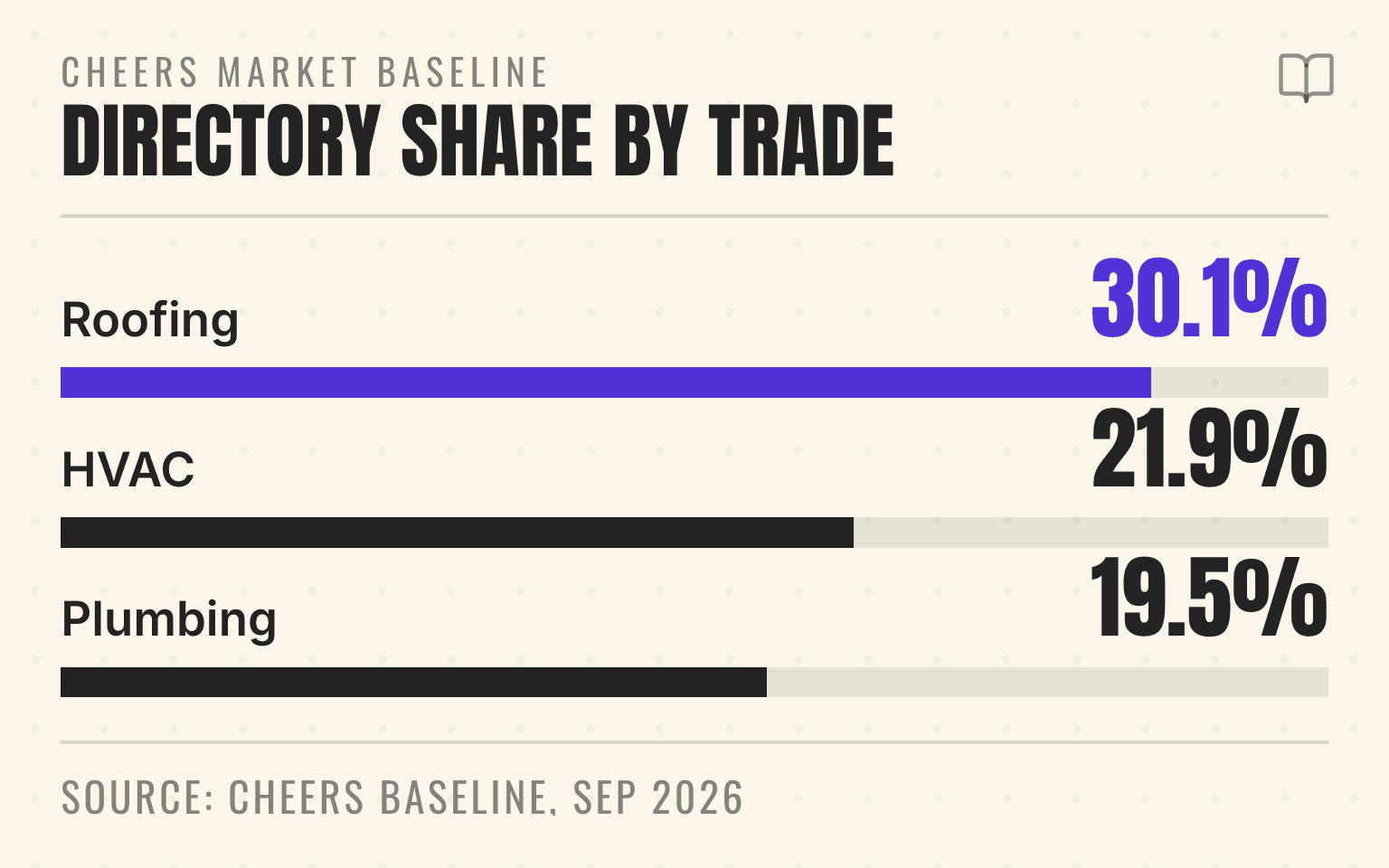
How much your directory listings matter depends on what you do. In the 28 days ending September 2, 2026, our market baseline ran home-services prompts across 100 metro service areas on four engines, and directories took 30.1% of the citations on roofing questions, 30.0% on garage door questions, and 19.5% on plumbing questions. A roofer and a plumber are working two different problems with the same word for it.
Cheers Market Baseline
Directories matter by trade
100
Metros
Directory and review-platform citation share by trade, Cheers Market Baseline, 28 days ending September 2, 2026
22,071 citations
10,200 citations
10,997 citations
72,097 citations
108,878 citations
100,465 citations
Cheers Market Baseline, 28 days ending September 2, 2026: 32 home-services prompts across 100 metro service areas on four engines, 356,019 citations classified by domain. Aggregate only. Methodology at cheers.tech/research/methodology.
| Trade | Directory share of citations |
|---|---|
| Roofing | 30.1% (22,071 citations) |
| Garage door | 30% (10,200 citations) |
| Pest control | 26.9% (10,997 citations) |
| Electrical | 24.2% (72,097 citations) |
| HVAC | 21.9% (108,878 citations) |
| Plumbing | 19.5% (100,465 citations) |
So the practical job is not "build 200 citations." It is to correct material conflicts and maintain the profiles buyers in your category actually use. Citation cleanup improves factual accuracy; it does not guarantee an AI recommendation. The per-trade and per-metro splits are in the home services AI visibility index, with the domain classification rules in the research methodology.
Why citations matter for GEO
If Google points to a current branch but Yelp shows a former address and a disconnected phone number, customers can reach the wrong place and crawlers can find competing records.
Important
Fix wrong addresses, phone numbers, hours, services, and destination URLs first. Do not present harmless formatting differences as a proven ranking penalty.
The engine you care about changes the answer again. Yext's October 2025 study of 6.8 million citations found that 52.15% of Gemini citations came from brand-owned websites, while for ChatGPT:
48.73% of citations came from third-party sites like Yelp, TripAdvisor, and MapQuest.
If you are deciding which sources matter by engine, read What Sources Do ChatGPT, Gemini, and Perplexity Use for Local Businesses?. If your locations are already inconsistent, start with How to Fix Conflicting Records Across 50 Locations. For a portfolio, multi-location local SEO is how we run the cleanup and keep it clean.
Start with the core platform checks
The right set depends on the category, but most local operators should verify:
Google Business Profile. The business-managed source for Google Search and Maps. Verify the fields customers use, including location, hours, phone, categories, services, photos, and website URL. Google's guidelines set the standard for what belongs there:
Represent your business as it's consistently represented and recognized in the real world across signage, stationery, and other branding.
Apple Business. Apple's current platform replaced Business Connect in April 2026. Use the multi-location Apple Business guide to govern physical locations, place cards, partner access, Actions, and reporting across the portfolio.
Bing Places. The business-listing management surface for Bing Search and Maps. Use the multi-location Bing Places rollout guide to pilot the new Google import and bulk tools, then verify each branch publicly.
Facebook Business Page. A public business and customer-feedback surface when the category's customers use it.
Yelp. A major review and business-information platform that appears in some search results and citation studies. For eligible service businesses, Yelp Assistant can also answer business questions and start a multi-provider quote request.
Pro Tip
Claim the profiles relevant to the business, complete the customer-facing fields, and keep material facts accurate. Exact punctuation does not need to be forced across every platform.
Tier 2: Data aggregators
Some listing vendors and data providers distribute business information to downstream publishers. Data Axle, Localeze, and Foursquare are examples, but their current networks and update behavior should be verified from their own documentation or account tools rather than copied from an old partner list.
Pro Tip
An aggregator update can distribute corrected facts to multiple downstream sites. Verify the important destinations because coverage and timing vary.
Tier 3: Industry directories
Every industry has directories that may be relevant to its buyers:
Home services: Angi, Thumbtack, Houzz, BBB, GuildQuality, Porch
Healthcare: Healthgrades, Zocdoc, Vitals
Legal: Avvo, Justia, FindLaw
Hospitality: TripAdvisor, OpenTable, Booking.com
Automotive: CarFax, RepairPal, AutoMD
Identify the directories customers use or that appear in the search and AI answers you audit. Claim and maintain only the profiles that fit the real business.
Next step
Is AI recommending your business?
Find out how visible you are across ChatGPT, Gemini, Perplexity, and AI Overviews.
Tier 4: Local and niche directories
Local chambers of commerce, city directories, trade associations, franchise directory pages, neighborhood publications, and local sponsorship pages may contain business listings. Treat them as customer-facing sources when they are legitimate and relevant, not as required AI-validation links.
The consistency audit
Before building new citations, audit what you have. Search your business name and phone number. Find every listing. Document the inconsistencies.
Common problems:
- A former or unrelated business name attached to the branch
- A wrong or obsolete street address
- Old phone numbers or addresses
- Duplicate listings
- Unclaimed listings with wrong info
Important
Fix material conflicts before adding new citations. Do not claim that one missing listing or harmless formatting difference has a universal ranking effect.
NAP standardization
Maintain a canonical record for each branch and use it to verify material facts:
Name: The correct public-facing business name for that location. Legal suffix and punctuation may vary where a platform requires a different format.
Address: The correct physical or service-area configuration. "Street" and "St." are equivalent; an old office is not.
Phone: A working number that reaches the promised location or routing path. Visual formatting is not the issue.
Document the canonical record in a brand guide or location system. When corporate, a regional manager, or a franchisee updates a listing, verify it against that record.
Ongoing maintenance
Citations drift over time. Platforms update, data gets stale, inconsistencies creep in.
Audit quarterly. Check your major platforms for accuracy. Search your business periodically to catch new listings that need correction.
Important
Judge citation cleanup by fewer wrong customer destinations and fewer conflicting branch records. Do not convert the cleanup count into an assumed AI score.
Sources
Checked September 2, 2026.
- Guidelines for representing your business on Google. Google Business Profile Help, accessed September 2026. support.google.com/business/answer/3038177. Source of the quoted real-world representation standard. Replaces the previous link to the Business Profile help home page.
- Tips to improve your local ranking on Google. Google Business Profile Help, accessed September 2026. support.google.com/business/answer/7091. Source of the point that complete and accurate information helps a profile show in local results.
- Intro to Apple Business. Apple Support, accessed September 2026. support.apple.com. Source of the current Apple platform scope for brand and location management.
- Introducing AI Performance in Bing Webmaster Tools Public Preview. Bing Webmaster Blog, February 10, 2026. blogs.bing.com/webmaster/February-2026. Microsoft's current documentation for the Bing side. Replaces the previous bing.com/forbusiness link, which returned an empty page shell on September 2, 2026.
- AI Visibility in 2025: How Gemini, ChatGPT, and Perplexity Cite Brands. Yext, October 29, 2025. yext.com/blog. Source of the quoted ChatGPT third-party citation share and the 6.8 million citation study.
- Cheers Market Baseline: 32 home-services prompts, 100 metro service areas, four engines, 28 days ending September 2, 2026, 356,019 citations, aggregate only. Home services AI visibility index and methodology. Source of the directory citation shares by trade.
Amadeus Peterson is the CTO of Cheers, the local search platform for service businesses.