

The FTC's guide to federal warranty law contains four words worth taping to a marketing wall: "Deceptive warranty advertising is unlawful." It also defines a phrase that sits on a great many home-services websites: "Satisfaction and Money back guarantees constitute an offer of a full refund for any reason."
Publish the warranty when it is specific enough for the local team to honor. Do not publish it as a trust badge that collapses the moment a customer asks what is covered, because a badge and an enforceable offer can be the same sentence.
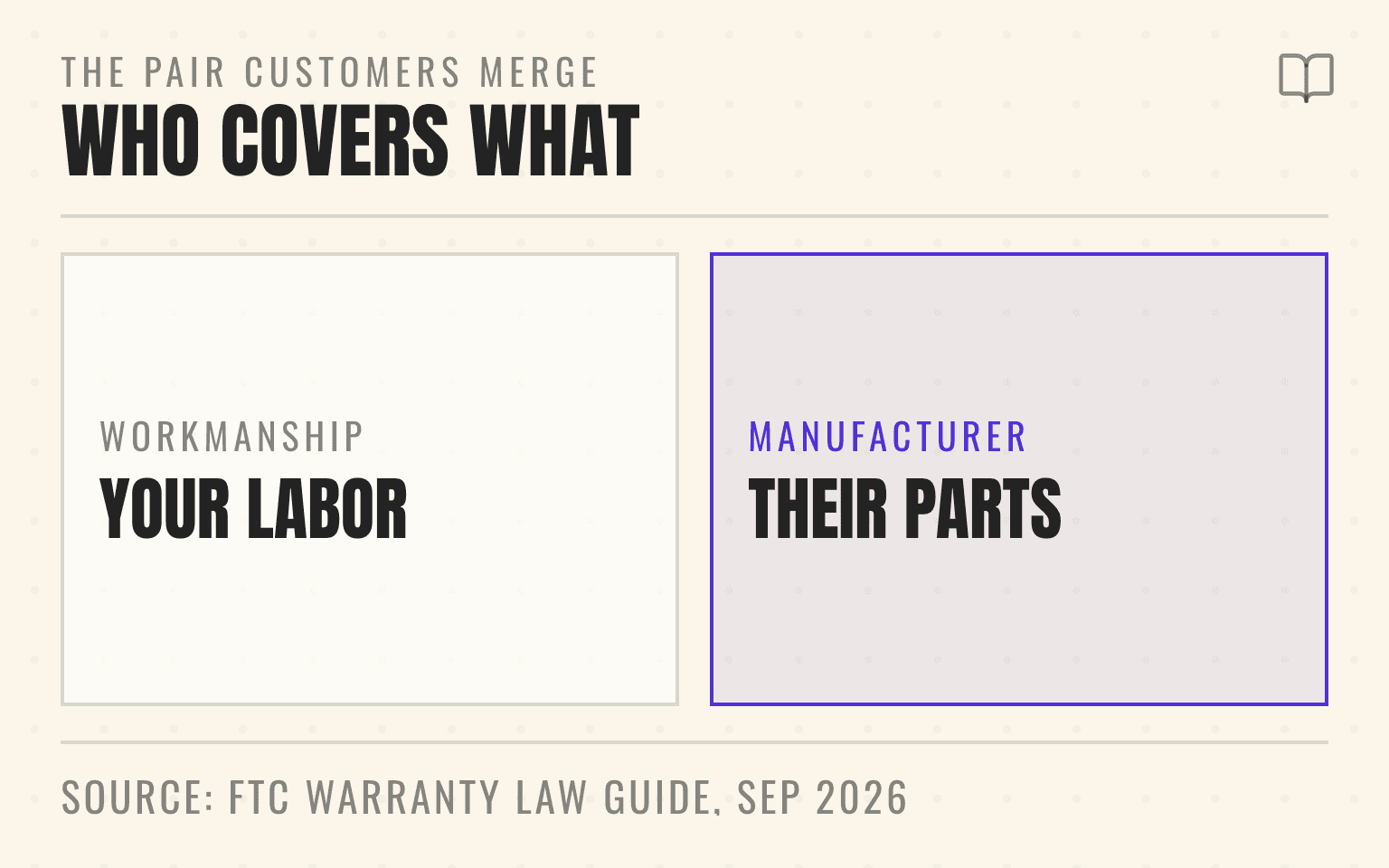
The pair customers merge
Your labor, their parts
Workmanship warranty
The company's own promise
- Labor, installation and service quality
- Duration, exclusions and what voids it
- Callback window and diagnostic fee rules
- Owned by the branch or franchisee
Manufacturer warranty
The product maker's promise
- Equipment, parts and components
- Registration windows and proof of purchase
- Claim approval sits with the manufacturer
- Branch may own labor on the repair visit
Federal Trade Commission: Businessperson's guide to federal warranty law (ftc.gov/business-guidance/resources/businesspersons-guide-federal-warranty-law), checked September 2026.
That distinction matters for roofing, HVAC, plumbing, garage doors, restoration, electrical, smart home, and franchise service brands. Warranty language is often one of the last proof points a customer checks before booking. It can also become part of the public source trail that search-enabled AI systems inspect when they compare providers.
Important
Publish warranty terms only when the website, profile, estimate, invoice, dispatcher, technician, and branch can repeat the same promise. AI visibility is not the reason to overstate coverage.
What official sources actually support
Google's AI Search guidance says generative AI features in Search rely on core Search ranking and quality systems. For a local service brand, that means the warranty page still has to be useful, crawlable, and written for customers before it can help AI Search.
Google Business Profile Help also matters because profile services can include details such as price and description. A warranty promise does not need to live inside every profile field, but the profile service description should not contradict the warranty or callback rule on the page.
The FTC is the stronger source for wording discipline. Its warranty and guarantee advertising guides are built around avoiding unfair or deceptive practices, and its Businessperson's Guide to Federal Warranty Law states flatly that "Deceptive warranty advertising is unlawful." The same guide sets the meaning of the most common phrase in the category: "Satisfaction and Money back guarantees constitute an offer of a full refund for any reason." A brand that will not issue a full refund should not publish that phrase.
Schema.org has warranty vocabulary, including WarrantyPromise, durationOfWarranty, warrantyScope, and the warranty property on offers. That is useful only after the visible page is clear. Hidden markup cannot rescue vague copy.
Crawler documentation is weaker evidence than FTC and Schema.org guidance here, but it creates one practical boundary: if warranty terms are buried in an inaccessible PDF or private sales material, search-enabled AI systems have less public evidence to inspect.
Separate the promises customers confuse
Most warranty pages fail because they mix four different promises.
The first is a workmanship warranty. This is the company's promise about labor quality, installation, workmanship, or service performed by its own team. A roofing workmanship warranty is different from shingle coverage, and warranties come up in nearly every ChatGPT answer about roofers. A garage door labor warranty is different from opener or spring manufacturer coverage.
The second is a manufacturer warranty. HVAC systems, water heaters, garage door openers, roofing materials, smart-home devices, and electrical components may carry manufacturer coverage. The service brand should explain when the manufacturer owns the product claim and when the local branch owns labor, registration, documentation, or return-visit work. When the page also names equipment brands or model families the team supports, use the equipment-brand publishing standard to keep service capability separate from authorization and warranty claims.
The third is a callback or service correction policy. Many home service brands do not call this a warranty, but customers still treat it like one. If the brand sends a technician back after a repair, says there is a 30-day callback window, or waives a diagnostic fee under certain conditions, the terms should be visible.
The fourth is a satisfaction, lifetime, or guarantee claim. This is where wording risk rises. If the page says "100% satisfaction guaranteed," the brand needs to define what satisfaction means, what remedy is available, who approves it, whether refunds are possible, and which services are excluded.
The warranty page should not make those promises sound interchangeable.
Map the warranty promise across sources
For a multi-location service brand, the warranty map should make one promise visible in several places without creating conflicting versions.
- Service page: explain the warranty that applies to the specific job, including duration, coverage, exclusions, manufacturer role, and claim path.
- Location page: show whether the branch, franchisee, service area, state license, or market has a different warranty rule.
- Google Business Profile services: keep service descriptions consistent with the page, especially when a service has price, eligibility, or callback limits.
- Estimate, invoice, and dispatch scripts: make sure the field handoff can repeat the public terms without adding hidden exclusions.
- Reviews and photos: use real customer proof to show follow-through, but do not quote reviews as if they expand the warranty.
- Structured data: mark up visible warranty facts only when the page already states them plainly.
This is why warranty content belongs near pricing, financing, credentials, and service proof. A price page that promises "best value" without warranty context is incomplete. A financing page that mentions monthly payments without warranty or equipment context can leave the buyer comparing offers that are not equivalent.
For adjacent standards, use the service-price publishing standard, the financing-options standard, and the Google Business Profile service-list workflow.
Where multi-location brands get into trouble
A one-location contractor can often explain warranty details from memory. A 70-location service brand cannot rely on that.
Problems usually start when a corporate page publishes one promise while local operations run several versions. A franchisee may honor a different labor warranty. A manufacturer may require registration within a certain window. One state may have different license, permit, or contract language. A recently acquired branch may still use old estimate templates. A membership plan may change callback fees. A storm-repair roofing page may promise coverage that does not apply to emergency tarping.
AI search does not need a special ranking factor for that to create damage. If the public source trail is inconsistent, an answer can summarize the wrong promise, skip the brand, cite a competitor with clearer terms, or send a customer to a page that creates a callback dispute.
For a garage door brand, separate spring warranty, opener warranty, panel replacement, labor callbacks, and same-day repair limitations. For an HVAC brand, separate equipment warranty, labor warranty, maintenance-plan conditions, registration support, and what happens when another contractor touched the system. For a restoration roll-up, separate emergency mitigation, reconstruction, insurance coordination, equipment rental, and post-job corrections.
The article does not need a legal theory to be useful. It needs the local team to publish only what it can stand behind.
Next step
Is AI recommending your business?
Find out how visible you are across ChatGPT, Gemini, Perplexity, and AI Overviews.
How to avoid deceptive guarantee language
The safest warranty content names the remedy and the limits.
"Lifetime warranty" is weak unless the page says whose lifetime, which part of the job, whether labor is included, whether it transfers, and what voids it. "Satisfaction guaranteed" is not weak at all, which is the problem: the FTC reads it as an offer of a full refund for any reason, so publish it only if that is what the branch will do. "We stand behind our work" is reassuring and answers nothing the buyer asked.
Better warranty copy gives customers the terms before they book. It says what is covered, what is not covered, how long coverage lasts, who owns the claim, what proof the customer needs, and how fast the branch responds. It also says when terms vary by location, service line, product, franchisee, manufacturer, or membership plan.
That specificity helps customers first. It also gives search and AI systems clearer public evidence than a generic trust badge.
Do not hide the real rule in a PDF no one links to. PDFs can be useful for legal terms, but the page should summarize the customer-facing rule in plain language and link to the full document when needed.
Why the margin for error is thin here
Cheers does not measure warranty disputes, and nothing below should be read as if it did. What the panel does show is where home-services reviews land. Across the 11 home-services companies with reviews over the 90 days ending September 2, 2026, aggregate only, the mean company rating was 4.58. Owners responded to 82.6% of the 4,870 reviews in that window, and 92.4% of those reviews came from Google.
That is context, not causation. It does mean a published post-job promise gets read carefully, and that a customer who feels a warranty was oversold has a very public place to say so.
Build the warranty exception map
Start with the warranties that affect booking decisions, not every edge case.
- Days 1 to 7: Inventory the warranty promises already visible on service pages, location pages, Google Business Profile services, ads, estimate templates, invoices, review replies, and third-party profiles.
- Days 8 to 14: Separate workmanship warranties, manufacturer warranties, callback policies, membership benefits, and satisfaction or lifetime claims.
- Days 15 to 21: Assign the owner and public page for each promise. Usually that means a service page, warranty page, or market-specific location page, with estimate and invoice templates matching the public copy.
- Days 22 to 30: Update profile services, internal links, schema where appropriate, dispatcher language, technician handoff notes, and AI visibility prompts for warranty-sensitive services.
Retest the same prompts after the updates. Search for service, market, warranty, guarantee, and competitor variants. Then inspect which sources are cited, whether the warranty language is accurate, and whether the right location appears.
If the warranty promise differs by branch, publish that difference. If the branch cannot honor the claim, do not make the claim.
Sources
Every external link below was opened and checked September 2, 2026.
- Businessperson's guide to federal warranty law. United States Federal Trade Commission, checked September 2026. Source of both quoted lines: that deceptive warranty advertising is unlawful, and that satisfaction and money back guarantees constitute an offer of a full refund for any reason.
- Advertising of warranties and guarantees. United States Federal Trade Commission, checked September 2026. Source of the warranty-advertising disclosure and deception guardrails.
- Optimizing your website for generative AI features on Google Search. Google Search Central, last updated July 2026. Source of the useful, crawlable, people-first standard behind AI features.
- Manage your services on your Business Profile. Google Business Profile Help, checked September 2026. Source of the service description and price fields.
- Edit your Business Profile. Google Business Profile Help, checked September 2026. Source of the requirement to keep profile information accurate, and of the review step before an edit goes live.
- WarrantyPromise and the warranty property. Schema.org vocabulary, checked September 2026. Source of durationOfWarranty, warrantyScope, and the offer-to-warranty relationship.
- Overview of OpenAI crawlers. OpenAI developer documentation, checked September 2026. Source of OAI-SearchBot being used to surface websites in ChatGPT search features.
- Perplexity crawlers. Perplexity documentation, checked September 2026. Source of PerplexityBot being designed to surface and link websites in Perplexity search results.
- Cheers Research methodology. Cheers panel, 90 days ending September 2, 2026, 11 home-services companies with reviews, aggregate only (corrected September 23, 2026). Source of the mean company rating, response rate, review count, and Google share quoted above.
The earlier version also cited 16 CFR Part 239 on eCFR. That URL redirected to a bot-check page on September 2, 2026 and could not be read, so the claims it supported now rest on the FTC guides above, which were opened and quoted.
- What location pages should include for AI Search. Internal companion for branch-level page requirements.
- How service-area businesses show coverage for AI search. Internal companion for service-area coverage and branch handoff rules.
Dylan Allen-Arnegård is the CEO & Co-Founder of Cheers, the local search platform for multi-location service businesses.