

Google Business Profile Help says posts publish announcements, offers, updates, and events on Search and Maps. Google does not document posts as a special AI-ranking signal. The help page had no publication date when checked on September 2, 2026.
Last verified: September 2, 2026.
Google's documentation says:
Posts can include text, photos, or videos to promote Business Profiles.
Durable source test
A post is current context
68.1%
Pooled AI citations from business websites
100
U.S. and Canadian metros
4
Answer engines
49,677
Local-intent runs
Cheers Market Baseline, 28 days ending September 2, 2026; 100 metros, four engines, aggregate only.
| Finding | Value | Base |
|---|---|---|
| Pooled AI citations from business websites | 68.1% | Stated in the source |
| U.S. and Canadian metros | 100 | Stated in the source |
| Answer engines | 4 | Stated in the source |
| Local-intent runs | 49,677 | Stated in the source |
That distinction matters for multi-location service brands. An HVAC group, med spa franchise, restoration rollup, or hospitality group may manage dozens of profiles. A post about a summer tune-up, new provider, local event, storm response window, or holiday schedule can make a profile feel current. But if the core service list, hours, phone path, location page, reviews, and citations disagree, the post is a patch on top of a weak source record.
Google's own AI Search guidance is conservative: generative AI features on Google Search are rooted in normal Search ranking and quality systems, and Google says Business Profiles can help local business information appear in AI responses. For operators, the lesson is simple. Use posts for timely updates. Use durable pages and profile fields for durable facts.
If you do not know which sources AI systems already use for your markets, start with a location-level AI visibility check, then compare the cited sources against the profile, location page, and recent posts.
Important
Treat Google Business Profile posts as current local context, not as the source of truth. The source of truth should be the profile fields, location page, reviews, photos, citations, and service facts that stay accurate after the post ages out.
What Google Business Profile posts are actually for
Google describes posts as a way to share announcements, offers, updates, and event details with customers on Search and Maps. That is a customer-communication surface. It is useful, but it is different from a location page, a primary category, a service list, or structured data.
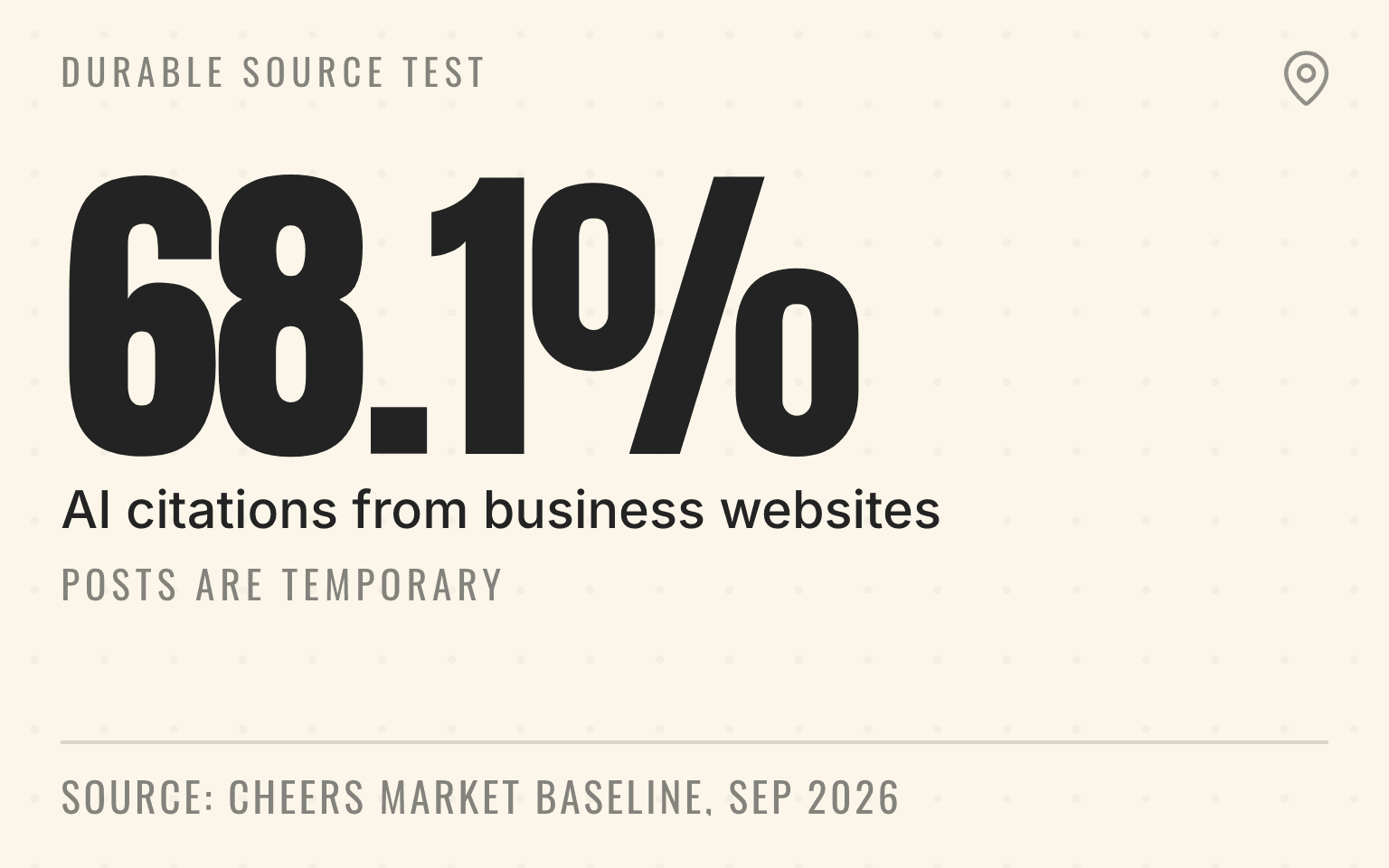
Cheers' Market Baseline found that business websites supplied 68.1% of pooled citations across 49,677 local-intent runs and 356,019 citations. That is why a durable service fact belongs on the branch page, even when a timely post repeats it. Cheers Market Baseline, 28 days ending September 2, 2026, 100 metros, four engines, aggregate only. Read the methodology.
For a service brand, posts are best when the update is both local and temporary. A garage door branch might have same-week availability after a storm. A med spa studio might add consultation slots for a new provider. A hotel might host a local event that changes guest demand. A pest control team might start seasonal mosquito service in specific markets. A restoration branch might open an after-hours response window during severe weather.
That is stronger than posting the same generic "we are the best" message across 80 profiles. It gives customers a reason to act, and it gives the team a dated branch update they can compare against the service page, profile fields, photos, and recent reviews.
Why posts are not enough for AI search
Google says pages need to be eligible for Search and useful to people before they can be considered for generative AI features. Google also says local results depend on relevance, distance, and prominence, with complete and accurate Business Profile information helping customers know what the business does, where it is, and when they can visit.
That is a stronger foundation than a post. A post may say the Phoenix HVAC branch is promoting AC tune-ups this week. The durable source record should still explain AC repair, tune-ups, emergency availability, service area, booking path, reviews, photos, and the matching location page. If those facts are missing, the post has nowhere to anchor.
Google AI Search for local businesses explains the broader foundation. Is Google Business Profile enough for AI visibility? covers why profiles need pages, reviews, citations, and source tracking around them.
The same logic applies outside Google. Search-enabled AI systems that use public web sources need crawlable, corroborated information. A post inside Google Business Profile may help Google-owned surfaces, but it should not be the only place a service, offer, event, or operating constraint exists.
What should live in posts versus profile fields
The operating rule is to separate temporary messages from durable facts.
Profile fields should carry the facts customers need repeatedly: business name, category, address or service area, hours, phone number, website URL, services, attributes, photos, and review response ownership. Location pages should explain the real service coverage, proof, booking path, pricing context, credentials, and FAQs customers need before they call.
Posts should carry timely context around those facts. A roofing branch can post about storm inspection availability, but the roof repair page should explain what markets the branch serves and how emergency tarping works. A med spa can post about a local consultation event, but the treatment page should explain provider qualifications, eligibility rules, and safety expectations. A hotel can post about a local event, but the profile and website should still own check-in details, amenities, phone, and booking paths.
What services multi-location brands should list in Google Business Profile is the service-field companion to this article. Where home service brands should publish emergency hours covers one place where posts can help, but only after the permanent hours and call path are correct.
Next step
Is AI recommending your business?
Find out how visible you are across ChatGPT, Gemini, Perplexity, and AI Overviews.
Where posts create risk
The most common risk is using posts to say things the branch cannot consistently prove elsewhere. That creates customer confusion and source drift.
A central marketing team may publish a financing offer to every profile even though franchise locations use different lenders. A restoration brand may post "24/7 response" after a storm even though only some branches have after-hours crews. A med spa may post treatment claims that require legal, provider, or clinical review. A home services brand may post a discount with exclusions that the location page does not explain.
Google's Business Profile policies apply to submitted content, including text, photos, and videos. That matters because posts often move quickly. The faster the cadence, the more governance matters.
For multi-location brands, posts should have three controls:
- Local truth check: the branch confirms the post is true for that market.
- Durable-source check: the website or profile field already explains the underlying service, hour, offer, event, or rule.
- Policy check: regulated claims, discounts, review language, photos, and urgency claims meet the same standard the brand uses on the website.
This is especially important for med spas, restoration, roofing, electrical, pest control, hospitality, and any franchise category where offers, licenses, availability, or service terms vary by location.
The multi-location posting standard
The right question is not "how often should we post?" It is "what local facts are changing often enough that customers and search systems need a public update?"
For an HVAC rollup, that may be seasonal maintenance, emergency weather response, heat pump rebates, service-area changes, or opening dates for a new branch. For a med spa group, it may be provider availability, local events, consultation windows, or treatment education that has already passed compliance review. For a hospitality group, it may be local events, temporary closures, renovated amenities, or guest-facing schedule updates.
Do not use posts to compensate for thin location pages. Use posts to keep a strong profile current.
A practical monthly workflow is:
- Pull profile fields, recent posts, location pages, and top review themes for priority branches.
- Flag posts that mention services, offers, hours, events, or availability that the website does not support.
- Remove or rewrite posts that are copied across locations where the claim is not locally true.
- Add one real local post only when a branch has a timely customer-facing update.
- Retest priority AI and local-search prompts after the durable source record is corrected.
The same monthly workflow can feed AI visibility audits across locations, because posts are only useful when they align with the sources AI systems actually cite.
Check post drift before repeating the cadence
Measure posts as part of source quality, not as a standalone vanity metric.
At the profile level, inspect whether the post matches the service list, hours, photos, reviews, and linked page. At the search level, inspect whether AI answers and local results describe the branch more accurately after the durable facts are corrected. At the operations level, ask whether branch managers can explain which updates deserve a post and which facts belong on the website.
For a multi-location brand, success is fewer contradictions across public sources, not a perfect posting calendar.
If a customer asks "who can repair my garage door today in Mesa?" the public record should answer the same way everywhere: the Business Profile, post, location page, reviews, photos, call path, and cited sources. When that happens, a post can support AI search because it reinforces the real branch story instead of trying to replace it.
Sources
- Create and manage posts on your Business Profile, Google Business Profile Help, no publication date. Checked September 2, 2026.
- Posts content policy, Google Business Profile Help, no publication date. Checked September 2, 2026.
- AI features and your website, Google Search Central, July 2026. Checked September 2, 2026.
- AI features and your website, Google Search Central, May 2025. Checked September 2, 2026.
- Tips to improve local ranking, Google Business Profile Help, no publication date. Checked September 2, 2026.
- Web crawlers and user agents, OpenAI, no publication date. Checked September 2, 2026.
- AI Visibility Statistics, Cheers Research, September 2026. Checked September 2, 2026.
- Research methodology, Cheers Research, September 2026. Checked September 2, 2026.
Dylan Allen-Arnegård is the CEO & Co-Founder of Cheers, the local search platform for multi-location service businesses.