

Most local businesses already publish hours. Across 467 completed Cheers public visibility grader runs with Google profile data from March 4 through June 8, 2026, 96.4% of profiles had an hours flag. An hours field cannot say whether a branch can take an urgent job right now, and that is the question a buyer asks at 11pm with water on the floor.
A buyer who asks "emergency plumber open now" or "garage door repair near me tonight" needs a provider that can answer the phone, dispatch a tech, and serve that market right away.
Cheers grader sample
Hours are not the gap
96.4%
Share of the sample with an hours flag
450
Profiles with an hours flag
467
Completed grader runs in the sample
Cheers public visibility grader, read-only aggregate of 467 completed runs with Google profile data, March 4 to June 8, 2026. Counts only whether the profile data included a hasHours flag; it does not measure hour accuracy.
| Finding | Value | Base |
|---|---|---|
| Share of the sample with an hours flag | 96.4% | Stated in the source |
| Profiles with an hours flag | 450 | Stated in the source |
| Completed grader runs in the sample | 467 | Stated in the source |
That is where many multi-location home service brands create confusion. The Google Business Profile says one thing. The branch page says another. A service-area page promises emergency help but sends the visitor to a generic form. The schema still shows old hours. The call tracking number routes to a queue that is closed after 6 p.m.
There is no special "after-hours" trick for AI search. The engines need the same local facts a customer needs: which location serves the job, when it can respond, how the customer reaches the right team, and whether the public sources agree.
Important
Publish emergency availability where customers and search systems can verify it: the Business Profile, the location page, the structured data, the service-area page, and the live call path.
The basic hours field is rarely the whole problem
In a read-only aggregate of 467 completed Cheers public visibility grader runs with Google profile data from March 4 through June 8, 2026, 450 profiles had a hasHours flag. That is 96.4% of the sample.
That finding has limits: it says nothing about whether the hours were accurate, and it cannot confirm emergency coverage, holiday coverage, phone routing, or profile-to-website consistency. What it does suggest is that most local businesses have some hours published already. The harder question is whether those hours explain the real operating promise.
For a 40-location HVAC group, a basic open-hours field may not tell the buyer whether after-hours AC repair is available in Phoenix on a Sunday. For a restoration rollup, the corporate homepage may say 24/7 while one acquired branch still uses legacy phone routing. For a garage door franchise, the profile may be open, but the location page may not say whether emergency spring repair is actually staffed in that market.
This is an operations problem before it is a schema problem.
What Google asks businesses to keep current
Google Business Profile Help gives businesses more hour surfaces than most brands use. Main hours cover a normal week. Special hours cover a business that "temporarily adjusts its hours of operation" or "remains closed for 6 days in a row or fewer." And then there is the field almost nobody fills in:
If you offer specific services with different times such as senior hours, or delivery and takeout hours, you can set More hours.
Google's own examples are retail-shaped, but the field is the closest thing the profile has to a service-specific availability record. Google also documents a detail worth knowing for split dispatch: to show a break in the day, "create 2 entries for the same day with different times." A branch that answers phones 8am to noon and 5pm to 10pm can say exactly that.
For home service operators, the practical split is simple. Main hours describe the normal office or service operation. Special hours handle holidays, seasonal schedules, and temporary changes; the multi-location holiday-hours operating guide covers the approval, bulk-update, and public-readback workflow. More hours can clarify service-specific availability when the profile supports it. When the buyer's question is how fast the branch can answer, schedule, or arrive, use the separate response-time publishing standard.
The mistake is using one of those fields as a substitute for the whole dispatch truth. A plumbing branch can be "open" because the phone line is staffed, while a specific job type still requires next-day scheduling. A restoration branch can accept emergency calls all night, while non-emergency estimates run during normal business hours. A franchise location can route after-hours calls through a central center, while the customer still needs local coverage confirmation.
Google's AI features guidance also matters here. Google says AI Overviews and AI Mode use normal Search foundations and do not require special schema.org markup. For local service brands, that means emergency availability should be treated as normal business information that deserves accurate, useful, crawlable sources.
For the broader Google AI Search baseline, read How Local Businesses Can Show Up in Google AI Search. For the profile-versus-source-stack question, read Is Google Business Profile enough for AI visibility?.
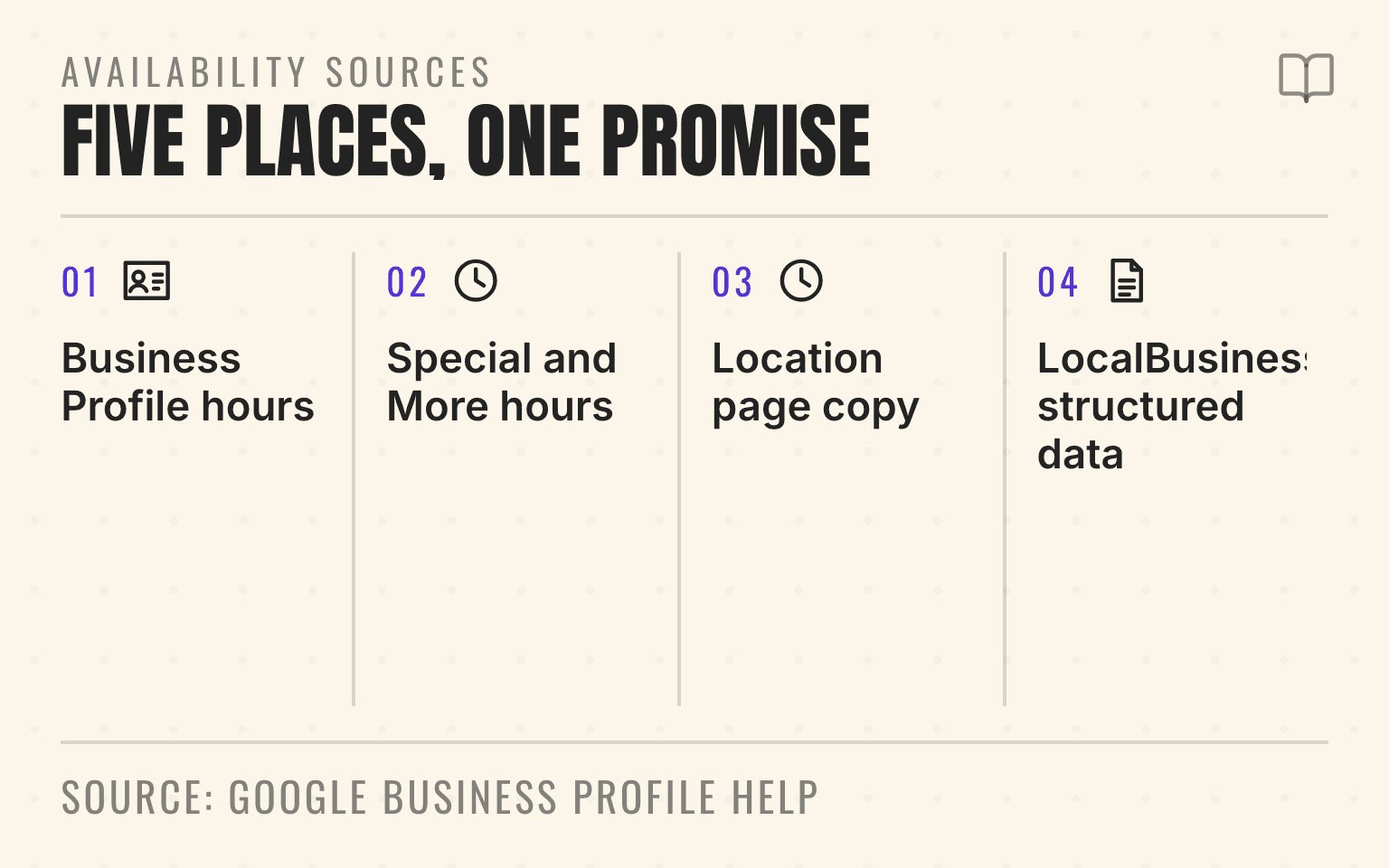
Publish availability in five places
The source stack should describe the same operating reality in different forms.
First, the Google Business Profile should show the current hours for that location and use special hours or more hours when the business has holiday, seasonal, or service-specific availability. A profile for an electrical branch should not borrow a national "24/7" claim if that branch only answers emergency calls in certain counties, and AI answers to emergency electrician questions lean hard on exactly that 24/7 language. Branches on Local Services Ads have a second reason: from October 1, 2026, Google bills unanswered calls inside listed business hours once the caller has held for more than 20 seconds.
Second, the location page should explain the practical promise in words. "Open 24 hours" is less useful than "Emergency plumbing calls are answered 24/7 for this branch's Phoenix service area. Install estimates and non-emergency repairs are scheduled during normal office hours." The page should also show the correct phone path and service area.
Third, service-area pages should not widen the promise. If a branch offers emergency drain clearing in Mesa and Tempe but not in every surrounding suburb, the page should say that clearly. This connects to the coverage standard in How service-area businesses should show coverage for AI search.
Fourth, LocalBusiness structured data should mirror the visible page. Google's local business structured data supports business facts such as address, telephone, opening hours, and related local details. Schema.org's OpeningHoursSpecification gives a machine-readable way to describe days and times. Neither source should say something a customer cannot read on the page.
Fifth, the live call or booking path should match the claim. If the page says emergency service is available, the phone, form, booking widget, and confirmation state should route the customer correctly. Can AI Agents Book Appointments From Your Website? covers the agent-readable side of that path.
Next step
Is AI recommending your business?
Find out how visible you are across ChatGPT, Gemini, Perplexity, and AI Overviews.
The multi-location failure mode is drift
Emergency availability changes constantly. Branches add technicians, lose coverage, adjust holiday hours, consolidate dispatch, or move after an acquisition. A single-location business can fix that manually. A rollup or franchise system needs a governance loop.
Drift usually shows up in four ways.
A brand-level page makes a broad claim that not every location can fulfill. A profile is updated, but the location page is not. The page is updated, but JSON-LD still emits the old hours from a template. The marketing page promises after-hours service, but operations route after-hours calls differently by market.
This matters for AI search because local recommendations depend on source clarity. If public sources disagree about whether a branch is open, whether it handles emergency calls, or which service area it covers, the answer system has to choose between conflicting facts. A customer has the same problem.
The fix is to assign truth owners instead of watering every page down to avoid risk. Operations owns real coverage and dispatch rules. Marketing owns visible page language. Local managers verify exceptions. Development owns the schema and template mapping. Revenue or customer experience owns the phone and booking path.
Use schema after the visible answer is clear
Structured data is useful when it labels a real page, not when it compensates for vague copy.
For a location page, start with visible facts: branch name, service area, normal hours, emergency availability, phone path, services offered, reviews, licenses, photos, and local proof. Then make the LocalBusiness JSON-LD match those facts. If the page says emergency calls are answered 24/7 but non-emergency estimates run Monday through Friday, do not flatten that into a generic always-open signal unless that is how the business really works.
When licenses, insurance, certifications, or warranty terms affect whether the branch can perform the job, use the narrower license and insurance proof standard and workmanship warranty standard before adding those facts to schema.
The same rule applies to service pages. If a service line has different availability than the branch's main hours, explain the difference in the page copy before trying to encode it. Schema can reinforce opening hours, phone, area served, and business identity. It cannot explain a dispatch exception that the page hides.
For the implementation layer, use What Is JSON-LD? The Technical Foundation of GEO and What Is Schema Markup? A Non-Technical Guide as companion references.
A 14-day emergency-hours cleanup
Use this before peak season, after an acquisition, or when call routing changes.
- Pick the top emergency services by market: AC repair, drain cleaning, water damage, electrical repair, garage door repair, pest emergency, or whatever creates urgent demand for the brand.
- Export the location list with normal hours, special hours, emergency availability, service-area coverage, phone routing, and booking path owner.
- Compare each Google Business Profile against the location page and service-area page. Mark any mismatch between profile hours, page copy, phone path, and schema.
- Rewrite the visible answer first. The customer should know when the branch answers, which services are available after hours, and what happens after the call.
- Update structured data only after the page is correct. Keep the schema narrower than the operating truth if the operating truth cannot be expressed cleanly.
- Test the path like a buyer. Search the market, open the profile, click the page, call the number, and submit the form outside normal office hours when that is part of the promise.
Do not end the audit with a spreadsheet. End it with an owner for each mismatch and a review date before the next seasonal demand spike.
The standard to use
For AI search, emergency hours should be treated as a public source of business truth.
That means the profile, page, schema, service-area coverage, and call path should all answer the same question: can this location help with this urgent job in this market now?
If the answer is yes, publish the proof clearly. If the answer is conditional, explain the condition. If the answer varies by branch, do not hide that behind one brand-wide 24/7 claim. The best local source is the one a customer can act on without guessing. Brands that want that branch-level alignment checked continuously can run the same loop through the Cheers home services platform or as part of a standing multi-location local SEO program.
Methodology
The first-party observation in this article uses an aggregate, read-only query against the Cheers-Marketing Supabase project. The sample includes 467 completed public visibility grader runs with Google profile data from March 4 through June 8, 2026. We counted only whether the Google profile data included a boolean hasHours flag. We did not inspect raw rows, customer identities, individual business names, phone numbers, emails, place IDs, prompts, or private URLs. The result is directional and does not measure hour accuracy, emergency coverage, holiday schedules, service-specific availability, or website consistency.
Sources
Every link below was opened and checked on September 2, 2026.
- Edit your business hours. Google Business Profile Help. Undated help page, checked September 2, 2026. support.google.com/business/answer/15300403. Source of the quoted More hours guidance, the special-hours definition, and the two-entry method for showing a break in the day.
- Guidelines for representing your business on Google. Google Business Profile Help. Undated help page, checked September 2, 2026. support.google.com/business/answer/3038177. Supports the requirement to keep Business Profile information accurate and current.
- AI features and your website. Google Search Central. Checked September 2, 2026. developers.google.com/search/docs/appearance/ai-features. Supports the guidance that AI Overviews and AI Mode use normal Search foundations and do not require special schema.org markup.
- Local business structured data. Google Search Central. Checked September 2, 2026. developers.google.com/search/docs/appearance/structured-data/local-business. Supports using local business structured data for visible business facts such as address, phone, and opening hours.
- OpeningHoursSpecification. Schema.org vocabulary. Undated type page, checked September 2, 2026. schema.org/OpeningHoursSpecification. Supports the machine-readable model for days and times when structured data reflects visible content.
- LocalBusiness. Schema.org vocabulary. Undated type page, checked September 2, 2026. schema.org/LocalBusiness. Supports the local business entity fields that reinforce visible branch facts.
Last verified: September 2, 2026.
Dylan Allen-Arnegård is the CEO & Co-Founder of Cheers, the done-for-you platform that manages the website, reviews, listings, structured data, and local content that get service businesses recommended across Google, Maps, ChatGPT, and Perplexity.