

Podium's own reviews product page, checked September 2, 2026, sells the outcome first: "Double your reviews on Google with Podium Reviews" through an "AI Reputation Specialist" that "intelligently crafts review invites and replies." For a home services company the harder question is upstream of the invite, at the moment the technician finishes the job.
Last verified: September 2, 2026.
The best Podium alternative for a home services company depends on whether the buyer needs a communication platform or a field-service review generation system. This guide is specifically for teams already evaluating or replacing Podium. Buyers starting with the broader category should use Best Review Management Software for Home Services.
Podium has a clear public position around customer communication. Its official materials describe reviews alongside messaging, web chat, payments, and lead conversion. That can be valuable for many local businesses.
Home services review generation has a narrower operating problem. HVAC, plumbing, electrical, restoration, roofing, garage door, and pest control companies earn reviews in the field. The strongest review moment happens after the technician explains the job, solves the issue, cleans up, and earns trust.
The Cheers review generation platform is built around that field moment: compliant asks, employee attribution, branch reporting, and local visibility work around the reviews.
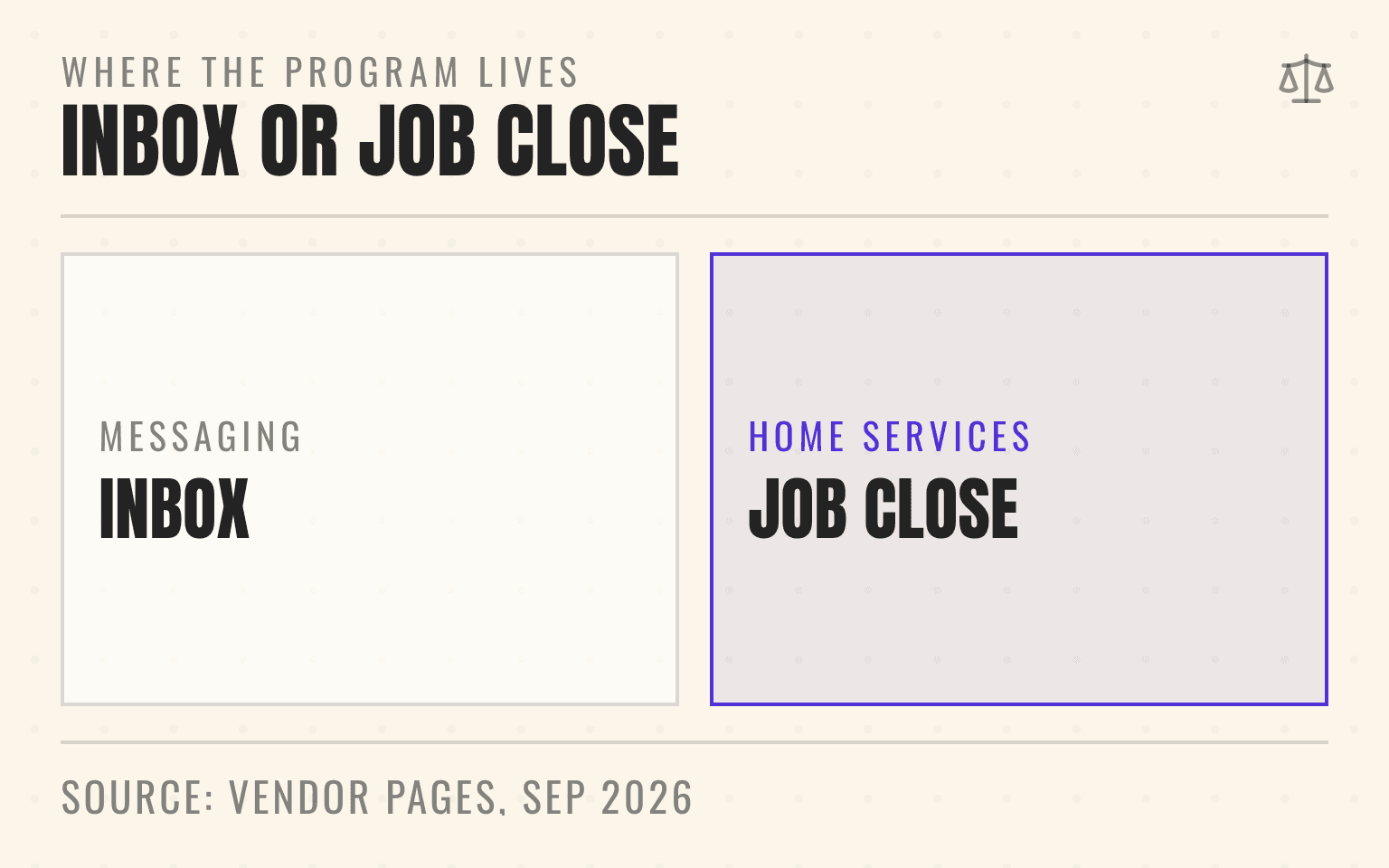
Messaging is not the whole review program
Messaging can help customers reply, schedule, pay, or leave feedback. But a home services brand still has to create review opportunities after real service.
If the workflow depends only on follow-up texts, office staff reminders, or a generic inbox, adoption usually varies by branch. Strong technicians may create trust that never becomes public proof. New markets may stay quiet. Managers may see review count but not which field behaviors created the reviews.
That is why the software evaluation should start in the field, not the inbox.
The volume gap is real and measurable. In the Cheers production review pull covering the 90 days ending September 2, 2026, the median home-services company collected 9.7 new reviews per location a month while the 75th percentile company collected 26.4, across 11 companies and 76 locations with at least one review. Aggregate only (corrected September 23, 2026), no company named; see the panel methodology and the Home Services AI Visibility Index. No inbox closes that gap on its own.
The replacement question should be precise. Keep Podium when the messaging, web chat, payment, and front-office workflows are the value. Compare a focused review platform when review capture, monitoring, and response are the job. Compare Cheers when the gap is the recurring work around reviews, profiles, local pages, citations, employee adoption, and AI visibility by market.

What a home services alternative should do
For home services, the platform should support a simple operating loop.
The eligible customer gets a neutral review path after real service. The request routes to the right Google profile. The activity is tied to the employee, branch, and service moment where possible. Managers can see adoption without creating rating pressure. Marketing can use review themes to improve local pages and AI visibility.
That loop is different from ordinary reputation management. Review Generation Software With Employee Attribution explains why attribution changes coaching, and the home-services review software comparison covers the HVAC and plumbing version, including the review tools inside ServiceTitan, Housecall Pro, and Jobber.
A practical Podium-alternative shortlist usually splits into five lanes:
Comparison
Podium alternatives for field-service review generation
Where each option earns its place when reviews are created at the job site, not in an inbox.
| Platform | Review generation | Employee attribution | AI prompt tracking | Messaging and payments | Done-for-you execution |
|---|---|---|---|---|---|
| Cheers | Core capability | Core capability | Core capability | Not the focus | Core capability |
| Podium | Core capability | Partial or add-on | Not the focus | Core capability | Not the focus |
| Birdeye | Core capability | Not the focus | Core capability | Core capability | Not the focus |
| Enterprise local suites (SOCi, Uberall, Yext) | Partial or add-on | Not the focus | Partial or add-on | Not the focus | Not the focus |
| Field-service CRM add-ons | Partial or add-on | Partial or add-on | Not the focus | Not the focus | Not the focus |
Pricing: Visibility $750/mo for up to 3 locations; Managed from $3,000/mo, priced to scope; bigger brands by contract
Best for: Home services brands that want a done-for-you program: technicians create the review moment and Cheers manages the visibility layer around it
Strengths
- Compliant review paths built around the service moment
- Attribution by employee, branch, market, and service line
- The website, listings, structured data, and local content around the reviews get managed, not just measured
Tradeoffs
- Not a customer-messaging suite: no web chat or payments
- Single-location shops may not need the operating layer
Pricing: Core $399/month, Pro $599/month; HVAC through sales
Best for: Front-office communication: texting, web chat, payments, review texts
Strengths
- Reviews ride along with strong customer messaging
- Payments and lead conversion live in the same inbox
Tradeoffs
- Built around the front-office inbox; the field service moment sits outside the design center
- Employee leaderboards track invites and credited reviews rather than the in-person service workflow
Pricing: Custom
Best for: Broader reputation, listings, and CX consolidation
Strengths
- Wide platform surface beyond reviews
- AI search visibility story via Search AI
Tradeoffs
- Field-service review operations are not the design center
- Execution stays with your team
Pricing: Custom
Best for: Listings, pages, reviews, and location data at enterprise scale
Strengths
- Strong multi-location data and reporting controls
- One contract for many local surfaces
Tradeoffs
- Review generation is monitoring-led, not field-led
- Heavyweight for a single home-services brand
Best for: Keeping the review ask inside the dispatch or job-management workflow
Strengths
- No new tool for technicians to learn
- Review request fires from the job record
Tradeoffs
- Reviews are an add-on feature, not a program
- No AI visibility layer and little coaching reporting
The short version
- The front office needs texting, chat, and payments in one inbox: Podium
- You want reputation, listings, and CX consolidated broadly: Birdeye
- The review ask should live inside dispatch software: Your CRM's add-on
- Technicians create the trust and you want the surrounding website, listings, and local content managed for you: Cheers
Capability reads reflect each vendor's official public positioning as of September 2, 2026, using the sources linked in this article. Pricing appears only where the vendor publishes it. Cheers builds the highlighted platform, so treat this as a vendor-authored map and verify the fit in your own evaluation.
Where Podium may still be right
Podium may be the better fit when the company mainly needs customer messaging, web chat, payments, or a broad front-office communication system. If those workflows are central and already working, replacing them may create more disruption than value.
The key diligence question is whether the review workflow goes deep enough for field-service operations, and whether it stays inside Google's rules while it does. Podium's own culture guide recommends a technician leaderboard, saying "Most companies see success with putting focus on the Leaderboard so technicians can also follow along," and reports that "72% of businesses believe that incentivizing employees has had a positive impact on the number of reviews collected." Google's contribution policy points the other way on staff review targets, and the FTC rule that took effect on October 21, 2024 covers incentives conditioned on review sentiment. A leaderboard that counts posted reviews is a different instrument from one that counts completed neutral asks, and only one of them is safe.
Ask whether the platform can show review opportunities by technician, branch, and market. Ask how it avoids selective asking, incentives, and rating pressure. Ask whether review language connects to location pages, Google profiles, and AI visibility work.
If the answer stops at "we send review texts," keep digging.
Where Cheers is sharper
Cheers is a better fit when review generation is one part of a managed local visibility program rather than a feature in an inbox.
That means the business cares about review velocity, employee attribution, Google profile strength, local pages, citations, AI recommendations, and the source gaps that make competitors appear more often. Cheers manages that whole layer, website, reviews, listings, structured data, and local content, so the field team's work shows up in Google, Maps, ChatGPT, and Perplexity.
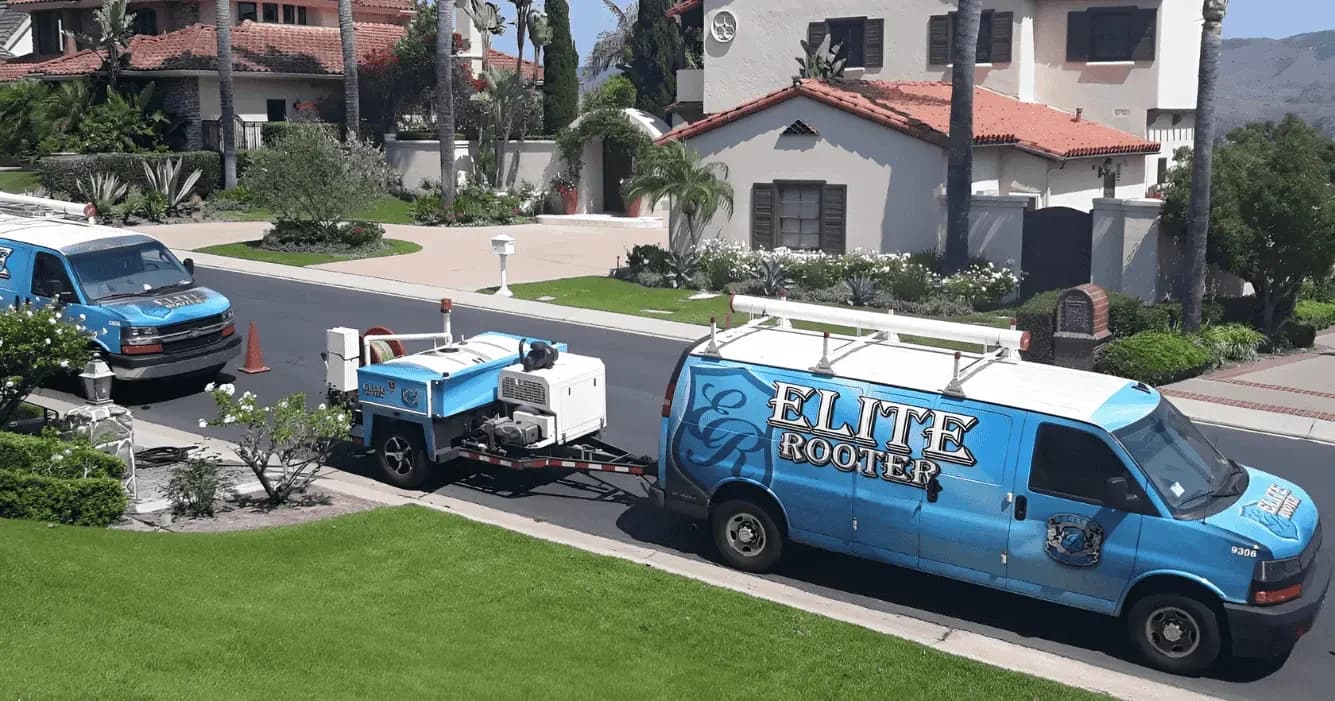
Action Furnace shows what that looks like in public. More than a thousand of its Google reviews trace back to a specific employee card, which means managers coach from evidence instead of averages; the Action Furnace case study breaks down the full June 2026 numbers. The Elite Rooter case study shows the same operating model running across a dozen plumbing markets.
The point is not the card. The point is that field activity, reviews, branches, and visibility can be managed together.
Next step
Is AI recommending your business?
Find out how visible you are across ChatGPT, Gemini, Perplexity, and AI Overviews.
The buyer test
Bring each vendor a realistic scenario: one strong technician, one new technician, one strong branch, one weak market, one emergency job, and one replacement estimate.
Ask the vendor to show exactly what happens. How does the review opportunity start? What does the customer see? Is the request neutral? How is the employee attributed? What can the manager coach? How does the platform avoid policy risk? How does review language support local visibility after the review exists?
Choose the system that improves the behavior that creates legitimate reviews. For a home services company, that is usually more important than another shared inbox.
If you want to see whether a field-service review workflow fits your team, use the demo action below with one strong branch, one weak branch, and the service moments you want managers to coach.
If you are replacing Reputation specifically, the Reputation.com alternatives guide starts with the workflows to retain and the branch pilot to prove before cancelling.
Sources
- Podium Reviews product page. Podium, checked September 2, 2026. Product positioning, AI review invites, and the single review inbox.
- Creating an Online Review-Based Culture. Podium guide, undated. Technician leaderboard recommendation and employee incentive statistics. Checked September 2, 2026.
- Podium customer communications. Podium, undated. Category context for messaging, web chat, and payments. Checked September 2, 2026.
- Birdeye Reviews AI. Birdeye, checked September 2, 2026. Stated coverage of 200 or more review sites.
- SOCi Genius Reputation Agent and Uberall review management. Vendor product pages, checked September 2, 2026. Uberall states it centralizes reviews from "Google, Facebook, Yelp, TripAdvisor, and 80+ more."
- Yext Listings. Yext, checked September 2, 2026. Multi-location listings category context.
- Tips to get more reviews. Google Business Profile Help, undated help page. Checked September 2, 2026.
- Manage customer reviews. Google Business Profile Help, undated help page. Checked September 2, 2026.
- Prohibited and restricted content. Google Maps contribution policy, undated policy page. Fake engagement, incentives, and staff review targets. Checked September 2, 2026.
- Rule on the Use of Consumer Reviews and Testimonials: Questions and Answers. Federal Trade Commission, November 2024. Rule effective October 21, 2024. Checked September 2, 2026.
- Home Services AI Visibility Index 2026. Cheers Research, September 2, 2026.
- Action Furnace case study and Elite Rooter case study. Public home services proof.
Dylan Allen-Arnegård is the CEO & Co-Founder of Cheers, the done-for-you platform that manages the website, reviews, listings, structured data, and local content that get service businesses recommended across Google, Maps, ChatGPT, and Perplexity.