

A homeowner asks Google to check what an AC diagnostic visit costs. Google calls nearby HVAC companies, collects the answers, and returns the options to the customer. At another branch, Google calls to confirm holiday hours for the Business Profile. Both calls may sound automated. They do not have the same purpose or the same operational risk.
Google described the customer side of this when it launched the feature:
Search can now call businesses to get pricing and availability information on your behalf, without you needing to pick up the phone.
Last verified: September 2, 2026.
There is a second lane. Google also runs automated calls and texts to confirm or update Business Profile information, and its help page states that "these calls are monitored and recorded for quality assurance." A multi-location operator needs to identify which lane a call belongs to before anyone quotes a fee, changes a public fact, or hangs up on a customer.
Two automated call lanes
Same voice, different risk
Booking risk
A customer asked
- Price or availability of a service
- Appointments and wait times
- Results emailed or texted to the customer
- Answer with the branch's normal service rules
Public-record risk
Google is checking the profile
- Confirms hours, inventory, business facts
- Can create a pending profile update
- Can post on the business's behalf
- Answer only from the approved location record
Google Business Profile Help: About automated calls and texts from Google, and Identify fraudulent calls; Google Search blog, July 16, 2025. All checked September 2, 2026.
Important
Treat a Google automated call as an operating event, not a ranking trick. Identify the request, apply the location's approved policy, record the outcome, and verify any customer route or public profile change afterward.
The policy below is designed for home service groups, franchise systems, med spa networks, and other service brands where one inaccurate answer can affect a real booking or a real location record. Teams that need this tied to a broader market-level visibility program can use the demo action below, but the call policy should stand on its own.
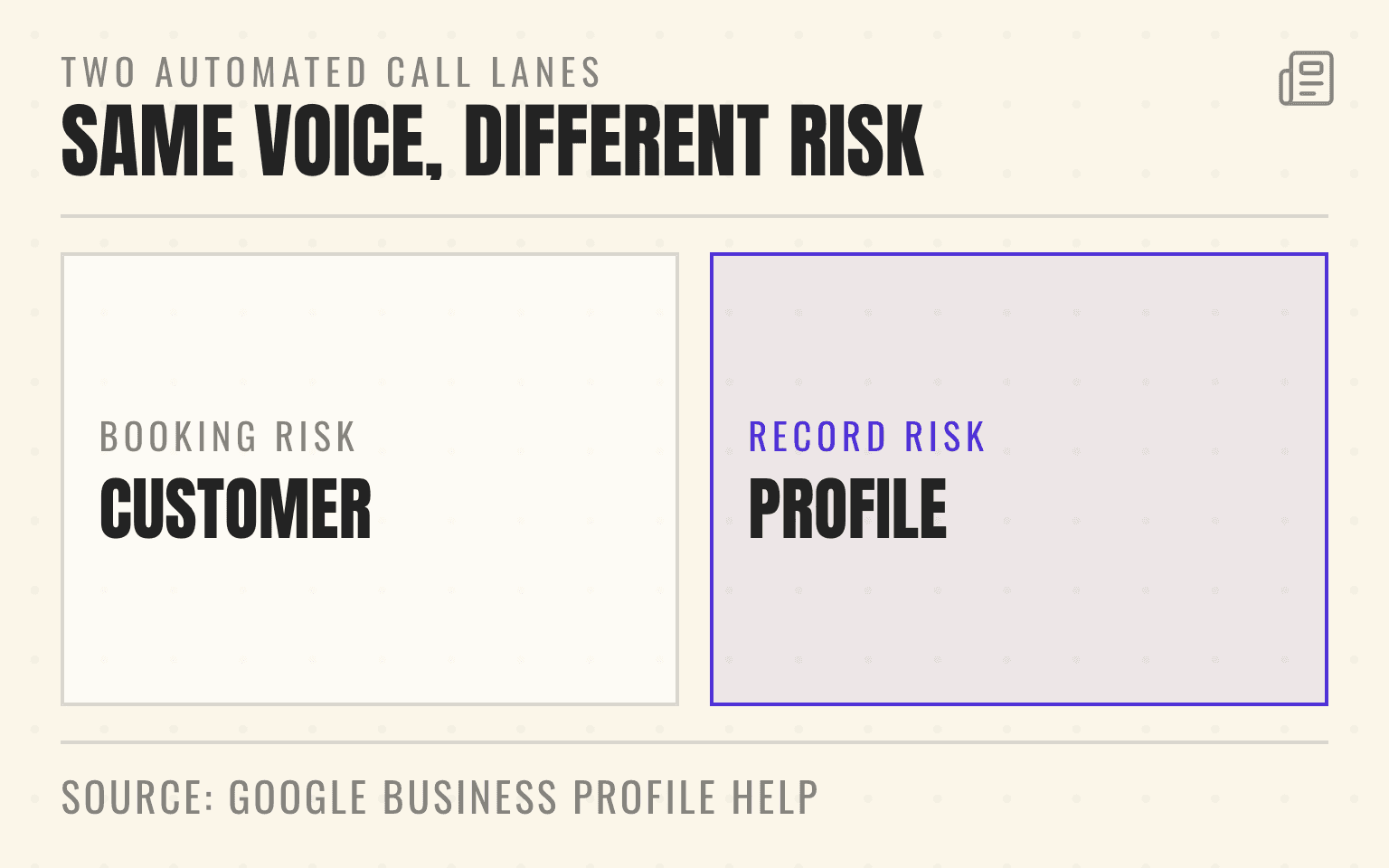
Google can make two different kinds of automated calls
Google's current documentation describes two distinct call lanes. The person answering the phone should know the difference before sharing anything.
A customer asked Google to call
Google Search introduced this on July 16, 2025: a customer selects an option such as "Have AI check pricing" and Google contacts local businesses about pricing and availability. Google Business Profile Help says customer-initiated calls can also book appointments and check wait times. Google then sends the collected details to the customer by email or text.
That makes this a customer inquiry, even though the voice on the line is automated. The branch should apply its ordinary rules for service area, price, availability, booking, and consent. A plumbing dispatcher can confirm a standard diagnostic fee if the market has approved one. The dispatcher should not turn that into a guaranteed repair total before anyone has inspected the job.
As of August 8, 2026, Google's help page says customer-initiated automated calls are available for eligible businesses in the United States except Indiana, Louisiana, Minnesota, Montana, and Nebraska. Google also says availability varies by region, language, and category. Operators should recheck the official help page before rolling the process into a new market.
Google is checking the Business Profile
Google also calls or texts businesses to confirm facts such as hours and inventory. Its help documentation says an automated conversation may create a pending profile update and, in some cases, a post on the business's behalf. Google says those calls and texts are monitored and recorded for quality assurance.
This is a profile-maintenance event, not a customer booking. The answer must match the approved location record. A front-desk employee should not extend hours because the clinic sometimes takes a late appointment, and a technician should not add a service because another branch offers it.
Use the multi-location Business Profile update workflow when a call produces a pending change or a public value that does not match the approved record.
Decide what each location is allowed to confirm
The useful script is not a paragraph that every employee memorizes. It is a boundary around five facts: the service, the price basis, the availability window, the booking status, and the location that owns the answer.
An HVAC branch may quote a diagnostic fee but require dispatch review before promising same-day arrival. A restoration location may confirm that emergency calls are answered overnight but cannot promise an onsite time until the duty manager checks distance and crew status. A med spa can confirm that consultations are available while keeping treatment eligibility, provider selection, and final pricing inside the clinic's normal intake process.
This is where public source work and phone operations meet. If a company publishes a fixed fee, the staff answering Google's call should be able to honor the same rule. If price depends on inspection, parts, permits, equipment, or urgency, use an approved range or explain the estimate process. The service-pricing guide and response-time guide show how to keep those promises specific by market.
The call should end with an accurate customer next step. "A coordinator must confirm that slot" is better than a false booking. "The diagnostic visit starts at this fee, but the repair is quoted after inspection" is better than an invented total.
Teach staff how to identify a legitimate Google call
Google says its legitimate automated calls identify Google and state the reason for the call, and its fraud guidance gives staff one line to hold on to:
You won't be asked to sign up for a service, pay money, or give personal info.
Those calls come from designated numbers that Google publishes in its help center.
Staff do not need to debate a suspicious caller. If the call does not identify Google and its purpose, asks for payment or credentials, or pressures the employee into an unrelated service, end the call. Check the number against Google's current list and escalate through the existing security or Business Profile owner.
Google also says automated calls are recorded. The employee should therefore share only business information approved for public or customer use. Do not give the caller employee schedules, customer details, account credentials, private extensions, or anything that would not belong on a public page or in a normal booking conversation.
Pro Tip
Put the identification rule beside the branch's phone script: Google plus purpose, designated number, no payment, no credentials. A call that fails the check stops there.
Next step
Is AI recommending your business?
Find out how visible you are across ChatGPT, Gemini, Perplexity, and AI Overviews.
Choose the settings profile by profile
Google Business Profile's advanced settings include separate controls for automated bookings or inquiries, calls and texts that keep a profile up to date, and posts made on the business's behalf. Google also documents voice opt-out during an automated call.
For a multi-location brand, the settings decision belongs in the location record. One clinic may use online scheduling and want booking inquiries enabled. A 24-hour service-area business may rely on a centralized call tree that needs testing before automated inquiries are useful. An acquired branch may need profile-maintenance calls disabled until the approved hours, phone, and service list have been reconciled.
Do not assume one manager's setting applies across the portfolio. Record the state for each profile, the owner who approved it, the reason, and the next review date. Google notes that opting out of automated calls does not stop every manual call, so the identification rule still matters.
Keep customer inquiries separate from profile updates
The two call lanes need different closeout checks.
For a customer inquiry, verify what Google sent back to the customer and whether the requested booking or call transfer actually reached the correct location. For a profile-maintenance call, review the Business Profile for a pending or published change. Google says conversational updates may remain pending for as long as five business days and that the business can review or remove posts made on its behalf.
Google has also added a "Collected info" view for select regions, languages, and business categories. It can show the source and date of information Google collected through automated calls and other methods. Review that record when it is available, but do not stop there. Google's help page warns that deleting a collected item does not reverse information already applied to the profile. The team must inspect the live Business Profile too.
Log the outcome without inventing a new attribution channel
Google's public documentation explains what the calls can do, but it does not describe a portfolio-level reporting system that joins every call to a booked job, profile change, and downstream revenue event. Operators should create that join in the systems they already trust.
Keep one lightweight record for each call:
- Location and public phone route that received it
- Date, time, and customer-inquiry or profile-maintenance lane
- Service, price, availability, booking, or profile fact requested
- Approved answer category, without customer or employee personal data
- Booking, transfer, opt-out, escalation, or profile-change outcome
- Owner and scheduled readback date
The record should not label every automated call an AI Mode lead. Google documents several automated calling programs. Use the specific call purpose and the customer's known route when available, then keep unknown attribution unknown.
For website bookings that an agent may attempt without a phone call, use the separate AI agent booking-readiness guide. The same location facts should hold across both routes, and the AI Visibility Grader shows whether the branch is named in the answers that trigger these calls in the first place.
Run a 14-day pilot before setting a portfolio rule
Start with branches that expose different failure modes instead of selecting the easiest locations. A useful pilot might include a centralized HVAC call center, a service-area plumbing branch, a med spa with provider-specific scheduling, a franchise location, and a recently acquired business with a legacy phone route.
- Days 1 to 3: inventory each profile's automated-call settings, public number, phone tree, approved price basis, availability language, and booking owner.
- Days 4 to 7: train the pilot locations, place test calls through the public route, and correct IVR or transfer failures before relying on automated inquiries.
- Days 8 to 14: review call records, customer handoffs, pending profile updates, collected information, and branch exceptions. Keep the setting only where the team can answer and verify the outcome.
Marketing should own the Business Profile standard and source alignment. Operations should own what locations may promise. The contact center or local manager should own the live answer. Revenue operations should own the booking and call-route join. One named profile owner should close any public update.
Finish with a public readback
The last step is deliberately ordinary. Call the public number. Check the booking path. Open the Business Profile in Search and Maps. Review collected information and pending changes when those surfaces are available. Confirm that the branch still shows the approved hours, service, price basis, and customer route.
Answering the call does not prove that the customer received the right option or that Google kept the intended profile fact. The readback is the proof. For a 100-location service brand, that turns an unfamiliar automated voice into a controlled operating event instead of one more untraceable exception.
Sources
Every link below was opened and checked on September 2, 2026.
- Deep Search and business calling in Google Search. Google, July 16, 2025. The customer-requested calls for local pricing and availability.
- About automated calls and texts from Google. Google Business Profile Help. Customer-initiated appointment, wait-time, price, and availability calls, geographic availability, call recording, and opt-out controls.
- About calls and texts from Google to confirm business info. Google Business Profile Help. The profile-maintenance lane, pending conversational updates, and posts made on a business's behalf.
- Manage advanced profile settings. Google Business Profile Help. The controls for automated inquiries, profile updates, prices, and availability.
- Identify fraudulent calls, emails, and messages. Google Business Profile Help. Designated numbers and the no-payment, no-personal-information rule.
- Edit your Business Profile and review collected info. Google Business Profile Help. The Collected info view and the warning that deletion does not undo information already applied.
Dylan Allen-Arnegård is the CEO & Co-Founder of Cheers, the local search platform for multi-location service businesses.