

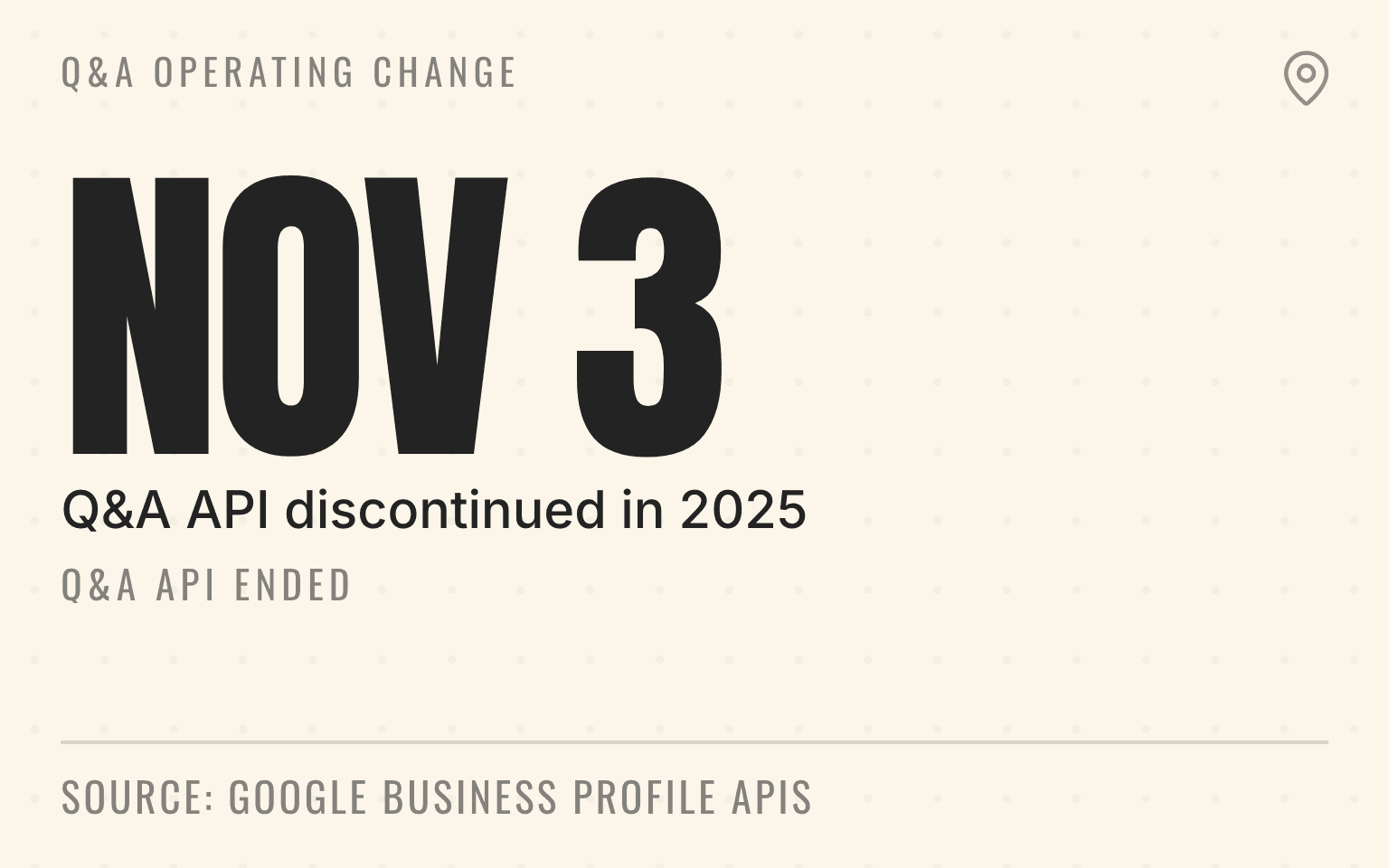
Google discontinued the My Business Q&A API on November 3, 2025. Google's changelog, updated August 28, 2026, says businesses can no longer read or post profile questions and answers through the API.
Last verified: September 2, 2026.
Google's documentation says:
The My Business Q&A API was discontinued on November 3, 2025. You can no longer read or post questions and answers using the API.
Q&A operating change
The API workflow ended
Nov 3
My Business Q&A API discontinued in 2025
Google Business Profile APIs: Q&A API changelog, updated August 28, 2026; checked September 2, 2026.
That is no longer a dependable operating model for multi-location service brands.
Google says the My Business Q&A API was discontinued on November 3, 2025, which means businesses can no longer read or post questions and answers through that API. At the same time, Google Business Profile help still says Q&A can be available only for select business categories and regions. That distinction matters. Q&A is not something operators should assume they can manage at scale, but it also is not safe to claim it disappeared from every customer surface.
The practical replacement is not one new widget. It is a governed answer system that answers recurring customer questions in places customers, Google, and AI systems can verify: location pages, service pages, profile fields, reviews, photos, booking paths, and frontline scripts.
Important
Treat Google Business Profile Q&A as a signal to replace, not a database to depend on. The scalable source of truth should be visible content and operating ownership that each location can actually keep current.
What changed with Google Business Profile Q&A
The API change is the cleanest line in the sand. Google's Business Profile API changelog says the My Business Q&A API was discontinued on November 3, 2025, and that businesses can no longer read or post questions and answers using the API.
For a brand with 30, 80, or 400 locations, that removes the practical path that made Q&A manageable. If a central reputation team cannot reliably pull questions, assign answers, update stale responses, and monitor new questions through an API, profile Q&A stops being a scalable source of truth.
The public feature is more nuanced. Google's current Business Profile help still describes Q&A as available only for select business categories and regions, and says business owners and profile managers can answer questions in the Q&A section when the feature is available.
So the operating rule should be simple: do not build a multi-location answer workflow around Google Business Profile Q&A. If Q&A appears on a profile, use it as customer research and keep answers accurate where you can. The durable answer should live somewhere you control and can govern.
Why this matters more in AI local search
Customer questions did not disappear. They moved into search prompts, map prompts, call paths, review language, and website comparisons.
Google says generative AI features in Search, including AI Overviews and AI Mode, are rooted in its core Search ranking and quality systems. It can compare indexed pages and related evidence before forming a response. For local operators, the job is not special AI copy. It is making the ordinary pages, profile fields, reviews, and frontline answers specific enough to trust.
Ask Maps makes the same direction visible in Maps. Google describes Ask Maps as a conversational experience that lets users ask complex real-world questions and get answers with a customized map. A customer no longer has to search only "plumber near me." They can ask for a service, constraint, timing, neighborhood, and preference in one prompt.
That changes the job for multi-location service brands. The question "Do you offer same-day service?" should not live only in an old profile Q&A thread. It should be visible in the dispatch rule, location page, service page, hours policy, review proof, and call script.
For the broader Google profile-and-page baseline, read Is Google Business Profile enough for AI visibility?. Q&A replacement is one specific failure mode inside that broader problem.
Where recurring answers should live now
The replacement answer system should start with the owned website because that is where the brand can show detail, update dates, internal links, and location differences. Google Business Profile still matters, but it should point back to facts the business can explain.
Use these sources deliberately:
- Google Business Profile fields for categories, services, hours, attributes, photos, description, and booking or appointment links where available.
- Location pages for branch-specific service areas, local phone paths, emergency availability, credentials, financing context, parking or access notes, and local proof.
- Service pages for job definitions, eligibility, constraints, warranties, consultation rules, dispatch expectations, and customer handoff details.
- Review themes for questions customers already ask or praise, without scripting reviews or asking customers to repeat keywords.
- Photos and videos for proof of real services, locations, equipment, vehicles, team uniforms, storefronts, treatment rooms, and completed work where appropriate.
- Frontline scripts for the answer the dispatcher, technician, estimator, or receptionist should give when a customer asks the same question offline.
Google Business Profile services deserve special attention. If customers repeatedly ask whether a branch performs tankless water heater installation, EV charger installs, Botox consultations, or storm-damage roof inspection, the service list should not be a generic national menu. Use the Google Business Profile service-list workflow to decide which jobs belong on which profiles.
How to audit old Q&A without creating FAQ spam
If old Q&A is still visible on priority profiles, audit it for intent before copying anything.
Start by separating questions into four groups. Some are branch facts, such as "Do you serve Scottsdale?" or "Is this location open on Sundays?" Some are service facts, such as "Do you repair tankless water heaters?" Some are policy facts, such as "Do you offer financing?" or "Do you accept insurance?" Some are customer support questions that do not belong in public SEO content, such as appointment rescheduling or account issues.
Branch facts usually belong on the location page. Service facts usually belong on the matching service page and profile service list. Policy facts may belong on a central policy page plus relevant branch or service pages. Support questions usually belong in the booking path, confirmation email, call-center script, or help flow.
Do not publish every old question as FAQ content. Google says you do not need special schema markup for generative AI search, and it warns against rewriting content just for AI systems. A thin FAQ block that repeats "Do you serve X?" across every city page is not a replacement for real local detail. It is just a bigger cleanup job later.
If the question is genuinely useful and the answer is visible on the page, FAQ schema can still label the content accurately. The content has to earn its place first.
Next step
Is AI recommending your business?
Find out how visible you are across ChatGPT, Gemini, Perplexity, and AI Overviews.
What local teams should own
The hard part is not writing the answer. It is keeping the answer true when operations change.
Marketing should own the public source: page copy, internal links, profile alignment, structured data where appropriate, and source freshness. Operations should own whether the answer is actually true in the field. Local managers should own branch exceptions, such as a temporary service gap, new specialist, changed access instructions, or local license detail. The reputation owner should watch review themes and profile surfaces for recurring questions. The AI visibility owner should test prompts by market and record which source gets cited.
For review-driven source work, use the review-to-content workflow. Reviews can reveal what customers care about, but the page should only make claims the operator can verify.
The cleanest ownership model is a small answer backlog. Each recurring question has a market, service, source, current answer, owner, review date, and fix status. That is enough structure for a regional operator without turning the work into a content bureaucracy.
A 30-day replacement plan
Week one is inventory. Pick the ten to twenty markets that matter most. Capture visible Q&A where it still exists, profile service gaps, repeated review themes, call-center questions, and AI prompts where the brand is missing or misrepresented. Do not try to audit every location at once.
Week two is source assignment. Decide which questions belong on service pages, which belong on location pages, which belong in GBP fields, and which belong only in frontline scripts. Delete or ignore questions that are too old, private, or no longer useful.
Week three is publishing. Update the highest-value service and location pages first. Add internal links from branch pages to service pages. Align GBP services and descriptions where the fields support it. Add photos that prove the service or location, not decorative images.
Week four is testing. Run the same customer questions across Google Search, Google Maps where available, ChatGPT, Perplexity, Gemini, Claude, and any reporting workflow your team uses. Record the answer, cited source, competitor, location fit, and next owner. The useful result is a clear owner for whichever source is missing or wrong.
If emergency availability is the recurring question, use the emergency-hours publishing workflow. If financing is the question, use the financing-options publishing standard. If the answer is a service price, use the service-price publishing standard for Google AI Search before copying one low-price claim across every branch. Those answers need more care than a generic FAQ block.
Check answer reliability by market
The first metric is not traffic. It is answer reliability.
Check whether the right page answers the question. Check whether the profile points to the right service. Check whether reviews and photos support the claim. Check whether AI answers cite your page, a competitor, a directory, a stale profile, or no useful source. Check whether the customer would still need to call just to learn a basic service fact.
Then segment by location. A parent brand may look fine while individual branches are invisible for the questions that drive calls. An HVAC group may own "AC replacement financing" in one market and lose it in another. A med spa group may answer consultation questions centrally while one location's page omits the service. A pest control franchise may have clean categories but no local answer for mosquito control seasonality.
That is why the replacement for Google Business Profile Q&A is an operating loop. Listen to customer questions. Decide where the answer belongs. Publish the visible source. Align the profile and frontline handoff. Retest the market. Assign the next fix.
Google Business Profile still matters. Q&A may still appear in some places. But for multi-location service brands, the answer bank now has to live in sources the team can govern.
Sources
- Q&A API changelog, Google Business Profile APIs, August 2026. Checked September 2, 2026.
- Edit your Business Profile, Google Business Profile Help, no publication date. Checked September 2, 2026.
- Tips to improve local ranking, Google Business Profile Help, no publication date. Checked September 2, 2026.
- AI features and your website, Google Search Central, July 2026. Checked September 2, 2026.
- AI features and your website, Google Search Central, May 2025. Checked September 2, 2026.
- How we're reimagining Maps with Gemini, Google, July 2026. Checked September 2, 2026.
Dylan Allen-Arnegård is the CEO & Co-Founder of Cheers, the local search platform for multi-location service businesses.