

Marking a branch permanently closed does not remove it. Google Business Profile Help is explicit: "If you mark a business as permanently closed, your Business Profile may still appear on Search and Maps for users who search for it." The profile stays, the reviews stay, and every stale citation pointing at it stays. A closure is a state change you publish, not a record you delete.
For a franchise system, home-services rollup, med spa group, or hospitality operator, a closure can leave behind a Google Business Profile, old location page, locator entry, phone route, citations, reviews, photos, schema, and AI-search citations. If those sources disagree, customers may call a dead number, drive to a closed branch, see the wrong service area, or get an AI answer that still treats the location as open.
Google's AI Search guidance says generative features rely on core Search systems, crawlable content, useful pages, and current local business details. OpenAI also separates search crawling from training crawling through OAI-SearchBot and GPTBot controls. For a multi-location brand, the practical takeaway is simple: closure cleanup has to update the sources that search and AI systems can retrieve.
Important
Closure is a state change, not a deletion reflex. Decide whether the branch is temporarily closed, permanently closed, moved, merged, or reopened, then make every public source say the same thing.
If you are not sure whether AI answers still recommend a closed branch, run an AI visibility check for the old market and service category before you remove or redirect anything.
The short answer
Treat closed-location cleanup as a source-state workflow.
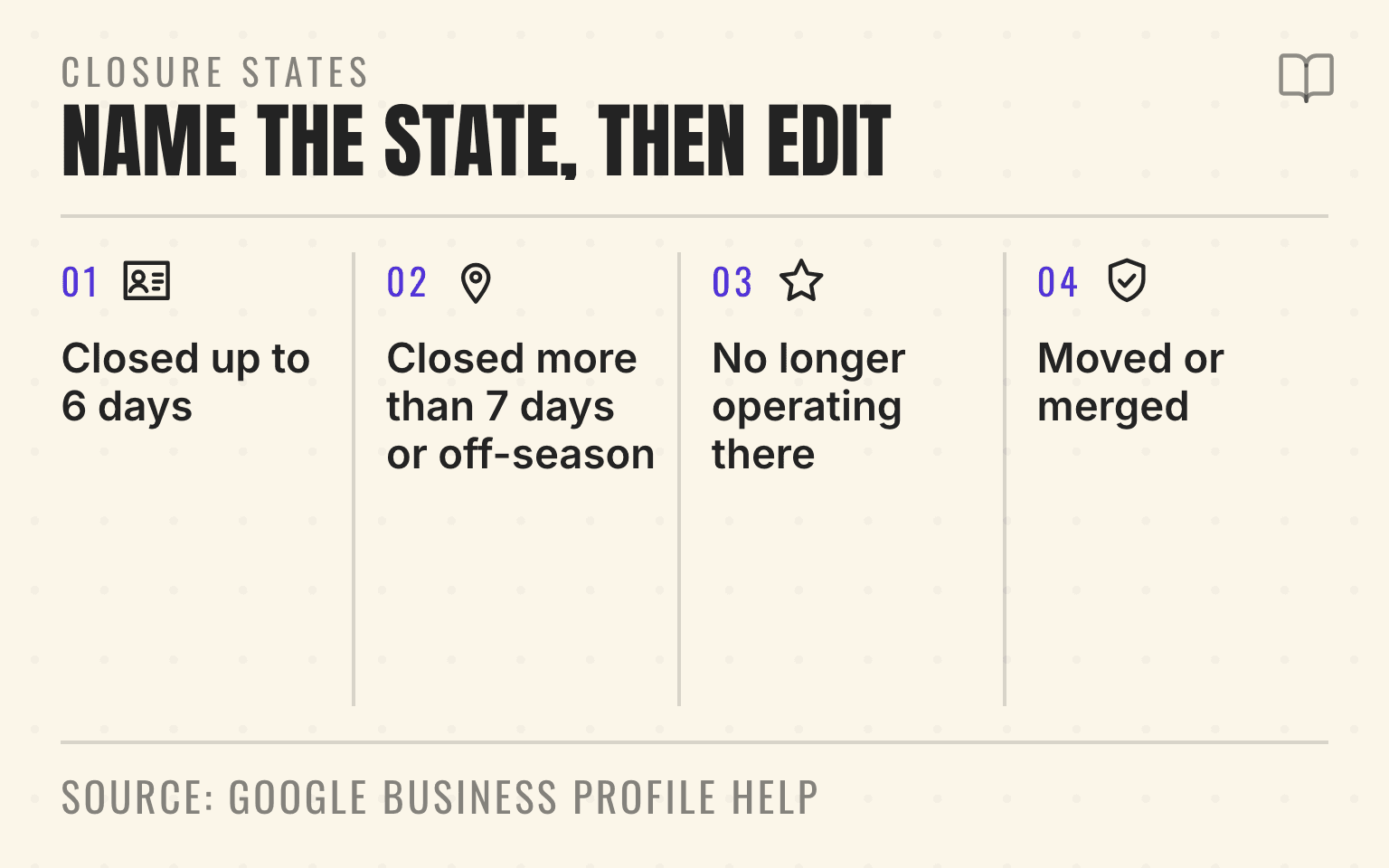
- Name the real state first: special hours, temporarily closed, permanently closed, moved, merged, or reopened.
- Update the Google Business Profile, main hours, special hours, phone path, website URL, and customer-facing status.
- Keep the old location page if customers still need an explanation, review context, service-area handoff, or redirect target.
- Use a permanent redirect only when the old page has a true replacement that should become canonical.
- Align LocalBusiness structured data, locator links, citations, review response ownership, call routing, and AI visibility tracking after the profile changes.
That order matters because an old branch can remain visible even after operations has moved on. Google says permanently or temporarily closed profiles can still show on Search and Maps for people who search for them. Google also says reviews can remain when a business closes. The source does not vanish just because the team stopped dispatching from that address.
Decide the closure state before anyone edits profiles
The first mistake is letting each team choose its own label.
A seasonal pest control branch may need special hours or a temporary closure. A restoration office that moved across town may need a profile update, review transfer path, and old-page explanation. A garage door branch absorbed into a nearby service area may need a permanent closure and a redirect to the surviving market page. A med spa location that paused for renovations may need temporarily closed on the profile, visible reopening information on the page, and no permanent redirect.
Google's two help pages still disagree at exactly seven days, and both were live when I checked them on September 2, 2026. The special-hours page says you can set special hours for a business that "remains closed for up to 6 days in a row," then adds that a business closed "for 7 or more days in a row" should be marked temporarily closed. The closed-status page says the opposite at the boundary: use special hours "If your business is closed for 7 days or less." Anything longer is unambiguous:
If your business is closed for more than 7 days, closed for the off-season, or closed indefinitely, use the option "Temporarily closed."
For an exact seven-day closure, confirm the current product workflow or ask support rather than presenting the boundary as settled. Permanent closure is for a location that is no longer operating as that source. Reopening is a separate state, and Google warns against reopening a business that was marked permanently closed because of a location or name change.
For multi-location brands, that means the closure decision should come from operations, not from a junior profile edit. The decision changes what happens to reviews, redirects, call routing, paid campaigns, franchise reporting, local managers, and customer support.
The Business Profile is the first public state change
Google Business Profile is often the source customers and AI systems see before they reach the website. If the profile state is wrong, the cleanup is already compromised.
For a temporary closure, update the profile state, hours, reopening estimate, phone path, and customer-facing page. If the branch is still taking calls for future bookings, say that on the page and make sure the phone route can handle the promise. If the location is not taking work, do not let ads, profiles, or location pages imply that it is.
Temporary closure also carries a ranking cost Google states plainly: "For broad queries, temporarily-closed businesses can rank after open businesses." That is worth knowing before a renovation pause turns into a two-quarter slide nobody attributed correctly.
For a permanent closure, mark the profile permanently closed and preserve the review-response owner for as long as customers still ask questions. Google says permanently closed profiles may still appear when users search for them. That visibility can be useful if the page clearly points customers to the right surviving location, but it is dangerous if the profile still links to a dead branch page or a phone number that routes nowhere.
Do not delete the location page by default
A closed-location page can still help customers and search systems understand what happened.
The page may have backlinks, branded searches, old reviews, citations, photos, and local demand. It may also be the only owned source that explains whether customers should call a nearby branch, book through a regional service area, or wait for a reopening. Deleting it immediately can create a worse customer path and remove the source that would have corrected stale third-party listings.
The stronger default is to update the page first. Add a clear closure state, final service date when appropriate, replacement location or service area, phone and booking route, review support path, and a short explanation of what changed. If the closure is temporary, keep the page indexable and current. If the location moved, use the Google Business Profile address-change workflow, explain the move, and link to the new branch. If the branch permanently closed and there is no useful replacement, consider whether a 410, noindex, or consolidated market page is better for the customer.
This is the inverse of a launch workflow. New locations need one source record before reviews and citations catch up. Closed locations need one source record so stale proof stops circulating.
Redirect only when the replacement is real
Redirects are powerful because Google treats permanent redirects as a signal that the target should become canonical. That is useful when a closed branch has a true replacement. It is risky when the target is a generic national page, a thin city page, or a different branch that does not actually serve the same customer.
Use a permanent redirect when the old page should no longer appear and the destination fully answers the old customer's need. A moved med spa location can redirect to the new location page after the page explains the move. A merged plumbing branch can redirect to the surviving branch or service-area page if that team now serves the old market. A closed franchise office with no replacement should not silently redirect to a corporate homepage just to preserve traffic.
Use a temporary redirect only when the closure is temporary and the original URL should return. Google says temporary redirects can send users elsewhere without telling Search to replace the source URL as canonical. That fits renovation closures, seasonal pauses, short staffing constraints, or temporary booking handoffs.
Structured data should match the visible closure state
LocalBusiness structured data can describe each location's name, address, URL, phone number, coordinates, hours, departments, and images. Google also supports seasonal opening-hour dates through validFrom and validThrough.
That does not mean schema should carry a hidden closure story. If the page says the location is closed, moved, or temporarily paused, the structured data should reinforce the same visible facts. If the phone number changed, the telephone value should not keep the old number. If the URL redirects, structured data should live on the destination page, not on an orphaned source. If the location is temporarily closed but still has an expected reopening, make the visible page clearer before you worry about markup.
This matters most on large location systems. A locator that still links to a closed branch can keep the URL discoverable. Indexable location finder pages help when they expose real branch URLs and current facts. They hurt when they keep stale locations alive without status labels.
Next step
Is AI recommending your business?
Find out how visible you are across ChatGPT, Gemini, Perplexity, and AI Overviews.
Reviews and photos need ownership after closure
Google says reviews can remain when a business closes temporarily or permanently. It also says customers can leave new reviews for temporarily closed businesses, but not permanently closed ones. If a business moves and keeps the same name, reviews may move to the new location, with exceptions.
That makes review governance part of closure cleanup. A closed branch may keep receiving questions, complaints, or reputation spillover. A moved branch may need review-transfer support. A temporarily closed branch may still earn customer feedback about rescheduled service, refunds, or communication quality.
Do not copy reviews from the old branch into a new page without context. If you use review excerpts on a moved-location page, make the source clear and keep the page honest about the transition. The policy-safe review-page standard is covered in using customer reviews on location pages for AI search.
Photos follow the same rule. Remove or contextualize images that imply active service at a closed location. Keep images that explain the handoff, new location, or service-area coverage. A closed storefront photo can be useful for customer clarity. A stale "now open" banner is a source of confusion.
Citations, maps, and call paths are the long tail
After the Google profile and website are updated, the remaining work is less visible but still important.
Apple Maps, Bing Places, Yelp, BBB, industry directories, franchise locators, old press pages, social profiles, ad landing pages, call-tracking pools, and appointment tools may still describe the closed location as open. AI systems that retrieve or cite external sources can repeat those stale details. Customers can also find them through normal search.
The size of that long tail is measurable. In the Cheers Market Baseline over the 28 days ending September 2, 2026, we classified 356,019 citations from 32 home-services prompts run in 100 metro service areas on four engines. Directory and review platforms took 23.0% of them, pooled, and two of the biggest, google.com and bbb.org, were cited in all 100 metros by all four engines. That is the surface area a closed branch keeps occupying while nobody is watching it. Platform-level counts are in the home-services AI visibility index, with classification rules in the methodology.
Cheers Market Baseline
Where a dead branch survives
23.0%
Directory share of 356,019 classified citations
100
Metros where google.com was cited
100
Metros where bbb.org was cited
4
Engines in the baseline
Cheers Market Baseline, 28 days ending September 2, 2026: 32 home-services prompts in 100 metro service areas on four engines, 356,019 classified citations. Method at cheers.tech/research/methodology.
| Finding | Value | Base |
|---|---|---|
| Directory share of 356,019 classified citations | 23.0% | Stated in the source |
| Metros where google.com was cited | 100 | Stated in the source |
| Metros where bbb.org was cited | 100 | Stated in the source |
| Engines in the baseline | 4 | Stated in the source |
Start with sources that either receive customers or get cited in answers. For a home-services brand, that usually means the Google Business Profile, branch page, locator, Apple Maps, Bing, Yelp, BBB, major data aggregators, ad landing pages, and call-tracking defaults. For med spas and hospitality, booking platforms and local directories may matter more. For franchises, the corporate locator and franchisee microsite are often the fastest way to fix the public story.
The closure workflow is related to duplicate-profile cleanup. Duplicate Google Business Profiles create conflicting source states while a branch is open. Closed locations create the same risk after the team stops watching them.
A 30-day closed-location cleanup plan
Use this sequence when a branch closes, moves, pauses for renovations, merges into a nearby location, or reopens after an extended closure.
- Days 1 to 3: Decide the state. Record whether this is special hours, temporarily closed, permanently closed, moved, merged, or reopened. Name the owner for profile edits, page edits, reviews, citations, call routing, and reporting.
- Days 4 to 7: Update customer-facing sources. Change the Google Business Profile, location page, locator, hours, phone route, booking path, and visible closure explanation. Pause or update ads that still promise service from the old branch.
- Days 8 to 14: Fix redirects and structured facts. Choose a permanent redirect only when a real replacement exists. Use temporary redirects for temporary closures. Update LocalBusiness structured data, sitemap entries, internal links, and profile website URLs.
- Days 15 to 21: Clean the external source stack. Update Apple Maps, Bing, Yelp, BBB, franchise locators, data aggregators, booking tools, and directories that customers or AI systems might cite.
- Days 22 to 30: Measure the old market. Test branded, service, and near-me prompts for the old location. Record whether AI answers still mention the closed branch, which source they cite, and which team owns the fix.
Stop when customers can understand the location state from the first source they find, and when reporting no longer treats closed-location demand, calls, reviews, or AI mentions as active branch performance. For a portfolio that closes, moves, or absorbs branches more than once a year, this belongs in a standing multi-location local SEO process rather than a one-time project.
Sources
Every link below was opened and checked on September 2, 2026.
- Mark your business as closed. Google Business Profile Help. Undated help page, checked September 2, 2026. support.google.com/business/answer/15300196. Source of the quoted lines on permanently closed profiles still appearing, on the more-than-7-days rule, and on temporarily closed businesses ranking after open ones.
- Set special hours. Google Business Profile Help. Undated help page, checked September 2, 2026. support.google.com/business/answer/6303076. Source of the quoted six-day special-hours limit and the seven-or-more-days threshold.
- Google's guide to optimizing for generative AI features on Google Search. Google Search Central. Last updated July 10, 2026, checked September 2, 2026. developers.google.com/search/docs/fundamentals/ai-optimization-guide. Supports the point that Google AI features rely on core Search foundations, crawlable content, and current local business details.
- Move your reviews across Business Profiles. Google Business Profile Help. Undated help page, checked September 2, 2026. support.google.com/business/answer/3098204. Supports the review-transfer, review-retention, and closure-review caveats.
- Mark your business as reopened. Google Business Profile Help. Undated help page, checked September 2, 2026. support.google.com/business/answer/15300571. Supports the reopened-state guidance and the warning against reopening a profile that was permanently closed because of a location or name change.
- Redirects and Google Search. Google Search Central. Checked September 2, 2026. developers.google.com/search/docs/crawling-indexing/301-redirects. Supports when permanent and temporary redirects should be used for retired or moved pages.
- Local business structured data. Google Search Central. Checked September 2, 2026. developers.google.com/search/docs/appearance/structured-data/local-business. Supports the structured-data guidance for location URLs, phone numbers, hours, and seasonal opening-hour dates.
- Overview of OpenAI crawlers. OpenAI Platform documentation. Checked September 2, 2026. platform.openai.com/docs/bots. Supports the distinction between OAI-SearchBot for ChatGPT search visibility and GPTBot for training access.
- Home Services AI Visibility Index 2026. Cheers Research. Market Baseline citation pull, 28 days ending September 2, 2026. cheers.tech/research/home-services-ai-visibility-index-2026. Source of the 23.0% pooled directory share and the 100-metro platform coverage.
Last verified: September 2, 2026.
Dylan Allen-Arnegård is the CEO & Co-Founder of Cheers, the local search platform for multi-location service businesses.