

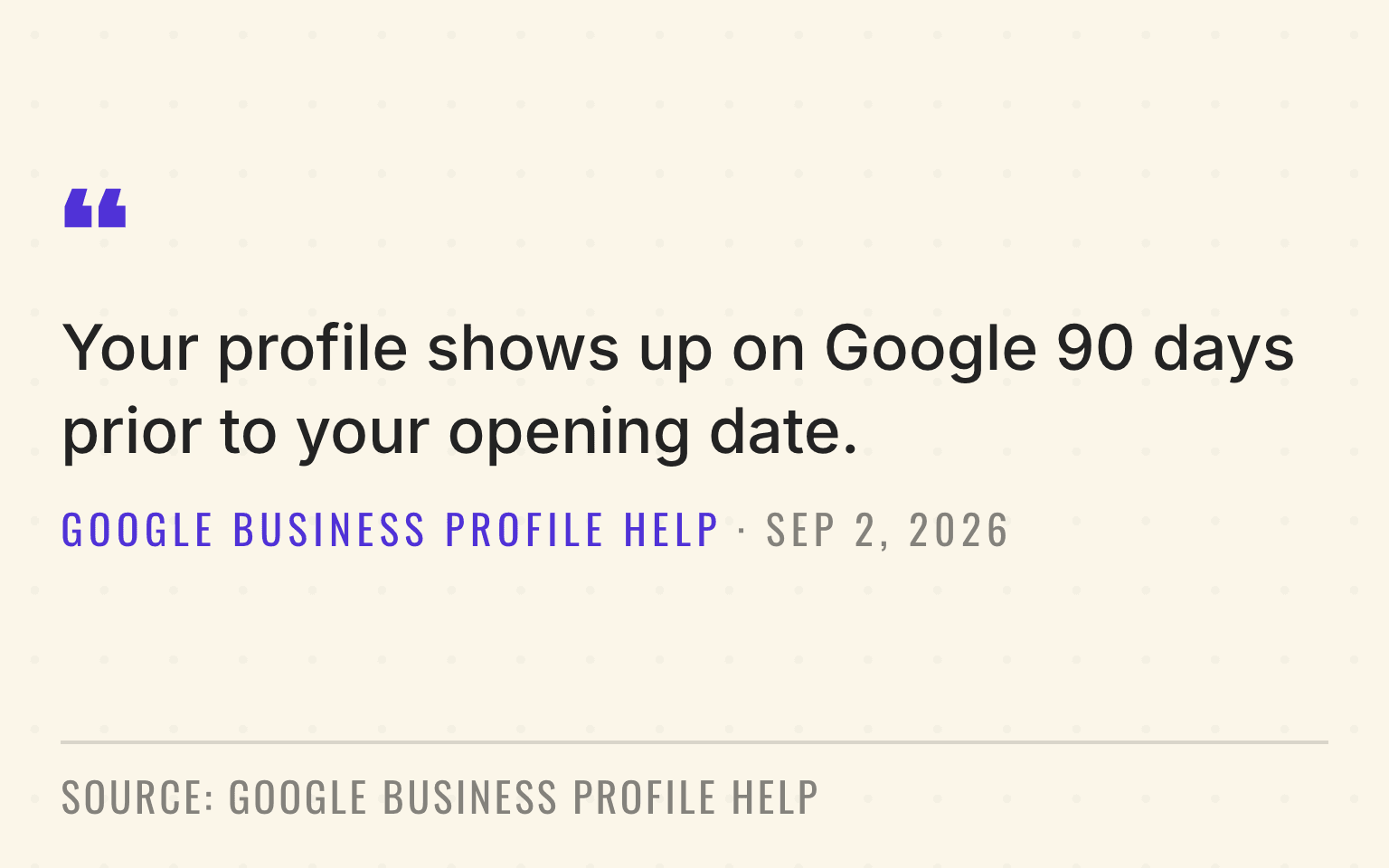
The launch window opens before the doors do. Google Business Profile Help says that once you set an opening date and verify the business, "your profile shows up on Google 90 days prior to your opening date." So the public source record for a new branch is live for a full quarter while the crew is still hiring. Whatever it says during those 90 days is what customers, directories, and AI answers learn first.
For a franchise system, home-services rollup, med spa group, restoration brand, or hospitality operator, the first public week is when Google, customers, directories, Apple Maps, Bing, ChatGPT search, and AI answer systems start reconciling a new local entity. If the profile says one thing, the location page says another, the phone path routes to a call center with no branch context, and the first reviews have no service language, the new branch starts life as a weak source.
This is not a special AI launch hack. Google's AI Search guidance says its generative features rely on normal Search systems, crawlable content, useful pages, and current business details. For a new local branch, that turns the launch into operations work: create one public source record, publish a useful location page, verify the profile, prove real service activity, and measure whether the right branch appears in priority markets.
Important
Launch the local source stack before you expect AI systems to recommend the location. A new branch needs the profile, page, proof, and contact path to agree while reviews and citations are still catching up.
If your team is opening new markets and does not know whether AI answers already cite the right branch or a competitor, run a location-level AI visibility check after the profile and page are live.
The short answer
Treat a new location launch as a source-sequencing workflow, not a one-day listing task.
- Before opening, confirm the legal location, real-world name, category, service area, phone path, opening date, and ownership.
- Publish a useful location page that explains the branch, service coverage, opening status, booking path, photos, and any constraints customers should know.
- Verify the Google Business Profile and keep the profile, page, schema, and locator pointing to the same branch URL.
- Capture first-service proof through photos, early reviews, staff ownership, and local citations.
- Measure AI answers by market and service after launch, then assign fixes to marketing, operations, local managers, or technical owners.
That sequence matters because a new location does not have the reputation history of mature branches. The owned sources have to do more work until reviews, citations, and local mentions build up.
Start with one branch source record
Before marketing asks for a location page, the brand needs one clean record for the branch. This is the source record that profile managers, web teams, call-routing teams, franchise operations, and review teams all use.
For a garage door franchise, that record should answer: what is the real business name, where does the crew work, which phone path reaches the right dispatch team, what services are available on day one, which services come later, and who owns local review response? For a med spa, it should separate treatments available at opening from treatments that require a provider, license, device, or consultation workflow. For a restoration branch, it should specify emergency availability, insurance coordination, equipment capacity, and the markets the team can actually serve.
Google's Business Profile guidelines put the standard plainly: "Represent your business as it's consistently represented and recognized in the real world across signage, stationery, and other branding." The same page says to choose the fewest categories that describe the core business and that there should only be one profile per business. It also draws a boundary most launch plans ignore: a service area "shouldn't extend farther than about 2 hours of driving time from where your business is based." That means the launch record should come from operations, not from a keyword sheet.
Before the first profile is created, use the franchise Business Profile naming rules to separate the public brand name from the city, service, legal operator, and page-title fields.
Use the opening date, but do not overpromise
Google Business Profile lets a business add an opening date, requires only the year and month, and accepts a date up to one year in the future. Once the profile is verified, it surfaces 90 days ahead of that date. That is useful for a franchise opening a new studio, branch, showroom, or field-service location. It also creates risk if the branch is not ready, because the profile is already answering questions.
An opening date should match the customer promise. If a plumbing branch is accepting calls before a public office is open, the page should explain what is bookable now. If a pest control branch has a verified service area but no same-day dispatch until the next week, do not imply full coverage. If a med spa location is open for consultations before specific treatments launch, say that clearly.
The same rule applies to location pages. What location pages should include for AI search covers the mature-page standard. A launch page can be lighter than a mature page, but it still needs to be useful: opening status, branch identity, services, service area, contact path, photos, local proof, and a path to the full location page after launch.
Verification is part of the operating timeline
Google is unambiguous about who controls this step:
Verification methods are automatically determined by Google and can't be changed.
The options depend on business type, public information, region, and business hours, and some profiles need more than one method. Video verification may require showing location, signage, tools, products, branded equipment, or other proof that the business exists and is authorized. Live video calls are only available inside the location's business hours, which is a scheduling constraint, not a marketing one.
That makes verification an operating dependency, not a marketing checkbox. If the field team has not installed signage, does not have branded equipment, or cannot access the location during business hours, the launch can stall. If the phone path cannot receive calls or texts, phone verification can fail. If a third party manages profiles, the business still needs ownership and access handled correctly.
For brands with many locations, Google also documents bulk profile workflows and bulk verification for eligible groups. Those tools help at scale, but they do not remove the need for branch-level QA. Bulk upload can spread bad data faster than a manual process if the launch record is wrong.
The Google Business Profile bulk-verification guide for home service franchises explains the customer-facing eligibility test, business-group setup, and separate path for pure service-area branches.
The location page should be crawlable before demand arrives
Google says pages need to be indexable and eligible for snippets to appear in generative AI features on Search, and sitemap submission is a discovery hint rather than a guarantee. For a new location, that means the website team should not wait until after opening week to make the branch page visible.
A useful launch page gives search systems and customers a canonical URL for the branch. It should appear in the location finder, sitemap, internal links, and profile website field. It should not be a thin city swap. It should explain the service coverage and branch proof that make the location real.
For a franchise opening in a new suburb, the branch page should link to the relevant service-area or city page only when that page helps the customer. If the brand uses a locator, location finder pages should expose crawlable branch URLs instead of trapping all local discovery inside a map state.
Structured data should mirror the public page
LocalBusiness structured data can tell Google about business details such as hours, departments, and other local facts. It should reinforce the visible page, not become the only place where the branch exists.
For a new location, structured data can identify the branch URL, parent organization, address or service area, phone path, opening hours, sameAs links, and the services or departments that are actually visible on the page. If a branch is not fully open, do not hide a stronger claim in schema than the customer sees in the copy.
This is also where franchise systems need consistency. A parent brand may have one identity, but each location needs its own branch facts. The mature franchise source model is covered in how franchise brands get recommended by ChatGPT. A launch workflow should build that graph from day one instead of cleaning it up months later.
Next step
Is AI recommending your business?
Find out how visible you are across ChatGPT, Gemini, Perplexity, and AI Overviews.
Early proof has to come from real work
New locations often have a proof gap. They need to show up before they have much local review velocity, but they should not borrow proof from a mature branch without context.
For home services, the first proof can be practical: a photo of the team documenting a completed job, a service-area explanation based on real dispatch rules, a first-review request workflow, and a profile that points to the correct branch page. For med spa and wellness locations, proof may be treatment-room readiness, provider availability, consultation rules, front desk ownership, and early customer feedback. For hospitality, proof may be opening photos, local amenities, booking paths, and staff ownership for reviews.
Do not manufacture reviews, copy testimonials from another branch, or imply services are available before operations can deliver them. Use the first month to collect truthful local evidence, then update the page, profile, and review workflow as the branch matures.
Measure the launch like an AI visibility problem
A new location launch is not done when the profile is verified. It is done when the right branch is findable, understandable, and measurable across the sources customers and AI systems use.
Use the first 30 days to inspect priority prompts by market and service. A roofing brand opening in Columbus might test roof repair, roof replacement, storm damage, financing, and emergency leak queries. A smart-home installer might test doorbell installation, home security setup, camera wiring, and monitoring questions. A med spa group might test treatment, safety, provider, consultation, and neighborhood queries.
Then compare the answers with the source stack. If competitors appear because their review profiles are stronger, assign review operations. If AI answers cite directories with stale phone numbers, assign citation cleanup. If Google shows the wrong service area, assign profile QA. If the page is not indexed, assign technical SEO. If the answer finds the old acquisition brand, use the rebrand source handoff workflow. If the branch later moves, closes, or reopens, use the closed-location cleanup workflow before redirects or profile edits drift out of sync.
The operating rhythm is similar to auditing AI search visibility across locations, but the launch window is more sensitive because the source graph is still forming.
Do not expect the count of locations to do the work by itself. Cheers cannot yet put a number on location count from its own panel: it covers 13 home-services companies, and no location-count group holds the ten companies a published rate needs, so those cells are suppressed rather than estimated. Adding a branch adds a source record that has to be maintained; it does not add visibility on its own. What the panel does publish is the base rate a new branch starts against, and it depends on the engine. Over the 28 days ending September 2, 2026, leaving out questions that name the company itself, aggregate only, the median company was named in 24.1% of its ChatGPT checks and 36.0% of its Google AI Mode checks. The cut is in the home-services AI visibility index, with the suppression rule in the methodology.
Cheers panel
The base rate depends on the engine
- Median company appearance rate: 13 companies measured on both engines
Cheers panel, 28 days ending September 2, 2026, 13 home-services companies, non-branded prompts, aggregate only (corrected September 28, 2026), cells under 10 companies suppressed. Method at cheers.tech/research/methodology.
| Measure | ChatGPT | Google AI Mode |
|---|---|---|
| Median company appearance rate | 24.1% | 36% |
A 30-day launch plan
Use this as a practical order of operations for new branches, franchisee openings, new service-area offices, or acquired locations that are being launched under the current brand.
- Days 1 to 7: Build the branch source record. Confirm real-world name, address or service area, category, phone path, opening date, services, ownership, branch URL, and who owns reviews.
- Days 8 to 14: Publish the launch page and profile inputs. Add the location page to the locator, sitemap, internal links, and profile website field. Prepare photos, description, categories, services, and verification proof.
- Days 15 to 21: Verify the profile and test routing. Confirm phone, form, booking, hours, service area, UTM, schema, profile link, and customer handoff. Fix mismatches before paid or franchise launch announcements.
- Days 22 to 30: Capture local proof. Request reviews from real customers, add first-service photos, update the page with live constraints, and check citations or platform listings that matter in the market.
- After day 30: Measure AI and local search prompts. Record the branch, competitors, cited sources, answer wording, profile status, indexed URL, and owner for each fix.
The launch record should stay alive after opening. New services, staff changes, hours, phone routing, license changes, and service-area updates should all flow back into the same source system. For a system opening several branches a year, that record belongs in a standing multi-location local SEO program rather than a launch checklist somebody owns once.
Sources
Every link below was opened and checked on September 2, 2026.
- Add a business opening date. Google Business Profile Help. Undated help page, checked September 2, 2026. support.google.com/business/answer/9174409. Source of the quoted 90-day pre-opening visibility rule and the one-year-ahead date limit.
- Verify your business on Google. Google Business Profile Help. Undated help page, checked September 2, 2026. support.google.com/business/answer/7107242. Source of the quoted line that verification methods are automatically determined and cannot be changed.
- Guidelines for representing your business on Google. Google Business Profile Help. Undated help page, checked September 2, 2026. support.google.com/business/answer/3038177. Source of the quoted real-world representation rule and the roughly two-hour service-area boundary.
- Google's guide to optimizing for generative AI features on Google Search. Google Search Central. Last updated July 10, 2026, checked September 2, 2026. developers.google.com/search/docs/fundamentals/ai-optimization-guide. Supports the point that Google AI features use normal Search foundations, crawlable content, local business details, and useful pages.
- Verify Business Profiles in bulk. Google Business Profile Help. Undated help page, checked September 2, 2026. support.google.com/business/answer/4490296. Supports the bulk verification caveats for larger location groups.
- Create a bulk upload spreadsheet for Business Profiles. Google Business Profile Help. Undated help page, checked September 2, 2026. support.google.com/business/answer/3370250. Supports the bulk upload workflow for managing multiple profiles.
- Local business structured data. Google Search Central. Checked September 2, 2026. developers.google.com/search/docs/appearance/structured-data/local-business. Supports using structured data to describe local business details that appear on the page.
- Build and submit a sitemap. Google Search Central. Checked September 2, 2026. developers.google.com/search/docs/crawling-indexing/sitemaps/build-sitemap. Supports the canonical URL and sitemap-discovery guidance.
- Overview of OpenAI crawlers. OpenAI Platform documentation. Checked September 2, 2026. developers.openai.com/api/docs/bots. Supports the distinction between search crawling and other OpenAI access modes for ChatGPT search.
- Add a location in Apple Business Connect. Apple Support. Checked September 2, 2026. support.apple.com/guide/business/add-a-location-abcb98816a34/web. Supports the point that non-Google local surfaces also need location management.
- Home Services AI Visibility Index 2026. Cheers Research. Cheers panel, 28 days ending September 2, 2026, 13 home-services companies, non-branded prompts, aggregate only (corrected September 28, 2026). cheers.tech/research/home-services-ai-visibility-index-2026. Source of the engine appearance rates and the suppressed location-count cells.
Last verified: September 2, 2026.
Amadeus Peterson is the CTO & Co-Founder of Cheers, the local search platform for multi-location service businesses.