

Google's Business Profile guidelines require the name customers recognize across storefronts, websites, stationery, and other branding. The page had no publication date when checked on September 2, 2026.
Last verified: September 2, 2026.
Google's documentation says:
Your name should reflect your business's real-world name, as used consistently on your storefront, website, stationery, and as known to customers.
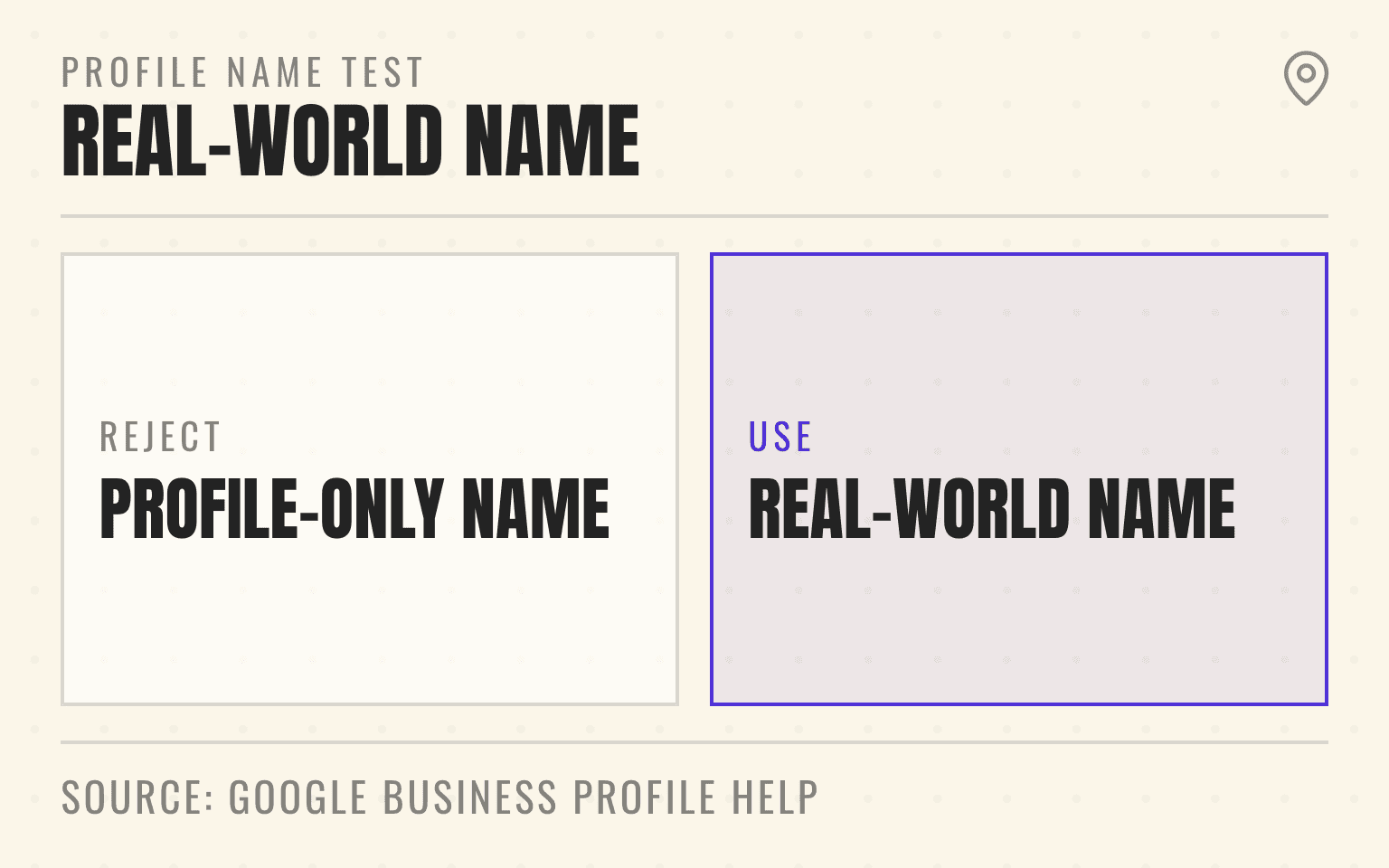
Profile name test
Use the name customers see
Do not use
Profile-only name
- City added only for search
- Service keywords added only for search
- Hours, phone, or tagline in the name
- Identity differs from real-world branding
Use this
Real-world name
- Seen on storefront or vehicles
- Repeated on the website and stationery
- Known to customers
- Consistent across same-brand locations
Google Business Profile Help: Guidelines for representing your business on Google; checked September 2, 2026.
That is not a naming strategy. It is 80 separate claims about what customers call the business.
Google's rule is based on the real-world name, not the phrase a location wants to rank for. A city, service, legal suffix, or sub-brand belongs in the Business Profile name only when it is part of the customer-facing identity and appears consistently in the real world. Otherwise, put the detail in the field designed for it.
Important
The Business Profile name is an identity field. It is not a place to combine the brand, city, service, hours, phone number, or marketing tagline.
For a 20- to 500-location service brand, the hard part is not correcting one profile. It is deciding which name is real, documenting the exceptions, and keeping profiles, location pages, signage, citations, and structured data aligned. That is part of the multi-location local SEO operating system, not a one-time cleanup.
The short answer
Most locations in the same franchise or chain should use the same public brand name. Google says locations within the same country should share one name unless their real-world representation consistently varies by location. It also allows distinct names for consistently operated sub-brands, departments, or business types.
This means "PipeRight" is the safe default when customers see PipeRight on the van, uniform, website, invoice, and location entrance. "PipeRight Phoenix" may be valid when Phoenix is part of the location's durable public name across those same surfaces. "PipeRight Best Emergency Plumber Phoenix" is not rescued by appearing only in the profile field.
The same test applies to services. A garage door franchise should not add "Spring Repair and Installation" to every profile name because those are important services. The Business Profile category and service fields, plus the local page, are where service meaning belongs.
Google asks for the name customers encounter in the real world
Google's guidelines for representing a business say the profile name should reflect the real-world name used consistently on the storefront, website, stationery, and as known to customers. The same document lists service information, location information, marketing taglines, store codes, hours, phone numbers, URLs, and unsupported legal terms as details that usually do not belong in the name field.
The word "usually" matters. Google gives examples of location-bearing names that are acceptable when the location term is part of the actual name. Its chain guidance also permits location-to-location variation when the storefront, website, or stationery consistently uses that variation.
For a plumbing franchise, a city name printed only in the location page's title tag is weak evidence for changing the profile name. A city name used on the permanent branch sign, customer agreement, franchise location page, service vehicle, local phone greeting, and customer receipts is a much stronger real-world identity. The decision turns on public use, not on whether a competitor put more keywords in its own name.
Legal name, trade name, domain, and profile name are different records
Multi-location teams often ask finance for the legal entity name and copy that into every public surface. That can create a different error.
The U.S. Small Business Administration's business-name guidance separates entity names, trademarks, doing-business-as names, and domain names because each serves a different purpose. A franchisee might be Desert Service Holdings LLC, operate publicly as PipeRight, own piperightphoenix.com, and use the parent brand's trademark under a franchise agreement.
Google does not tell that operator to put "Desert Service Holdings LLC" in the profile just because it appears on tax documents. It asks for the name customers recognize. Google also says legal terms such as LLC, Ltd, or Inc. require real-world proof when they are used as part of the profile name.
The website can preserve the legal relationship without turning the profile name into a corporate filing. The location page can say that the Phoenix branch is operated by Desert Service Holdings LLC under the PipeRight brand. The footer, privacy policy, terms, or franchise disclosure can carry the legal entity where it helps the customer. The profile name can remain PipeRight if that is the real public identity.
Structured data can keep these layers explicit. Google's Organization structured data guidance recognizes "name," "alternateName," and "legalName" as separate properties. Its LocalBusiness guidance says to define each business location as a LocalBusiness and use the fully qualified URL for that specific location. Markup should reinforce the visible page, not invent a different branch name for machines.
A city or service belongs in the name only when the business uses it as a name
Consider an 80-location plumbing franchise that uses one national brand. Each branch has a different address, service area, phone route, review set, and location page. Those differences do not require 80 different Business Profile names. The profile already has fields for address or service area, phone, hours, category, services, and website.
Now consider a med-spa group with two consistently operated concepts: Luma Aesthetics and Luma Laser. Each concept has distinct signage, treatment menus, booking paths, staff training, and pages across every applicable market. Google's chain guidance allows distinct names for sub-brands or business types when the distinction is applied consistently. The exception is based on a real operating identity, not on adding "laser hair removal" to one location that wants more impressions.
A third case is a restoration roll-up that acquired a strong local company. If the acquired brand remains on the trucks, uniforms, contracts, phones, and location page, changing the profile to the parent brand creates a mismatch. First use the Google Business Profile acquisition ownership handoff to establish control of every location. If the roll-up completes a real rebrand, the acquisition and rebrand source handoff should move the public identity in a controlled order.
Pro Tip
Use the sentence test: "A customer standing at the location or meeting the field team would call this business ___." If the answer changes only when a marketer opens Google, the proposed profile name is probably not the real-world name.
Next step
Is AI recommending your business?
Find out how visible you are across ChatGPT, Gemini, Perplexity, and AI Overviews.
Put local and service context in the fields built for it
Keeping the profile name clean does not mean hiding local relevance. It means placing evidence where customers can use it.
The location page title and heading can identify the brand, city, and principal service in plain language. The page body can explain service areas, emergency rules, equipment types, licenses, hours, financing, and proof from local jobs. The Business Profile can use accurate categories, services, service areas, attributes, hours, description, photos, website link, and booking path. Reviews and citations can add customer and third-party context without rewriting the official name.
For an electrical franchise in Columbus, the profile name may remain "BrightCurrent" while the location page is titled "BrightCurrent Electricians in Columbus, Ohio." The page can explain panel upgrades, EV chargers, emergency work, and the counties that branch serves. LocalBusiness structured data can name BrightCurrent, use the Columbus branch URL, and include the local phone and address. The entity-fragmentation audit should flag any source that turns those distinct fields into competing identities.
This separation also improves governance. Marketing can update a service page without requesting a profile-name change. Operations can adjust service coverage without renaming the branch. A franchisee can keep a distinct legal entity without forcing customers to learn it as the public brand.
Build an evidence file before editing a portfolio
Name changes can affect far more than the visible profile label. Google's Business Profile policy overview says significant identity changes may be rejected when they appear to turn one business into another. Google's edit-status guidance says verified profile edits are reviewed and can be accepted, pending, or not approved.
Before anyone submits changes across a location group, record:
- Current profile name, proposed name, location ID, owner, verification state, and last material edit
- Permanent signage, vehicle or uniform branding, customer receipts, stationery, and the local phone greeting
- Location page H1, title, canonical URL, LocalBusiness name, parent organization, and legal operator disclosure
- Franchise agreement, DBA or trade-name record, and local registration when they explain a real public variation
- Categories, services, service area, address, hours, and booking path that should carry details removed from the name
- Exception reason, approval owner, rollout wave, rollback rule, and evidence folder for every location that differs from the default
Do not create fake evidence to justify a preferred profile name. If operations wants a location-specific brand, build that identity through the normal legal, franchise, signage, website, customer, and field processes first.
Roll out a correction without creating a new identity problem
Start with a sample that represents the portfolio. Include a normal storefront, a pure service-area branch, a franchisee-operated location, an acquired brand, and any legitimate sub-brand. Confirm the intended name and evidence with the people who own brand, operations, legal, local marketing, and profile access.
Then correct the surrounding source stack before or alongside the profile edit. The location page, structured data, franchise locator, major citations, call greeting, and customer materials should not continue publishing an old or inflated name. New branches should inherit the standard through the franchise location launch process rather than improvising the name during verification.
Avoid broad edits while a profile is in the middle of verification. Google's verification guidance warns that changing the name, address, or category while waiting for a postcard invalidates the code. Google may also ask for more information or re-verification after business details change.
After the pilot, watch edit status, verification prompts, duplicate creation, profile visibility, customer calls, website routing, and citations. A name standard is successful when the profile identifies the right business and the remaining fields explain where it is, what it does, and how to book it.
A 30-day naming governance plan
Week 1: classify every name
Export the active profile inventory and group locations by public brand, sub-brand, franchisee, acquired brand, and legal operator. Mark the names that add cities, services, hours, store codes, legal suffixes, or taglines. Do not assume every variation is wrong. Attach the real-world evidence and name the owner who can verify it.
Week 2: write the default and exception rule
Choose one default profile name for each brand or consistently operated sub-brand. Write a narrow exception rule for true location-specific names. State which fields will carry city, service, hours, and legal context instead. Give new-location and acquisition teams the same standard.
Week 3: align the source stack and pilot edits
Update the visible pages, structured data, locator, citations, and customer materials that should agree with the approved identity. Pilot a small, representative set of profile edits. Preserve screenshots, edit status, verification requests, and support correspondence.
Week 4: expand only after the pilot is stable
Roll out by business group or region, not across the entire portfolio at once. Track exceptions separately. Recheck the profile, location page, categories, services, citations, and customer routing after each wave. If Google treats a proposed rename as a different business identity, stop and resolve the business transition instead of forcing another edit.
The finished system should give each location one recognizable public name and enough structured local context to distinguish the branch. Customers should not need a keyword-stuffed profile name to understand where the business operates or what the team can do.
Sources
- Guidelines for representing your business on Google, Google Business Profile Help, no publication date. Checked September 2, 2026.
- Business Profile policies, Google Business Profile Help, no publication date. Checked September 2, 2026.
- Understand what happens to profile edits, Google Business Profile Help, no publication date. Checked September 2, 2026.
- Verify your business, Google Business Profile Help, no publication date. Checked September 2, 2026.
- Organization structured data, Google Search Central, June 2026. Checked September 2, 2026.
- LocalBusiness structured data, Google Search Central, June 2026. Checked September 2, 2026.
Dylan Allen-Arnegård is the CEO & Co-Founder of Cheers, the local search platform for multi-location service businesses.