

Google's Business Profile guidelines say categories should complete the statement "This business IS a," not describe everything it has. The page had no publication date when checked on September 2, 2026.
Last verified: September 2, 2026.
Google's documentation says:
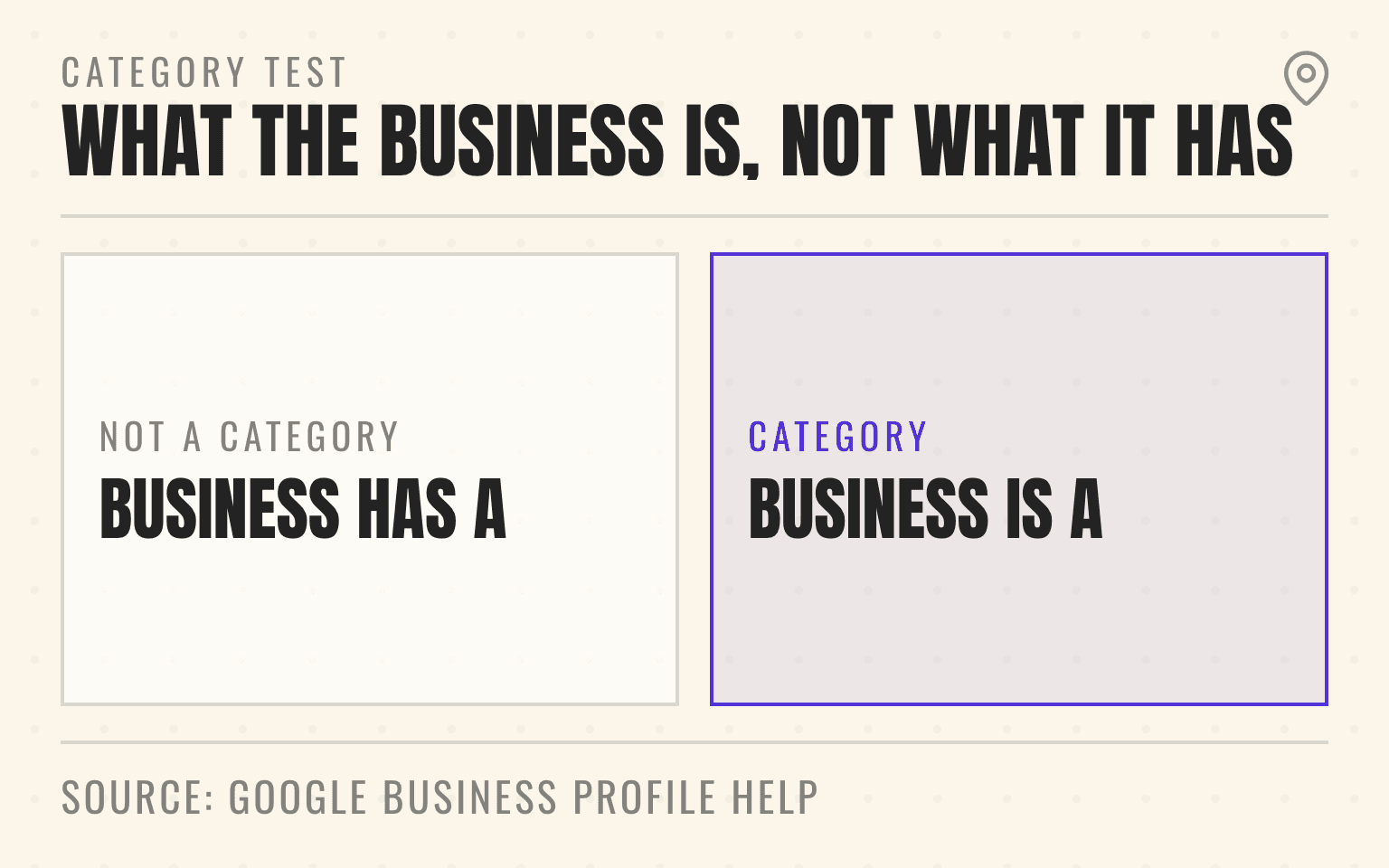
Select categories that complete the statement: "This business IS a" rather than "this business HAS a."
Category test
What the business is, not what it has
Service detail
This business HAS a
- Drain cleaning
- AC tune-ups
- Laser treatment
- Emergency availability
Category
This business IS a
- Plumber
- HVAC contractor
- Medical spa
- Restoration service
Google Business Profile Help: Guidelines for representing your business on Google; checked September 2, 2026.
That sounds simple until a brand has 80 profiles, three acquired companies, mixed franchise operators, service-area branches, and locations that sell different jobs in different markets. One branch may be an HVAC contractor. Another may be a plumbing contractor. A third may be a showroom, training center, or independently operated department that should not borrow the same categories.
For AI search, the category mistake goes beyond Maps hygiene. Google says Business Profile categories affect local ranking, and Google AI Overviews and AI Mode can use query fan-out across subtopics and data sources. If the profile calls a location one thing, the website calls it another, and reviews describe a third thing, the branch becomes harder to match to the right local intent.
Important
Treat the primary category as an operating fact. It should name the public-facing business at that location, not the keyword the marketing team wishes it ranked for.
Keep that category decision separate from the identity field. Google Business Profile name rules for franchise locations explain when a city, service, sub-brand, or legal suffix can appear in the public name and when it belongs elsewhere.
If your team is not sure which profiles are being retrieved or cited for priority local searches, start with a location-level AI visibility check, then compare the profile category against the source stack behind the answer.
The short answer
For a multi-location service brand, the safest category standard is:
- Use one primary category that best describes the actual business customers can hire at that location.
- Use additional categories only when they describe meaningful public-facing business lines or departments, not every service, product, or keyword variation.
- Keep services, service areas, location pages, structured data, photos, reviews, and call routing aligned with the selected categories.
- Review category changes before acquisitions, rebrands, new service-line launches, franchise transfers, and market expansions.
- Document the reason for each category exception so future profile edits do not create a quiet drift.
That gives marketing enough specificity to compete, and gives operations a standard they can defend.
Categories decide what the branch is
Google's category guidance is direct: the primary category should best describe the business, and the category should come from Google's available list. If the exact category is not available, Google says to choose a more general category that describes the business. Google's broader Business Profile guidelines also say to choose the fewest number of categories needed to describe the overall core business.
That matters for service brands because categories are tempting keyword fields. A garage door company might want "Garage Door Supplier," "Garage Builder," "Door Shop," and "Repair Service" because each sounds adjacent to a buyer query. But if the branch is a field-service garage door repair company, the category set should not pretend it is also a showroom, construction company, or unrelated nearby business.
The category is the business type. It is not the service menu.
For an HVAC branch, "HVAC contractor" or the closest available category describes the branch better than a pile of air conditioning, furnace, duct cleaning, and indoor air quality keywords. For a pest control company, the category should identify the pest control business, while termite treatment, mosquito control, rodent exclusion, and inspection details belong in services and page copy. For a med spa, the category should match the actual clinic model, while injectables, facials, laser hair removal, and body contouring belong in services and pages only where that location offers them.
Services and pages prove what the branch does
Categories open the door to relevance. Services and pages do the detailed work.
Google's services editor lets eligible businesses add services, create custom services, and add details such as price or description. That is where job-level detail belongs. The service list can say "drain cleaning," "tankless water heater installation," "EV charger installation," or "microneedling" when the location actually provides that work.
The location page should then reinforce the same local truth in visible text. It should show the branch, service area, services, hours, phone path, reviews, photos, credentials, and booking route. For the fuller page standard, use what location pages should include for AI search. For the service-list layer, use what services multi-location brands should list in Google Business Profile.
When a profile category, service list, and location page agree, the branch is easier for customers and search systems to understand. When they disagree, every downstream source has to guess which version is true.
The multi-location rule
The larger the brand, the more category governance matters.
A 40-location plumbing and HVAC rollup may have markets that operate as one combined contractor and markets that still operate as separate plumbing and HVAC brands after acquisition. A franchise system may have some operators approved for electrical work and others limited to plumbing. A med spa group may have clinics with different provider licenses, treatment rooms, and booking rules.
Do not force one category template across locations when operations are not the same. Also do not let every local manager improvise categories based on competitor profiles. The right middle ground is a category matrix tied to the business model.
For each profile, the matrix should identify the approved primary category, approved additional categories, service-line conditions, source of approval, and review date. That can be a simple spreadsheet, but it should be owned by someone who can reconcile marketing goals with operations reality. Profile edits should be treated like changes to hours, service areas, phone numbers, and pricing: useful when accurate, risky when loose.
This is especially important after rebrands. Home service rollups handling rebrands for AI search need category review in the same cleanup pass as names, URLs, citations, reviews, and profile ownership.
Next step
Is AI recommending your business?
Find out how visible you are across ChatGPT, Gemini, Perplexity, and AI Overviews.
When additional categories make sense
Additional categories make sense when they describe real public-facing business lines or departments.
Google's category documentation uses the example of a grocery store with a bakery and deli. The same logic applies to service brands, but with more discipline. If an HVAC company also operates a separately marketed plumbing division from the same verified location, an additional category may be appropriate. If a med spa has a real public-facing laser hair removal service category available, and that location actually offers it, an additional category may support the profile.
But additional categories should not become a service taxonomy. Google says not to select a category for every product or service. That means a profile should not use categories to chase every job phrase, coupon phrase, city phrase, or competitor phrase.
There is also a department boundary. Google says independently operated, public-facing departments should have their own Business Profiles instead of adding their categories to the main profile. For a local service brand, that matters when a showroom, retail counter, training center, medical department, franchise office, or partner business shares the address but is not the same customer-facing operation.
If the profile is already duplicated or split across several records, resolve that first. How multi-location brands should fix duplicate Google Business Profiles covers that cleanup workflow.
Where category mistakes create AI search problems
Category drift creates source conflict.
Suppose a restoration branch keeps "Water Damage Restoration Service" as the public category, but the website has shifted the market toward fire damage and mold remediation, the service list has old content from a prior brand, and reviews mostly mention carpet cleaning from before the acquisition. A customer asking an AI system for "emergency mold remediation near me" may see mixed evidence. The brand may be relevant in operations, but the public source stack does not make that relevance clear. The restoration ChatGPT guide shows which records the engines actually cite when someone asks for water damage help.
The same problem appears in home services when a branch lists a category for a service it subcontracts or no longer staffs. It appears in franchises when corporate updates categories nationally before franchise operators can actually perform the work. It appears in wellness groups when a clinic adds a category tied to a treatment that only some licensed providers can offer.
AI visibility does not require guessing the exact internal weight of categories. The practical issue is source consistency. Google says local relevance depends on how well a Business Profile matches what someone is searching for, and complete detailed business information helps Google better understand the business. Google also says AI features use the same Search foundations and may inspect multiple sources during query fan-out. If the category, page, service, review, and schema layers disagree, that source stack is weaker.
The better pattern is boring: one profile category standard, one service taxonomy, one page standard, and one review loop that confirms whether customers actually describe the location the same way the brand does.
How to audit categories across locations
Start with the highest-value markets and the services where category mistakes would change buyer intent.
Export or review every profile's primary category and additional categories. Compare each category to the visible location page, service list, service area, phone path, review themes, photos, and structured data. Mark the profile as aligned, overbroad, under-specific, stale after rebrand, or needs operations review. Then assign an owner and a review date before changing anything.
Do not bulk-edit categories because a competitor appears to rank with a broader category. Google says there is no way to request or pay for a better local ranking, and the local ranking factors are relevance, distance, and prominence. Category work should improve relevance by making the profile truthful and complete. It should not turn a profile into a keyword container.
After category changes, recheck the location's AI answers, local search results, profile visibility, and source citations. If visibility changes, document what else changed at the same time. Categories rarely move alone. Reviews, photos, services, pages, citations, and verification state often change during the same project.
Is Google Business Profile enough for AI visibility? covers why the profile still needs owned pages, reviews, citations, and source tracking around it. Category governance is one piece of that larger local source system.
Sources
- Manage your business category, Google Business Profile Help, no publication date. Checked September 2, 2026.
- Guidelines for representing your business on Google, Google Business Profile Help, no publication date. Checked September 2, 2026.
- Tips to improve your local ranking, Google Business Profile Help, no publication date. Checked September 2, 2026.
- Edit your Business Profile, Google Business Profile Help, no publication date. Checked September 2, 2026.
- Manage your services, Google Business Profile Help, no publication date. Checked September 2, 2026.
- AI features and your website, Google Search Central, May 2025. Checked September 2, 2026.
- Introduction to structured data, Google Search Central, June 2026. Checked September 2, 2026.
- LocalBusiness structured data, Google Search Central, June 2026. Checked September 2, 2026.
Dylan Allen-Arnegård is the CEO & Co-Founder of Cheers, the local search platform for multi-location service businesses.