

Google Business Profile Help gives the current owner three days to respond to an ownership request for a verified storefront or hybrid profile. The page had no publication date when checked on September 2, 2026.
Last verified: September 2, 2026.
Google's documentation says:
The current profile owner has 3 days to respond.
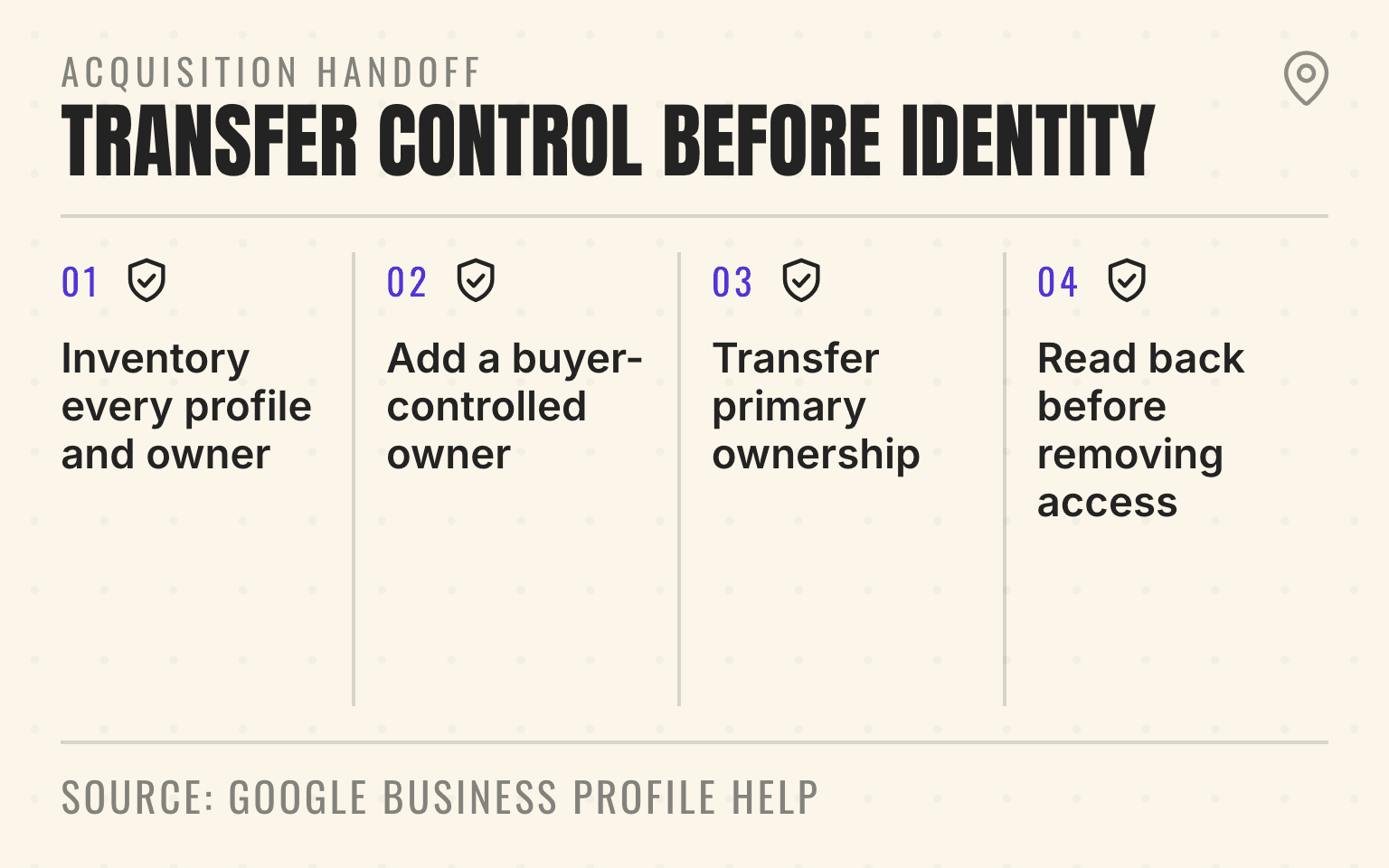
Acquisition handoff
Transfer control before identity
- 01Diligence
Inventory every profile and owner
Record profile URL, business group, primary owner, managers, and verification
- 02Access
Add a buyer-controlled owner
Use an individual company-managed Google Account
- 03Control
Transfer primary ownership
Build Google's seven-day action limit into the closing plan
- 04Close
Read back before removing access
Verify buyer and seller views, group placement, and public customer routes
Google Business Profile Help: Request ownership and Transfer primary ownership; checked September 2, 2026.
- Four-step Google Business Profile ownership transfer process for an acquisition.
- 1. Inventory every profile and owner: Record profile URL, business group, primary owner, managers, and verification
- 2. Add a buyer-controlled owner: Use an individual company-managed Google Account
- 3. Transfer primary ownership: Build Google's seven-day action limit into the closing plan
- 4. Read back before removing access: Verify buyer and seller views, group placement, and public customer routes
The legal transaction does not change Google access automatically. One profile may sit in the seller's personal Google Account. Another may belong to a former employee. A third may be managed through an agency account that no one included in diligence. If the buyer discovers that after close, a routine handoff becomes a location-by-location recovery project.
Important
Treat Google Business Profile primary ownership as a closing deliverable. Secure control first, verify it profile by profile, and make public identity changes only after the access cutover is stable.
For a 20- to 500-location service platform, the answer is an acquisition ledger and a controlled transfer sequence. Do not rely on a seller saying, "Marketing has the login."
The short answer
To transfer Google Business Profile ownership after an acquisition, add a buyer-controlled Google Account as an owner, let Google's seven-day limitation period pass, transfer primary ownership, and verify the result from both the buyer and seller sides. Then place the profile in the correct business group and remove obsolete access only after the buyer has completed a readback.
Google says a primary ownership transfer keeps the profile's business information, including reviews. That makes the existing eligible profile the asset to control. Creating a replacement because the current access is inconvenient can produce a duplicate and split the public record.
After the handoff, run a location-level visibility check for priority markets. Confirm that the profile, location page, phone route, business name, and cited sources still point to the acquired operating team.
Ownership and business identity are separate decisions
An acquisition creates at least two different Google Business Profile jobs.
The first job is access: who can edit the profile, add users, remove users, and transfer primary ownership. Google's owner and manager guidance distinguishes primary owners, other owners, and managers. Only the primary owner can transfer primary ownership.
The second job is public identity: whether the acquired business keeps its name, becomes a parent-brand location, operates as a sub-brand, moves, closes, or combines with another location. That decision affects the name, category, address or service area, phone, website, and other public fields.
Do not collapse those jobs into one edit session. A buyer can take control of an existing profile without immediately renaming it. The post-acquisition rebrand workflow covers the public source migration. This guide covers the control plane that has to be secure before that migration starts.
Treat profile access as a closing deliverable
The buyer needs a complete inventory before the seller, local managers, or incumbent agency lose interest in the handoff. Start during marketing diligence, then make the final access schedule part of the closing checklist.
Record these fields for every acquired location. If the seller calls every identifier a "Google location ID," use the Google identifier crosswalk before importing the ledger:
- Store code, Business Profile ID, current Place ID and capture date, public profile URL, and the real branch or service area each identifier represents
- Verification state, duplicate state, suspension state, and whether the address is shown or hidden
- Current primary owner, other owners, managers, business group, and pending invitations
- Google Account controlled by the seller, a current employee, a former employee, an agency, or an unknown party
- Business name, primary category, phone, website URL, hours, service area, review count, and matching location page
- Intended buyer-controlled owner, target business group, handoff date, seven-day eligibility date, and removal date for old access
- Proof of acceptance and a dated readback from both the buyer account and the public profile
This is not a password inventory. Google recommends giving each user their own access instead of sharing credentials. The ledger should identify accountable accounts and roles without storing passwords, recovery codes, or private authentication data.
The seller should also disclose every agency, listings vendor, franchise administrator, and local manager with profile access. An acquisition can transfer the business while leaving a marketing vendor as the only person able to add the buyer.
Build the target access structure before sending invitations
Google describes business groups as a safer way to share access to multiple Business Profiles. A business group works like a shared folder: owners and managers of the group can work on the profiles placed inside it, and new profiles can inherit that operating structure.
The buyer should decide the target structure before the first invitation goes out. A single-brand platform may use one business group with a small set of corporate owners and narrower manager access for local teams. A multi-brand rollup may need separate business groups when different operators, agencies, or franchise teams should not see or edit every location.
Use the multi-location Business Profile access guide to define primary owners, continuity owners, group boundaries, agency delegation, onboarding, and offboarding before the acquisition invitations begin.
Google's business group guidance warns that one group gives broad access across the profiles inside it, while multiple groups create separate spreadsheets and management surfaces. That is an operating tradeoff, not a naming convention.
Use buyer-controlled company accounts for durable ownership. Give employees, local managers, and agencies the least role that lets them do their job. Do not leave the only primary-owner path tied to a seller's personal account, a departed employee, or an agency relationship that may end.
For portfolios with 10 or more eligible locations, the bulk-verification guide for home service franchises explains how verification eligibility, business groups, duplicates, and pure service-area profiles affect the larger management plan.
Next step
Is AI recommending your business?
Find out how visible you are across ChatGPT, Gemini, Perplexity, and AI Overviews.
Run the handoff in a strict sequence
The safe transfer is a chain of confirmed states. Each state should be visible in the acquisition ledger before the team advances.
Add buyer-controlled owner access
The current profile owner invites the designated buyer account as an owner. The buyer accepts the invitation and confirms that the profile appears in its account. Manager access is not enough when the buyer needs to become primary owner because only owners can change other users' roles.
When the buyer is already an owner or manager, the current primary owner can use Google's primary ownership transfer flow. For larger portfolios, technical teams can also use Google's documented Business Profile API transfer process, but API access does not remove the need for the right source and destination permissions.
Wait for the seven-day limitation period
Google limits what a new owner or manager can do during the first seven days. The new user may be unable to remove other users, delete or restore the profile, or transfer primary ownership. A closing plan that expects a same-day invite, transfer, and seller removal can fail even when both parties cooperate.
Record the invitation acceptance time and the first eligible transfer date. Keep the seller available until the transfer and readback are complete.
Transfer primary ownership and read it back
After the limitation period, the current primary owner assigns the buyer account as primary owner. The buyer signs in separately, verifies its role, and checks that the correct profile appears in the intended account or business group.
The readback should cover more than the role label. Confirm the public profile URL, business name, category, phone, website link, hours, service area or address, review count, and verification status. Test the customer phone route and location page from outside the account.
Move the profile into the right business group
Once control is stable, transfer the profile into the buyer's target business group if it is not already there. Google documents both dashboard and API paths for moving locations between accounts or groups. Confirm the profile in the destination before changing the seller's role.
Only then should the buyer remove old employees, obsolete agencies, or the seller account according to the purchase agreement. Keep a second accountable buyer-controlled owner where the operating model requires continuity, and schedule a periodic access review.
Use the ownership-request path when the seller cannot grant access
Some acquisitions begin with no cooperative primary owner. The seller may have lost the Google Account, the profile may belong to an old agency, or the account hint may point to an unknown address.
Google's request ownership process gives storefront and hybrid businesses a way to request access to an already verified profile. Google says the current owner has three days to respond. If the request is denied, the requester can still suggest an edit and may be able to appeal. If there is no response, Google may offer a claim and verification path.
Service-area businesses use a different support route. Google tells requesters to contact support and choose the transfer-ownership reason. Bulk-verified accounts can also encounter an owner-conflict state and request access through that workflow.
Track every request, confirmation email, response deadline, appeal, and verification action in the acquisition ledger. Google's API implementation guidance recommends a follow-up seven to ten days after an ownership claim starts because merchant action and email acceptance can create drop-off.
Do not create a second profile while the ownership request is unresolved. The duplicate Business Profile cleanup guide explains why the brand should establish what each profile represents and resolve control before changing the website or citations.
Keep public edits out of the access cutover
Once the buyer has control, pressure builds to standardize the acquired profiles immediately. That can make the transfer harder to diagnose.
A primary-owner change is an access event. A name, address, category, phone, website, or service-area change is a public identity event. A duplicate merge or closure is a profile-state event. Run them as separate workstreams with separate evidence and rollback decisions.
For example, a plumbing platform may acquire six service-area businesses under a strong local brand. The buyer can transfer ownership into its business group without changing the public name. If the platform later completes a real rebrand, use the franchise Business Profile naming rules and rebrand workflow to align field evidence, pages, profiles, citations, phone routes, and customer materials.
This separation also protects the audit trail. If visibility, calls, or verification status changes after cutover, the team can tell whether the cause was access, identity, routing, or a separate profile edit.
A 30-day acquisition operating plan
Use the calendar as a control sequence, not a promise that Google will complete every request on a fixed day.
- Before close: inventory every profile and access role, identify the primary owner, choose buyer-controlled owner accounts, design business groups, and add the handoff to the purchase checklist
- Close through day 7: accept owner invitations, preserve seller availability, log request deadlines, avoid public identity edits, and begin recovery paths for unknown or disputed profiles
- Day 8 through day 14: transfer primary ownership where eligible, move profiles into the correct groups, read back roles and public fields, and test website and phone routes
- Day 15 through day 30: remove obsolete access after verification, resolve duplicates and rebrand decisions in separate workstreams, audit priority-market visibility, and schedule quarterly access reviews
The finished portfolio should answer one question without opening a support ticket: who controls each location's public identity today?
That answer should name a buyer-controlled primary owner, an appropriate business group, current supporting users, and the last successful readback. Any location that cannot answer it remains an acquisition integration risk.
Sources
- Transfer primary ownership of a Business Profile, Google Business Profile Help, no publication date. Checked September 2, 2026.
- Request ownership of a Business Profile, Google Business Profile Help, no publication date. Checked September 2, 2026.
- Manage owners and managers, Google Business Profile Help, no publication date. Checked September 2, 2026.
- Create and manage business groups, Google Business Profile Help, no publication date. Checked September 2, 2026.
- Move a profile to an organization account, Google Business Profile Help, no publication date. Checked September 2, 2026.
- Transfer locations, Google Business Profile APIs, August 2026. Checked September 2, 2026.
- Locations setup, Google Business Profile APIs, August 2026. Checked September 2, 2026.
- Guidelines for representing your business on Google, Google Business Profile Help, no publication date. Checked September 2, 2026.
Dylan Allen-Arnegård is the CEO & Co-Founder of Cheers, the local search platform for multi-location service businesses.