

A local service business can use real customer reviews on location pages when the reviews are accurate, relevant, and presented honestly. Marking them up is a separate question with a stricter answer. Google's review snippet documentation, last updated July 24, 2026, states the rule directly:
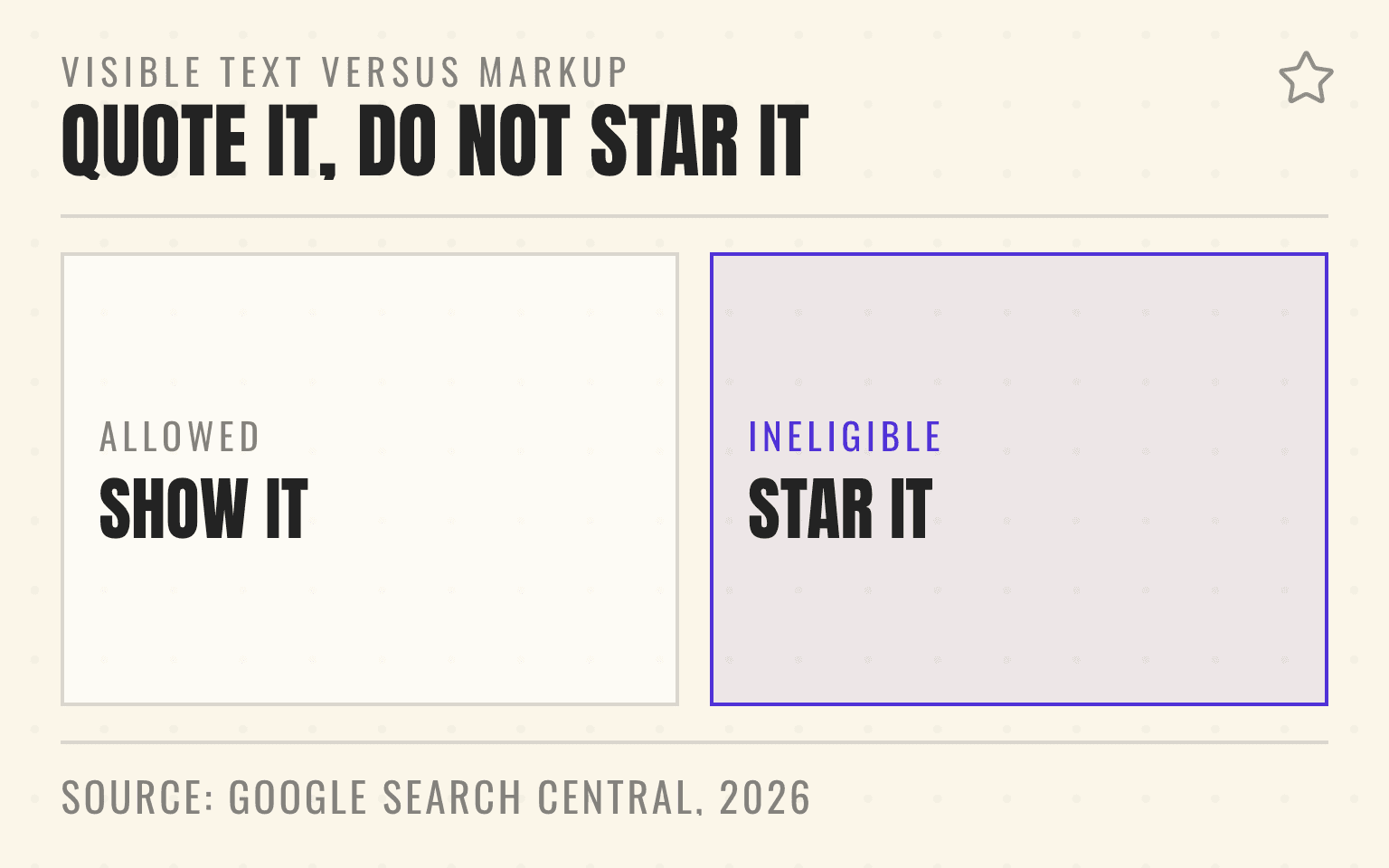
"If the entity that's being reviewed controls the reviews about itself, their pages that use LocalBusiness or any other type of Organization structured data are ineligible for star review feature."
Last verified: September 2, 2026.
That does not mean copying every Google review into a carousel, marking up third-party reviews as if they were first-party ratings, or putting a Phoenix HVAC review on a Tucson location page because it sounds better. The useful version is narrower: use reviews as location-specific proof that customers, Google, and AI search systems can inspect.
For multi-location service brands, this is an operations problem as much as a website problem. Reviews belong to real jobs, real branches, real employees, and real customers. When the website disconnects those reviews from the location that earned them, the proof gets weaker.
Important
Treat reviews on location pages as evidence, not decoration. Use them to prove which services a branch actually performs, how customers describe the work, and why that local team can be trusted.
The short answer
Use customer reviews on location pages when the review came from that location or clearly applies to that service area, the quote is not edited into a different meaning, and the page makes the source clear enough for a customer to trust it.
Do not use the same "best" testimonials across every branch. Do not hide the source if the review came from Google, Yelp, Facebook, a survey, or a first-party form. Do not add review schema to copied third-party reviews for your own LocalBusiness pages. Google's review snippet documentation says local business or organization pages are ineligible for the star review feature when the reviewed entity controls reviews about itself, including embedded third-party review widgets. It is equally short about the other shortcut: "Don't aggregate reviews or ratings from other websites." And on incentives inside markup: "Don't include fake or undisclosed incentivized reviews on your page or in your structured data markup."
The operator version is simple: quote the review for humans, keep the quote honest, and be careful with structured data.
Why reviews matter on location pages
Google's guidance for generative AI features says AI Overviews and AI Mode use normal Search foundations. It also says publicly accessible, crawlable content is how Google Search generative AI systems access site data. That makes visible page proof more useful than hidden reputation data.
A plumbing branch page needs more than the phrase "drain cleaning." It should show whether customers in that market actually mention clogged drains, emergency response, sewer camera inspections, or same-day scheduling. A med spa page needs more than a service list for Botox or laser hair removal. It should give local proof that the service is offered by that location, with language customers recognize.
That proof helps human buyers first. It can also help search systems connect the business entity, location, service, and customer experience. Google explains that Business Profile information can come from owners, crawled web content, licensed data, users, reviews, photos, and Google's interactions with local places. If a branch page, Business Profile, reviews, photos, and service menu all describe the same local reality, the business is easier to understand.
The mistake is treating reviews as a shortcut. Reviews do not fix a thin page. They support a page that already has accurate location facts, service coverage, phone routing, hours, and a clear booking path. For the broader page standard, use what location pages should include for AI search.
The review has to belong to the location
Multi-location brands often centralize marketing, but customers experience the business locally. That creates a common review problem: the brand has strong reviews somewhere, but the page needs proof for a specific branch.
For an HVAC group, a Scottsdale review about emergency AC repair should not carry the Dallas branch page unless the page clearly labels it as brand-level proof. For a restoration rollup, a water-damage review from an acquired company should stay tied to the market, brand name, and service period that earned it. For a franchise system, corporate should not pull one franchisee's strongest reviews into every market without context.
The same rule applies to service lines. A five-star review about a friendly maintenance visit does not prove that the branch performs sewer line repair, EV charger installation, termite treatment, or laser resurfacing. If the location page is trying to rank, be cited, or be recommended for a specific service, the proof should support that service.
This is why review operations and content operations need to share the same taxonomy. Reviews should be tagged by location, service, employee or team when appropriate, and source. Then the website can use the right proof instead of the most flattering proof.
What not to mark up
Visible reviews and review structured data are not the same thing.
A local business can quote a real customer review on a page when it has the rights and context to do so. That does not automatically mean the page should add Review or AggregateRating markup for that review. Google's review snippet rules are strict for local businesses and organizations. Review content must be visible on the page, ratings must be sourced directly from users, and businesses should not aggregate reviews or ratings from other websites. Google also says local business and organization pages are ineligible for the star review feature when the entity controls reviews about itself.
For a multi-location service brand, the safe default is:
- Show real review excerpts visibly on the relevant location or service page.
- Label the source when it matters, such as Google, Yelp, a first-party survey, or a verified customer interview.
- Avoid Review or AggregateRating markup for copied third-party reviews about your own local business pages.
- Use LocalBusiness structured data for stable facts such as name, address, phone, hours, URL, area served, and sameAs profiles.
- Validate structured data, but do not treat rich-result eligibility as the goal.
The purpose of the page is trust and clarity. Star snippets are not the strategy.
If your team is updating schema across many locations, pair this article with what schema markup is and whether local businesses should still use FAQ schema for AI search.
FTC and Google rules change the workflow
Review content is regulated and platform-governed. That matters because the same shortcut can create both search risk and compliance risk.
The FTC's Consumer Reviews and Testimonials Rule, effective October 21, 2024, covers fake reviews, false reviews, bought reviews, insider reviews without proper disclosure, review suppression, and misleading review displays. The Commission's own guidance draws the line where a testimonial block starts hiding things:
"Organizing reviews in a way that makes it difficult for consumers to know about or find negative reviews could be an unfair or deceptive act."
For website teams, the practical lesson is that a testimonial block should not make the review set look cleaner, more representative, or more verified than it really is.
Google Business Profile guidance also warns against incentives for customers to post, change, or remove reviews. Google says reviews and other Maps contributions must reflect a genuine experience, and it describes incentives such as free or discounted goods or services in exchange for reviews as fake and misleading content.
That creates a clear operating boundary. Ask for honest feedback after real service moments. Do not pressure customers for five stars. Do not filter requests only to happy customers. Do not reward the review itself. Do not copy a review into a page if the edit changes the meaning.
If your team needs the collection side, use review generation or read the review collection at point of service playbook and the compliance playbook for collecting more reviews without getting flagged.
Next step
Is AI recommending your business?
Find out how visible you are across ChatGPT, Gemini, Perplexity, and AI Overviews.
How to use reviews without making the page thin
Reviews should support specific page claims.
For a roofing location page, a review about a same-week leak repair can sit near the roof repair section. A review about clean crews and jobsite cleanup belongs near the customer-experience or warranty section. A review about financing only helps if the page explains the real financing path. The quote should give the reader evidence at the moment they need it.
A branch's bench of usable quotes is thinner than its review count suggests, which is another reason to place them carefully. In the Cheers production review pull covering the 90 days ending September 2, 2026, the median home-services company collected 9.7 new reviews per location a month, across 11 companies and 76 locations with at least one review. That is roughly 29 candidate quotes a quarter for one branch, before you filter for the right service line and for reviews specific enough to quote. Aggregate only (corrected September 23, 2026), no company named; see the panel methodology and the Home Services AI Visibility Index.
Avoid the generic carousel pattern where every location page shows three vague five-star quotes. "Great service" is not useless, but it does not prove much. A better review excerpt names the job, location context, service moment, or outcome without exposing private customer information.
For AI search, this is the difference between a page that merely claims quality and a page that contains retrievable evidence. A model or search system does not need a wall of testimonials. It needs clear, corroborated facts: what the branch does, where it works, how customers describe the work, and which sources support the same story.
A practical publishing standard
Use this standard before putting reviews on location pages at scale:
- Keep the original review text, source, date, rating, location, and service tag in an internal library.
- Match each quote to the branch or service area that earned it.
- Shorten only for length, never to change sentiment, service, location, or outcome.
- Remove private details that do not belong on a public page.
- Label the review source when a reasonable reader would need that context.
- Rotate stale quotes when operations, brand names, service lines, or ownership change.
- Keep negative and mixed feedback visible on the source platform instead of implying the public review set is perfect.
That last point matters. A website does not need to reproduce every negative review, but it should not present a curated block in a way that implies the business has no meaningful negative feedback anywhere.
Where reviews fit in the location source stack
Reviews are one layer. They work best when the rest of the location source stack agrees.
Google Business Profile should show the correct branch, category, services, hours, photos, and review stream. The location page should explain the same services in plain language. Structured data should mirror visible facts. Citations should reinforce the same name, address, phone, and category. The booking path should route the customer to the branch or service area the page describes.
If those sources disagree, review excerpts can make the contradiction more visible. A branch page that lists "24/7 emergency plumbing" but only shows reviews about planned remodels does not build much confidence. A med spa page that lists a service without any local proof, provider context, or booking path looks thin even if the brand has strong reviews elsewhere.
For source-stack context, read is Google Business Profile enough for AI visibility? and how to turn reviews into AI search content.
What to inspect this month
Start with the top service pages and top market pages, not the whole site.
Pick ten high-value location pages. For each one, check whether the visible reviews match the location, service line, and current brand. Then check whether the page uses structured data in a way that respects Google's review snippet rules. Finally, compare the page against the Google Business Profile and the review source itself.
If a quote is real but belongs to another branch, move it or relabel it. If a quote is strong but too generic, replace it with a service-specific review. If a page is using copied third-party reviews inside AggregateRating markup, remove or revise that markup. If a review reveals a recurring customer phrase, use it to improve the visible service copy after operations confirms the phrase is accurate.
The page does not need to become a testimonial wall. It needs the branch, service, proof, policy, and source stack to point in the same direction.
Sources
- Review snippet structured data. Google Search Central, last updated July 24, 2026. Self-controlled review ineligibility, the aggregation ban, and the incentivized-review rule. Checked September 2, 2026.
- Local business structured data. Google Search Central, 2026. Stable business facts in LocalBusiness markup. Checked September 2, 2026.
- Optimizing your website for generative AI features. Google Search Central, last updated July 2026. Checked September 2, 2026.
- Schema.org: Review. Schema.org vocabulary. Checked September 2, 2026.
- Rule on the Use of Consumer Reviews and Testimonials: Questions and Answers. Federal Trade Commission, November 2024. Rule effective October 21, 2024. Checked September 2, 2026.
- Tips to get more reviews. Google Business Profile Help, undated help page. Checked September 2, 2026.
- How Google sources business information. Google Business Profile Help, undated help page. Checked September 2, 2026.
- Home Services AI Visibility Index 2026. Cheers Research, September 2, 2026.
Dylan Allen-Arnegård is the CEO & Co-Founder of Cheers, the local search platform for multi-location service businesses.