

Google Business Profile Help defines calls as clicks on the call button, not connected calls or booked jobs. The performance page had no publication date when checked on September 2, 2026.
Last verified: September 2, 2026.
Google's documentation says:
Calls: The number of clicks on the call button on your Business Profile.
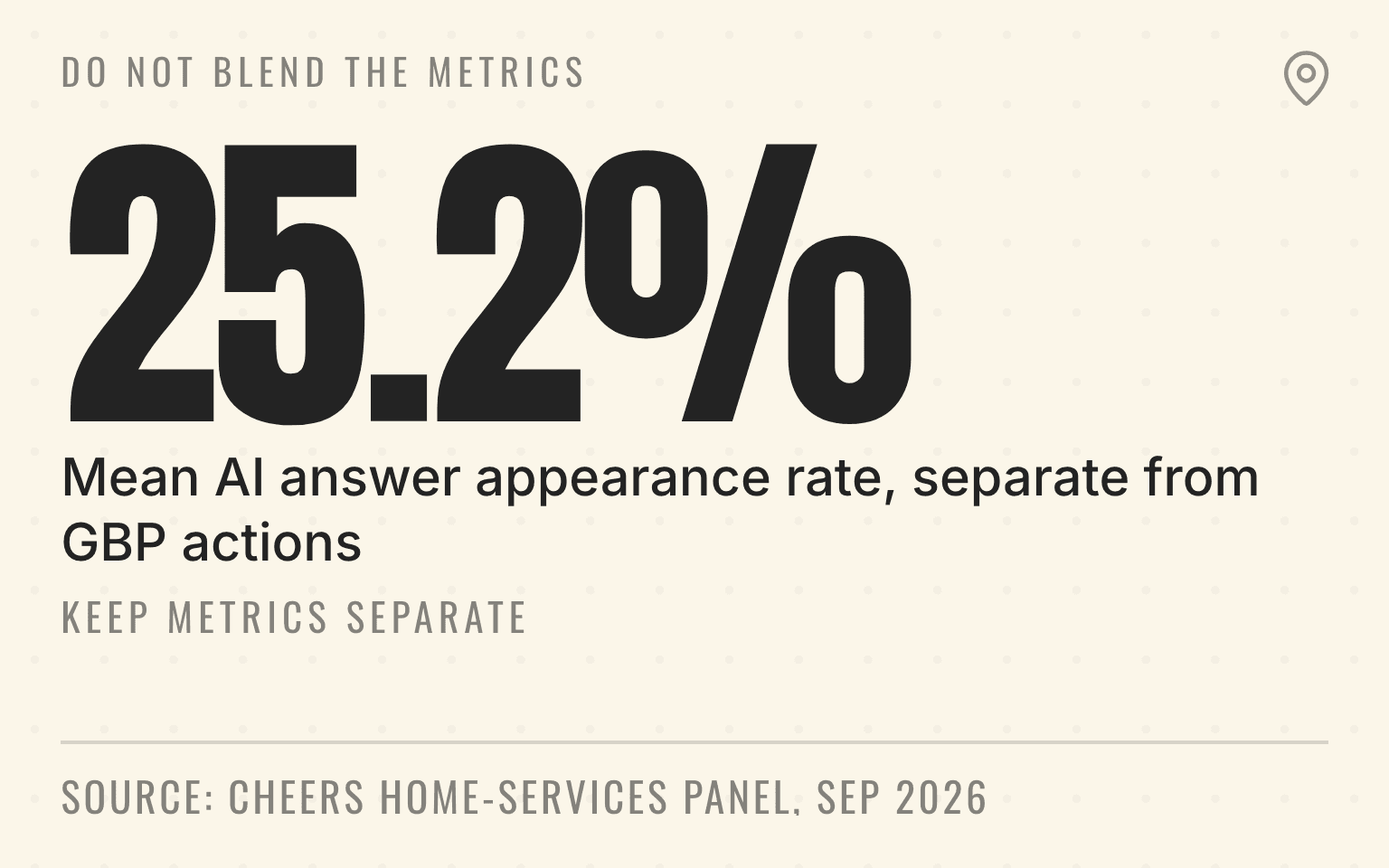
Do not blend the metrics
Profile actions are not AI visibility
25.2%
Mean AI answer appearance rate
13
Home-services companies
28
Days ending September 2
Cheers panel, 28 days ending September 2, 2026, 13 home-services companies, non-branded prompts, aggregate only (corrected September 28, 2026).
| Finding | Value | Base |
|---|---|---|
| Mean AI answer appearance rate | 25.2% | Stated in the source |
| Home-services companies | 13 | Stated in the source |
| Days ending September 2 | 28 | Stated in the source |
Google Business Profile performance data is useful when the team reads each metric as a specific customer action. It becomes misleading when the portfolio treats all interactions as leads or blends 80 locations into one reassuring total.
Important
A Business Profile metric is an observation, not a verdict. Separate discovery, profile actions, completed customer outcomes, and AI visibility before assigning credit or blame to a location.
The short answer
For most home service and local service portfolios, the useful Google Business Profile performance metrics fall into two groups. Views and search terms show how people found a profile. Website clicks, call clicks, direction requests, messages, and bookings show what they did on the profile.
Google says the data covers Business Profile activity on Search and Maps, and can include both organic results and Google Ads. That makes the report a profile-interaction dataset, not a clean organic ranking report and not a revenue report.
The separate Cheers home-services panel recorded a 25.2% mean AI answer appearance rate across 13 home-services companies, leaving out questions that name the company itself. That is a different metric and should not be blended into Business Profile calls or views. Cheers panel, 28 days ending September 2, 2026, 13 home-services companies, non-branded prompts, aggregate only (corrected September 28, 2026). Read the methodology.
Google's August 2026 Local Services Ads Performance Max migration creates a separate paid baseline problem because historical Local Services Ads performance reports do not carry into Google Ads.
The practical rule is to read search terms and impressions as discovery evidence, then inspect website clicks, call clicks, and direction requests separately by location. Connect those actions to web analytics, call outcomes, booking records, and revenue before changing budgets or branch priorities.
If the operator also needs to know whether ChatGPT, Gemini, Perplexity, or Google AI is recommending the right branch, the AI Visibility Grader measures a different part of the customer journey. Business Profile performance does not replace that source and recommendation audit.
What the metrics actually measure
Google's Business Profile performance help defines each metric narrowly. The definitions matter because the names can sound closer to business outcomes than they are.
Views and search terms show discovery
Views count unique visitors who viewed the Business Profile on Search or Maps, with a person counted a limited number of times across devices and only once per day on a given device and platform. A view does not mean the person opened the website, called, requested directions, or booked.
Search terms show the queries used when the profile appeared. Google updates this data monthly and says businesses cannot directly manage the queries. For a pest-control network, the useful pattern is not one exact keyword. It is whether a branch appears for the services and local needs it can actually fulfill, then whether those appearances produce a relevant action.
Website clicks, call clicks, and directions are different hand-raisers
A website click is a click on the website link in the profile. It does not show what happened after the visit. A call is a click on the profile's call button. It does not show whether the person reached the right branch or booked service. A direction request shows that someone asked Google for directions, with Google's counting adjusted for repeated taps, cancellations, and spam.
These actions also mean different things by business model. Direction requests may be valuable for a med spa, hotel, or garage door showroom. They are harder to interpret for a plumbing service-area branch that hides its address and dispatches technicians to customers. A high direction-request share is not automatically better than a high call-click share.
Bookings and messages depend on setup
Google says booking data appears when bookings are managed through a supported booking provider. Messages and other business-specific metrics may not apply to every profile. A blank or zero metric can therefore mean the feature is not configured or not relevant, not that customers refused to act.
This is one reason a portfolio should record metric eligibility and integration status before comparing branches. A med spa using a supported booking provider and an HVAC branch routing every job through phone dispatch should not be graded on the same action mix.
What Cheers data shows across multi-location portfolios
Cheers analyzed aggregated Google Business Profile performance data from February 3 through July 13, 2026. The public sample includes 23 multi-location organizations, 840 connected location or service-area profiles, and 120,701 profile-day observations. Every organization had website clicks, call clicks, and direction requests during the period.
For each organization, Cheers calculated the share of recorded profile actions represented by website clicks, call clicks, direction requests, and bookings. The median organization-level share was 35.2% for website clicks, 24.0% for call clicks, and 39.0% for direction requests. Only one organization recorded booking data, so bookings are not a defensible cross-portfolio comparison in this sample.
Those figures do not establish an industry benchmark. Profile count, business model, customer access, market mix, paid activity, and Google feature eligibility differ across the sample. They do show that no single action type describes how customers use Business Profiles across a multi-location portfolio.
Pro Tip
Use the action mix as a diagnostic. If a location's mix changes, ask what changed in visibility, profile setup, routing, customer access, paid activity, or measurement before treating the movement as growth or decline.
A profile action is not a lead
The fastest way to misuse Business Profile performance is to rename every action a conversion.
For an HVAC branch, a call-button click needs a connected-call status, qualified-service status, and booked-job outcome. For a restoration company, a website click needs the landing page, form or phone handoff, service area, urgency, and booked incident. For a garage door showroom, a direction request may be closer to a visit, but the team still needs a showroom or CRM outcome to know whether the customer arrived.
The call tracking guide for home service brands explains how to preserve attribution without publishing conflicting phone numbers. Website links need the same discipline. Google's manual tagging guidance explains how UTM parameters populate Analytics traffic-source dimensions. Use a consistent profile source and a location-specific campaign or content value, then keep the destination URL aligned with the correct branch page.
Next step
Is AI recommending your business?
Find out how visible you are across ChatGPT, Gemini, Perplexity, and AI Overviews.
Google's Analytics link helps, but it can hide location gaps
Google now lets an Analytics property link to one or more Business Profiles. The new Google Business Profile report can bring interactions, website clicks, calls, directions, messages, bookings, and menus into Analytics alongside website and app reporting.
That is useful for an executive portfolio view. It is not enough for branch management. Google's Analytics documentation says the report sums metrics across linked profiles and cannot segment or filter them by individual profile. It also limits Business Profile metrics in Analytics to the last six months and does not allow those metrics in custom explorations or comparisons.
A 60-location brand can therefore use the link to see the channel's overall interaction trend while still needing a location-level dataset for diagnosis. Google allows multi-profile spreadsheet downloads, and the Business Profile Performance API returns daily metrics by location plus monthly search-keyword impressions. The right access path depends on whether the team needs an occasional review, a recurring location scorecard, or an automated data pipeline.
Compare locations without creating a false leaderboard
Raw totals reward large markets, long measurement windows, and profiles with more eligible actions. Ratios can create a different problem when the denominator is tiny. A branch with two call clicks and one booking should not outrank a branch with 400 qualified calls because its apparent booking rate is higher.
Start with comparable location groups. Separate storefronts from service-area branches. Compare the same time window, business model, service mix, and measurement coverage. Then use three reads: action volume, action mix, and downstream outcome rate.
A useful exception queue is more valuable than one national rank. Flag locations whose impressions fell while profile accuracy stayed stable, whose call clicks rose while connected calls fell, whose website clicks grew without branch-page engagement, or whose direction requests changed after an address or access update. Each pattern has a different owner.
Google says local results are mainly based on relevance, distance, and prominence. Performance metrics report observed discovery and interaction; they are not published ranking factors and should not be reverse-engineered into a score. The location-level AI visibility audit uses the same discipline: compare like markets, preserve source evidence, and assign the fix to the right location or team.
Business Profile reporting does not measure AI recommendations
Business Profile performance can show that customers found and acted on a profile in Google Search or Maps. It does not show whether ChatGPT recommended the business, which sources Gemini cited, whether Perplexity chose a competitor, or whether Google AI presented the correct branch for a service query.
That distinction matters because the surfaces can move independently. A location may have healthy profile calls while AI assistants cite an outdated directory. Another may earn AI citations from a strong location page while its Business Profile routes website clicks to the wrong market.
If website clicks land on a generic homepage or the wrong branch, use the profile-to-location-page mapping guide before interpreting portfolio click totals.
Google Business Profile alone is not the full AI visibility system. Use Business Profile performance for Google discovery and profile actions. Use Search Console and Analytics for owned-site search and traffic. Use call, booking, and CRM systems for customer outcomes. Use provider and source tracking for AI recommendations and citations.
Run a 30-day measurement reset
Give one analytics owner and one operations owner responsibility for the definitions. Then work through the portfolio in this order:
- Days 1 through 5: inventory verified profiles, profile type, metric eligibility, website destination, phone route, booking setup, and current data access.
- Days 6 through 12: standardize the reporting window, profile identifiers, location groups, and website-link attribution. Keep storefront and service-area locations separate.
- Days 13 through 21: connect call clicks to connected and booked calls, website clicks to branch-page outcomes, directions to visit or customer records where available, and bookings to completed service.
- Days 22 through 30: review exceptions with branch owners, document the cause, assign one correction, and preserve a baseline for the next complete period.
Do not end the month with a blended interaction total. End with a small set of location exceptions whose cause, owner, and next measurement are clear.
Methodology
This analysis uses aggregated Cheers Google Business Profile performance data from February 3 through July 13, 2026. It includes parent organizations with at least two connected location or service-area profiles, producing 23 organizations, 840 profiles, and 120,701 profile-day observations. Organization-level action shares use website clicks, call clicks, direction requests, and bookings. Medians were calculated across organizations so the largest portfolios did not determine the result. No customer names, profile names, locations, raw rows, or private identifiers were used. The sample reflects connected Cheers customers and is not a universal local-search benchmark.
Sources
- Understand your Business Profile performance and insights, Google Business Profile Help, no publication date. Checked September 2, 2026.
- Connect Google Business Profile to Google Analytics, Google Analytics Help, no publication date. Checked September 2, 2026.
- Business Profile Performance API, Google Business Profile API, no publication date. Checked September 2, 2026.
- Tips to improve your local ranking, Google Business Profile Help, no publication date. Checked September 2, 2026.
- Traffic-source dimensions and manual tagging, Google Analytics Help, no publication date. Checked September 2, 2026.
- Home Services AI Visibility Index, Cheers Research, September 2026. Checked September 2, 2026.
- Research methodology, Cheers Research, September 2026. Checked September 2, 2026.
Dylan Allen-Arnegård is the CEO & Co-Founder of Cheers, the local search platform for multi-location service businesses.