

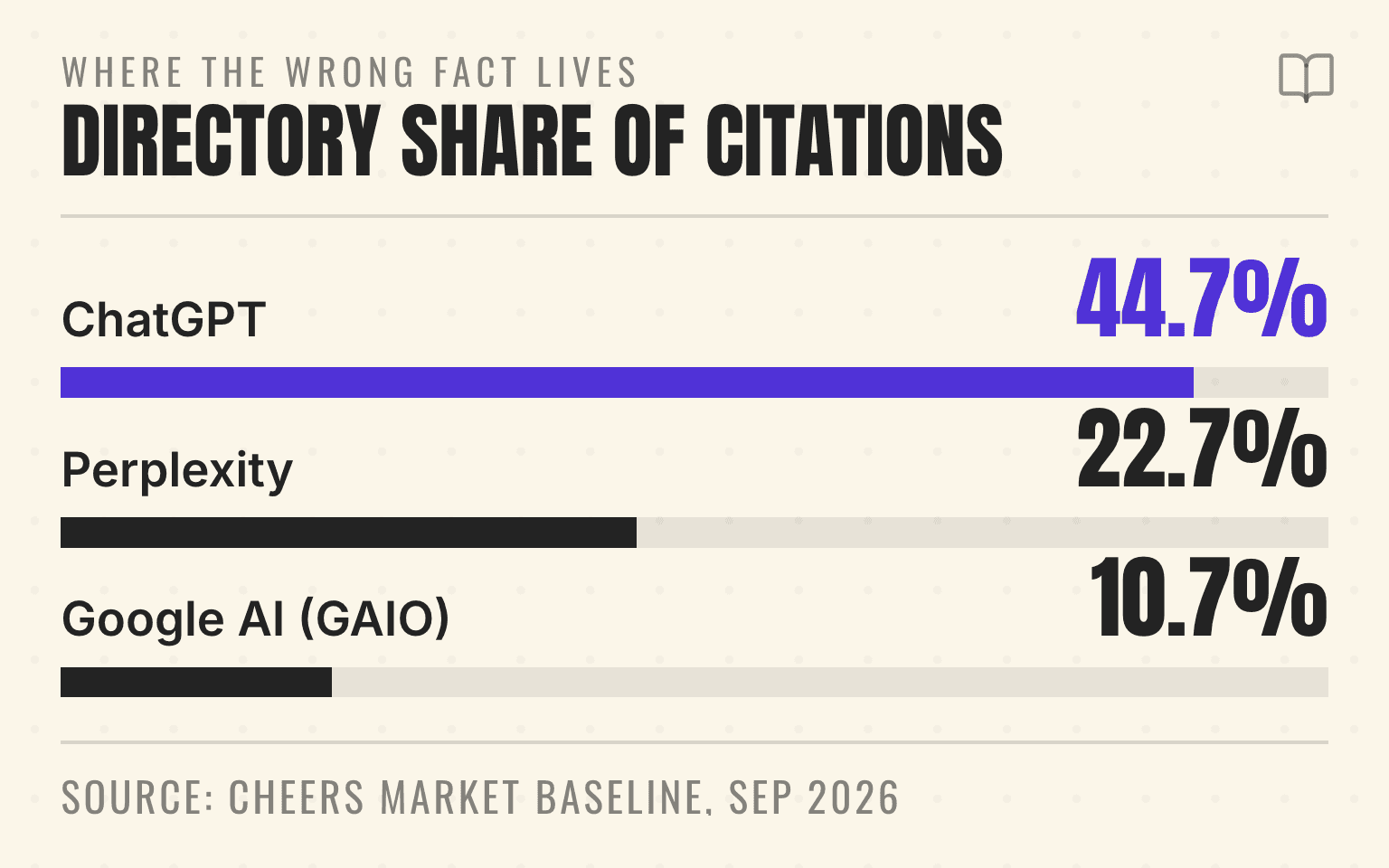
When ChatGPT states something wrong about a local business, the odds are good that a directory said it first. In the Cheers Market Baseline for the 28 days ending September 2, 2026, directories and review platforms accounted for 44.7% of ChatGPT's 70,723 home-services citations, against 17.2% for Gemini and 10.7% for Google's AI Overviews and AI Mode. No other engine in the set leaned on third-party listings anything like as hard.
So a customer asks ChatGPT for an emergency plumber and sees your former branch phone number, or asks whether your HVAC company runs 24-hour service and gets the hours of a location that closed after an acquisition. It looks like a ChatGPT problem. The correction almost always begins at a public source and one specific location record, and more often than not that source is a listing you do not own.
Where the wrong fact lives
ChatGPT reads directories
44.7%
ChatGPT
Directory and review-platform share of home-services citations by engine, Cheers Market Baseline, 28 days ending September 2, 2026
70,723 citations classified
144,036 citations classified
41,356 citations classified
99,904 citations classified
Cheers Market Baseline, 28 days ending September 2, 2026: 32 home-services prompts in 100 metro service areas, 356,019 classified citations, aggregate only.
| Engine | Directory share of its citations |
|---|---|
| ChatGPT | 44.7% (70,723 citations classified) |
| Perplexity | 22.7% (144,036 citations classified) |
| Gemini | 17.2% (41,356 citations classified) |
| Google AI Overviews and AI Mode | 10.7% (99,904 citations classified) |
Important
Do not open a company-wide "ChatGPT is wrong" project. Create one incident for one branch, one fact, one prompt, and one source. A wrong phone number needs a different owner than an unsupported service claim.
If you do not know which locations or prompts are affected, check the priority markets and buyer questions where your brand appears before turning one screenshot into a portfolio-wide conclusion.
Start by separating four kinds of wrong answer
The remediation path depends on what ChatGPT actually did. Treat the answer as evidence, not as a diagnosis.
A cited source contains the wrong fact
This is the most direct case. ChatGPT says the Denver branch closes at 5 p.m. and cites a directory page that still shows the former schedule. Save the cited URL, correct the directory if you control it, and document an outreach or dispute if you do not.
The cited source is correct, but the answer misstates it
Save the source passage and the answer together. Correcting the page will not help when the page is already right. Use ChatGPT's feedback tools, then retest the question in a new search response. Do not rewrite an accurate page to match a one-off bad summary.
No visible source is attached
Run the same question with ChatGPT search enabled and open the sources panel when the interface offers one. Record what the interface showed, including the absence of a panel. An answer with no visible citation is a limit on your evidence, not a licence to guess which directory or profile supplied the statement, and guessing is how teams end up rewriting a page that was already correct.
The answer resolves the wrong branch or market
A correct fact about the wrong location is still an operational failure. Capture the location context ChatGPT used, the requested city or service area, the branch it named, and the customer route it supplied. OpenAI's web search documentation confirms geography is an input: "To refine search results based on geography, you can specify an approximate user location using country, city, region, and/or timezone." The same prompt can therefore produce a different local answer in another market.
The industry source-audit workflow explains how to capture source panels and URLs across engines. For an active correction, keep the scope tighter: one wrong fact and the sources visible beside it.
Build a correction record before changing anything
An HVAC group with 60 locations cannot manage these incidents through screenshots in Slack. The evidence needs to join the answer to the approved branch record and the person who can correct the source.
For each incident, record:
- Prompt, ChatGPT mode, market, test date, wrong statement, cited URL, source type, affected branch, approved value, business owner, source owner, correction date, and planned readback dates
- Customer impact, such as a dead phone route, false open status, wrong service claim, old address, closed branch, or confusion with a similarly named company
The approved value should come from operations, not from whichever public profile happens to look newest. A restoration rollup may need dispatch to confirm the phone route, HR or licensing to confirm a practitioner or credential, and the regional GM to confirm whether a service is actually available in that market.
This is a smaller version of the multi-location entity cleanup process. The difference is that a ChatGPT correction record begins with a captured answer and ends with a scheduled readback.
Correct the source that owns the fact
Do not copy the same update across every public surface until the operating team has approved the value. Then fix the places that are wrong, starting with the source ChatGPT cited and the location's owned record.
Fix the location page and structured data together
If your own page shows the wrong hours, phone number, address, or service, update the visible copy first. Then update applicable LocalBusiness structured data so it describes the same facts. Google's LocalBusiness documentation supports location-level properties such as name, address, telephone, hours, URL, and business type. Structured data should describe what a customer can verify on the page.
OpenAI's crawler documentation describes OAI-SearchBot as the agent "used to surface websites in search results in ChatGPT's search features", and keeps it separate from GPTBot, which crawls "content that may be used in training our generative AI foundation models". You do not need to open training access to make a corrected page eligible for ChatGPT search.
Fix the public profile when the profile is wrong
Google lets a verified business "update details like your address, hours, contact info, and photos to help customers find and learn more about your business". It also warns that the edit is not instant: "We review your changes before we update them live on your profile." Correct a wrong Google Business Profile because customers use Google Search and Maps, and because the profile feeds other records. Do not correct it expecting a ChatGPT update on a schedule.
The same rule applies to Bing Places, Apple Business Connect, review platforms, trade directories, and local publications. Fix the surface that contains the error, and resist the urge to name one listing as ChatGPT's permanent source of truth. The Cheers Market Baseline found 23 platform and directory domains cited across 33 or more of the 100 metros, which is a source mix, not a single upstream record.
Ask third-party publishers for a precise correction
When an old article or directory page is cited, send the page URL, the exact wrong statement, the approved replacement, and a public source that verifies it. A publisher is more likely to act on a bounded factual correction than a request to "improve our AI visibility."
For a roofing company, that might mean correcting a page that says the branch offers solar installation when it only performs roof repair. For a med spa group, it might mean removing a practitioner who left the location. For a plumbing rollup, it might mean replacing a former acquisition phone number that now reaches another company.
If the affected branch closed, moved, or rebranded, use the closed-location cleanup workflow rather than deleting every old reference. Historical pages may need a clear status and route to the operating location.
Next step
Is AI recommending your business?
Find out how visible you are across ChatGPT, Gemini, Perplexity, and AI Overviews.
Use ChatGPT feedback without confusing it with source repair
ChatGPT offers in-product response feedback, and OpenAI operates a separate reporting path for safety, legal, privacy, impersonation, and policy concerns. Save the bad response and use whichever is appropriate.
Feedback and source correction do different jobs, and conflating them is how an incident stays open for a quarter. Feedback tells OpenAI about one response. Updating a cited directory, owned location page, or public profile corrects the evidence that customers, crawlers, and other search products can all reach. Do both when appropriate, but never treat a thumbs-down as confirmation that a public business fact has changed.
Pro Tip
Preserve the original answer, source URL, and correction evidence. If the error returns, the team should be able to see whether ChatGPT selected an unchanged source, summarized a correct source badly, or resolved the wrong location.
Keep OAI-SearchBot access separate from training access
A corrected page cannot be selected from your site if OAI-SearchBot is blocked from search inclusion. Check robots.txt, CDN or firewall rules, HTTP status, canonical URL, indexability, and whether the correct facts appear in server-rendered text.
OpenAI's crawler documentation is explicit that these are separate switches:
Each setting is independent of the others, for example, a webmaster can allow OAI-SearchBot in order to appear in search results while disallowing GPTBot.
The same page describes OAI-SearchBot as the agent used "to surface websites in search results in ChatGPT's search features", and gives the one published timing figure in this whole workflow: "For search results, please note it can take ~24 hours from a site's robots.txt update for our systems to adjust."
The practical policy for a local service site is simple: decide search inclusion and training access separately. The AI crawler access guide covers the robots.txt implementation without treating every OpenAI user agent as the same bot.
Run a 30-day correction workflow
One clean readback is better than ten speculative edits. Use a short incident cycle with named owners.
- Days 1 to 3: Reproduce the answer with the market and ChatGPT mode recorded. Capture citations, source panels, and the approved branch value. Classify the customer impact and assign the source owner.
- Days 4 to 10: Correct the owned page, structured data, profile, directory, or article that contains the wrong fact. Submit precise third-party corrections and ChatGPT feedback where appropriate. Verify the public source itself after the change.
- Days 11 to 30: Retest the original prompt in the same market and add two nearby query variants. Record whether the answer, cited source, named branch, phone route, and service claim are correct. Escalate repeated errors with the full evidence trail.
For a PE-backed platform, the central team should own the incident schema and source standards. Regional operators should approve the real branch facts. Marketing or web teams should update owned pages and profiles. The contact center should independently test phone and booking routes.
Close the incident only after a location-level readback
Do not close the ticket because a CMS, directory dashboard, or Google Business Profile editor says "saved." Read the public page, open the cited source, test the phone or booking route, and rerun the prompt in the affected market.
The final record should say what changed and what did not. A corrected source with an unchanged ChatGPT answer is not a failed source edit. It means the answer still needs observation. A corrected ChatGPT answer with an unchanged bad directory is not a complete fix either, because customers can still find the wrong page directly.
The goal is not to make every answer identical. It is to make the real branch, service, hours, and customer route accurate wherever the source is under your control, then preserve enough evidence to diagnose what ChatGPT shows next.
Sources
Every link below was opened and checked September 2, 2026.
- Overview of OpenAI crawlers. OpenAI developer documentation, checked September 2026. Source of the quoted OAI-SearchBot and GPTBot descriptions, the independence of each robots.txt setting, and the roughly 24-hour robots.txt adjustment window.
- Web search tool. OpenAI API documentation, checked September 2026. Source of the quoted approximate user location fields that refine search results by geography.
- Edit your Business Profile. Google Business Profile Help, checked September 2026. Source of the two quoted sentences about editable details and the review step before an edit goes live.
- Local business (LocalBusiness) structured data. Google Search Central, last updated December 2025. Source of the location-level properties structured data can describe, and of the statement that Google does not guarantee features that consume structured data will appear.
- Cheers Research methodology and the Home Services AI Visibility Index 2026. Cheers Market Baseline, 28 days ending September 2, 2026: 32 home-services prompts in 100 metro service areas across four engines, aggregate only. Source of the per-engine directory citation shares and the 70,723 ChatGPT citations quoted above.
Amadeus Peterson is the CTO & Co-Founder of Cheers, the local search platform for multi-location service businesses.