

Since February 10, 2026, Bing Webmaster Tools has reported which of your URLs get cited in AI answers, and one of its metrics names the mechanism outright: grounding queries, "the key phrases the AI used when retrieving content that was referenced in AI-generated answers." Retrieval, then citation. That is the sequence the audit below reconstructs by hand for every other engine.
So the useful question is not "does AI search know my brand?" It is "which public sources did the answer use when it decided who to recommend?"
For a multi-location HVAC, plumbing, electrical, roofing, med spa, or franchise service brand, that source list is the operating map. It tells you whether AI search found your location page, a Google surface, a review site, a trade directory, a local publication, a competitor page, or an outdated acquisition record.
That matters because the fix changes by source. If ChatGPT cites Yelp and BBB, another blog post will not solve the miss. If Google AI Mode is pulling from the Search index and the branch page is thin, a citation cleanup project will not solve it either. If Perplexity cites an old directory page with the wrong phone number, the work belongs to the source owner before it belongs to content.
When a ChatGPT source contains a wrong local fact, use the business-information correction workflow to turn the cited URL into a bounded location incident and verified readback.
The Cheers AI Visibility Score gives a quick snapshot. The workflow below is for the operator who needs to turn source evidence into location-level work.
Important
Treat every AI answer as a source audit rather than just a ranking result. The cited URLs show where the system found evidence strong enough to put near the answer.
What counts as a source in AI search?
For this article, a source is any URL, citation, related link, cited page, search result, or source panel entry that an AI answer exposes or that official engine tooling reports as supporting an AI response.
OpenAI's web search documentation says the model's response "will include inline citations for URLs found in the web search results," and its bots page documents OAI-SearchBot as the crawler behind ChatGPT search visibility. Anthropic is more absolute about it:
Citations are always enabled for web search.
Perplexity's Search API returns ranked web results from a refreshed index, and its answer products return web-grounded responses with citations. Google Search Central says AI Overviews and AI Mode rely on normal Google Search foundations and can include information about local businesses from Google Business Profiles. Gemini Apps can show related sources and links in some response types. xAI's Grok docs describe web search and citation attributes for source traceability.
Those surfaces are not the same thing. A ChatGPT source panel is not a Google Search Console report. A Perplexity citation is not a Google Business Profile ranking factor. A Grok API citation is not proof that every consumer-facing Grok answer will expose the same link.
That is why the audit should record the surface precisely: engine, product mode, prompt, market, date, cited URL, source type, and what the source proves.
Start with the buyer question, not the tool
The source audit should begin with the questions customers actually ask when they are choosing a provider. For a home services brand, that usually means emergency, repair, replacement, financing, warranty, service-area, and "who should I hire" prompts. For med spa or aesthetics, it may mean treatment fit, safety, provider trust, pricing expectations, and neighborhood availability.
Do not start with a vendor dashboard. Start with one market and one buyer decision.
For an HVAC rollup, a strong test might be "who should I call for emergency AC repair in Phoenix tonight?" For a garage door brand, it might be "best garage door spring repair company near Scottsdale with same-day service." For a med spa group, it might be "best med spa for first-time Botox in Columbus."
Then run the same prompt family across the engines that matter to the buyer journey. At minimum, test Google AI Mode or AI Overviews when available, ChatGPT search, Gemini, Claude with web search, Perplexity, and Grok if your market uses it. Keep the wording consistent enough to compare, but do not pretend one prompt represents the whole market.
Capture URLs before interpreting the answer
The first pass is mechanical. Save the answer, the date, the engine, the market, the mentioned providers, and every visible source URL. If an engine shows related links, source panels, citations, or cited pages, capture those links before arguing about whether the answer was "right."
A clean source log should include the buyer question, target city or service area, engine, date, recommended brand, cited URL, source domain, source type, location match, service match, competitor mention, and next owner. Source type should be plain: owned location page, service page, Google surface, review site, trade directory, local media, social page, forum, aggregator, competitor page, or unknown.
For a franchise operator, the most important fields are often location match and service match. A source that mentions the parent brand but not the local branch may support brand awareness while still failing the customer decision. A source that mentions "plumbing" but not sewer backup, water heater repair, or emergency dispatch may be too broad for the actual query.
This is where the source log becomes more useful than a screenshot. It lets a CMO see patterns by domain, a regional GM see location gaps, and an operations owner see where public proof is missing.
Compare engines by source behavior
The source mix will not be identical across engines. That is the point of the audit.
Google's AI features are tied to Google Search foundations, so the first checks are indexability, snippet eligibility, useful visible content, structured data that matches visible content, internal links, and current Google Business Profile details. If a local answer fails on Google, inspect the page, profile, service coverage, review proof, and Search Console evidence before blaming an AI-specific issue.
ChatGPT search needs a separate source view. OpenAI's docs separate search crawling from model training crawling, and ChatGPT search can expose citations or a Sources panel. If ChatGPT cites directories or review sites more than your owned pages, the local source stack is probably carrying more of the answer than your website. In the Cheers Market Baseline for August 31 to September 20, 2026, 84% of ChatGPT's home-services answers with citations cited at least one directory, review platform or "best of" list; where ChatGPT gets its information breaks that down by platform and country.
Claude, Perplexity, Gemini, and Grok should be logged the same way. Do not assume the same domain carries the same weight across engines. A trade directory may appear repeatedly in Perplexity. A well-structured location page may show up in Gemini or Google. A stale local listing may appear in ChatGPT. Reddit is a small and very local slice: 93% of the Reddit threads AI engines cited for home-services questions came from city subreddits. The audit is strongest when it shows those differences in one source taxonomy.
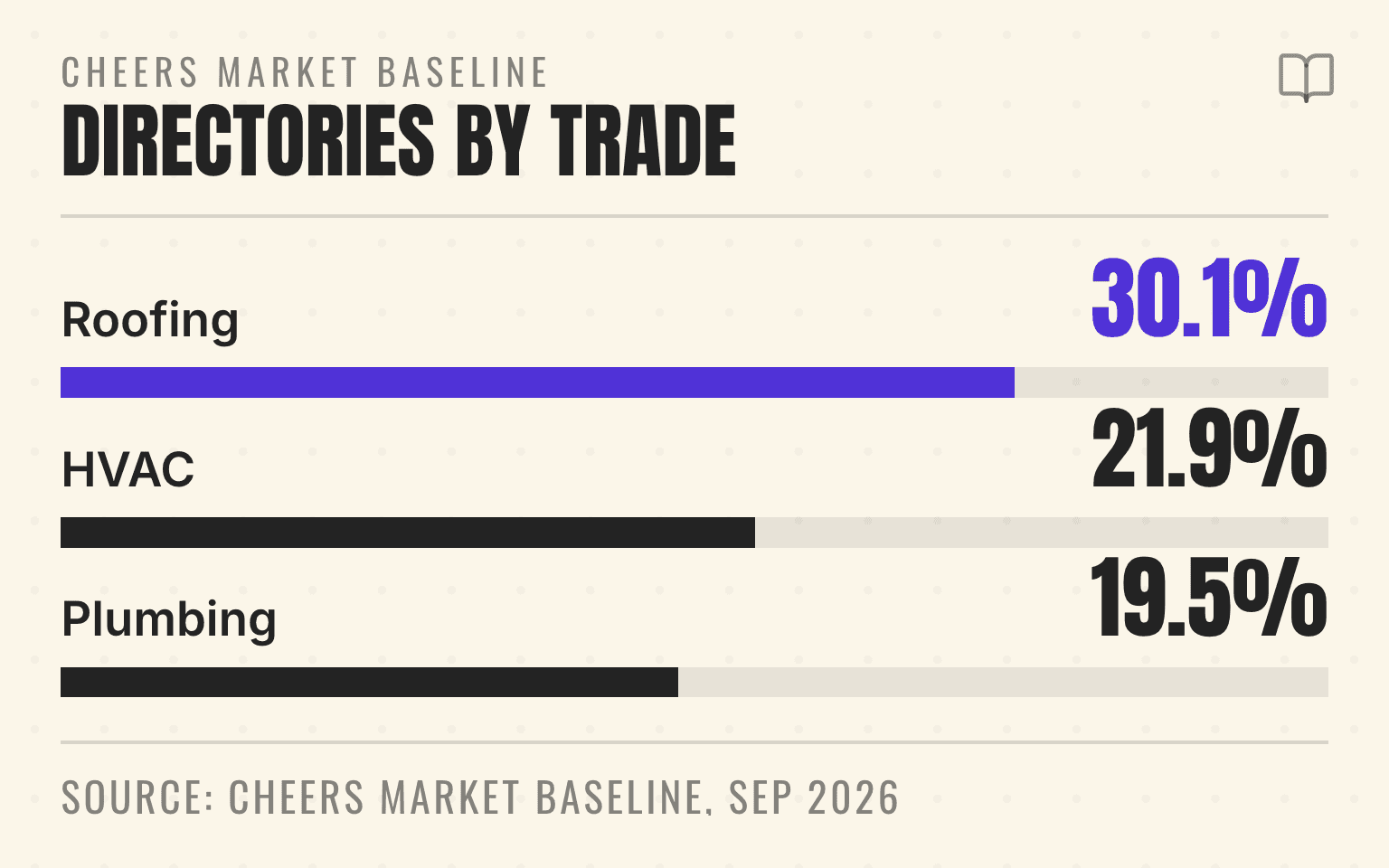
The source mix also moves by trade, which is the part most brand-level dashboards flatten. In the Cheers Market Baseline over the 28 days ending September 2, 2026, we classified 356,019 citations from 32 home-services prompts run in 100 metro service areas on four engines. Directories took 21.9% of HVAC citations and 19.5% of plumbing citations, but 30.1% of roofing citations and 30.0% of garage door citations. Contractor and franchise sites carried 75.2% of plumbing citations and only 63.2% of roofing citations. A roofing brand and a plumbing brand doing identical directory cleanup are not buying the same amount of upside, which is why how plumbing companies get recommended by ChatGPT starts from the page rather than the profile. The per-trade table is in the home-services AI visibility index, with domain classification rules in the methodology.
Cheers Market Baseline
How much your own site carries
Contractor and franchise website share of citations, by trade prompt
19.5% directories
21.9% directories
24.9% directories
24.2% directories
30.0% directories
30.1% directories
Cheers Market Baseline, 28 days ending September 2, 2026: 32 home-services prompts in 100 metro service areas on four engines, 356,019 classified citations. Method at cheers.tech/research/methodology.
| Trade | Business-site share of citations |
|---|---|
| Plumbing | 75.2% (19.5% directories) |
| HVAC | 71.6% (21.9% directories) |
| Restoration | 70.3% (24.9% directories) |
| Electrical | 69.8% (24.2% directories) |
| Garage door | 63.6% (30.0% directories) |
| Roofing | 63.2% (30.1% directories) |
For the broader engine-by-engine source pattern, use Each AI search engine trusts different sources. For crawler access decisions, pair this audit with which AI crawlers local businesses should allow.
Next step
Is AI recommending your business?
Find out how visible you are across ChatGPT, Gemini, Perplexity, and AI Overviews.
Turn cited sources into fixes
A source audit is not finished when the spreadsheet is full. It is finished when every repeated source problem has an owner.
If an AI answer cites your own location page, inspect whether the page names the exact service, market, branch, phone path, hours, proof, and next action; what location pages should include for AI search turns that into a page spec. If the answer cites a review site, inspect whether the profile is claimed, the location facts are accurate, and recent customer language matches the service. If the answer cites a trade directory, inspect category, service area, credentials, and phone number. If the answer cites a competitor page, inspect what proof that page has that yours does not.
When the repeated pattern is competitor selection rather than source confusion, use why AI search recommends a competitor instead of your business to separate query fit, source proof, branch evidence, and owner assignment.
For a multi-location operator, the fix usually lands in one of five places. Marketing owns prompt design, source logging, internal links, and page changes. Operations owns review velocity, technician adoption, job proof, and location-specific service truth. Local managers own profile accuracy, photos, hours, and branch facts. Development owns crawlability, structured data, redirects, and templates. Leadership owns priority markets and the tradeoff between cleaning existing sources and launching new pages.
That ownership model is why source tracking belongs beside AI search traffic tracking and inside an AI visibility platform, rather than inside a generic SEO report. Traffic tells you what arrived. Sources tell you what the answer trusted before the buyer clicked or never clicked.
Do not chase one-off citations
Every AI system can return a strange source occasionally. Do not rebuild a branch strategy around one answer.
Prioritize a source only when it repeats across important prompts, appears in priority markets, contains wrong location facts, explains a competitor win, or blocks a buyer from reaching the correct branch. A stale Yelp profile with the wrong phone number matters more if it appears across emergency plumbing prompts in three markets. A random forum thread matters less if it appears once and does not change the recommendation.
The same rule applies to owned pages. If an AI answer cites the corporate homepage for a local service query, that may mean the branch page is not strong enough. If the answer cites a service page but not the location page, the page may explain the job but fail to connect it to dispatch coverage. If the answer cites a location page and still recommends a competitor, compare review proof, third-party sources, photos, credentials, and service specificity.
A 14-day source audit plan
Start small. Pick five priority prompts, five priority markets, and the six engines or modes most relevant to your buyers. Run the prompts on the same day, capture every visible source URL, classify the source type, and mark whether the right branch and service appeared.
In the first week, fix source errors that are obviously wrong: dead URLs, incorrect phone numbers, stale acquired brand names, wrong categories, missing service areas, profile links to the wrong branch, and pages blocked from crawling. In the second week, assign deeper work: location page rewrites, review generation focus, directory cleanup, internal links, structured data alignment, and follow-up tests.
Then rerun the same prompt set. You are not looking for instant certainty. You are looking for source movement: fewer stale citations, more owned pages, better branch matches, more accurate service language, and clearer next actions for the customer.
For a full location-level cadence, use How to audit AI search visibility across locations. For third-party cleanup, use the citation stack for AI search.
What the source audit should change
The source audit should change the weekly operating meeting.
Instead of saying "we are down in AI visibility," the team can say "Perplexity is citing a trade directory with the wrong category in Austin," "ChatGPT is citing Yelp for emergency drain cleaning and our profile is thin," or "Google AI is finding the service page but not the Phoenix branch page."
That is the level where the work becomes concrete. The fix might be a profile edit, a review request push, a page rewrite, a schema alignment, a redirect, a directory cleanup, or a local manager follow-up. It should not be another abstract AI visibility task.
When the same source errors stop repeating, the brand becomes easier to verify. That is the practical goal: make every priority location easier for AI search, customers, and operators to trace back to the right public evidence.
Sources
Every link below was opened and checked on September 2, 2026.
- Web search. OpenAI Platform documentation. Checked September 2, 2026. developers.openai.com/api/docs/guides/tools-web-search. Source of the quoted line on inline citations for URLs found in web search results.
- Overview of OpenAI crawlers. OpenAI Platform documentation. Checked September 2, 2026. developers.openai.com/api/docs/bots. Supports the distinction between OAI-SearchBot for ChatGPT search visibility and OpenAI's other crawlers.
- Google's guide to optimizing for generative AI features on Google Search. Google Search Central. Last updated July 10, 2026, checked September 2, 2026. developers.google.com/search/docs/fundamentals/ai-optimization-guide. Supports the point that Google AI features rely on Search foundations and current business details.
- AI features and your website. Google Search Central. Checked September 2, 2026. developers.google.com/search/docs/appearance/ai-features. Supports the description of AI Overviews and AI Mode from a site owner's perspective.
- Tips to improve your local ranking on Google. Google Business Profile Help. Undated help page, checked September 2, 2026. support.google.com/business/answer/7091. Supports the need for complete, accurate, current local business information.
- Web search tool. Anthropic Claude documentation. Checked September 2, 2026. docs.anthropic.com/en/docs/build-with-claude/tool-use/web-search-tool. Source of the quoted line that citations are always enabled for web search.
- Search API quickstart. Perplexity developer documentation. Checked September 2, 2026. docs.perplexity.ai/docs/search/quickstart. Supports the description of Perplexity's ranked web search results and source controls.
- View related sources. Google Gemini Apps Help. Undated help page, checked September 2, 2026. support.google.com/gemini/answer/14143489. Supports the Gemini source-linking caveat.
- Web Search and Citations. xAI developer documentation. Checked September 2, 2026. docs.x.ai/developers/tools/web-search and docs.x.ai/developers/tools/citations. Support the Grok source and citation discussion.
- Introducing AI Performance in Bing Webmaster Tools Public Preview. Bing Webmaster Blog, Microsoft. Published February 10, 2026, checked September 2, 2026. blogs.bing.com/webmaster/February-2026/Introducing-AI-Performance-in-Bing-Webmaster-Tools-Public-Preview. Source of the quoted grounding-queries definition.
- Home Services AI Visibility Index 2026. Cheers Research. Market Baseline citation pull, 28 days ending September 2, 2026. cheers.tech/research/home-services-ai-visibility-index-2026. Source of the per-trade citation mix.
Last verified: September 2, 2026.
Amadeus Peterson is the CTO & Co-Founder of Cheers, the local search platform for multi-location service businesses.