

AI recommends a competitor when the retrieved evidence makes that business a clearer fit for the location and service in the prompt. I diagnose the miss in this order: location match, service proof, business facts, review evidence, cited sources, and engine access.
Last verified: September 2, 2026.
The comparison has to use the exact answer. A generic brand search cannot explain why one branch lost an emergency plumbing recommendation in one city.
Save the evidence before changing anything
Record the prompt, engine, location context, businesses named, wording of the recommendation, and every cited page. The citation trail is the only part of the mechanism the vendors actually document. OpenAI's web search guide puts it plainly:
Web search allows models to access up-to-date information from the internet and provide answers with sourced citations.
The same document explains how geography enters the request: "you can specify an approximate user location using country, city, region, and/or timezone." Google describes query fan-out in AI Mode, where the model issues concurrent related queries and shows supporting links. Perplexity's own developer docs describe real-time, ranked web results with citations on the answer side.
None of them publish a fixed local ranking formula, and no third-party tool has one either. Google's guidance is direct about that: "No third-party tool has access to our internal ranking or AI systems." So work from the citation trail, not from a score.
Compare the six likely gaps
- Location match: does the winning source prove the competitor serves the requested market while your branch page stays vague?
- Service proof: does the competitor have a clear page and recent customer language for the exact job?
- Business facts: do your website, Business Profile, phone, hours, service area, and public listings agree?
- Review evidence: do recent reviews describe the service and outcome in customers' own words?
- Cited sources: is the engine relying on a directory, publisher, or business page where the competitor has stronger or more current evidence?
- Engine access: can the engine's search crawler reach the page you expect it to use?
Do not manufacture reviews, copy the competitor, or publish thin pages for every wording variation. Google says creating many pages mainly to target query variations or fan-out searches can violate its scaled content abuse policy.
Use the panel as context
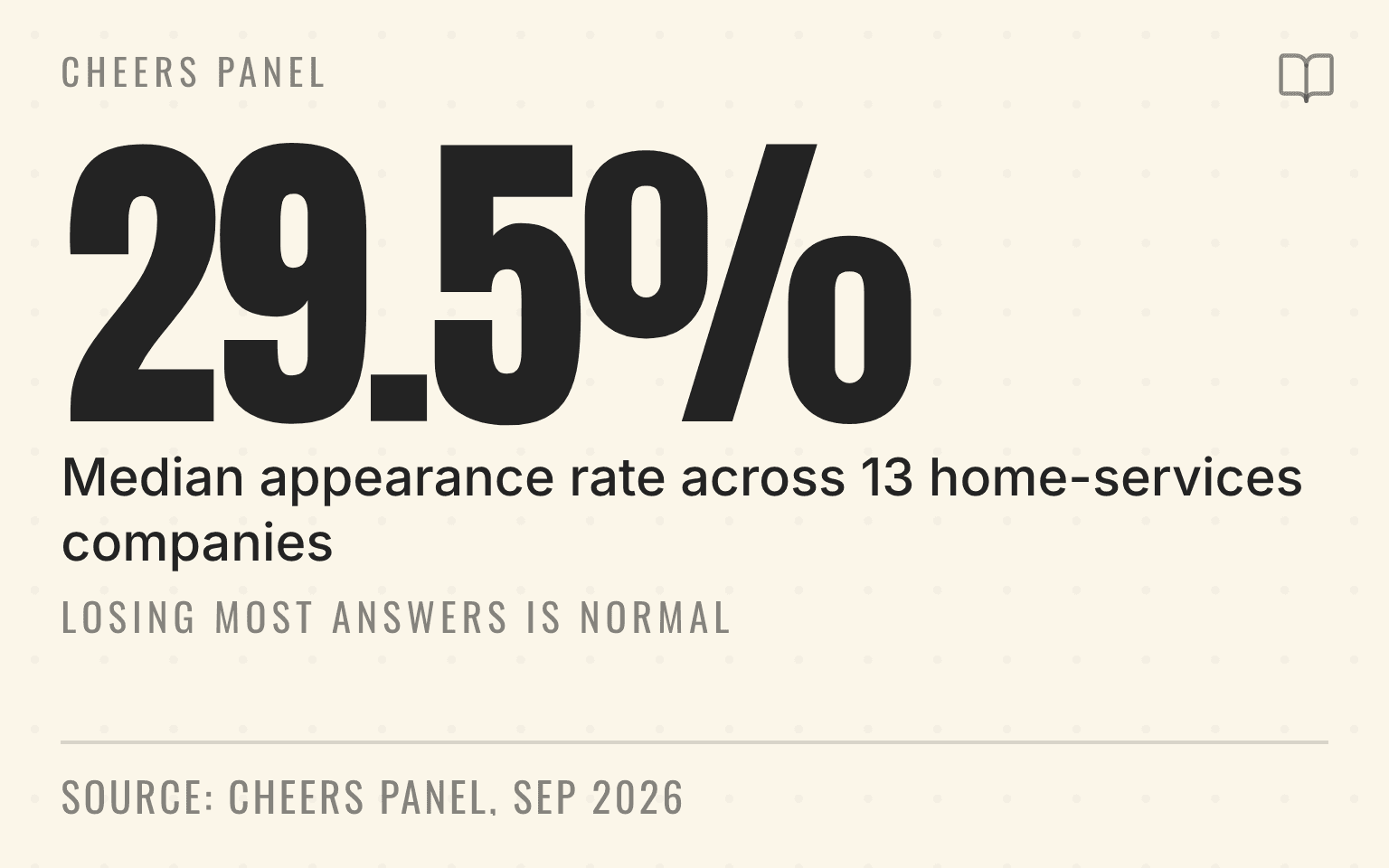
The mean company appearance rate is 25.2 percent in the Cheers panel, 28 days ending September 2, 2026, 13 home-services companies, leaving out questions that name the company itself, aggregate only. The median is 29.5 percent. Missing from one answer is common; missing across the high-intent prompt set is the problem to fix. The shortlist also moves on its own: in the Cheers Market Baseline, Google AI Mode named only 41% of the same businesses again when the same question for the same city was asked a week later, which is why AI recommends different businesses every time you check.
The spread is what makes the average useless on its own. The 25th percentile company appeared in 12.8 percent of its checks and the 75th in 34.9 percent. All 13 companies were named at least once, so "AI never mentions us" is rarely literally true. The home-services AI visibility index publishes the distribution; the methodology defines a check and an appearance.
Cheers panel
The spread, not the average
25.2%
Mean
Cheers panel, 28 days ending September 2, 2026, 13 home-services companies, 958,754 checks, non-branded prompts, aggregate only (corrected September 28, 2026). Method at cheers.tech/research/methodology.
| Population | Position | Appearance rate |
|---|---|---|
| Appearance rate per company | p25 | 12.8% |
| Appearance rate per company | p50 | 29.5% |
| Appearance rate per company | p75 | 34.9% |
That panel covers 593 distinct tracked prompts across the 13 companies, and I only report the aggregate. Underneath it I keep the branch, prompt, engine, competitor, and source attached to every result so an average does not hide a local miss.
Next step
Is AI recommending your business?
Find out how visible you are across ChatGPT, Gemini, Perplexity, and AI Overviews.
Turn one miss into one owned fix
If the cited page has the wrong hours, correct the hours. If the competitor wins on a specific service page, improve the real customer information and proof on the corresponding branch page. If the review set never mentions the service, fix the neutral post-service request process instead of scripting customer language.
The location audit workflow shows how to assign the work. For trade-specific versions of the same diagnosis, see HVAC and plumbing. The engine source comparison explains why the winning source can change by product.
Use the AI Visibility Grader for a current baseline. Keep the answer and source trail so the next run can be compared with the same scope. If the next question is whether to hand this to an agency or run it in-house, Cheers compared with an SEO agency sets out who owns which part of the work.
Sources
Every link below was opened and checked on September 2, 2026.
- Web search. OpenAI Platform documentation. Checked September 2, 2026. developers.openai.com/api/docs/guides/tools-web-search. Source of the quoted lines on sourced citations and approximate user location.
- Google's guide to optimizing for generative AI features on Google Search. Google Search Central. Last updated July 10, 2026, checked September 2, 2026. developers.google.com/search/docs/fundamentals/ai-optimization-guide. Source of the quoted line on third-party tools, plus the query fan-out and scaled-content guidance.
- Search API quickstart. Perplexity developer documentation. Checked September 2, 2026. docs.perplexity.ai/docs/search/quickstart. Supports the real-time ranked web results and citation behavior described here.
- Spam policies for Google web search. Google Search Central. Checked September 2, 2026. developers.google.com/search/docs/essentials/spam-policies. Supports the scaled content abuse warning against publishing a page per query variation.
- Home Services AI Visibility Index 2026. Cheers Research. Cheers panel, 28 days ending September 2, 2026, 13 home-services companies, 958,754 checks, 593 distinct non-branded prompts, aggregate only (corrected September 28, 2026). Figures first pulled September 3, 2026. cheers.tech/research/home-services-ai-visibility-index-2026. Source of the mean, median, percentile, and zero-appearance figures.
Last verified: September 2, 2026.
Dylan Allen-Arnegard is the CEO and Co-Founder of Cheers. I help multi-location service brands get recommended by AI search and Google, with results tracked by location, employee, and competitor.