

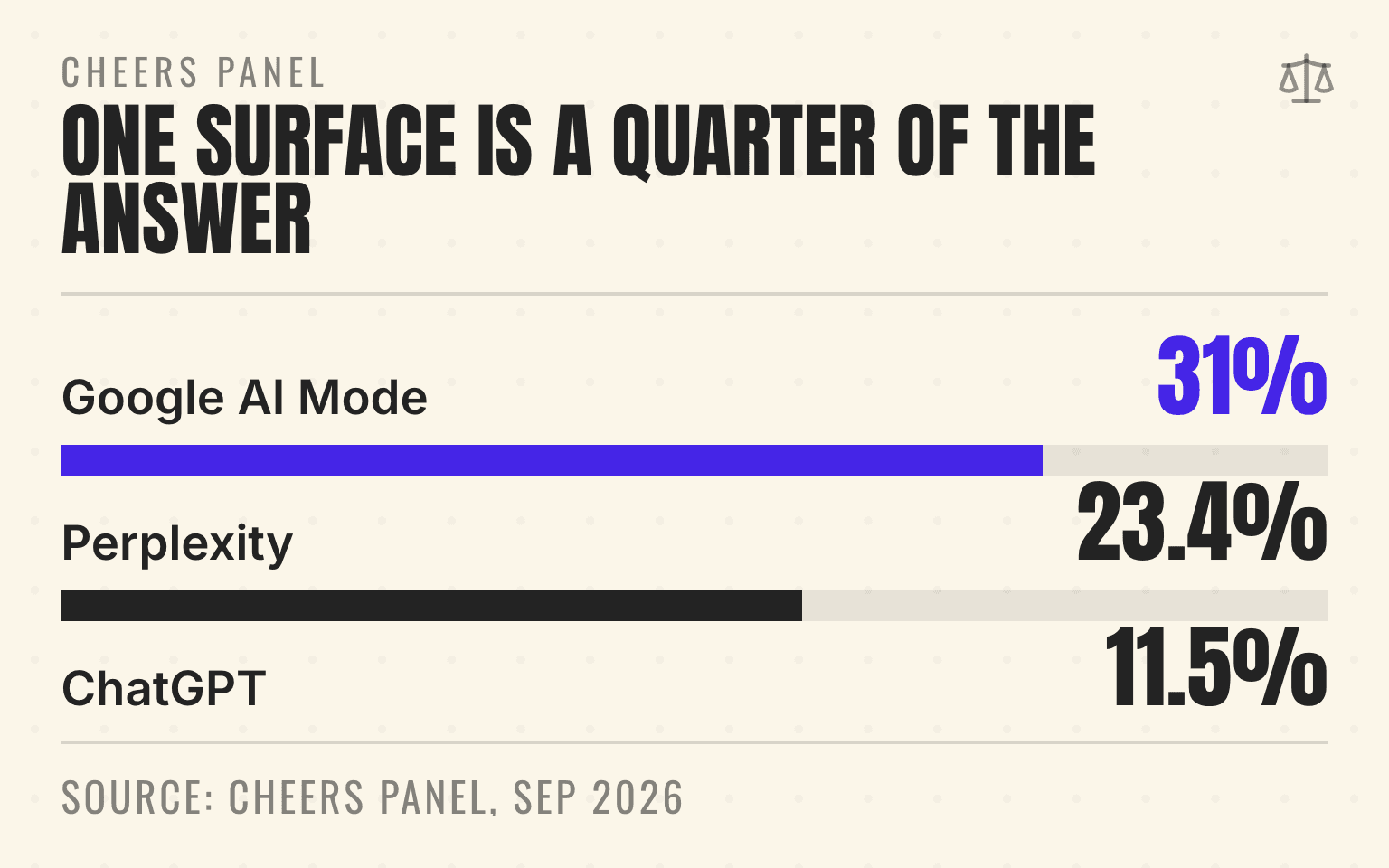
The four engines do not behave alike. In the Cheers production panel covering the 28 days ending September 2, 2026, across 13 home-services companies, leaving out questions that name the company itself, the mean company citation rate was 31.0% on Google AI Mode, 23.4% on Perplexity, 11.5% on ChatGPT, and 10.8% on Gemini. Software that reports one surface is reporting a quarter of the problem.
Last verified: September 2, 2026.
Those panel figures are aggregate only, no company named; see the panel methodology and the Home Services AI Visibility Index.
Most local SEO software was designed for a marketer at a desk. A multi-location service business needs something else: a system that makes each branch easier to find, trust, and recommend when a customer asks who to hire.
That matters because local SEO is no longer only a listings project. Google still uses relevance, distance, and prominence for local results, and complete business information still matters. Its local ranking page states the review half in one line: "More reviews and positive ratings can help your business's local ranking." But a 60-location HVAC group, 30-location plumbing brand, med spa franchise, or restoration rollup also has to manage review velocity, location pages, service-area proof, employee adoption, citations, and AI answers across markets.
Important
For service brands, local SEO software should turn visibility gaps into operating work. If a platform only reports listings or rankings, it is probably not enough.
Full disclosure: Cheers competes in this category with a done-for-you program, not another software seat. Use the framework here to interrogate every vendor on your shortlist, including us, and judge whether the criteria fit your operation.
If the immediate job is replacing a listings contract, our Yext alternatives guide focuses on publisher coverage and the transfer of account control.
Start with the business problem
Most local SEO software categories were built around one surface: listings, rankings, reviews, pages, or reporting. Multi-location service brands need those surfaces to connect.
An HVAC buyer does not care whether the weak link lives in the citation system, the location page, the Google Business Profile service list, or the review program. The buyer asks who can fix the AC. The answer engine or search result needs enough evidence to pick the right branch.
That is why multi-location local SEO software should be evaluated by the full local evidence loop:
- Can the system show location-level gaps in profiles, pages, reviews, citations, and AI answers?
- Can it distinguish the parent brand from the local branch customers can hire?
- Can it track which competitors and cited sources appear for priority buyer prompts?
- Can it connect reviews to the employees and service moments that created them?
- Can it tell a regional manager, marketer, or local owner what to fix next?
If the answer is no, the platform may still be useful. It is just not the whole local SEO system.
What the software should cover
A practical evaluation has six capability groups.
The shortlist should be grouped by the job.
Comparison
Local SEO software for multi-location service brands
Listings tools, enterprise suites, SEO platforms, and operating systems do different jobs. Match the tool to the failure mode.
| Platform | Listings and profile data | Location pages | Review generation | AI prompt tracking | Done-for-you execution |
|---|---|---|---|---|---|
| Cheers | Core capability | Partial or add-on | Core capability | Core capability | Core capability |
| Yext | Core capability | Core capability | Partial or add-on | Core capability | Not the focus |
| Uberall | Core capability | Core capability | Partial or add-on | Partial or add-on | Not the focus |
| SOCi | Core capability | Core capability | Partial or add-on | Core capability | Not the focus |
| Birdeye | Core capability | Partial or add-on | Core capability | Core capability | Not the focus |
| SEO suites (Semrush and peers) | Partial or add-on | Partial or add-on | Not the focus | Core capability | Not the focus |
Pricing: Visibility $750/mo for up to 3 locations; Managed from $3,000/mo, priced to scope; bigger brands by contract
Best for: Service brands that want local SEO done for them: the website, reviews, listings, structured data, and local content managed by market
Strengths
- Manages the website, reviews, listings, structured data, and local content in one program
- AI answer tracking connects every gap to a managed fix
- Done-for-you model for teams without spare operators
Tradeoffs
- Not a self-serve listings sync tool for a single storefront
- Less suited to brands that only need rank tracking
Pricing: Custom
Best for: Enterprise listings, location pages, and publisher data control
Strengths
- Deep publisher network and structured location data
- Scout adds AI search visibility tracking at enterprise scale
Tradeoffs
- Listings-first: review velocity and field adoption sit elsewhere
- Enterprise data platform rather than a done-for-you operating partner
Pricing: Custom
Best for: Multi-location marketing across listings, reviews, and local pages
Strengths
- Location marketing breadth across European and US markets
- Listings, reviews, and pages under one contract
Tradeoffs
- Platform breadth, not field-service operating depth
- Execution routes back to your local teams
Pricing: Custom
Best for: Enterprise local marketing with social and AI in the suite
Strengths
- Hundreds-of-locations scale across listings, social, and reviews
- Genius Search adds AI visibility to the suite
Tradeoffs
- Enterprise complexity for mid-size service brands
- Field review generation is not the design center
Pricing: Custom
Best for: Reputation-led local marketing in one broad platform
Strengths
- Reviews, listings, messaging, and Search AI in one suite
- Wide industry coverage
Tradeoffs
- Breadth over service-brand operating depth
- Your team still owns the weekly fixes
Pricing: Published tiers; AI add-ons priced separately
Best for: Research, audits, rank tracking, and content workflows
Strengths
- Deep keyword, audit, and content tooling
- AI visibility add-ons are arriving in the suites
Tradeoffs
- Site-centric: branch operations live outside the tool
- Local add-ons exist, but the suites center on research and content workflows
The short version
- Listings accuracy and location data are the dominant problem: Yext or Uberall
- Enterprise suite for listings, social, and local pages: SOCi
- Reputation-led consolidation across many industries: Birdeye
- An SEO team that needs research and audit depth: An SEO suite
- The website, reviews, listings, structured data, and local content managed for you by market: Cheers
Capability reads reflect each vendor's official public positioning as of September 2, 2026, using the sources linked in this article. Pricing appears only where the vendor publishes it. Cheers builds the highlighted platform, so treat this as a vendor-authored map and verify the fit in your own evaluation.
The vendors describe those jobs in their own words. Yext Listings says its "distribution agent pushes verified brand data directly to 200+ publishers and LLMs in real time." Uberall says it "centralizes reviews from Google, Facebook, Yelp, TripAdvisor, and 80+ more into a single streamlined workspace." Yext Scout offers to show "how you appear across Google Search, Google Maps, and Google AI Overviews, plus ChatGPT, Gemini, Claude, and Perplexity." Read those as scope statements, not as evidence about outcomes.
That grouping matters because "best local SEO software" is not one category. A listings platform, a rank tracker, a review inbox, a local-page system, and a service-brand operating platform can all be useful, but they do different jobs.
Profile and listings coverage comes first. The software should help identify inconsistent names, addresses, phone numbers, categories, hours, service areas, and duplicate listings. For service-area businesses, it should also make coverage and dispatch reality clear. Is Google Business Profile enough for AI visibility? explains why the profile needs backup from pages, reviews, citations, and structured facts.
If the shortlist includes broader reputation platforms, compare them with Birdeye alternatives and competitors, with published prices. If budget is the deciding factor, use How Much Does AI Visibility Software Cost? before comparing line items.
Review generation comes next. Review monitoring is useful, but service brands need a process that creates new, compliant, location-specific Google reviews from real customer interactions. If the software cannot help with review velocity, the brand may still look weak even when listings are clean.
Location pages matter because they are the owned source that explains services, service areas, proof, and booking paths. Google warns against building pages for every query variation when the pages do not help users. Strong location pages should answer real customer decisions, rather than city-keyword swaps alone.
AI visibility tracking is now part of local SEO for high-intent buyers. A platform should record whether the right brand appears in ChatGPT, Gemini, Perplexity, and Google AI surfaces for priority prompts, which competitors appeared, and which sources were cited. How to audit AI search visibility across locations is the operating workflow behind that measurement.
Reporting has to create work. A dashboard that shows 200 weak locations is not enough. The system should assign the miss to a likely owner: page, profile, review, citation, tracking, or operations.
Proof matters. A platform selling multi-location service outcomes should be able to show dated proof, public case studies, or a clear method for reading results. Cheers proof pages publish dated examples for Hello Sugar, Sierra, Elite Rooter, and Action Furnace.
Next step
Is AI recommending your business?
Find out how visible you are across ChatGPT, Gemini, Perplexity, and AI Overviews.
The listings-only trap
Listings tools are useful. They make the business easier to verify across maps, directories, and data sources. But clean listings do not automatically create new reviews, explain service quality, publish field proof, or tell AI systems which branch handles which job.
A plumbing brand may have accurate listings and still lose when AI answers cite a competitor's stronger service page, BBB profile, or review pattern. A franchise brand may have a complete directory and still confuse AI systems if the parent brand, franchisee, location page, and Business Profile do not resolve into one local entity.
That is why listings work should be connected to source tracking. When an AI answer cites a directory, inspect that directory. When it cites a competitor's page, inspect the page. When it skips the brand because reviews are thin, the fix is review operations, not another listing sync.
When software is enough
Software is enough when the team already has owners for every recurring task.
If marketing owns location pages, operations owns review capture, local managers own profile accuracy, and leadership reviews the scorecard monthly, then a focused platform can make the team faster. The software surfaces gaps and the organization fixes them.
If those owners do not exist, the team needs more than software. It needs a done-for-you operating model or a services layer that keeps the cadence moving. That is especially true after acquisitions, rebrands, franchise expansion, emergency-hour changes, and service-line changes. The source stack drifts fastest when the business changes.
For a PE-backed service platform, the buying question should be blunt: will this tool produce a cleaner dashboard, or will it produce better location-level work?
How to evaluate vendors
Do not start with a demo script. Start with five real markets.
Choose one strong market, one weak market, one recent acquisition, one priority growth market, and one branch with uneven reviews. Ask each vendor to show how the system would inspect those five markets across profiles, reviews, pages, citations, AI answers, competitors, and owners.
Then look for the output. The best local SEO software should produce fewer vague recommendations and more assignable work: update this branch page, fix this profile field, grow reviews for this service line, clean this citation source, add local proof here, retest this prompt next week.
If the platform cannot show that path, it may still be a useful tool. It is not the operating system for local visibility.
If you want to compare software against your actual branch map, use the demo action below with five markets: strong, weak, recently acquired, priority growth, and uneven reviews.
Sources
- Tips to improve your local ranking on Google. Google Business Profile Help, undated help page. Relevance, distance, prominence, and the review sentence. Checked September 2, 2026.
- Optimizing your website for generative AI features. Google Search Central, last updated July 2026. Checked September 2, 2026.
- Do you need an SEO?. Google Search Central, last updated June 5, 2026. Checked September 2, 2026.
- Tips to get more reviews. Google Business Profile Help, undated help page. Checked September 2, 2026.
- Yext Listings, Yext Pages, and Yext Scout. Yext product pages, checked September 2, 2026.
- Uberall review management, SOCi Genius Local Search Agent, and Birdeye Search AI. Vendor product pages, checked September 2, 2026.
- Home Services AI Visibility Index 2026 and methodology. Cheers Research, September 2, 2026. Per-engine appearance and citation rates across 13 home-services companies, non-branded prompts, 28 days ending September 2, 2026 (corrected September 28, 2026).
Dylan Allen-Arnegård is the CEO & Co-Founder of Cheers, the done-for-you platform that manages the website, reviews, listings, structured data, and local content that get service businesses recommended across Google, Maps, ChatGPT, and Perplexity.