

Start with the sentence that voids most photo programs. Google's image documentation says: "Google doesn't index CSS images." If your location-page hero, your gallery, or your before-and-after set is painted in with a CSS background, it is not an image as far as Google is concerned. That is a five-word rule that decides whether any of the work below counts.
Beyond that, photos help when they make real service work easier to verify. They do not replace reviews, location pages, Google Business Profile accuracy, citations, or crawlable text.
That distinction matters for multi-location service brands. A 60-location pest control group may have hundreds of job photos on phones, a few old storefront images on Google Business Profile, and location pages with no current proof. A roofing franchise may have strong crews in every market, but its website only shows generic stock photos. A med spa group may post polished images on social, while the local page has no photo evidence of the studio, treatment room, or team.
AI search does not need a pile of images. It needs sources that make the business, location, service, and proof clear. Real photos can help that source story when they are accurate, discoverable, and connected to text a customer can read.
Important
Treat photos as location-level evidence. The photo should prove something specific about a service, branch, team, property, or customer experience, then the page and profile text should explain that proof.
The short answer
Yes, photos can help AI search visibility, but not as a standalone ranking tactic.
Google says the same SEO foundations apply to AI Overviews and AI Mode. Pages need to be eligible for Search, useful for people, and crawlable. On images specifically, its generative AI guidance makes a limited but real promise:
our generative AI search features can bring in relevant images and video, which means more opportunities for your website to appear beyond web page links.
More opportunities, not a ranking factor. Google also says important content should be available in textual form, which is the constraint the rest of this article works inside.
I should be straight about what our own data does and does not show. The Cheers panel does not measure whether photos change an AI recommendation, and I am not going to imply that it does. What it measures is what comes back as a citation. In the Cheers Market Baseline over the 28 days ending September 2, 2026, we classified 356,019 citations from 32 home-services prompts in 100 metro service areas on four engines, and 68.1% of them pointed at contractor and franchise websites. Engines hand back page URLs. A photo earns its place by making the page behind that URL more credible to the person who clicks it. Classification rules are in the methodology, and the citation cut is in the home-services AI visibility index.
For a local service brand, that means a photo program should answer a practical question: can Google, ChatGPT search, Perplexity, and a customer see enough evidence to understand which location performs which service in which market?
For ChatGPT and Perplexity, the defensible claim is narrower than it is for Google: crawler docs show how public sources can be fetched or linked, not that photos are a confirmed ranking factor. Treat images there as crawlable source context attached to useful text.
How local businesses can show up in Google AI Search covers the broader Google AI Search foundation. This article focuses on one proof layer: photos.
If the proof needs motion, spoken explanation, or a visible diagnostic sequence, use the video SEO workflow for home service companies to connect the recording to an inspectable page, matching metadata, and the right location.
What a photo can prove
A good service photo answers a fact question.
For an HVAC branch, a photo of a technician documenting an outdoor unit after a repair can support the claim that the branch performs residential AC service. For a restoration company, a photo of drying equipment on a contained job site can support emergency water-damage capability. For a med spa, a current studio and treatment-room photo can support the local experience a buyer is comparing.
A weak photo does the opposite. Generic trucks, stock interiors, AI-generated service scenes, and old team shots create friction because they do not verify current local work. They also create governance risk when the same image appears across many locations with no market-specific context.
Photos are strongest when they sit next to the facts they support. A pest control foundation photo should live near text about termite inspections, crawl-space checks, the branch that performed the work, and the service area. A garage door spring repair photo should sit near copy that explains emergency repair, parts carried, safety constraints, and how the customer reaches the local team.
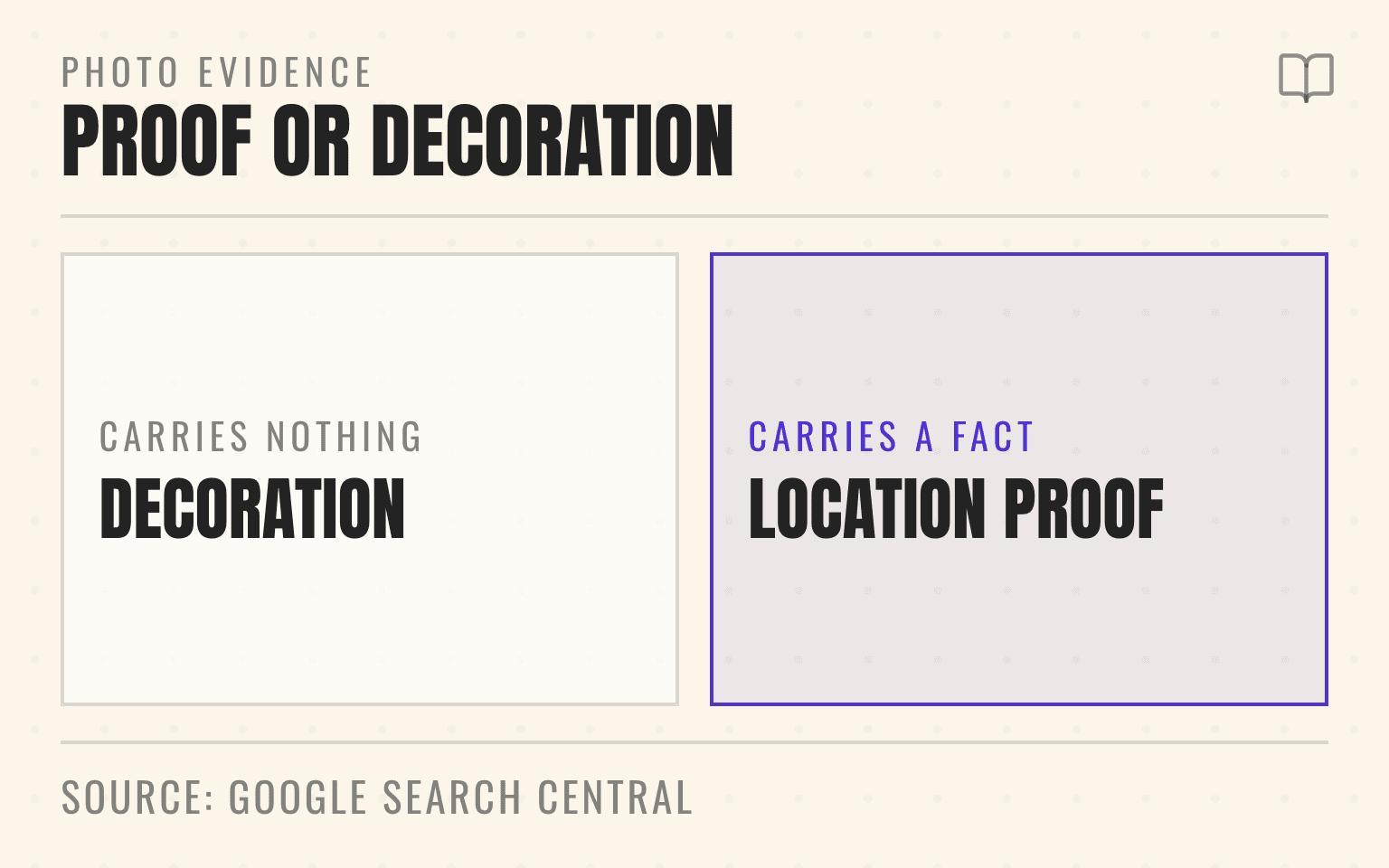
That is the useful mental model: a photo is proof attached to a source, not decoration attached to a page.
Where photos belong in the local source stack
Most operators think about photos as a Google Business Profile task. That is too narrow for AI search.
Business Profile photos are still important. Google says verified businesses can add photos and videos of the shop front, products, and services. For businesses with 10 or more locations, photos can be uploaded in bulk. Google also says photos should be in focus, well lit, not heavily altered, and should represent reality.
Paid local media needs a separate check. Google's current Local Services Ads requirements add a regional restriction for AI-generated and AI-edited images, so operators in affected markets should use the Local Services Ads real-photo workflow before reusing a page or profile asset.
The website matters too. Google's image guidance is blunt about discovery: "Using standard HTML image elements helps crawlers find and process images," and "Google doesn't index CSS images." It also says the landing page, captions, image titles, filenames, and alt text all help explain what the image shows, and that the most important attribute for image metadata is the alt text.
For multi-location brands, the practical source stack starts with Google Business Profile. Exterior, interior, team, service, and job photos should represent the actual branch or service area.
The next layer is the location page. Branch-specific photos should sit near visible copy about services, coverage, credentials, reviews, and contact paths. Service pages can add job or equipment photos that clarify high-intent work like emergency HVAC, roof repair, water restoration, pest inspections, or garage door repair.
Third-party profiles matter when they already shape local discovery. Directories, review platforms, industry listings, and local sources can corroborate the same facts. Structured data and image metadata should reinforce what the page already shows rather than introduce hidden claims.
That stack also connects to Is Google Business Profile enough for AI visibility?. The profile is an anchor. It works better when owned pages, reviews, citations, and visible proof support the same local entity.
Do not put the important facts only inside the image
AI search visibility still depends on readable sources. A photo of a technician at a job site may show real work, but it does not reliably explain the brand, branch, service, city, financing option, license, warranty, or booking path by itself.
Put the facts in text near the image.
For a service-area plumbing brand, the caption can explain that the photo shows a slab leak inspection performed by the North Dallas team. The surrounding copy can describe the cities served, the diagnostic process, and when the branch can dispatch. The alt text can describe the visible scene for accessibility and image understanding, without repeating every keyword the marketer wants to rank for.
Google's image guidance is useful here because it is plain. Use HTML image elements. Place images near relevant text. Use short, descriptive filenames. Write useful alt text. Keep image quality high without slowing the page.
For location pages, pair this with What should location pages include for AI search?. A photo program should strengthen the same page standard: local entity, service fit, proof, contact path, and structured facts.
Next step
Is AI recommending your business?
Find out how visible you are across ChatGPT, Gemini, Perplexity, and AI Overviews.
Multi-location brands need a photo standard
The hardest part is not taking photos. The hard part is making photos consistent enough to trust across locations.
A useful standard says what each location should capture, where the asset goes, who approves it, and which facts must match before publishing. It should also say what the team will not publish: stock photos, generated service scenes, misleading before-and-after images, customer-identifiable photos without permission, screenshots, watermarked images, or one generic truck photo reused across 80 branches.
For a PE-backed home services platform, the standard may be simple at first:
- Every branch needs current exterior or service-area proof, team or service vehicle proof, core service photos, and one photo per high-value service line.
- Every photo needs an owner, date, location or market, service label, approval status, and destination surface.
- Website photos need descriptive filenames, useful alt text, and nearby copy that explains the service and branch.
- Business Profile photos need to represent reality and meet Google's quality rules.
- Monthly review should remove stale, duplicate, misleading, or low-quality photos from active source surfaces.
That is one operating system across Google Business Profile, the website, citations, and review platforms. It prevents the common franchise problem where one location looks current, another looks abandoned, and a third looks like a different company.
Service-area businesses should document coverage, not fake storefronts
Service-area businesses have a different photo problem from storefronts. The buyer is often asking whether a team actually serves the market, whether it performs the exact job, and whether the contact path reaches the right crew.
Photos can help, but only if they document real work. A pest control company should not imply a public office if customers never visit one. A garage door brand should not reuse the same showroom photo across every market. A restoration roll-up should not hide regional capability behind one corporate hero image.
Better photos show job context without exposing private customer details. A technician documenting a foundation treatment, an installer photographing a completed door system, a restoration crew showing equipment setup without personal items, or a roofing team capturing material details can all support service-area proof.
How service-area businesses should show coverage for AI search covers the broader coverage issue. Photos are one way to show that the coverage claim is real.
Make photo access part of the crawler check
Photos cannot support AI search if the sources around them are blocked, slow, hidden in scripts that crawlers cannot process, or served only as CSS backgrounds.
For Google, start with Search fundamentals. Make the page indexable, internally linked, eligible for snippets, and useful to customers. Use standard image markup and avoid relying on the image file to carry facts that should be text.
For answer engines outside Google, crawler controls matter too. OpenAI documents OAI-SearchBot for surfacing websites in ChatGPT search features. Perplexity documents PerplexityBot for surfacing and linking websites in search results. If the location pages, service proof, or image files are blocked by robots.txt, CDN rules, or a web application firewall, the photo evidence may not be available when the answer system looks for sources.
That does not mean every crawler gets every path. It means the team should make an intentional policy. Which AI crawlers should local businesses allow? covers that decision in more detail.
A 30-day photo evidence plan
Start with the markets where wrong or missing local proof costs the most: emergency service lines, newly acquired branches, franchise markets with inconsistent pages, and locations where AI answers cite competitors or directories instead of owned sources.
- Week 1: Audit Business Profile photos, location-page images, service-page images, and top third-party profiles for 10 priority locations.
- Week 2: Define the required photo set by vertical: exterior or service-area proof, team or vehicle proof, core services, high-value jobs, and proof that supports reviews.
- Week 3: Publish the strongest approved photos with descriptive filenames, alt text, captions, and nearby copy. Remove duplicate, stale, misleading, or low-quality assets.
- Week 4: Re-run priority AI search prompts, check which sources are cited, inspect Search Console and crawler logs where available, and assign the next fixes by location.
The goal is not to win AI search with images. The goal is to make every priority location easier to verify.
If the Houston branch performs emergency roof tarping, the page should say that, the Business Profile should support it, reviews should contain real customer proof, and photos should make the work visible. If the Columbus studio offers laser hair removal, the location page should explain the service, show the real studio, and route the buyer to the right booking path. If the Phoenix HVAC branch handles after-hours AC repair, the source story should not depend on one generic brand photo.
Photos help AI search when they make local proof more concrete. They fail when they are treated as a cosmetic task. Running that standard across every branch is multi-location local SEO work with a local owner attached, not a photoshoot.
Sources
Every link below was opened and checked on September 2, 2026.
- Image SEO best practices. Google Search Central. Checked September 2, 2026. developers.google.com/search/docs/appearance/google-images. Source of the quoted lines that standard HTML image elements help crawlers find images and that Google does not index CSS images, plus the filename, caption, and alt-text guidance.
- Google's guide to optimizing for generative AI features on Google Search. Google Search Central. Last updated July 10, 2026, checked September 2, 2026. developers.google.com/search/docs/fundamentals/ai-optimization-guide. Source of the quoted line on generative AI features bringing in relevant images and video.
- AI features and your website. Google Search Central. Checked September 2, 2026. developers.google.com/search/docs/appearance/ai-features. Supports the point that normal SEO requirements apply, important content should be textual, and Business Profile information should stay current.
- Manage photos and videos for your Business Profile. Google Business Profile Help. Undated help page, checked September 2, 2026. support.google.com/business/answer/6103862. Supports Business Profile photo and video management, including bulk upload for businesses with 10 or more locations.
- Business-specific photo tips. Google Business Profile Help. Undated help page, checked September 2, 2026. support.google.com/business/answer/6123536. Supports the reality-based photo standard: in focus, well lit, free of significant alterations or excessive filters, representative of reality.
- LocalBusiness. Schema.org vocabulary. Undated type page, checked September 2, 2026. schema.org/LocalBusiness. Supports using image properties when structured data matches visible local business facts.
- Overview of OpenAI crawlers. OpenAI Platform documentation. Checked September 2, 2026. developers.openai.com/api/docs/bots. Supports the distinction between OAI-SearchBot for ChatGPT search features and other OpenAI user agents.
- Perplexity crawlers. Perplexity developer documentation. Checked September 2, 2026. docs.perplexity.ai/docs/resources/perplexity-crawlers. Supports crawler access considerations for PerplexityBot and Perplexity-User.
- Home Services AI Visibility Index 2026. Cheers Research. Market Baseline citation pull, 28 days ending September 2, 2026. cheers.tech/research/home-services-ai-visibility-index-2026. Source of the 68.1% business-site citation share. The panel does not measure image impact on AI recommendations.
Last verified: September 2, 2026.
Dylan Allen-Arnegård is the CEO & Co-Founder of Cheers, the done-for-you platform that manages the website, reviews, listings, structured data, and local content that get service businesses recommended across Google, Maps, ChatGPT, and Perplexity.