

Google's Business Profile guidelines say a practitioner qualifies for a dedicated profile only when the person is public-facing and can be contacted directly at the verified location during stated hours. The page had no publication date when checked on September 2, 2026.
Last verified: September 2, 2026.
Google's documentation says:
Practitioners should create their own dedicated Business Profiles if they operate in a public-facing role.
Practitioner eligibility
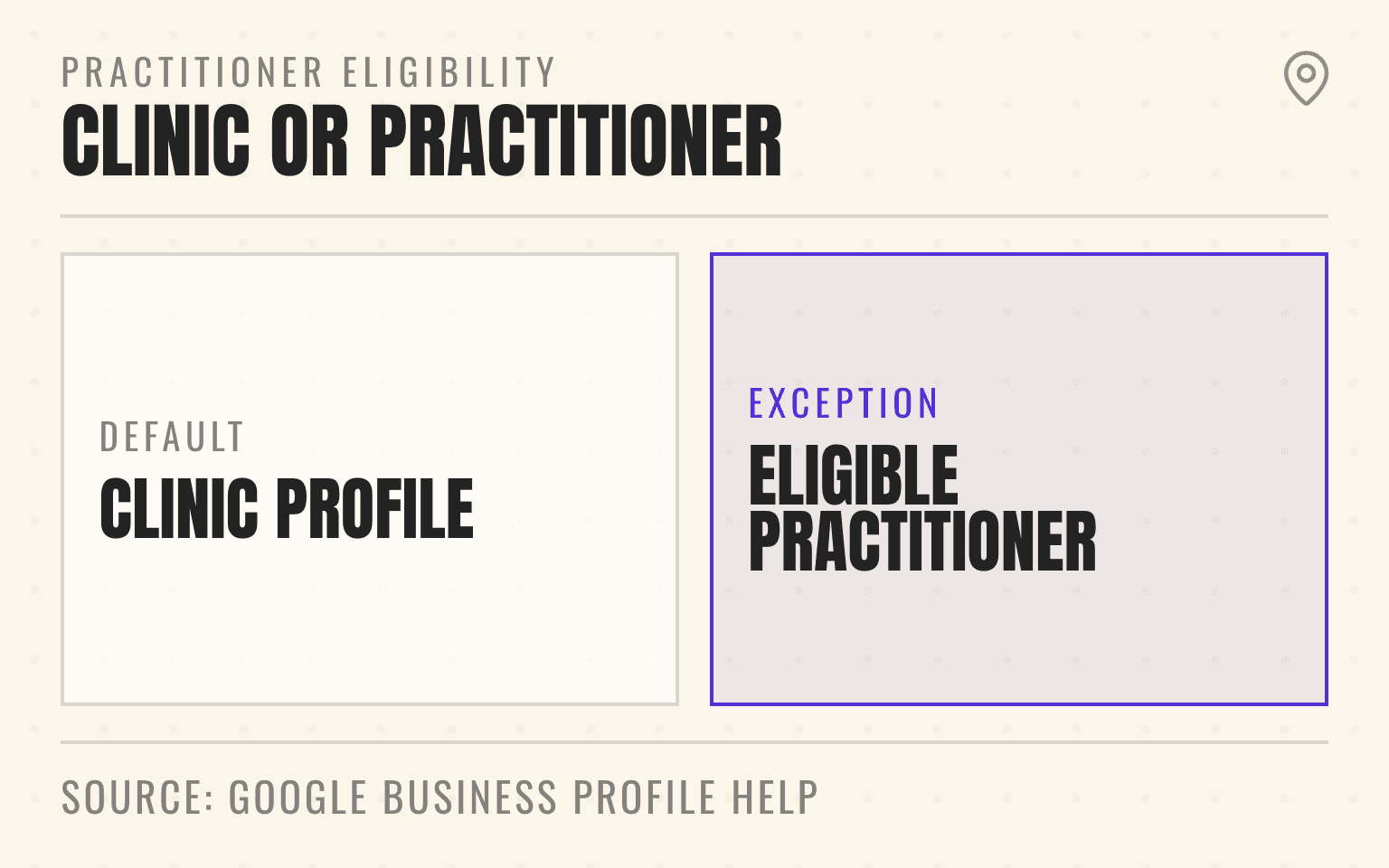
Clinic by default, practitioner by exception
Default
Clinic profile
- Represents the customer-facing location
- Carries clinic phone and booking path
- Owns shared services and hours
- Remains when staff changes
Exception
Practitioner profile
- Person is public-facing
- Directly contactable at the verified location
- Uses the practitioner's own name
- Has an owner and departure plan
Google Business Profile Help: Guidelines for representing your business on Google; checked September 2, 2026.
The question is not how many profiles Google will accept. It is which real-world entity each profile represents.
Google's guidelines for individual practitioners set a narrow test. A practitioner should create a dedicated Business Profile when the person is public-facing and can be contacted directly at the verified location during stated hours. Google also says support staff should not create their own profiles and one practitioner should not create separate profiles for every specialization.
For a multi-location med spa, that means the clinic location is the default record. A separate practitioner profile is an exception for an eligible, directly bookable professional whose public identity the organization can keep accurate. Before adding one, check how the clinic and provider appear across priority local queries, then compare the public result with the actual booking path, schedule, website, and ownership record.
Important
Create a practitioner profile because the person meets Google's real-world eligibility rules, not because the location wants another result in the local pack.
Start with the clinic profile architecture
Each customer-facing clinic needs a location record that describes the business people can visit: real-world name, address, phone, hours, website destination, categories, services, photos, and booking path. Google says a Business Profile is for a business that makes face-to-face contact with customers during stated hours. The profile should match the operation at that location.
A provider profile does not replace the clinic profile. Google's multiple-practitioner guidance says the organization should create a Business Profile for the location, separate from an eligible practitioner's profile. That distinction gives the portfolio two possible entities: the clinic where customers book and the public-facing professional they may choose.
Start with one approved inventory that labels every record as clinic, practitioner, department, duplicate, closed, or uncertain. This is the same entity-classification work used in the duplicate Business Profile cleanup workflow. If the team cannot explain which entity a proposed profile represents in one sentence, do not create it yet.
For example, a 12-clinic aesthetics group may have one clinic profile per staffed location. An injector who is directly bookable at the Denver clinic may qualify as a practitioner. A regional trainer who visits for staff education but does not take customer appointments does not meet the same public-contact test.
Apply Google's two-part practitioner test
Google describes an individual practitioner as a public-facing professional, typically with a customer base of their own. Its explicit eligibility test has two parts: the person operates in a public-facing role, and the person can be contacted directly at the verified location during stated hours.
Use those words literally. "Public-facing" means the person actually sees or serves customers. "Contacted directly" means the customer can reach a real path that resolves to that practitioner at that clinic. A generic call center that cannot find the provider's schedule is weak evidence. A booking page that lists the provider at a different market is a conflicting record.
Google does not publish a med-spa-specific list of eligible roles. An injector, nurse practitioner, physician, physician assistant, or esthetician may or may not qualify depending on the actual customer relationship and contact path. A medical director who is named on compliance documents but never takes appointments should not receive a practitioner profile merely because the title sounds authoritative.
The cited guidance also does not settle every rotating-provider scenario. If a provider works at several clinics, do not automatically create a profile at every address. Record the working locations, schedule, direct contact path, profile owner, and customer destination. Escalate the unresolved model to Google Business Profile support instead of turning uncertainty into duplicate records.
Keep the clinic and practitioner names separate
When several practitioners work at one location, Google says the practitioner profile title should contain only the practitioner's name and should not include the organization name. The clinic keeps its own location profile under the real-world business name.
For a solo practitioner who is the only public-facing practitioner at a branded location, Google recommends a shared profile using the format "brand: practitioner name." That is a different operating model from a clinic with several providers.
Do not add the city, treatment, hours, or "best injector" language to the practitioner's name. Put location and service details in the fields designed for them. The Business Profile naming guide explains why names should follow real-world identity rather than a keyword plan.
The same rule protects the brand during staffing changes. A practitioner profile should never be renamed to the replacement provider. The old and new people are different entities. If the outgoing provider no longer works at the verified location, the public record needs a location, contact, and status review.
Choose categories and services for the entity that exists
Google's business category guidance says to choose a specific primary category that best describes the business, then use a few additional categories for other meaningful business types. It also says not to add a category for every product or service.
Apply that rule separately to the clinic and practitioner. The clinic category should describe the customer-facing med spa location. A practitioner category should describe that person's real public role, when an appropriate category exists. A service menu belongs in the services field and on the relevant website page, not in a set of extra profiles.
A clinic offering injectables, laser treatments, and skincare does not need three Business Profiles at one address. Google explicitly warns against creating separate profiles for different services offered by the same business. The multi-location category workflow can keep the default and approved exceptions consistent across the portfolio.
Give each approved profile a working customer route
Google's eligibility and ownership rules say an authorized representative should use an authoritative phone number and website that the business owner can verify. For an eligible practitioner, those routes should help the customer reach that practitioner at the stated clinic.
The destination page should identify the provider, clinic, services, credentials that the company is approved to publish, schedule or availability limits, and one current booking or contact path. It should also link back to the clinic page. The technician and provider bio standard covers when a standalone bio adds useful proof and when a team section is enough.
Do not use the clinic homepage by default if it forces a customer to restart the search for the provider. Do not send the profile to a provider page that names a former clinic. Google says Business Profile information can also be informed by crawled website content, user contributions, licensed data, and other sources. Conflicting owned pages make the public entity harder to maintain even when the profile edit itself is correct.
Google Search Central's LocalBusiness structured data guidance can help the clinic page describe the location and its public facts. It does not create practitioner eligibility, and Google does not publish a special schema shortcut for ranking a provider profile.
Next step
Is AI recommending your business?
Find out how visible you are across ChatGPT, Gemini, Perplexity, and AI Overviews.
Decide ownership before the profile goes live
A practitioner profile adds another access record to the portfolio. Assign a primary owner, continuity owner, business group or management boundary, approved managers, recovery path, and quarterly review date before launch.
Google says only owners and authorized representatives may verify and manage a Business Profile. The practitioner should know who owns the profile, what the organization will edit, and what happens if the employment or contractor relationship ends. Corporate marketing, a clinic manager, and an agency should not all assume somebody else controls recovery.
The multi-location access guide explains Google's owner, manager, business group, and agency controls. For a med spa group, the operating goal is continuity without hiding control from the practitioner whose identity the profile represents.
Keep a provider-profile register with:
- Provider name, public role, eligibility evidence, clinic, stated hours, direct contact path, and provider page
- Primary owner, continuity owner, managers, business group, verification state, last public readback, and unresolved exceptions
- Start date, expected clinic changes, offboarding owner, and the decision required if the provider stops being directly bookable there
This register is an operating recommendation from Cheers, not a Google ranking factor.
Send review requests to the right entity
If a clinic and an eligible practitioner both have profiles, decide which customer experience each review request should describe before staff begin sending links. The safest rule is to ask for a genuine review of the entity the customer actually experienced, without incentives, filtering, or pressure.
Do not alternate links only to balance review counts. Do not send every clinic customer to a practitioner profile they did not choose or interact with. Do not ask staff to review themselves or the clinic. Google's Maps content policies prohibit fake engagement and conflicts of interest.
Website proof also needs a clear entity. The guide to using customer reviews on location pages explains how to publish real customer language without making the clinic, practitioner, or schema say more than the review supports.
For a three-location med spa, a review about the front desk, scheduling, and overall clinic experience may belong to the clinic. A review that specifically describes an appointment with a directly booked practitioner may belong to that practitioner's eligible profile. The customer decides what to say. The brand controls whether its request route is honest and consistent.
Treat departures and clinic moves as entity changes
A provider departure is not a normal staff edit when that person has a separate public profile. The profile name, verified location, phone, hours, website destination, owners, and customer reviews may all be tied to the practitioner's identity.
Before the last appointment, record whether the provider will remain directly contactable at the clinic, move to another verified location, or stop practicing publicly. Remove stale clinic routes, revoke obsolete managers, preserve an accountable owner during the transition, and check the public result after Google processes the change. Do not rename the profile to the replacement provider or leave the old booking page live.
Google's duplicate and ownership guidance includes practitioner profiles among the cases that may need separate review. If a move or departure creates an uncertain duplicate, use Google's documented resolution path rather than deleting, merging, or recreating records by guesswork.
For a PE-backed med spa platform, add profile control to the employment, contractor, acquisition, and divestiture checklists. Provider lifecycle data changes faster than clinic data. The system needs a named owner who can make the public profile follow the actual practitioner relationship.
Pilot the model before adding every eligible provider
Use two clinics that expose the hard cases: one stable location with several public-facing providers and one clinic with a rotating or departing provider. Test the profile architecture there before expanding it.
- Days 1 through 5: Inventory every clinic and practitioner profile, classify the represented entity, document access, and flag duplicates or uncertain eligibility
- Days 6 through 12: Apply the public-facing and direct-contact tests, approve the clinic and provider pages, and choose the small pilot set
- Days 13 through 20: Correct names, categories, services, phone routes, website destinations, owners, and review-request paths for the pilot
- Days 21 through 30: Read the profiles back in Search and Maps, test booking and phone routes, close resolved exceptions, and assign the recurring audit
The pilot is complete when operations can answer five questions for every practitioner profile: who the profile represents, why the person qualifies, where the person is directly reachable, who controls the record, and what happens when the clinic relationship changes.
Sources
- Guidelines for representing your business on Google, Google Business Profile Help, no publication date. Checked September 2, 2026.
- Business eligibility and ownership, Google Business Profile Help, no publication date. Checked September 2, 2026.
- Manage your business category, Google Business Profile Help, no publication date. Checked September 2, 2026.
- Resolve duplicate profiles and ownership issues, Google Business Profile Help, no publication date. Checked September 2, 2026.
- How Google sources and uses Business Profile information, Google Business Profile Help, no publication date. Checked September 2, 2026.
- LocalBusiness structured data, Google Search Central, June 2026. Checked September 2, 2026.
Dylan Allen-Arnegård is the CEO & Co-Founder of Cheers, the local search platform for multi-location service businesses.