

Google's Business Profile guidelines allow separate service-area profiles only when the locations have separate staff and separate service areas. The page had no publication date when checked on September 2, 2026.
Last verified: September 2, 2026.
Google's documentation says:
There should only be one profile per business, as this can cause problems with how your information displays on Google Maps and Search.
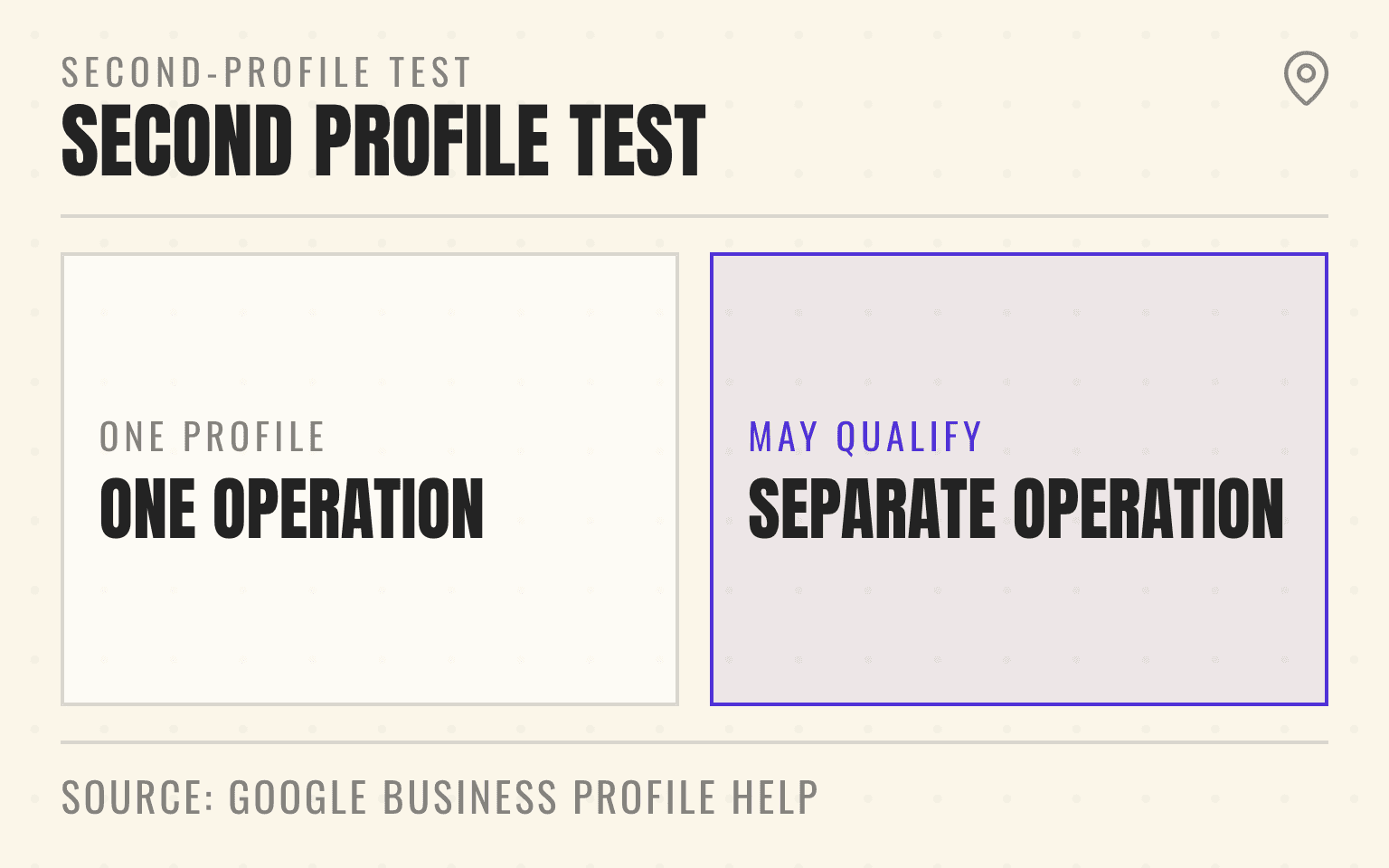
Second-profile test
A market boundary is not a location
One profile
One operation
- One staffed base
- One shared dispatch team
- One overlapping service area
- Extra services or city pages
May qualify
Separate operation
- Separate real location
- Separate staff
- Separate service area
- Independent operating evidence
Google Business Profile Help: Guidelines for representing your business on Google; checked September 2, 2026.
The answer does not depend on how many neighborhoods the company wants to reach. It depends on whether the second profile would represent a second eligible business operation.
Google allows a service-area business to have one profile for each real location when the locations have separate staff and separate service areas. Google also says a business should have only one profile per business location, and that an additional service is insufficient for another profile.
Important
A second Google Business Profile needs a second eligible operation. A new city, territory, service, phone number, mailbox, or landing page is not enough.
The short answer
A home service company can have multiple Google Business Profiles in one city when each profile represents a separate, staffed business location that independently meets Google's eligibility rules. For a service-area business, each base needs its own staff and service area. If customers do not visit the address, the profile should hide that address.
The same company should not create separate profiles for plumbing and drain cleaning from one shop, for north and south territories handled by the same dispatch team, or for a virtual office that only receives mail. Those are services and marketing boundaries, not separate business locations.
For a 20- to 500-location operator, this is a governance decision. Cheers' multi-location local SEO system connects eligible profiles to the location pages, review programs, citations, and measurement that each real branch can support.
Start with the business, not the city
Google's Business Profile representation guidelines say there should be only one profile per business. The same guidance gives service-area businesses a narrow path to multiple profiles: each real location must have separate staff and separate service areas.
That means a city is not the unit of eligibility. A business can operate two eligible locations inside one city. It can also cover 20 cities from one eligible base and still have only one profile.
Consider a Phoenix HVAC company with one staffed base, one dispatch team, and technicians who cover the whole metro. Splitting the territory into Phoenix North and Phoenix South does not create two business locations. Adding a second phone route does not change that.
Now consider the same company after it opens a second permanent base with its own branch manager, local technicians, equipment, dispatch responsibility, service area, and operating records. That second base may qualify for another service-area profile, even if both profiles name Phoenix as part of their coverage.
The profile should describe the operation the customer can actually reach. It should not describe the market share the company hopes to win.
Use a five-part eligibility test
Before anyone creates a profile, make the regional operator and marketing owner document five facts:
- Confirm that the business controls a durable operating base where the local team works. A postal address, registered agent, virtual office, or occasional meeting room is not an operating base.
- Identify the distinct staff who report to or work from the location. A technician who crosses an internal territory line does not become a separate branch staff.
- Map the separate, accurate service area owned by the base. The boundaries should match dispatch rules rather than a list of target keywords.
- Confirm that the business makes in-person contact with customers during stated hours, either at an eligible customer-facing location or by traveling from a service-area base.
- Assemble evidence of the location and the team's authority through permanent signage when required, tools, equipment, workspace, business documents, staff access, or other evidence Google requests.
Google chooses the available verification method. Its video verification guidance asks businesses to show the location, proof that the business exists, and proof that the person controls it. Service-area businesses may show work equipment, branded items, business documents, or an employee-only workspace. A profile plan that cannot survive that evidence review is not ready. Use the service-area video verification playbook to assign the local recorder, rehearse the one-take route, and keep private information out of frame.
What fails the eligibility test
Most bad second-profile proposals start with a reasonable growth goal and use the wrong local-search asset to pursue it.
A second city or franchise territory
A plumbing company may have one branch whose crews serve Glendale, Peoria, and Surprise. Google lets service-area businesses define accurate coverage by city, postal code, or another area type. Its service-area guidance allows up to 20 areas and recommends keeping the overall coverage within roughly two hours of driving time.
If the existing branch really covers those markets, the operator should update its service area and publish accurate market evidence. It should not create three profiles simply because customers search with three city names. The service-area coverage guide explains how the profile, market page, reviews, citations, and schema should support the same dispatch truth.
A second service line
One plumbing business does not qualify for separate plumbing, drain cleaning, water heater, and sewer profiles at the same location. Google's duplicate-profile guidance explicitly says multiple services from the same business do not warrant separate profiles.
Use the primary category, additional categories, services, and owned service pages to explain the work. If two operating brands truly remain distinct after an acquisition, evaluate the brand and location facts. Do not manufacture a second identity around a profitable keyword.
A mailbox, virtual office, or unstaffed yard
Google says a virtual office is not eligible unless the location is staffed by the business's team during stated hours. An unstaffed warehouse, mail suite, or coworking address does not become eligible because the company can receive a postcard there.
The virtual-office rules for home service companies separate an ineligible mailing address, a hidden-address service-area base, and the narrow staffed coworking exception before a team creates the profile.
Service-area businesses that do not receive customers at the address should hide it. The public profile can still show an accurate service area. Showing an address that is closed to customers makes the profile describe a storefront that does not exist.
Next step
Is AI recommending your business?
Find out how visible you are across ChatGPT, Gemini, Perplexity, and AI Overviews.
When two businesses share one address
Google can allow multiple profiles at one address when distinct, eligible businesses operate there. Its duplicate guidance points to separate business names and permanent signage as evidence that two businesses are not the same place duplicated.
This matters after acquisitions. A restoration platform may keep two acquired brands operating from one industrial yard. If each brand has a real public identity, separate staff or customer path, permanent signage, its own phone and website source, and a distinct operating role, each may qualify. If the buyer has combined the brands into one team with one public identity, keeping both profiles alive can create duplicate risk.
The legal entities alone do not settle the question. Two LLCs can represent one customer-facing business. One parent company can operate several genuine local brands. The profile decision should follow the real-world identity and location customers encounter.
The same distinction appears in med spa groups. Individual practitioners can sometimes qualify under Google's practitioner rules when they are public-facing and directly contactable at the verified location. The med spa practitioner Business Profile guide turns that exception into a location, access, page, and departure workflow. A practitioner profile is not a template for technicians, comfort advisors, or sales staff whose work belongs to the home service business.
Match the profile model to the way the branch operates
Google recognizes storefront, service-area, and hybrid businesses. The address settings should match the operating model.
A storefront receives customers at the location during stated hours. A hybrid business receives customers there and also travels to them. A pure service-area business travels to customers and hides its address.
Do not relabel a dispatch yard as a storefront to make it look more local or to enter a bulk-verification set. Google says profiles for 10 or more locations may use bulk verification, but duplicate, suspended, and disabled profiles do not count. Pure service-area locations can require individual verification. The bulk-verification guide for home service franchises covers that portfolio split.
For each proposed profile, write one sentence that a customer, local operator, and verifier would all recognize: "This profile represents the Tempe service base whose team handles HVAC repair across Tempe and Chandler." If the sentence instead describes a campaign, keyword, or territory with no accountable base, stop the creation request.
Build the website and phone path for the same branch
Eligibility is the first gate. A second profile also needs sources that identify the same local operation.
Google's representation guidelines ask service-area profiles to use a location phone number and website that represent the specific business location. Google Search Central separately recommends claiming the Business Profile, maintaining official business details, and adding accurate LocalBusiness structured data to the matching page.
Give each eligible branch a useful location page with its real service area, services, hours, phone path, operator, credentials, local proof, and booking route. Link the Business Profile to that page when it is the best customer destination. Keep the public business name consistent with the real-world brand.
Avoid solving the problem with a pile of near-identical city pages. Google's spam policy treats substantially similar city or regional pages that funnel users to one destination as doorway abuse. A real branch page should contain facts that change because the branch changes.
This source alignment also matters in AI search. Google's AI features guidance says Business Profile information can help local businesses appear in AI responses. It also says the normal Search fundamentals still apply. There is no separate AI loophole for an ineligible profile.
Run a 14-day pre-creation review
Treat another profile as a controlled location launch, even when the branch has existed for years.
- During days 1 to 3, name the operating base, branch owner, staff, service area, business model, public name, and reason another profile is needed. Compare the proposed record with every existing profile at the address and in the market.
- During days 4 to 7, verify the lease or ownership, signage plan when applicable, tools and equipment, staff access, phone routing, hours, website page, and customer handoff. Route uncertain duplicates through Google's process before creating anything.
- During days 8 to 10, review the profile name, categories, services, address visibility, service areas, phone, website URL, and business group. Have a local operator read the record back against real operations.
- During days 11 to 14, create and verify only the eligible profile. Test the live phone and page, record the public URL and ownership, and schedule a 30-day audit for edits, duplicate warnings, verification state, and source consistency.
If the team discovers two profiles that represent one business location, stop the launch and use the duplicate Business Profile cleanup workflow. If the proposed second base passes every gate, the company has a defensible profile tied to an operation it can maintain.
Sources
- Guidelines for representing your business on Google, Google Business Profile Help, no publication date. Checked September 2, 2026.
- Resolve duplicate profiles and ownership issues, Google Business Profile Help, no publication date. Checked September 2, 2026.
- Manage service areas, Google Business Profile Help, no publication date. Checked September 2, 2026.
- Business eligibility and ownership, Google Business Profile Help, no publication date. Checked September 2, 2026.
- Verify your business with a video recording, Google Business Profile Help, no publication date. Checked September 2, 2026.
- Verify Business Profiles in bulk, Google Business Profile Help, no publication date. Checked September 2, 2026.
- AI features and your website, Google Search Central, July 2026. Checked September 2, 2026.
- Spam policies, Google Search Central, August 2026. Checked September 2, 2026.
- Establish your business details with Google, Google Search Central, December 2025. Checked September 2, 2026.
Dylan Allen-Arnegård is the CEO & Co-Founder of Cheers, the local search platform for multi-location service businesses.