

Google's Business Profile guidelines say a virtual office where the business does not operate is ineligible. The page had no publication date when checked on September 2, 2026, and its coworking exception still requires signage, customer access, and the business's own staff.
Last verified: September 2, 2026.
Google's documentation says:
A virtual office that allows businesses to rent space at an address but doesn't operate out of the location is not eligible.
Location eligibility
A rented address is not a branch
Ineligible
Virtual office
- Mail or suite access only
- No business staff during stated hours
- No real customer operation
- Address exists for marketing
Eligible model
Real operation
- Business operates from the location
- Staff and evidence match the profile
- Address hidden if customers do not visit
- Service area matches dispatch reality
Google Business Profile Help: Guidelines for representing your business on Google; checked September 2, 2026.
That shortcut fails Google's stated eligibility test. Google says a rented physical mailing address where a business does not operate, also known as a virtual office, is not eligible for a Business Profile. A coworking office has a narrow exception only when the business maintains clear signage, receives customers there during business hours, and has its own staff there during those hours.
Home service companies do have a valid alternative. A plumbing, HVAC, roofing, pest control, electrical, or restoration business can use a real operating address for verification, hide that address when customers are not served there, and show the territory as a service area.
Important
A lease, mailbox, registered-agent address, or meeting-room reservation does not create an eligible branch. Approve a new profile only after the place, staff, customer-contact model, service area, and evidence describe one real operation.
For a portfolio with dozens of profiles, treat eligibility as the first gate in the multi-location local SEO operating system. Name, reviews, services, pages, and citations cannot make an ineligible location safe.
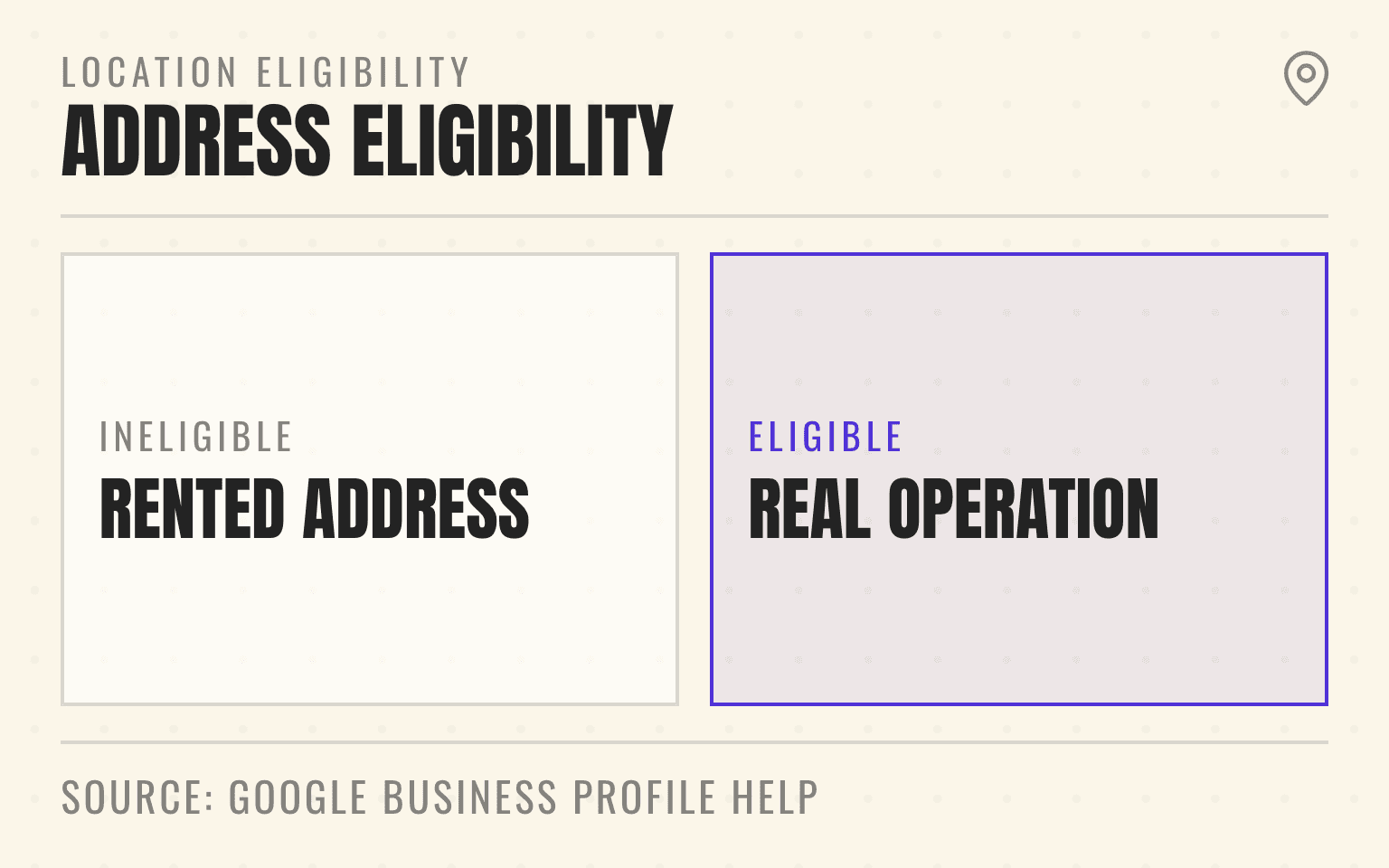
Google draws the line at real-world operations
Google's Business Profile rules separate three models that operators often blend together:
- A virtual office or remote mailbox is an address the company rents but does not operate from. Google says that location is not eligible.
- A service-area business travels to customers and does not serve them at its address. It uses a real base, hides the address, and publishes an accurate service area.
- A storefront or hybrid business receives customers at the location during stated hours. In a coworking space, Google also requires clear signage and staff from the business to be present during those hours.
The legal address, the payroll address, and the eligible Google location do not have to be the same concept. A roofing company may register its LLC through an agent, receive accounting mail at a corporate office, and dispatch crews from a warehouse. The profile should represent the real operation that meets Google's rules, not whichever address is easiest to rent.
Google's broader eligibility guidance says a business must make in-person contact with customers during its stated hours. Home services meet that requirement by traveling to customers. An online-only lead-generation site does not become eligible because it rents a suite number.
A hidden address is not a fake address
Operators sometimes hear "hide the address" and treat it as permission to use any address. Google makes a different distinction. The address can be hidden from customers, but the underlying place still needs to be real.
Consider an electrician who operates from a home workshop and visits every customer on site. If customers are not served at the home, Google says the business should remove the address from the public profile and show a service area. The address remains part of the verification record even though Maps does not display it.
Google lets a service-area business choose up to 20 cities, postal codes, or other supported areas. It says the overall boundary generally should not extend more than about two hours of driving time from the base. That is a coverage control, not a way to create extra locations.
The service-area coverage guide explains how the profile, location page, reviews, citations, and dispatch rules should describe the same markets. The hidden-address setting protects customers from being routed to a non-customer-facing base. It does not erase the need for operational truth.
A second profile needs a second operation
Multi-location operators should ask a harder question than "Do we have an address in this city?" The useful question is "What separate operation does this profile represent?"
An HVAC rollup may acquire a company with a staffed shop, its own technicians, equipment, local phone route, and defined service area. That is evidence of a separate branch. A roofing platform that rents one meeting room per month in a target city has an address, but it does not have a staffed operation there.
A restoration company may open a second equipment base with a branch manager and crews who start their shifts there. The operator still needs to choose the correct profile model. If customers do not visit, the address should be hidden. If the company wants to display the location as a storefront or hybrid business, it needs customer access, stated hours, permanent signage, and staff who can receive those customers.
Use the multiple Business Profiles eligibility guide before opening another profile in the same metro. Separate territories, services, phone numbers, and landing pages do not replace a separate base and staff.
Do not solve a coverage problem with an address
Virtual-office proposals usually start with a legitimate growth problem. The brand serves a city but has weak Maps visibility there. A franchise territory has no profile. A new acquisition wants leads before the facility opens. The wrong response is to turn a market target into a fake location record.
If one staffed plumbing branch covers three counties, publish the real service area on the profile and support it with useful market pages. Explain which branch handles the work, which services are available, how emergency calls are routed, and where the customer books. Do not create three profiles from mailboxes in the largest cities.
If a franchisee has sold a territory but has not opened an operating base, the profile launch is early. The team can prepare the location page, call path, profile inventory, verification owner, and evidence plan. The profile should wait until the business can satisfy the location model it claims.
This matters beyond Google Maps. Google says Business Profile information can appear in its AI experiences, but it does not create a separate AI eligibility path. An ineligible location is not durable local proof for Google Search, AI Mode, or any other system that reads the public record.
Next step
Is AI recommending your business?
Find out how visible you are across ChatGPT, Gemini, Perplexity, and AI Overviews.
Audit the portfolio before Google does
The safest portfolio review starts with the physical operation and works outward. Give one owner responsibility for a row that includes:
- The profile URL, Business Profile ID, store code, internal location key, public address state, and current service areas.
- The actual site type, daily staff, business hours, signage, customer access, equipment, phone route, and location page.
- The lease or ownership record, business registration, utility evidence, and other current documents available for verification or appeal.
- The relationship between the base and its crews, services, dispatch boundary, citations, reviews, and acquired-brand identity.
- A decision to keep the address visible, hide it, correct it, merge a duplicate, remove an ineligible profile, or prepare an appeal.
M&A should flag every acquired mailbox, home address, shared suite, coworking office, and closed facility before profile access changes. Operations should confirm where employees start work and which team owns the territory. Marketing should keep the profile and location page aligned with that answer. The agency should not create a location until the internal owner approves the eligibility record.
For video verification, rehearse only after the location model is settled. The service-area video verification playbook covers location, business, and management evidence without exposing private documents in the recording.
Fix eligibility before appealing a restriction
If Google restricts a profile that uses a virtual office, changing only the public wording is not enough. First decide whether the business has an eligible real base. If it does, correct the profile to that real operation and choose the right address visibility. If it does not, the company should not represent the target market as a separate location.
Google tells businesses to prepare appeal evidence before opening the evidence form. It lists business registration, licenses, tax certificates, and utility bills as examples, and says the business name and address on the documents should match the profile. Once the evidence form is opened after an appeal, Google gives 60 minutes to submit the files.
Google also says not to create another Business Profile for the same business while an appeal is under review. For appeals covering more than 10 profiles, its tool accepts a spreadsheet with evidence and the Business Profile ID for each location.
The multi-location suspension appeal guide covers the portfolio incident workflow. The virtual-office decision belongs before that workflow because an appeal packet cannot turn an ineligible address into a real branch.
Run a 30-day market-launch gate
Week 1: classify every proposed location
Name the base, staff owner, customer-contact model, service area, public address state, and reason the profile should exist. Reject any row whose only assets are a rented address, phone number, and landing page.
Week 2: inspect the operation
Have a local operator confirm where the team works, what equipment is stored there, how customers are served, which hours are real, and whether signage and customer access support a storefront or hybrid claim. Record the hidden-address decision for pure service-area locations.
Week 3: align the customer route
Build or update the location page, local phone path, services, hours, service area, citations, and booking route. The page should describe the branch that exists, not the market the company hopes to enter later.
Week 4: verify and read back
Create or correct only the profiles that passed the gate. Complete the verification method Google offers, then check the live record in Search and Maps. Record the public URL, ownership, phone destination, page destination, address visibility, service areas, and next review date.
Approve the operation before the map pin
The rule is simple enough for an investment committee or regional GM to use. If the company cannot point to the people, place, service work, customer-contact model, and evidence behind the location, it should not approve another Google Business Profile.
A hidden real address can support a legitimate service-area business. A displayed virtual address cannot manufacture a branch. Build the market around the operation, then let the profile describe it accurately.
Sources
- Guidelines for representing your business on Google, Google Business Profile Help, no publication date. Checked September 2, 2026.
- Manage service areas, Google Business Profile Help, no publication date. Checked September 2, 2026.
- Manage your business address, Google Business Profile Help, no publication date. Checked September 2, 2026.
- Business eligibility and ownership, Google Business Profile Help, no publication date. Checked September 2, 2026.
- Appeal Business Profile content and profile restrictions, Google Business Profile Help, no publication date. Checked September 2, 2026.
- AI features and your website, Google Search Central, July 2026. Checked September 2, 2026.
Dylan Allen-Arnegård is the CEO & Co-Founder of Cheers, the local search platform for multi-location service businesses.