

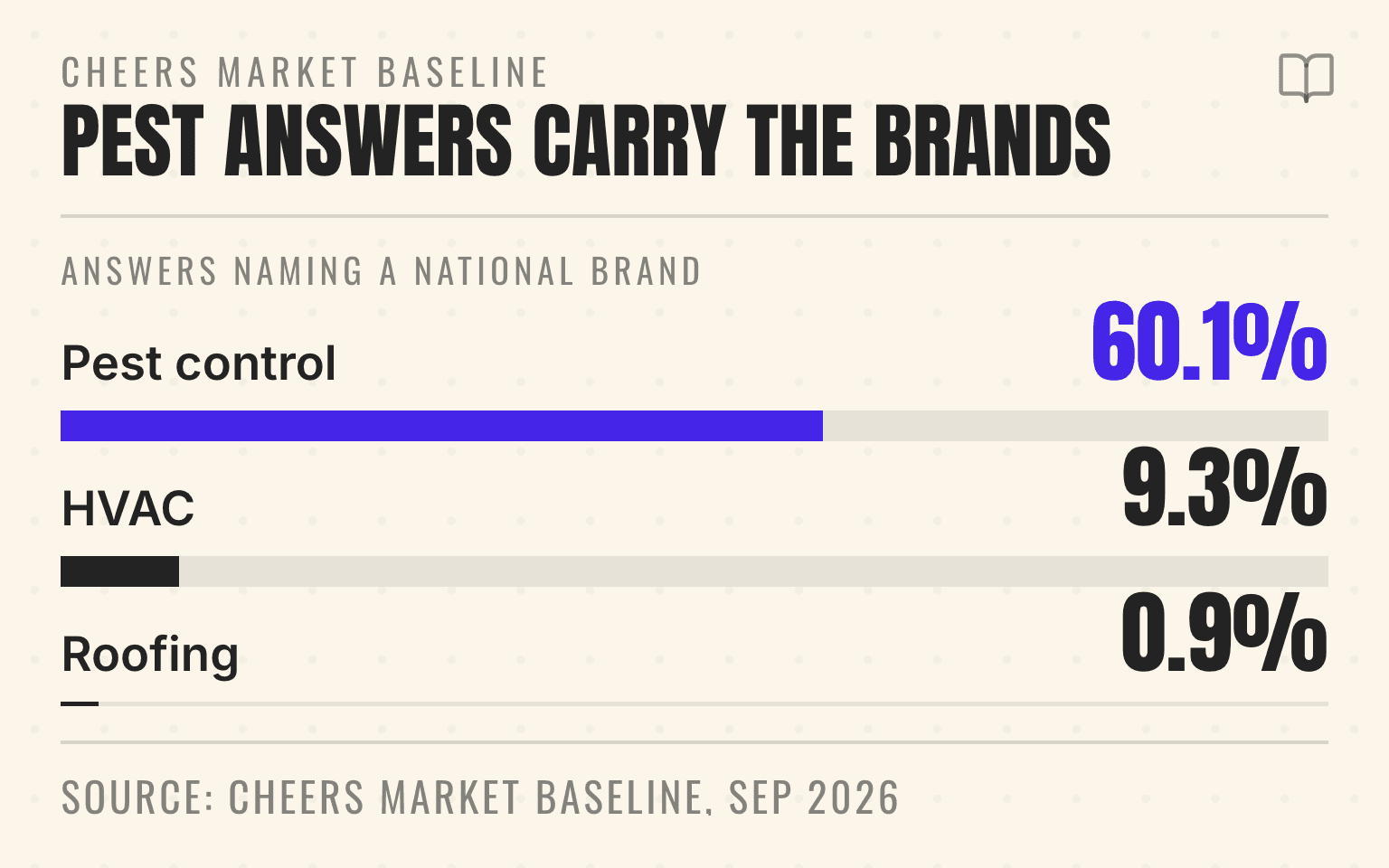
Pest control companies get recommended by ChatGPT for the places the national brands leave open, and that's most of them. On the question "who are the best pest control companies for home pest treatment?", 60.1% of answers from ChatGPT, Gemini, Perplexity and Google AI Mode named at least one national pest control brand, against 9.3% of answers on HVAC questions, yet those brands filled only 22.1% of the business names in the answers (Cheers Market Baseline, August 31 to September 20, 2026). Roughly three names in four went to regional and local companies, and the answers described them by their service plans, the pests they treat and how safe the treatment is around kids and pets.
Last verified: September 23, 2026.
That gives a local or regional pest company a clear target. You aren't trying to push the national brand out of the answer; you're trying to be one of the names beside it. Below is what the answers said, where they pulled it from, and one ChatGPT problem that hit pest control harder than any trade we can measure. If you run pest locations across several states, the free AI visibility check shows how one of them comes out on these engines.
Important
Pest control is one question in our data, asked every week in 100 metros: about 300 answers per engine, 1,193 in all. Read each figure as a finding about that question. We don't ask about termites, wildlife, mosquitoes or commercial accounts separately.
National brands take a fifth of the names, not the whole answer
The chart at the top shows how often a national franchise brand turned up in answers that named any business. Water damage restoration led at 69.4% and pest control came next at 60.1%, well ahead of garage door repair (40.6%) and plumbing (36.4%); HVAC sat at 9.3% and roofing at 0.9%. The roofing guide shows what a trade looks like with almost no national brand in the answers, and the restoration guide covers the one trade where brands showed up more often than in pest control.
The engines differed a lot. Perplexity put a national brand in 82.6% of its pest answers, Gemini in 68.2%, ChatGPT in 48.8% and Google AI Mode in 41.8%. Treat Perplexity's figure as the shakiest of the four, because our name extraction caught the fewest of its businesses. Across all four engines, a national brand was the first business named in 22.5% of pest answers.
For a national network, that means the brand name appears in 41.8% to 48.8% of answers on Google AI Mode and ChatGPT, as one name among several, and every location still has to carry its own reviews and page. Google's Business Profile rules help with the consistency part: "All locations must also have the same category if they provide the same service." A network whose locations sit on different primary categories for the same service is splitting its own evidence, and our guide to choosing Business Profile categories covers how to pick one.
The answers sell a plan
Pest control question
The answer sells a plan
Pest answers mentioning a recurring schedule or service plan
Quarterly service named in 43.3%
Cheers Market Baseline, August 31 to September 20, 2026: answers from ChatGPT, Gemini, Perplexity and Google AI Mode to 32 home-services questions in 100 US and Canadian metros. One question, about 300 answers per engine. Plan terms counted anywhere in the answer text on September 23, 2026.
| Engine | Share of answers |
|---|---|
| ChatGPT | 81.3% |
| Gemini | 76.3% (Quarterly service named in 43.3%) |
| Google AI Mode | 50.3% |
| Perplexity | 26.3% |
Pest answers read like plan comparisons. ChatGPT mentioned a recurring schedule or service plan (quarterly visits, bi-monthly service, a protection plan, a subscription) in 81.3% of its pest answers, Gemini in 76.3%, Google AI Mode in 50.3% and Perplexity in 26.3%. Gemini named quarterly service specifically in 43.3%.
Safety language was mostly a Google-engine theme. Gemini described treatments as pet-safe, family-safe, eco-friendly or similar in 71.0% of its pest answers and Google AI Mode in 64.0%, against 27.0% on ChatGPT. Guarantees were common too: ChatGPT mentioned a warranty or guarantee in 71.7% of its pest answers and Gemini in 78.7%. Prices mostly weren't there. ChatGPT put a dollar figure in 7.3% of pest answers and Google AI Mode in 3.7%.
One caveat before you use these: we counted any sentence that mentioned a plan, a guarantee or safety, general hiring advice included, so the rates describe the conversation, not the reasons an engine chose anyone. As a brief for a location page, they still work. Say which plans that location sells and how often a technician visits, what the re-service guarantee covers, which pests the plan includes and which cost extra, and how the team treats homes with pets and small children. A location that doesn't sell plans should say what it does instead, because silence on the topic leaves that part of the answer to whoever did write it down.
ChatGPT's map showed pest companies at their worst
ChatGPT map cards, September 18 to 22
Low ratings came in on Yelp cards
46.0%
ChatGPT pest answers with cards showing a company under 4.0 stars
Base: 100 ChatGPT pest answers with rated cards
10.6%
Named pest companies under 4.0 on ChatGPT cards
ChatGPT rated appearances
2.1%
Same measure on Google AI Mode
Google AI Mode rated appearances
28.1%
ChatGPT's Yelp-sourced pest cards under 4.0 (other cards 1.1%)
ChatGPT pest map cards
Cheers Market Baseline, August 31 to September 20, 2026: answers from ChatGPT, Gemini, Perplexity and Google AI Mode to 32 home-services questions in 100 US and Canadian metros. ChatGPT cards captured September 18 to 22, 2026; Google AI Mode cards August 31 to September 20. Yelp split counted September 23, 2026.
| Finding | Value | Base |
|---|---|---|
| ChatGPT pest answers with cards showing a company under 4.0 stars | 46.0% | 100 ChatGPT pest answers with rated cards |
| Named pest companies under 4.0 on ChatGPT cards | 10.6% | ChatGPT rated appearances |
| Same measure on Google AI Mode | 2.1% | Google AI Mode rated appearances |
| ChatGPT's Yelp-sourced pest cards under 4.0 (other cards 1.1%) | 28.1% | ChatGPT pest map cards |
From September 18 to 22, when we captured ChatGPT's map cards, 46.0% of its pest answers with cards showed at least one company under 4.0 stars. That's the highest rate of any trade with enough ChatGPT card data to publish; plumbing was next at 37.6%, then HVAC at 29.3%, roofing at 22.5% and electrical at 18.3%. Google AI Mode's cards looked nothing like that. Only 2.1% of the pest companies it named showed under 4.0 stars, against 10.6% on ChatGPT's cards.
Yelp accounts for most of the gap. About a third of ChatGPT's pest cards (35.7%) linked to Yelp, and 28.1% of those Yelp cards showed under 4.0 stars, against 1.1% of its other pest cards. Across every trade, 98% of ChatGPT answers that showed a sub-4-star card involved a Yelp card, and when we matched the same businesses in the same cities, their Yelp-sourced cards on ChatGPT averaged 4.3 stars against 4.9 on Google AI Mode. The rest of ChatGPT's cards landed within a tenth of a star of Google AI Mode's rating for 98% of the businesses we could match. Our guide to why ChatGPT shows a lower star rating than Google walks through that comparison across every trade.
You can't fix that with a Yelp review drive. Yelp's rule is plain: "Don't ask anyone to review your business, be it customers, mailing list subscribers, friends, family, etc." What you can do is claim every location's Yelp page, correct its hours and service area, and reply to its reviews in public. Then keep asking every customer for a Google review, since ChatGPT's non-Yelp cards tracked Google AI Mode's ratings almost exactly. Electricians had the fewest low-rated cards of any trade we can publish, and the electrician guide shows what their review picture looked like instead.
Next step
Is AI recommending your business?
Find out how visible you are across ChatGPT, Gemini, Perplexity, and AI Overviews.
Where pest answers land on your site
When the engines cited a pest control company's own website, 54.4% of those citations went to location pages or pages naming both the service and the city, and 37.9% went to the homepage. For roofing, the homepage drew 67.7%. In pest control, the location page is the one to fix first.
Google AI Mode also cited government or licensing sites in 12.7% of its pest answers, against 1.3% of its answers across all 32 questions. We didn't classify those pages further, so I won't claim what they were. The licensing behind the trade is real, though. The EPA says "Federal law requires any person who applies or supervises the use of restricted use pesticides (RUPs) to be certified," and notes that many states require certification for every commercial applicator. For pest control, Google's Local Services Ads screening wants general and professional liability insurance and, where the state requires them, business and owner licenses.
The answers mentioned licensing less often than you'd expect: in 13.7% of ChatGPT's pest answers, 14.0% of Google AI Mode's and 23.5% of Perplexity's. A license number sitting next to the service area on each location page costs nothing to add, and it gives the answer a fact it rarely brings up on its own.
The lists ChatGPT reads for pest control
Expertise.com led ChatGPT's pest citations, showing up in 52.7% of its answers, ahead of Angi or HomeAdvisor (30.3%) and BBB (24.3%); a pest company's own site appeared in 43.0%. Perplexity cited Angi or HomeAdvisor in 41.6% and Expertise.com in 40.6%. Google AI Mode cited company websites in 93.3% of its pest answers, plus Thumbtack in 12.7% and Yelp in 12.3%.
Booking links barely figured. Only 5.0% of Google AI Mode's pest answers linked to an online booking page, against 39.4% for plumbing, so the plan details on the page matter more than the booking button on the profile.
A week's work for a pest network
Start with five locations, not fifty. The point of the first week is to see the answer your customers see and fix the pages behind it.
- Pick five locations and run the pest question in ChatGPT and Google AI Mode for each city, noting which national brand appears and which local names sit beside it.
- On each of those location pages, publish the plans the location sells, the visit frequency, the re-service guarantee, the pests covered and the state license number.
- Claim and correct each location's Yelp page and reply to its reviews, without asking anyone for a Yelp review.
- Put every location that sells the same service on the same primary Business Profile category.
The Cheers home services program tracks this location by location across portfolios that run pest, HVAC, plumbing and other brands, with review requests tied to the technician who did the visit.
Methodology
Every week, Cheers asks ChatGPT, Gemini, Perplexity and Google AI Mode the same 32 home-services questions in 100 metro areas across the United States and Canada, and records every business each engine names, with its star rating, review count and map position where the engine shows one, and every source it cites. This analysis covers the three weeks from August 31 to September 20, 2026: 34,742 usable answers (9,434 from ChatGPT, 9,435 from Google AI Mode, 9,364 from Gemini and 6,509 from Perplexity) across 60 US and 40 Canadian metros. We excluded empty or cut-off answers, most of them from a Perplexity collection outage. Each question was asked once per city per week, so week-to-week changes include normal answer-to-answer variation. Business names were extracted automatically; a hand check of 40 answers found the extraction caught about three in four of the businesses a reader would count, so counts are lower bounds. Star ratings and review counts are the figures each engine displayed; for ChatGPT and Gemini we captured them from September 18 and September 14 onward. Findings describe associations in this sample, not how any engine ranks businesses.
Pest control is one of the 32 questions: "who are the best pest control companies for home pest treatment?" It drew 300 answers each from ChatGPT, Google AI Mode and Gemini and 293 from Perplexity. Google AI Mode's rating figures cover 1,209 rated appearances in 270 answers, and ChatGPT's cover 584 in 100 answers from September 18 to 22; Gemini's pest card data was too thin to publish. National brands are counted from an internal list and never named, and answers that mention a brand only to warn against it still count, so brand shares lean high. The plan, quarterly and safety mention rates and the Yelp split of ChatGPT's pest cards are extra counts we ran on September 23, 2026 over the same answers with the same exclusions. How the Market Baseline works is on our research methodology page.
Sources
- Cheers Market Baseline, Cheers-owned organization, 34,742 usable answers from four AI engines, August 31 to September 20, 2026. Source of every pest control and cross-trade figure above. Method: research methodology.
- Don't Ask for Reviews. Yelp Support Center, undated, checked September 23, 2026. Source of the quoted rule against asking for reviews.
- How to Get Certified as a Pesticide Applicator. US Environmental Protection Agency, last updated March 11, 2026, checked September 23, 2026. Source of the quoted certification requirement and the note on state rules.
- Guidelines for representing your business on Google. Google Business Profile Help, undated, checked September 23, 2026. Source of the quoted category consistency rule.
- Business screening and verification requirements, United States. Google Local Services Help, undated, checked September 23, 2026. Source of the pest control license and insurance requirements.
Dylan Allen-Arnegård is the CEO & Co-Founder of Cheers, the local search platform for multi-location service businesses.