

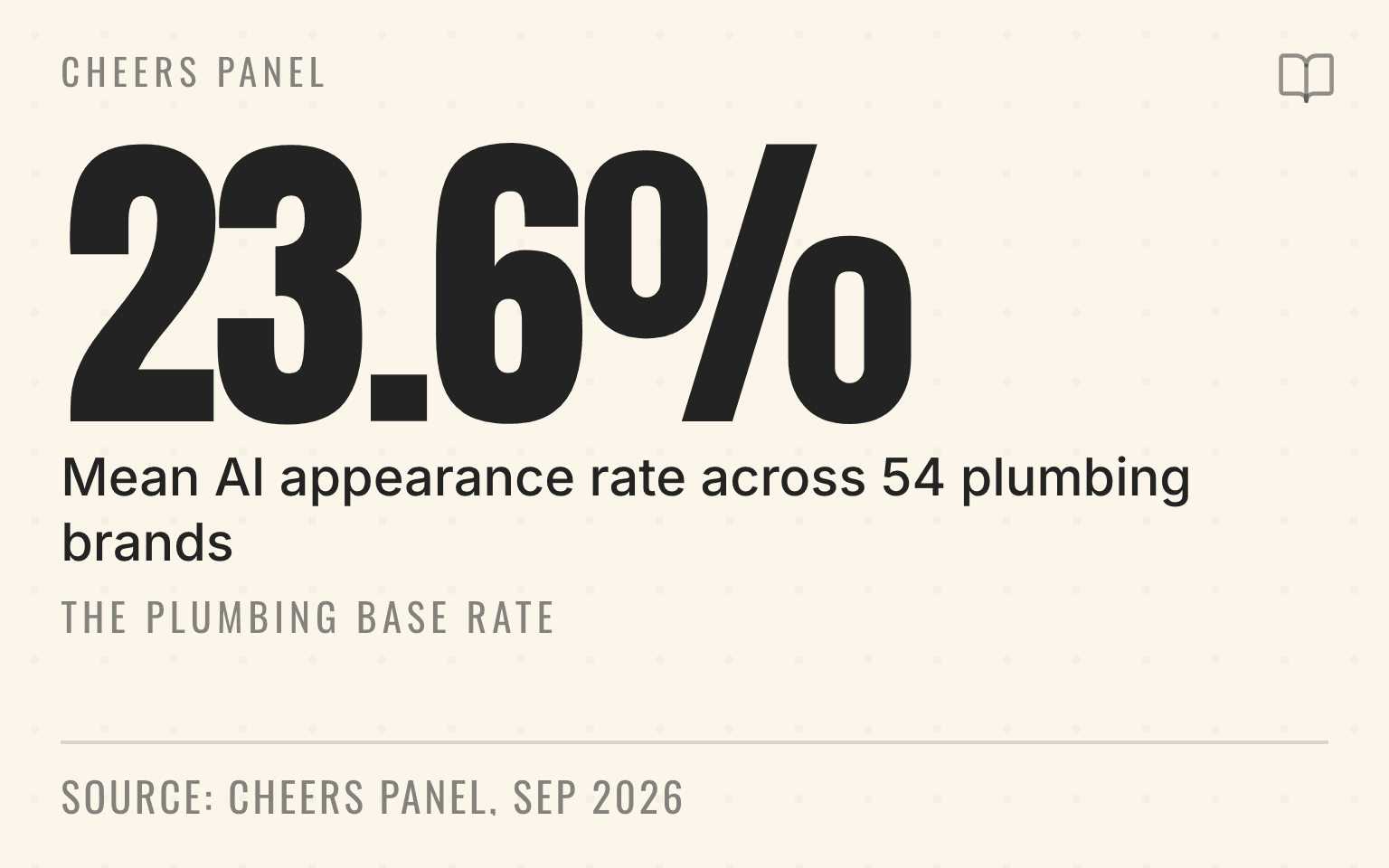
The 54 plumbing organizations in the Cheers panel appeared in a mean 23.6% of their tracked AI runs over the 28 days ending September 2, 2026, with a median of 21.5% and a citation rate of 19.5%. Aggregate across 119 home-services organizations, no customer named. That is the base rate a plumbing brand is arguing with.
A homeowner with a sewer backup, a clogged drain, or a dead water heater is not running a research project. They ask one question, often in one tool, and hire fast. Plumbing companies get recommended by ChatGPT when public sources make that fast decision safe: the right market, the right job, and enough recent proof to trust. Method behind the figures above is in the home-services AI visibility index and the methodology.
The Cheers plumbing solution is built for that market-level evidence loop: Google reviews, employee attribution, location and service proof, profile accuracy, citations, and AI visibility tracking.
Plumbing recommendations are urgent
A plumbing answer has to resolve three things quickly: does this company serve the market, does it handle the specific job, and is there enough recent public proof to trust it?
That means generic reputation is not enough. A brand can have plenty of reviews and still look weak for emergency drain cleaning if the market page, reviews, citations, and third-party profiles do not mention that work. A parent brand can look strong while one local market is thin.
For plumbing, prioritize the jobs customers search under pressure: drain cleaning, sewer backup, leak repair, water heater repair, camera inspection, repipe work, fixture repair, emergency plumbing, and same-day availability where true.
What AI checks before recommending a plumber
Plumbing recommendations usually depend on urgency plus proof. The source trail should answer five checks quickly.
- Can this company handle the emergency here? The market, hours, dispatch rule, and phone path should be clear.
- Does it handle the exact job? Drain cleaning, sewer backup, leak repair, camera inspection, and water heater work should not blur together.
- Do recent reviews describe the job? Specific customer language is more useful than generic five-star volume.
- Do third-party sources agree? Yelp, BBB, Bing-visible directories, and industry profiles should reinforce the same market and service facts.
- Can a manager improve the miss? If a prompt skips one market, the owner should know whether the fix is reviews, page proof, profile data, or citations.
That is why plumbing review generation and AI visibility should sit in the same operating loop. Cheers review generation creates the service-moment proof; Cheers AI visibility tracking shows where that proof is or is not being used.
Build the source trail
The source trail should make the local operation obvious. The Google Business Profile should match the service area, categories, hours, phone path, and review pattern. The market or location page should explain the services, proof, booking path, and dispatch reality. Citations and directories should not contradict the name, phone, market, or services.
OpenAI's crawler documentation matters here because access comes before evidence:
Sites that are opted out of OAI-SearchBot will not be shown in ChatGPT search answers, though can still appear as navigational links.
OpenAI also notes it can take roughly 24 hours after a robots.txt change for its systems to adjust, so this is a check to run before a campaign, not during one. Google's side is equally plain: "Businesses with complete and accurate info are more likely to show up in local search results." Normal Search foundations still shape AI visibility, which means useful content, crawlability, visible text, structured data that matches the page, and complete local information.
Plumbing is also the trade where the owned page carries the most weight. Across the Cheers Market Baseline over the 28 days ending September 2, 2026, plumbing prompts produced 100,465 classified citations: 75.2% went to contractor and franchise websites, the highest share of any trade we measured, against 19.5% to directories and 3.1% to Google properties. Roofing, by comparison, sent 30.1% of its citations to directories. For a plumbing brand, a thin market page is the expensive problem; the directory profile is the cheap one.
Cheers Market Baseline
Plumbing leans on your page
75.2%
Plumbing
Contractor and franchise website share of citations, plumbing against other trades
100,465 citations
108,878 citations
9,971 citations
72,097 citations
22,071 citations
Cheers Market Baseline, 28 days ending September 2, 2026: 32 home-services prompts in 100 metro service areas on four engines, 356,019 classified citations. Method at cheers.tech/research/methodology.
| Trade | Business-site share of citations |
|---|---|
| Plumbing | 75.2% (100,465 citations) |
| HVAC | 71.6% (108,878 citations) |
| Restoration | 70.3% (9,971 citations) |
| Electrical | 69.8% (72,097 citations) |
| Roofing | 63.2% (22,071 citations) |
For the Google-specific operating plan, use Google's AI Search Playbook for Plumbing Companies. It translates Google's current Search and Business Profile guidance into service, location, proof, and 30-day execution decisions for plumbing teams.
What Sources Does ChatGPT Use to Give Recommendations? covers the broader source question. For plumbing, the practical standard is tighter: every important market should have enough public evidence to answer the urgent job.
Restoration brands need a related but loss-specific source trail. The restoration ChatGPT recommendation guide separates water, fire, mold, storm, and commercial proof by market.
Next step
Is AI recommending your business?
Find out how visible you are across ChatGPT, Gemini, Perplexity, and AI Overviews.
Reviews should describe the job
Plumbing review language should not be scripted. The request should stay neutral and compliant. But after reviews exist, the company should read the themes that customers naturally mention.
If customers repeatedly mention sewer backups, cleanup, same-day service, dispatch clarity, camera inspections, water heaters, or courteous technicians, those themes should inform location and service pages. Turn reviews into AI search content explains how to do that without misusing testimonials or review schema.
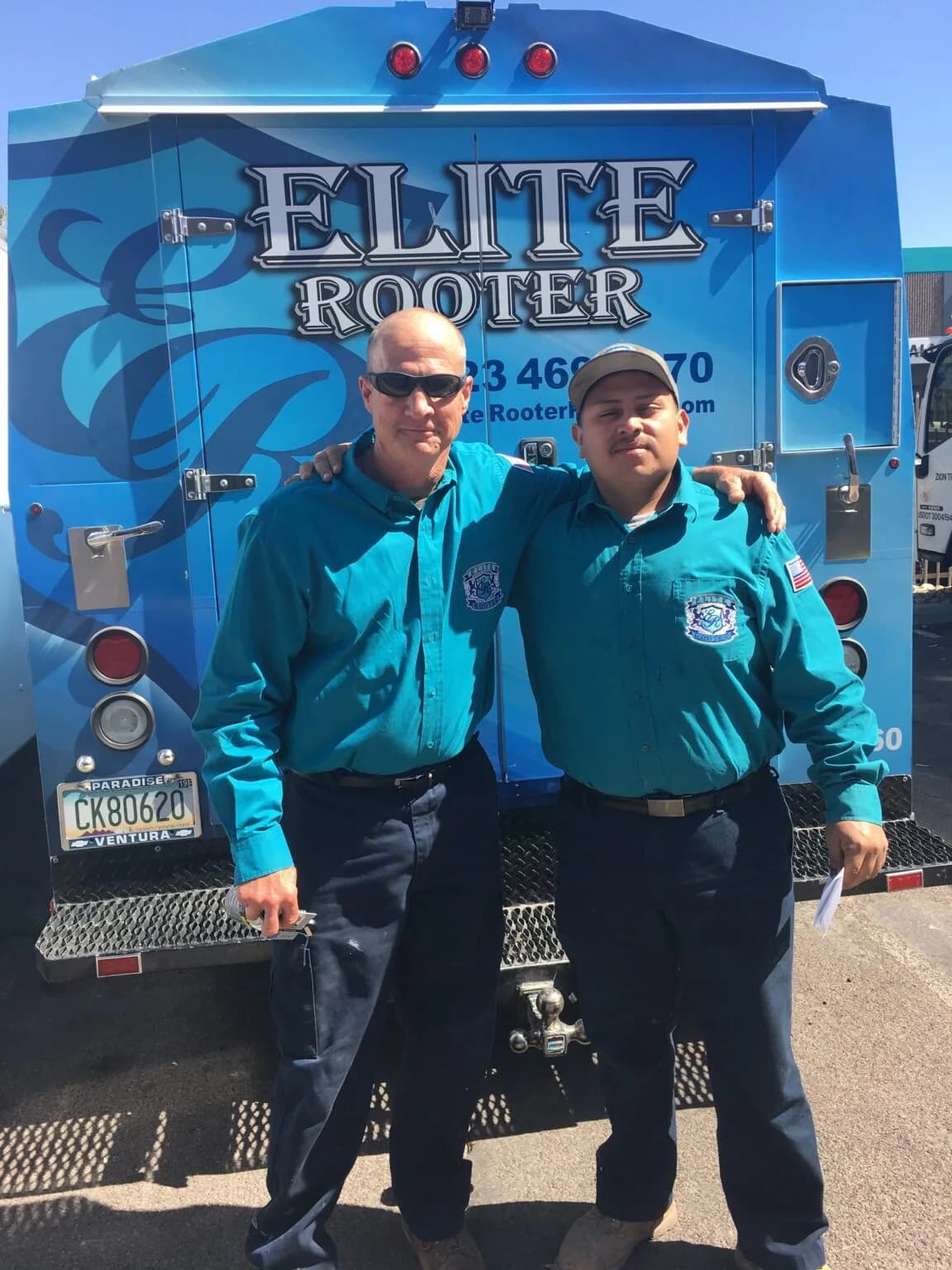
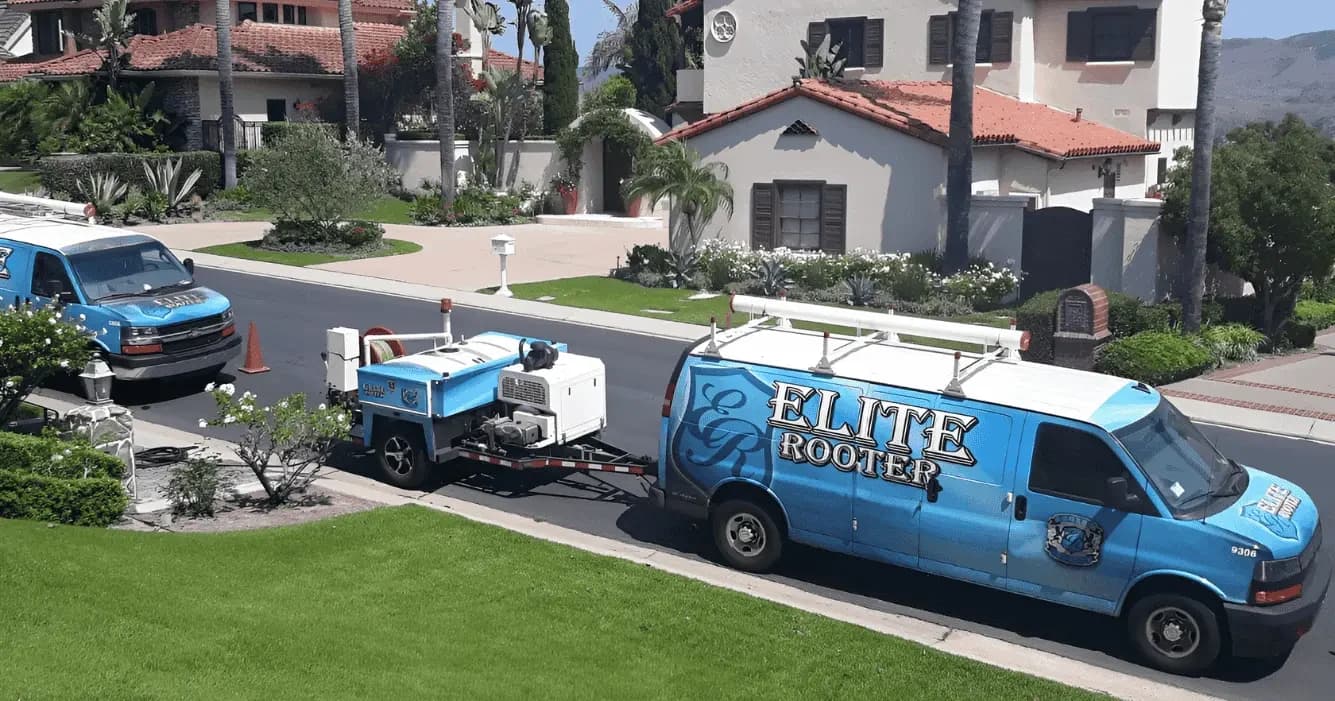
Elite Rooter is the public proof example. The Elite Rooter case study reports 12 active local markets, 11,546 active Google reviews, 107 active employee cards, 1,083 taps, and 16,435 AI visibility checks in the June 2026 proof window.
Track market prompts
The tracking set should mirror plumbing demand. A useful prompt set might include emergency plumber, drain cleaning, sewer backup, water heater repair, leak repair, and camera inspection by market.
Each run should record the provider, prompt, market, competitors, cited sources, answer text, and owner. If the answer cites a directory, inspect that directory. If it cites a competitor's sewer page, inspect the page. If it names a competitor because the local reviews are stronger, fix the review workflow.
For plumbing, the miss is usually concrete. The page is thin, the market is unclear, the profile is stale, the review language is weak, or a third-party source is stronger than the owned page.
If you want to test urgent plumbing prompts by market, use the demo action below with the drain, sewer, water heater, leak, and emergency jobs you care about. If the open question is whether to keep this with an agency, Cheers compared with an SEO agency lays out the split of work.
Sources
Every link below was opened and checked on September 2, 2026.
- Overview of OpenAI crawlers. OpenAI Platform documentation. Checked September 2, 2026. platform.openai.com/docs/bots. Source of the quoted OAI-SearchBot opt-out consequence and the roughly 24-hour robots.txt adjustment window.
- Tips to improve your local ranking on Google. Google Business Profile Help. Undated help page, checked September 2, 2026. support.google.com/business/answer/7091. Source of the quoted line on complete and accurate business information.
- Google's guide to optimizing for generative AI features on Google Search. Google Search Central. Last updated July 10, 2026, checked September 2, 2026. developers.google.com/search/docs/fundamentals/ai-optimization-guide. Supports the Search foundation behind AI visibility.
- Home Services AI Visibility Index 2026. Cheers Research. Cheers panel and Market Baseline, 28 days ending September 2, 2026, 119 home-services organizations, aggregate only. cheers.tech/research/home-services-ai-visibility-index-2026. Source of the plumbing appearance, citation, and source-mix figures.
- Elite Rooter case study. Cheers. Checked September 2, 2026. cheers.tech/proof/elite-rooter. Source of the June 2026 proof-window figures quoted here.
Last verified: September 2, 2026.
Dylan Allen-Arnegård is the CEO & Co-Founder of Cheers, the done-for-you platform that manages the website, reviews, listings, structured data, and local content that get service businesses recommended across Google, Maps, ChatGPT, and Perplexity.