

Restoration is the loss type where third-party listings carry the most weight. In the Cheers Market Baseline for the 28 days ending September 2, 2026, the water damage restoration prompt drew 9,971 citations across 100 metro service areas and four engines, and 24.9% of them came from directories and review platforms. On plumbing prompts in the same window the directory share was 19.5%. A restoration brand that only fixes its own website is leaving a quarter of the cited evidence to somebody else.
There is no direct submission form, hidden schema field, or review count that guarantees placement either. OpenAI's crawler documentation describes OAI-SearchBot as the agent "used to surface websites in search results in ChatGPT's search features", and that is the whole published mechanism. What a restoration company can control is whether current public sources make one fact pattern easy to verify: this team serves this market, handles this loss type, and can support the claims it makes.
Restoration market pages
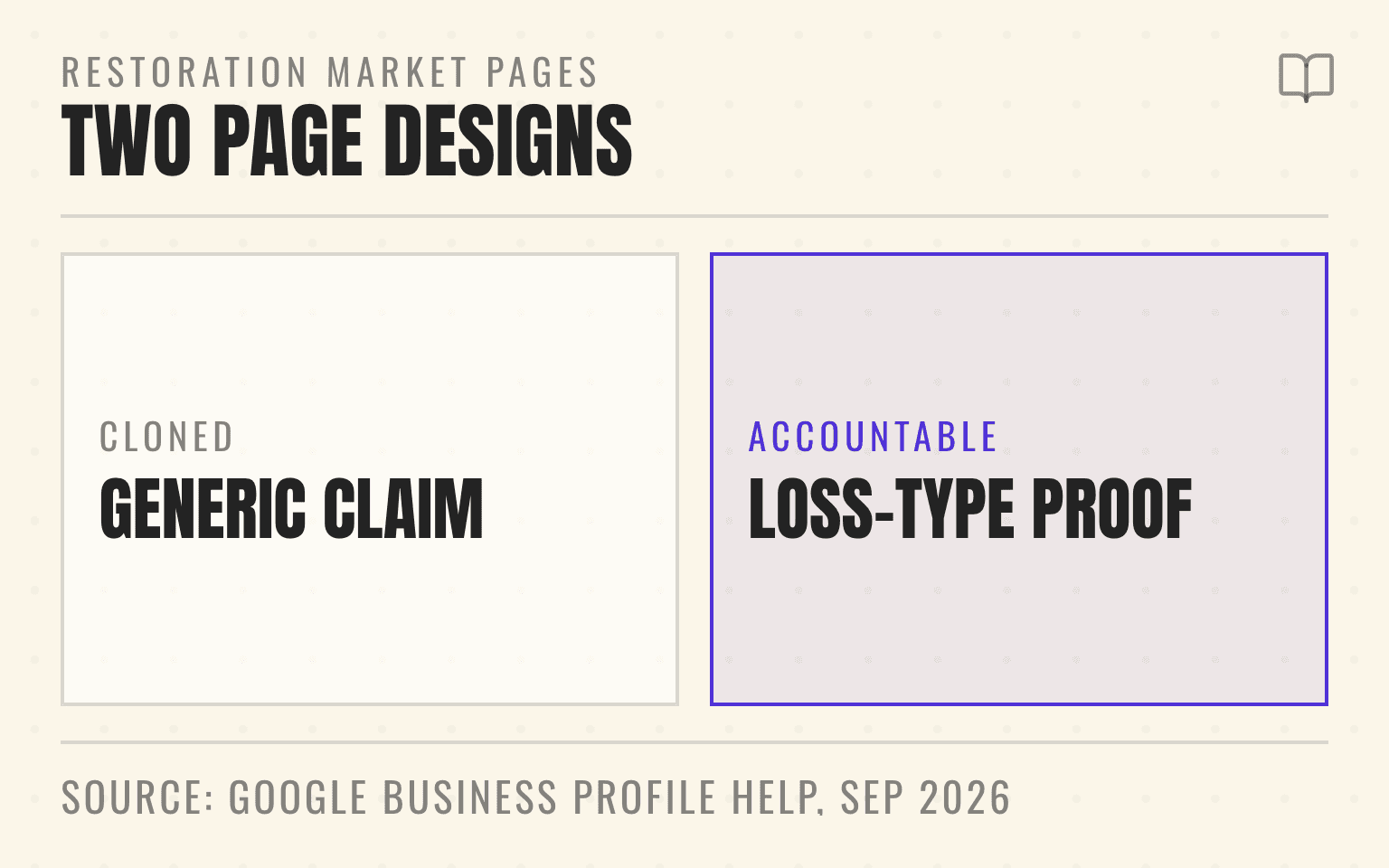
Cloned page or loss proof
Cloned across 80 cities
Generic restoration page
- One water-damage paragraph, city name swapped
- 24-hour claim with no dispatch behind it
- Whole-state coverage, no boundary
- Credentials attributed to the parent brand
One accountable market
Loss-type market page
- Water, fire, mold, storm scoped separately
- Response boundary the branch can honor
- Up to 20 specific service areas, per Google
- Licences named against the operating entity
Article body; service-area rules from Google Business Profile Help, Manage your service areas (support.google.com/business/answer/9157481), checked September 2026.
That distinction matters for a restoration platform with 20, 50, or 200 markets. The job is not to make the parent brand sound generally authoritative. It is to build a public evidence trail for water damage, fire and smoke cleanup, mold remediation, storm response, and commercial losses in every market the company can actually serve.
Important
ChatGPT recommendations are outputs to measure, not rankings a restoration company can claim or guarantee. Build verifiable market evidence, then test whether it appears.
Start with what ChatGPT can verify
ChatGPT search links to sources on the web, and geography is an explicit input. OpenAI's web search documentation says: "To refine search results based on geography, you can specify an approximate user location using country, city, region, and/or timezone." The sources selected can change from one answer to the next, which is why a single screenshot proves very little.
That makes a prompt such as "who should I call for water damage restoration near me?" more demanding than a branded search. A useful answer has to resolve the loss type, market, availability, and credible local operator. A national homepage rarely answers all four.
The ChatGPT source guide explains the wider retrieval model. For restoration operators, the practical translation is simple: owned pages and outside profiles should agree on the branch, service area, service lines, and customer path.
The Cheers visibility platform tracks that source trail by market, including prompts, providers, recommendations, competitors, and citations.
Create one market evidence record
Before publishing new pages, give operations and marketing one approved record for each real market. This is the reference used to reconcile the website, Business Profile, review sites, industry listings, call routing, and future AI visibility checks.
The record should include:
- Public business name, branch or dispatch base, service area, local phone route, and hours
- Water, fire, mold, storm, contents, reconstruction, and commercial capabilities that the team actually performs
- Emergency-response language that dispatch can honor, without turning an aspiration into a public promise
- Applicable licenses, insurance, certifications, and the location or legal entity they belong to
- A canonical market page, its booking or call action, and an operating owner who can correct stale facts
- Recent job proof, customer language, and third-party profiles that support the market and loss types
- The markets, services, or claims the location must not publish because the operation cannot substantiate them
This is especially important after an acquisition. The portfolio may inherit a strong local name, a separate call center, old franchise pages, duplicate profiles, and review records under several legal entities. ChatGPT cannot reconcile an integration plan that the public web still contradicts.
Make each real market page useful under pressure
A restoration market page should help someone facing an active loss. It needs a clear service area, phone path, truthful availability, loss types, expected first steps, credentials, proof, and the branch or team responsible for the response. The location-page checklist covers the broader multi-location standard.
Avoid copying the same water-damage paragraph across 80 city pages. A useful Phoenix page might explain monsoon-related water intrusion, commercial drying capacity, local response boundaries, and the team that receives the call. A Columbus page may have different storm, freezing, or property-management proof. If there is no meaningful local difference and no accountable operating owner, the page is probably a doorway page rather than evidence.
Service-area businesses also need a consistent coverage model, and Google's rule is short: "If you don't serve customers at your business address, remove your address from your Business Profile." Google also caps the list, "You can have up to 20 service areas", and asks operators to "be as specific and accurate as possible". None of that is a ChatGPT ranking factor. All of it is a durable standard for publishing honest local facts, and 20 is a useful ceiling for a restoration brand tempted to claim a whole state. The service-area coverage guide shows how to apply it without inventing storefronts or market reach.
Make profiles and reviews agree with the job
OpenAI does not publish a complete list of sources used for every local answer. Do not tell a branch manager that Google Business Profile, Yelp, BBB, or an industry directory is a guaranteed ChatGPT input.
Do make the important public sources accurate. Google requires a business to use its real-world name, precise address or service area, accurate hours, and a direct phone and website for the location. If a restoration brand claims 24-hour emergency service on one page while the local profile, call route, and recent reviews point somewhere else, the customer has an evidence conflict before an AI system does.
Reviews add a different kind of proof. They can show whether customers naturally describe water extraction, drying equipment, smoke cleanup, containment, communication, documentation, and the actual market served. Do not script that language or gate review requests. Read the themes after legitimate reviews exist, then use them to find missing service answers and operating gaps.
Yelp said in August 2026 that ChatGPT users can reach "Yelp's trusted reviews, ratings, photos, and business details directly within the chat experience". That is evidence a major local review corpus is reachable inside ChatGPT. It is not proof that Yelp controls a restoration recommendation, and the announcement itself is about restaurant reservations and waitlists rather than restoration dispatch. Review quality, profile accuracy, and owned-page evidence still have to be managed separately.
Next step
Is AI recommending your business?
Find out how visible you are across ChatGPT, Gemini, Perplexity, and AI Overviews.
Separate proof by loss type
"Restoration" is too broad for many customer questions. A company may be excellent at residential water mitigation and lack the equipment, certification, or staffing for large commercial fire losses. The public evidence should preserve those differences.
For water damage, publish the response boundary, extraction and drying scope, equipment and monitoring process, documentation expectations, and market-level job proof. For mold work, explain containment, assessment boundaries, local licensing or protocol requirements where applicable, and when a separate environmental professional is involved. For fire and smoke work, distinguish emergency board-up, soot and odor cleaning, contents handling, and reconstruction.
The EPA's advice to anyone hiring a mold remediation contractor is to "make sure they have experience cleaning up mold, check their references". That is not an AI ranking signal. It is a useful editorial test: can the market page help a cautious customer verify who will do the work and what the operator is qualified to claim?
Let search crawlers reach the evidence
OpenAI's crawler documentation keeps the two decisions apart: "Each setting is independent of the others, for example, a webmaster can allow OAI-SearchBot in order to appear in search results while disallowing GPTBot." GPTBot exists "to crawl content that may be used in training our generative AI foundation models". Deciding one does not decide the other.
Check robots.txt, page-level noindex rules, canonical tags, server responses, and any firewall rules that affect the canonical market and service pages. One timing note from the same page: "For search results, please note it can take ~24 hours from a site's robots.txt update for our systems to adjust." OpenAI publishes its crawler IP ranges, so a security team can verify allowlists without opening private portals or customer records.
Crawler access is a prerequisite, not an optimization strategy by itself. A reachable page can still be thin, stale, or contradicted by stronger sources. Use the AI crawler guide to separate search discovery, training controls, and agent access.
Measure the recommendation by market
One brand prompt is not a visibility program. Test a stable set that matches real customer demand, such as water damage restoration, fire damage cleanup, mold remediation, storm damage, commercial restoration, and emergency response, paired with priority markets.
Record the provider, date, prompt, recommended companies, cited sources, correct branch, and owner for each gap. If a directory is cited with the wrong phone, fix the directory. If a competitor's loss-specific page is cited, compare the evidence. If the correct branch appears but the call routes to another market, treat it as a conversion failure.
ChatGPT referral sessions carry their own source parameter, which makes them separable in analytics. Keep that traffic apart from visibility checks, qualified calls, booked jobs, and revenue. A citation is not a lead, and a lead is not a completed restoration job.
That market-by-market readout should still connect each miss to the operating work behind it.
Use a 30-day operating plan
- Week 1: Select five priority markets and approve one market evidence record for each
- Week 2: Repair the canonical market pages, local phone paths, coverage, services, and credential claims
- Week 3: Reconcile Google Business Profile, Yelp, priority citations, reviews, robots rules, and canonical signals
- Week 4: Run the same service-and-market prompts, inspect cited sources, assign gaps, and connect referral traffic to qualified outcomes
Do not expand to the full portfolio until the first five markets survive a public readback. The result should be boring in the best way: one real team, one accurate market record, useful service proof, reachable pages, and outside sources that repeat the same facts.
Sources
Every link below was opened and checked September 2, 2026.
- Overview of OpenAI crawlers. OpenAI developer documentation, checked September 2026. Source of the quoted OAI-SearchBot and GPTBot descriptions, the independence of the two robots.txt settings, and the roughly 24-hour adjustment window.
- Web search tool. OpenAI API documentation, checked September 2026. Source of the quoted approximate user location fields.
- Guidelines for representing your business on Google. Google Business Profile Help, checked September 2026. Source of the real-world name, address or service area, hours, phone, and location-website requirements.
- Manage your service areas for service-area and hybrid businesses. Google Business Profile Help, checked September 2026. Source of the three quoted rules: remove the address, up to 20 service areas, be specific and accurate.
- Optimizing your website for generative AI features on Google Search. Google Search Central, last updated July 2026. Source of the crawlable people-first standard and of the absence of AI-only markup requirements.
- Mold remediation in schools and commercial buildings, chapter 1. United States Environmental Protection Agency, checked September 2026. Source of the quoted contractor-selection advice.
- Yelp brings reservations and waitlist to ChatGPT. Yelp Official Blog, August 10, 2026. Source of the quoted description of Yelp content inside the ChatGPT experience.
- Cheers Research methodology and the Home Services AI Visibility Index 2026. Cheers Market Baseline, 28 days ending September 2, 2026: the water damage restoration prompt across 100 metro service areas and four engines, 9,971 classified citations, aggregate only. Source of the restoration and plumbing directory shares quoted above.
Three OpenAI help-center pages and one Axios report cited in the earlier version could not be opened for verification on September 2, 2026. Their claims were moved to OpenAI documentation and a Yelp announcement that were opened and quoted directly.
Amadeus Peterson is the CTO & Co-Founder of Cheers, the local search platform that helps multi-location service brands track recommendations, cited sources, reviews, and location-level visibility across Google and AI search.