
Google's guide to generative AI features, last updated July 10, 2026, sets one hard gate before any of the advice matters: "To be eligible to be shown in generative AI features on Google Search, a page must be indexed and eligible to be shown in Google Search with a snippet, fulfilling the Search technical requirements." Everything below that line is about being useful, not about a plumbing-only ranking trick, because Google publishes no such thing.
The customer side is just as plain. A homeowner asking Google about a leaking water heater wants to know who can help nearby, how fast they can get there, and whether they have handled that equipment before. Each location has to explain the work it can actually do, real job evidence has to support the claim, and the Google Business Profile has to agree with the website.
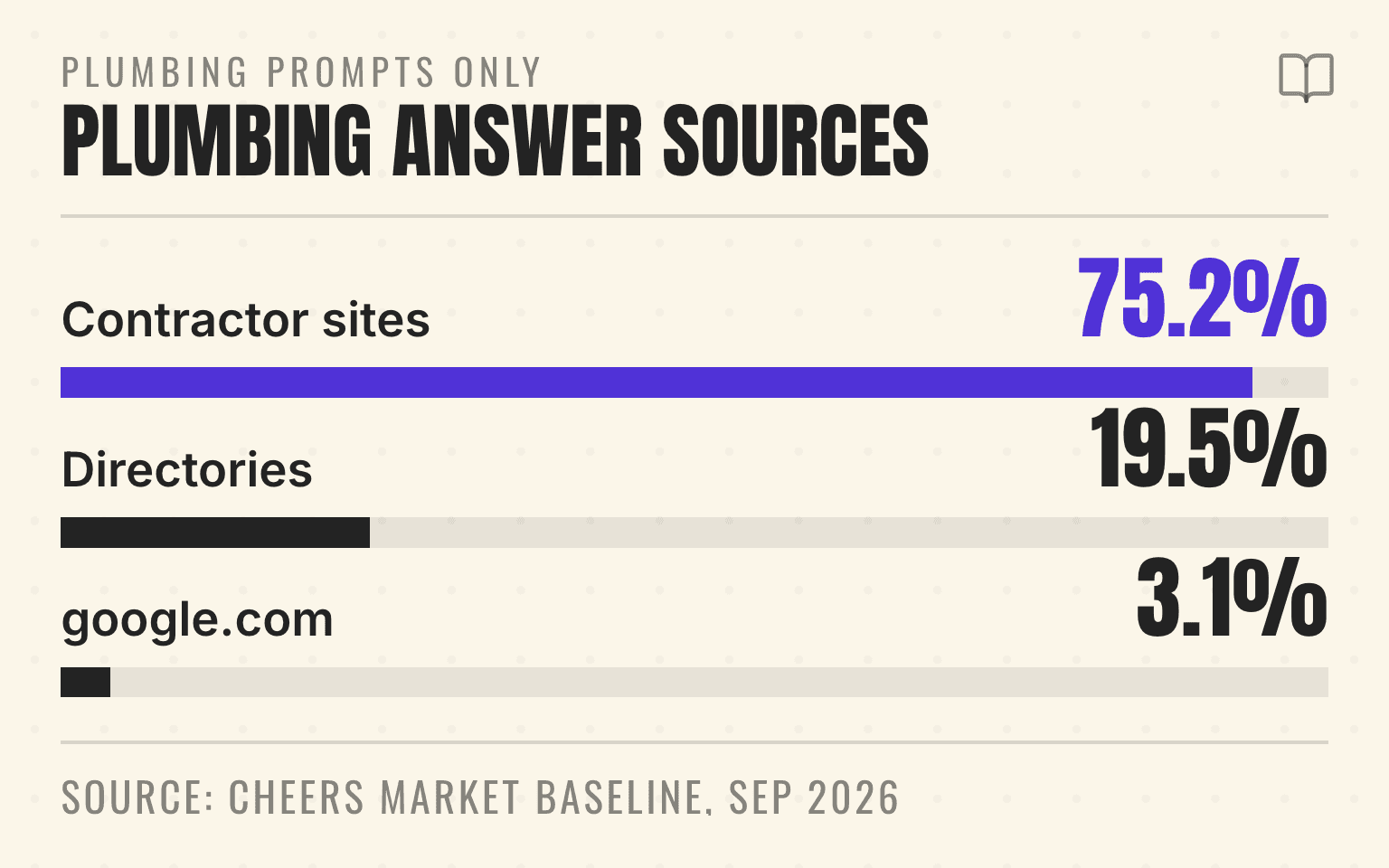
Plumbing prompts only
Your own site is the source
75.2%
Contractor sites
Citation source class on plumbing prompts, Cheers Market Baseline, 28 days ending September 2, 2026
The pages a plumbing brand controls
Angi, BBB, Yelp, Expertise and similar
Business Profile and Maps surfaces
Reddit, Facebook, YouTube and similar
Cheers Market Baseline, 28 days ending September 2, 2026: plumbing prompts only, 100 metro service areas, four engines, 100,465 classified citations, aggregate only.
| Source class | Share of plumbing citations |
|---|---|
| Contractor and franchise websites | 75.2% (The pages a plumbing brand controls) |
| Directories and review platforms | 19.5% (Angi, BBB, Yelp, Expertise and similar) |
| google.com | 3.1% (Business Profile and Maps surfaces) |
| Social and forum sources | 2.2% (Reddit, Facebook, YouTube and similar) |
Important
Google says AI Overviews and AI Mode have no additional technical requirements. A page still needs to qualify for Google Search and help the customer. Inclusion is never guaranteed.
The broader Google AI Search guide for local businesses explains the foundation across industries. This article applies that guidance to plumbing, where service specificity and local availability change the hiring decision. Operators can also run a location-level AI visibility check before deciding which markets need work first.
What Google actually says about AI Search
Google says its AI features rely on core Search ranking and quality systems. AI Overviews and AI Mode can ground an answer in indexed web pages. Query fan-out may also turn one customer question into several related searches.
For a plumbing company, a page that only says "full-service plumber" leaves too much unresolved. Google may still need to determine whether the company fixes that specific problem in the customer's market. It may also look for evidence that the branch is available now and easy to contact.
Google's technical baseline remains familiar. The page must be open to crawling, and the useful information needs to appear as readable text. Internal links should lead Google and customers to the right service page. Any structured data should match what the page says. The Google Business Profile also needs to stay current.
Google also says businesses do not need a special AI file or a new type of schema markup. That removes a common distraction. Plumbing companies should improve the sources customers already use to make a decision.
Turn a broad plumbing category into specific service evidence
Google's Business Profile documentation is unusually concrete for plumbers. Its own worked example is a plumbing one:
For example, a plumbing business might get options such as "Install faucet" or "Repair toilet."
Eligible service businesses can add those individual offerings, plus service descriptions and, where appropriate, price information.
The operator decision is not to stuff every possible phrase into the profile. It is to compare the profile's service list with what the local team actually dispatches.
A Phoenix branch may have the equipment and training for sewer camera inspections. A nearby acquisition may only handle routine drain cleaning and send larger sewer jobs to another team. The two profiles should not publish the same service list. Doing so creates a customer problem before it becomes a search problem.
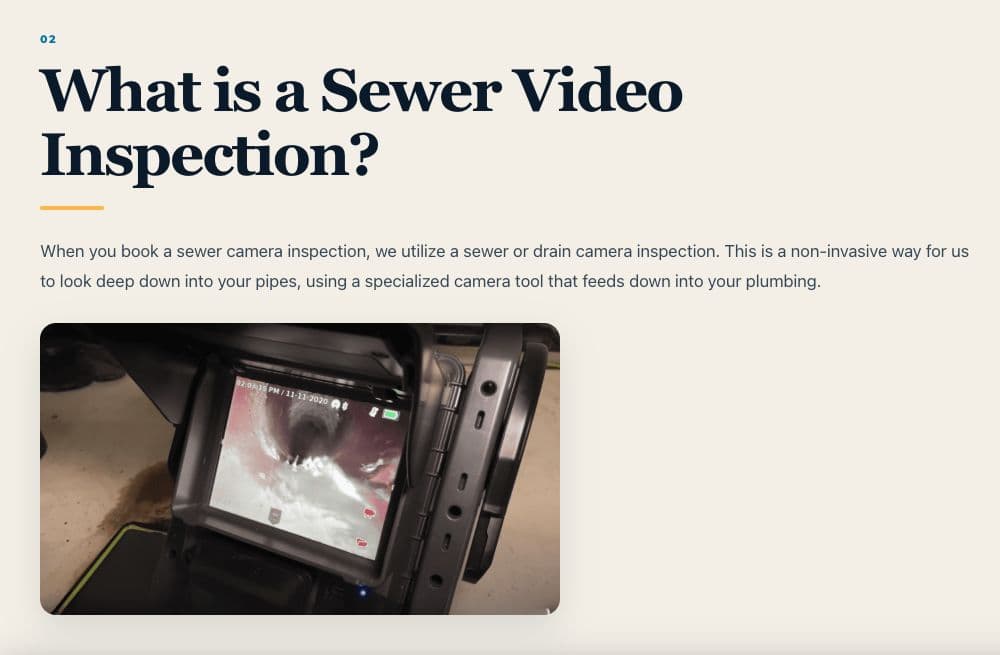
The website should carry the deeper explanation. A useful sewer camera inspection page can tell a homeowner when an inspection is appropriate and what the technician will look for. It should also explain what the customer receives afterward. The location page can then clarify which local team performs the inspection.
A water heater page needs a different explanation. It can help the customer decide whether repair or replacement is more likely. It should describe the equipment that branch handles and state emergency availability only when the local team can honor it.
Google warns against making a separate page for every query variation primarily to influence rankings or AI responses. One strong page that answers the actual customer decision is better than dozens of nearly identical city-and-service combinations. The Google Business Profile services guide provides a location-level way to govern that list.
A perfect example of this is Elite Rooter. Its live sewer-camera inspection page explains the service in plain language. It also shows a real camera feed, so the customer can understand the inspection before booking.
Give Google first-hand plumbing knowledge to retrieve
Google's generative AI optimization guide asks website owners to publish non-commodity content based on real experience. Its example contrasts a generic homebuyer article with a first-hand look inside a sewer line.
Plumbing companies already produce this knowledge during normal work. A drain technician may notice that older homes in one market suffer the same type of root intrusion. That observation is more useful than another generic article about clogged drains because it comes from work the local team actually sees.
The same principle applies to water heaters and emergency service. Installers know which site conditions tend to create a change order. Regional managers know why one branch can respond quickly while another covers too much territory to promise the same timing.
That experience should become customer-facing information. A service page can explain what the crew checks before recommending hydro jetting. If roots keep returning, the page can explain why that problem requires a different conversation from a one-time blockage.
Location pages should carry the operating context. When same-day service depends on the dispatch boundary, say so plainly. A customer should not have to call before learning whether the promise applies in that market.
The value comes from what the company actually knows, not from adding the phrase "AI Search" to generic plumbing advice. Google says its systems can understand relevance without an exact query match, so the page should use the language customers and technicians naturally use.
Next step
Is AI recommending your business?
Find out how visible you are across ChatGPT, Gemini, Perplexity, and AI Overviews.
Make the website and Business Profile agree
Google says Business Profile information can come from more than the business owner. Google may also use public web pages or licensed data. Customers can contribute information too. Each source can reinforce what a plumbing location says about itself or introduce a conflict.
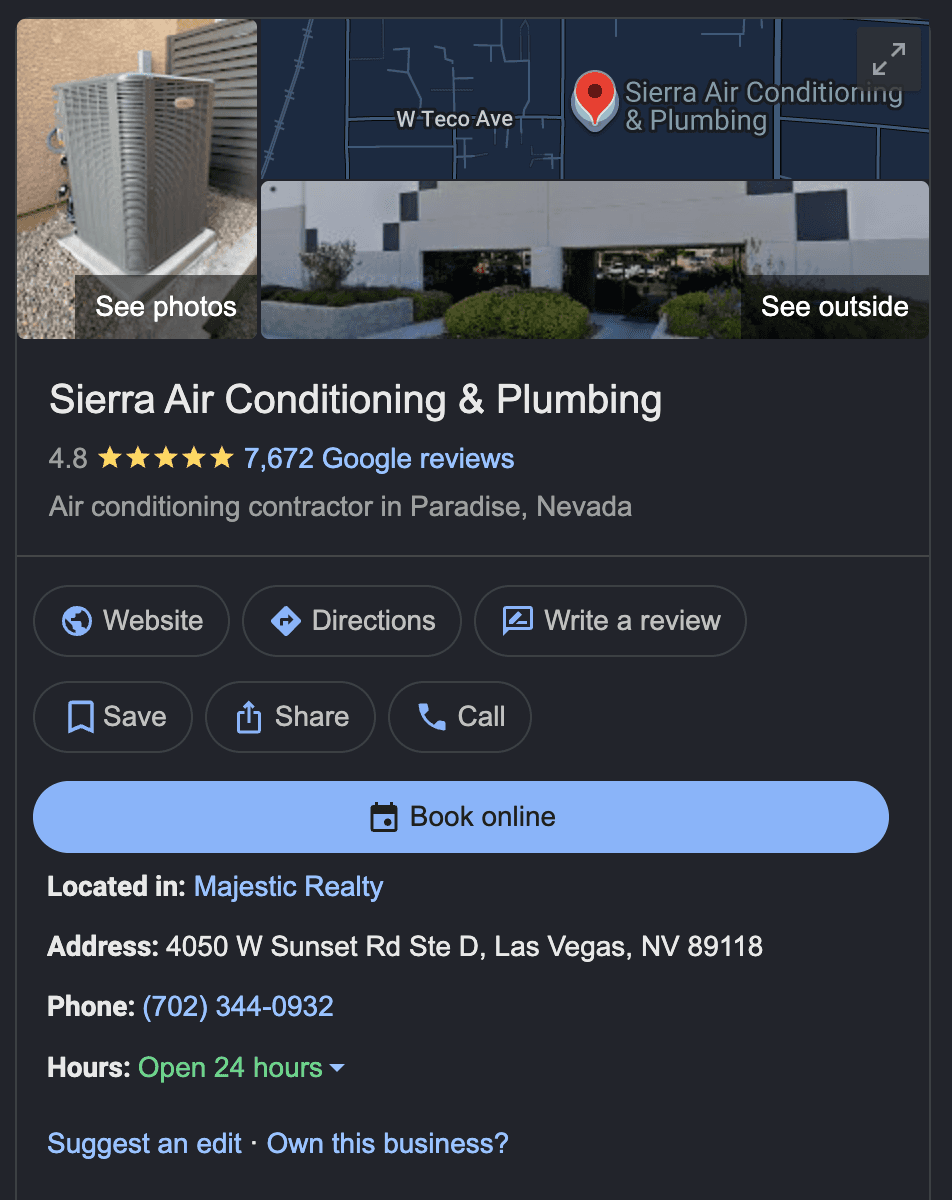
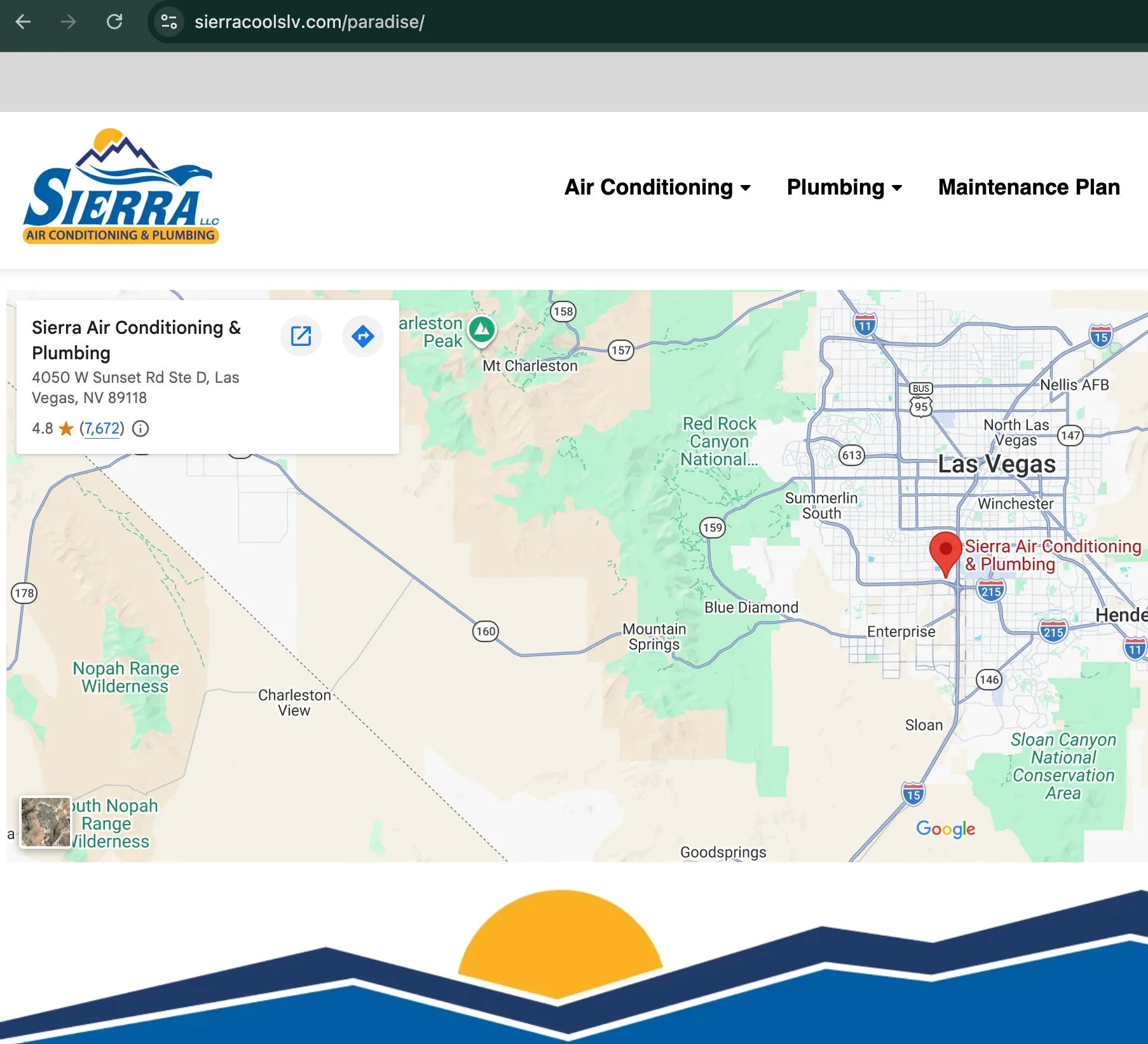
Start with what a customer can verify. Does the phone number on the Google Business Profile reach the same branch shown on the location page? Do the posted hours match when the team actually answers? The service area and service list should also describe the work that branch can perform today.
The customer path is the final check. A profile that says "open 24 hours" is weak evidence if the phone tree sends overnight calls to voicemail. A location page should not advertise trenchless sewer work for a branch that no longer has the equipment.
For a multi-location plumbing brand, consistency does not mean making every location identical. The parent brand can set the naming standard and page structure. It can also define how review requests are handled. Local operators still need to confirm their current hours and coverage. They should also verify that emergency claims lead to a booking path the branch can fulfill.
Structured data belongs in the same audit. Google says it should match the visible text. If the markup contains a phone number that customers cannot find on the page, fix the page or the markup. Apply the same rule when the markup describes a service area or offering that the page does not support.
One location, two public surfaces
The facts should match
Google Business Profile
Paradise location page
Use photos and reviews as customer proof
Google's generative AI guide asks site owners to support text with media, in its words "Supporting your textual content with high-quality images and videos, when applicable". Its Business Profile guidance separately recommends keeping that visual material current and relevant to the services the location offers.
For plumbing, useful visual proof is straightforward. A sewer camera image can show what the technician found and help a customer understand the recommendation. A completed water heater installation can prove that the local team performs that work. Google says Business Profile photos should represent reality without significant alteration or excessive filtering.
Reviews add another form of public evidence. Google's local-ranking guidance says reviews and positive ratings can support prominence in local results. That does not prove a direct plumbing-specific review weight in AI Mode. It does show why recent, legitimate customer feedback belongs in the local evidence set.
Review requests should remain neutral and consistent. After customers respond in their own words, operators can study what they mention. Do customers notice that the technician protected the home and cleaned up afterward? Do they praise fast dispatch or explain how the plumber handled a difficult water heater? Those patterns reveal what the market already associates with the branch. The review-to-content workflow explains how to use those themes without scripting customer feedback.
Plan for the questions behind the question
Query fan-out changes how a plumbing team should review its content. Consider a homeowner asking, "Who is the best plumber for a leaking tankless water heater near me?"
That question can lead Google in several directions. Does the company repair tankless units, or does it only install them? Is the customer's address inside the service area? Can the local team respond today? Google may also look for proof that other customers trusted the company with similar work.
The plumbing company does not need a separate page for every possible combination. Its website and Google Business Profile do need to resolve those questions without contradicting each other. Pricing context and a clear contact path can help the customer make the final decision.
This is where a market-level audit is more useful than a keyword inventory. Test a real customer question in a priority market, then record which businesses appear. Look at the sources Google uses to support the answer.
The source usually points toward the owner of the fix. If the service is missing from the profile, the profile team should investigate. If Google cannot reach the page, the web team owns the problem. The local operator should correct inaccurate hours. Weak job proof belongs with the people who manage field documentation and customer reviews.
The query fan-out explainer goes deeper on how Google expands one local-service question before composing an answer.
Plumbing AI Search evidence
Weak proof vs. useful proof
Replace vague, duplicated signals with evidence that describes the real plumbing service and the branch behind it.
Avoid this
Weak evidence
Broad service claims
"Full-service plumber" with no explanation of the actual job.
Cloned branch information
Every location lists the same hours, services, and availability.
Thin query pages
A near-duplicate page for every city and service variation.
Generic proof
Stock photos and unsupported claims that do not show real field work.
What Google encounters
Ambiguous service and location fit
Do this
Useful evidence
Specific service evidence
Pages explain the real tankless repair, sewer camera, or water-heater job.
Accurate local operations
The profile, page, hours, service area, and call routing agree for each branch.
First-hand guidance
Technicians explain the process, limits, and when the service is appropriate.
Current customer proof
Original job photos and legitimate reviews reinforce the service and market.
What Google encounters
Clear, verifiable local evidence
Run the plumbing playbook over 30 days
Days 1 through 7: Find the market-level gaps
Choose the plumbing jobs that matter most to the business, then focus on a few priority markets. Ask Google the same service-and-location questions a customer would use. Record the company that appears and open the sources behind the answer. The goal is to find where Google chooses the wrong branch or favors a competitor.
Days 8 through 14: Reconcile what the public sees
Put each priority Google Business Profile beside its matching location page. Check whether the hours agree and whether the phone path reaches the right team. Then compare the published services with the branch's current dispatch rules. Correct any service-area or booking claim the local operation cannot fulfill.
Days 15 through 21: Publish proof from real work
Improve the pages that support an actual customer decision. A technician-informed explanation can make a service page more useful. An original job photo can show that the branch performs the work. Be honest about availability, and consolidate thin query-variation pages instead of producing more of them.
Days 22 through 30: Retest the same questions
Confirm that Google can crawl and index the updated pages. Review the live profile rather than relying on an internal spreadsheet. Then test the same customer questions again. Record the next fix against the location and give it a clear owner.
Repeat the audit on a set cadence. Hours change, and teams may move between branches. An acquisition can change the real service area. Equipment can also be reassigned. Any of those changes can make a location inaccurate even when the corporate site has not changed.
What the plumbing numbers look like
Cheers tracks a home-services panel of 119 organizations, and 54 of them do plumbing. Over the 28 days ending September 2, 2026, aggregate only, the median plumbing organization was named in 21.5% of its tracked runs and the mean was 23.6%, with the business cited as a source in 19.5%. That is roughly four in five buyer questions where the brand simply does not come up.
The separate Cheers Market Baseline shows where the answers do come from on plumbing prompts specifically. Of 100,465 citations on plumbing questions across 100 metro service areas, contractor and franchise websites supplied 75.2%, directories and review platforms 19.5%, google.com 3.1%, and social or forum sources 2.2%. For a plumbing brand that is unusually good news: the biggest single source class on plumbing answers is the kind of page you own and can rewrite this week. Definitions are in the Cheers Research methodology, and the wider cut is in the Home Services AI Visibility Index 2026.
Measure visibility without inventing certainty
Google reports traffic from AI Overviews and AI Mode inside the Search Console Performance report under the "Web" search type. It does not provide a complete plumbing-company report that isolates every AI answer. Search Console also does not reveal every source behind a local recommendation.
Use Search Console to see whether the relevant pages are indexed and earning impressions. Analytics can show what visitors do after they arrive. Call tracking can help connect those visits to customer demand. Keep a separate market-level test so the team can see whether Google presents the correct location and which public sources appear with it.
No single metric proves that a plumbing company has "optimized for AI." Ask a narrower question instead. Can Google find first-hand evidence for this service in this market? If the customer acts on the answer, will the correct local team be able to help without encountering a contradiction?
Sources
Every link below was opened and checked September 2, 2026.
- Optimizing your website for generative AI features on Google Search. Google Search Central, last updated July 2026. Source of the quoted eligibility gate, the media guidance, the statement that structured data is not required, the first-hand non-commodity content advice, and the scaled-content limits.
- AI features and your website. Google Search Central, last updated December 2025. Source of AI Overviews and AI Mode eligibility, the absence of extra technical requirements, and Search Console reporting.
- Manage your services on your Business Profile. Google Business Profile Help, checked September 2026. Source of the quoted plumbing service example and of the description and price fields.
- Tips to improve your local ranking on Google. Google Business Profile Help, checked September 2026. Source of the relevance, distance, and prominence factors, including reviews and ratings.
- How Google sources business information. Google Business Profile Help, checked September 2026. Source of the mix of owner, web, licensed, and user contributions behind a profile.
- Cheers Research methodology and the Home Services AI Visibility Index 2026. Cheers home-services panel and Market Baseline, 28 days ending September 2, 2026, aggregate only. Source of the 54-organization plumbing appearance rates and the 100,465-citation plumbing source mix.
The article previously cited a Google Small Business Bulletin community thread. That post could not be opened for verification on September 2, 2026, so the claims it supported were moved to Google's own published guidance above.
Joseph Duerden works on GTM and operations at Cheers, helping local service businesses turn AI visibility findings into practical marketing work.